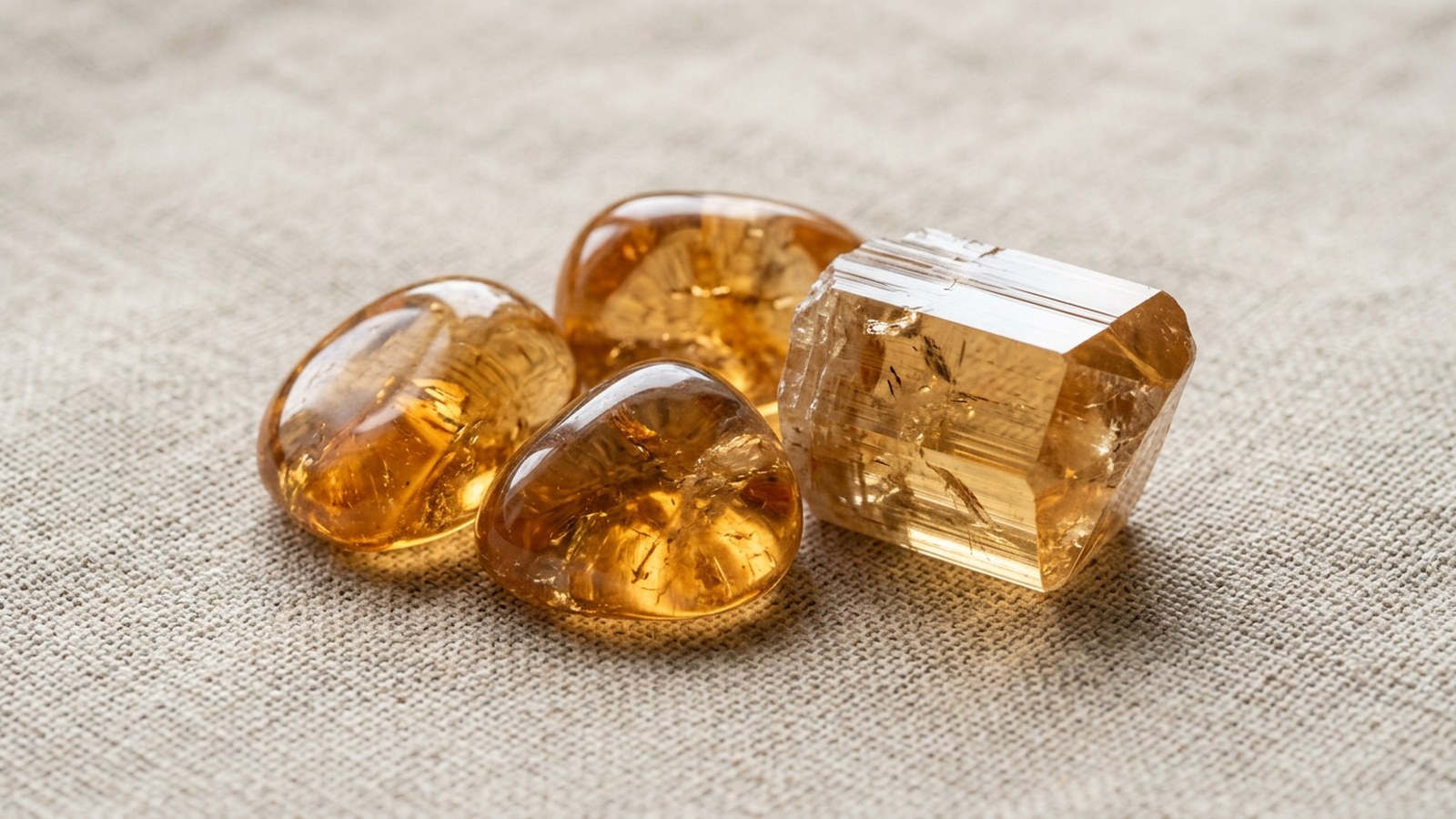
The first topaz I ever held was a rough crystal from Brazil, about the length of my thumb, pale sherry gold and so clear that I could read the label on the box through it. What surprised me was the weight. It sat in my palm heavier than a piece of quartz the same size, and its faces were so flat and bright that it looked cut, although nobody had touched it. Along one end ran a perfectly smooth break, glassy as a windowpane, where the crystal had once split along its cleavage.
That mix of clarity, warmth and quiet density is a good summary of what topaz is said to offer. In crystal tradition it is a stone of clear intention and steady, unshowy confidence, worn by people who want to see their goals plainly and keep going towards them. In this guide I cover what topaz means in that tradition, what each colour is said to carry, the real mineralogy (including why every blue topaz you have seen was almost certainly colourless once), its long and tangled history, and how to look after it.
Topaz meaning in short
Topaz is an aluminium silicate containing fluorine, Al2SiO4(F,OH)2, and it is the mineral that defines 8 on the Mohs hardness scale. In modern crystal practice it stands for clarity, honest self-expression and warm, grounded confidence. Golden and imperial topaz are linked with the solar plexus and with abundance, blue topaz with the throat and calm communication, and colourless topaz with focus. It is a traditional birthstone for November, and blue topaz appears on many modern lists for December.
Reasons to work with topaz
Topaz is a stone for setting a goal and meaning it. When I have a vague wish that needs to become a plan, a golden topaz on the desk works as a reminder to write the plan down. Tradition calls it a stone of intention, and I find its clarity makes that easy to remember.
Topaz is a companion for honest conversations. Blue topaz is the colour people choose before a difficult talk, a job interview or a moment when they tend to say yes when they mean no. Its traditional reading is calm, truthful speech.
Topaz is a stone of warm confidence. Imperial and golden topaz carry the old solar associations, and many people wear them in a stretch when they need to take up a little more room, at work or at home, without becoming loud about it. It sits naturally with my picks of crystals for courage.
Topaz is a practical everyday stone. Because it is hard, it suits rings and bracelets that are worn every day, which keeps its meaning in front of you.
Topaz meaning: healing energy
Emotional healing. In crystal tradition topaz is linked with generosity and emotional steadiness, the sense that there is enough warmth to share. It is offered to people who feel stingy with themselves after a hard season.
Spiritual healing. Clear and blue topaz are associated with truth and inner listening. Practitioners use them in meditation to sit with a question until the honest answer becomes audible.
Mental healing. Colourless topaz is a traditional focus stone, kept nearby while studying or planning. You will find it beside other clarity stones in my list of crystals for focus.
Physical healing. Older lapidaries credited topaz with easing everything from eye complaints to fevers. These are traditional beliefs, not medical advice, and topaz should never replace care from a qualified professional.
- Chakras: solar plexus for golden and imperial topaz, throat for blue
- Zodiac signs: Sagittarius and Scorpio
- Element: Fire
- Numerical vibration: 6 in most modern crystal lists
- Affirmation: "I see clearly what I want, and I move towards it calmly."
What each topaz colour is said to carry
Golden and sherry topaz is the historic topaz, the one ancient writers meant when they spoke of a sun stone. It is associated with abundance, optimism and the will to follow through, which is why it often appears with crystals for abundance and in my guide to crystals for money.
Imperial topaz, orange to pinkish orange with a reddish glow, is read as personal power held with dignity. It is the rarest and most valuable colour.
Blue topaz in sky, Swiss and London shades belongs to calm communication and clear thinking. If you love blue stones for the throat chakra, compare it with aquamarine, which carries a gentler, watery version of the same theme.
Pink topaz is linked with kindness and affection. Colourless (white) topaz stands for clarity and focus, and it is often used as a modest stand in for diamond.
Green topaz is a common search, and the honest answer is that natural green topaz is very rare. Almost every green topaz for sale is treated or coated colourless topaz. In older texts, "green topaz" usually meant peridot, for reasons I explain in the history section. Most practitioners give it the heart chakra meanings of growth and renewal.
Mystic topaz is colourless topaz with a thin metallic coating that throws rainbow colours. Its meanings are borrowed from the rainbow (joy, play), and the coating is the part to look after.
Topaz geology: the stone that defines hardness 8
When Friedrich Mohs built his scratch scale in 1812, he chose ten reference minerals, and topaz is number 8. Every other gem rated 8 is being compared to it. It scratches quartz easily, so ordinary dust (which is mostly quartz) cannot dull it, and only corundum (ruby and sapphire) and diamond are harder among common gems.
Topaz also has one perfect cleavage, a direction across the crystal where the atomic bonds are weak, so a sharp knock at the wrong angle can split even a flawless stone cleanly in two. That is the smooth break I saw on my first crystal, and it is why jewellers set topaz with protective settings and why a topaz ring should come off for heavy work.
Chemically, topaz is an aluminium silicate in which fluorine and hydroxyl share a site. It crystallises in the orthorhombic system as stubby prisms with striated sides and wedge-shaped ends, with a specific gravity of about 3.5 and a refractive index of about 1.61 to 1.64. It grows from fluorine rich fluids in granite pegmatites and in cavities in rhyolite lava, sometimes to enormous sizes: crystals weighing hundreds of kilograms have come out of Brazilian pegmatites.
Pure topaz is colourless. Chromium gives the pinks and the red tint in imperial topaz, while yellows, browns and blues come from colour centres, tiny defects in the crystal that trap electrons. Colour centres explain the most important fact about blue topaz. Almost all of it starts as colourless or pale stone that is irradiated (with gamma rays, electron beams or, for the deep London blue, neutrons in a reactor) and then heated to settle the colour. The result is stable and safe. In the United States, neutron irradiated stones must be held until any residual activity falls below regulatory limits before they can be sold, which is one reason a reputable seller discloses the treatment.
Colour centres can also fade. The sherry topaz crystals of Topaz Mountain in Utah bleach to colourless after days or weeks in sunlight, and some brown topaz from other sources does the same.
Topaz history and lore
The name is usually traced to Topazios, an island in the Red Sea described by classical writers and generally identified with Zabargad. The trouble is that Zabargad's famous gem is peridot, so the original "topaz" was probably a green stone. Another theory links the word to the Sanskrit tapas, fire. For centuries the name drifted across almost any yellow gem, which is how yellow quartz came to be sold as topaz, a story I tell in full in citrine vs topaz.
Is topaz in the Bible? Yes, in several places. Exodus 28:17 lists pitdah, translated topaz, in the first row of the high priest's breastplate. Job 28:19 says the topaz of Ethiopia (Cush) cannot equal wisdom, Ezekiel 28:13 names it among the stones of Eden, and Revelation 21:20 makes topaz the ninth foundation of the New Jerusalem. Most scholars think the biblical stone was peridot or another yellow green gem, since the mineral we call topaz was not distinguished until much later.
In Egyptian lore as retold by modern writers, golden topaz carried the glow of the sun god Ra. Greek stories said topaz lent strength and could make its wearer invisible in danger, and later European lapidaries claimed it calmed anger, broke enchantments and grew stronger and weaker with the phases of the moon. Hildegard of Bingen, the twelfth century abbess, is recorded as recommending topaz steeped in wine as a remedy for dim eyes.
Some famous stones show how the name kept wandering. The 1,680 carat Braganza in the Portuguese crown jewels was long called a diamond and is now widely believed to be colourless topaz, though it has never been tested. The American Golden Topaz at the Smithsonian, cut from Brazilian rough, weighs 22,892.5 carats, and the El-Dorado topaz is larger still at about 31,000 carats. Even the word "imperial" has two origin stories: one says pink Ural topaz was reserved for the Russian tsars, the other credits Brazil's emperor Dom Pedro II. Neither is well documented, so I treat both as stories.
Where topaz comes from
Brazil leads, with the Ouro Preto district of Minas Gerais famous for imperial and sherry topaz. Pakistan (Katlang) produces natural pink, Russia's Urals gave the historic blues and pinks, and Sri Lanka, Nigeria, Madagascar, Mexico and the United States add more. Topaz is the state gem of Utah, and blue topaz is the state gem of Texas.
Is topaz a precious stone? In the old trade split, only diamond, ruby, sapphire and emerald were called precious, and topaz fell into the "semi-precious" group. The labels have no technical meaning today. Treated blue topaz is inexpensive, while fine natural imperial topaz can cost more than many sapphires.
Caring for and cleansing topaz
Clean topaz with warm soapy water and a soft brush. Avoid ultrasonic and steam cleaners and sudden temperature changes, all of which can open the cleavage. Keep mystic topaz away from abrasives, and store sherry and brown topaz out of strong sunlight. Topaz will scratch quartz and softer stones, so give it its own pouch.
For energetic cleansing, a short rinse is fine for uncoated stones, and moonlight, sound or a bed of clear quartz are gentle options; my cleansing crystals guide covers each method. If you want to check what you are buying, my guide to spotting real crystals walks through simple tests.
A last word
My thumb sized crystal still sits on my desk, slightly paler than when it arrived because I once left it on a sunny windowsill for a summer. I like it more for that. If topaz calls to you, choose the colour that matches what you need to see clearly, wear it where you will notice it, and let it remind you to say what you mean. For a warm companion stone, golden citrine shares its November month and its sunny mood, and blue topaz sits beautifully with tanzanite and turquoise for December birthdays (see the November and December birthstone pages).