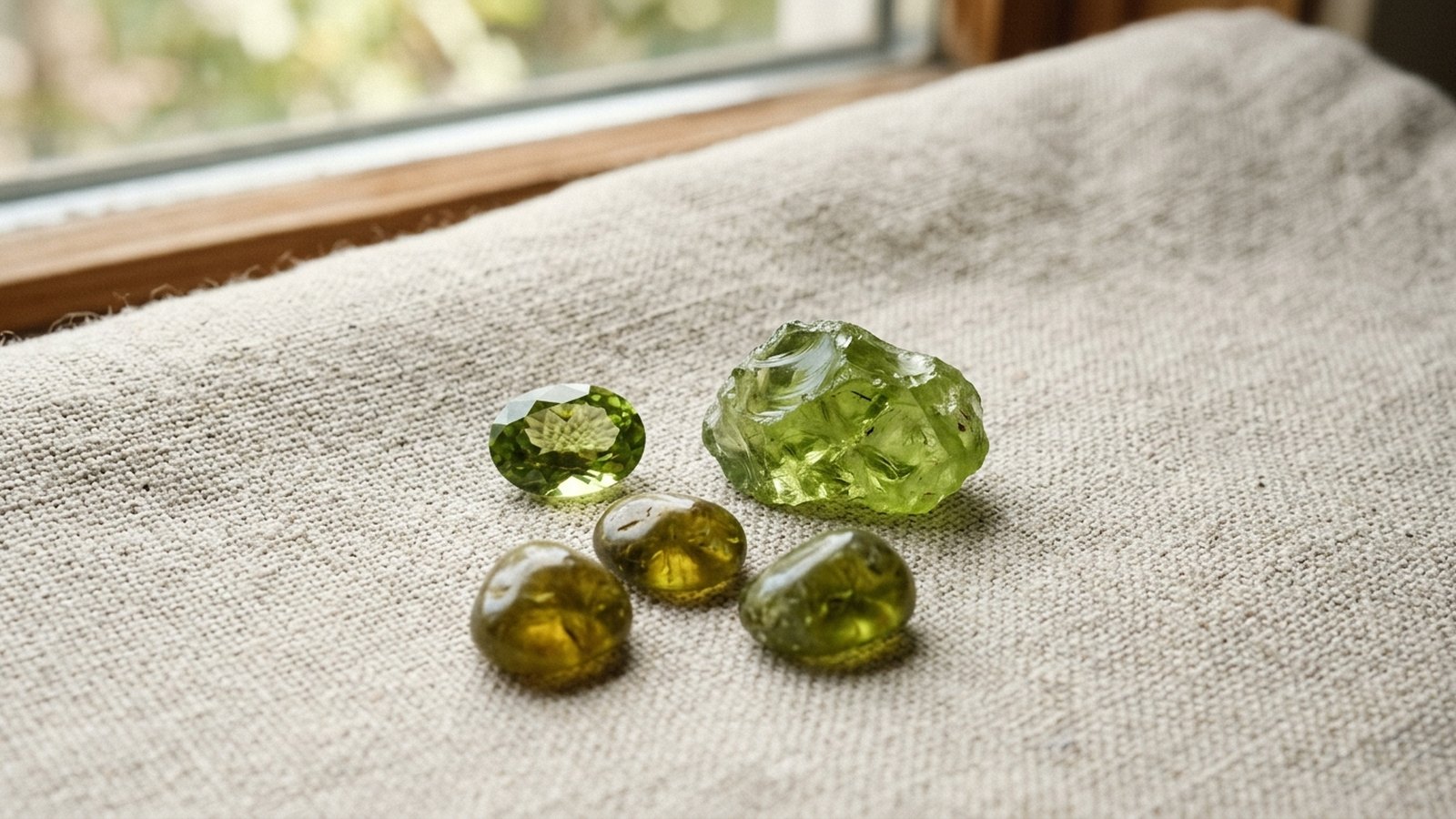
There is a particular green that peridot does, and no other stone quite matches it. Not the blue-leaning depth of emerald, not the soft chalky mint of prehnite. Peridot is olive and gold at once, the colour of a leaf held up to late afternoon light. The peridot meaning I have come to trust follows from that warmth: across two thousand years, tradition has handed this stone the same job again and again, which is to loosen envy, resentment and bitterness, and to let a person feel light enough to receive something good.
I keep a small tumbled peridot in the same shallow dish as my citrine, and I notice I reach for it in a very specific mood. Not sadness, not fear. The mood I would call gripping. The one where someone else's good news lands in my chest as a small unwelcome weight, or where I am holding a grudge that is costing me more than it is costing anyone else.
Peridot is also the August birthstone, a gem born in the earth's mantle rather than the crust, and one of the very few you can hold knowing that identical crystals have arrived here inside meteorites. Let me take you through all of it, including the strange story of how peridot spent centuries wearing other gemstones' names.
Reasons to Work With Peridot
Peridot is the stone I suggest when comparison has become a habit. Envy is rarely dramatic. It shows up as a flat feeling while scrolling, a slightly clipped congratulations, a private tally of who is ahead. Peridot's traditional role is to interrupt that tally, not by shaming you out of it but by turning your attention back to what is actually yours. The honest question it seems to ask is simple: what would you be building right now if you were not measuring? If that pattern runs deep, pair it with our guide to crystals for self-love.
Peridot is a stone for the end of a grudge. Not the injury itself, which belongs to gentler stones like rose quartz, but the long afterlife of the injury, the part where you are still carrying it because setting it down feels like letting someone off the hook. Old lapidaries describe peridot as dispelling bitterness and jealousy, and I read that as a stone for the specific fatigue of resentment. You are allowed to be right about what happened and still be tired of holding it.
Peridot is a working stone for new starts you did not choose. A job that ended, a move you did not want, a relationship that closed. Its energy is not the pep talk of carnelian or the bright ignition of sunstone. It is more like the first green on ground that has burned, which is not a metaphor I invented. Peridot arrives in the world through volcanoes.
Peridot is associated with earned abundance rather than luck, closer to a warm sense of enoughness than to windfall thinking. I like it on a desk during money conversations, next to green aventurine or pyrite, and our guide to crystals for money and abundance sets out how I actually use them.
Peridot is, by long tradition, a night stone. Set in gold and worn as a talisman, it was said to keep away nightmares, a reputation that appears in text after text from antiquity through the Middle Ages. There is something fitting about a gem called the gem of the sun being asked to hold the dark hours. If sleep is why you are here, read our crystals for sleep guide alongside this one.
Peridot Meaning: Healing Energy
Everything in this section is tradition and intuition, gathered from lapidaries, folk practice and my own time with the stone. It is a way of paying attention, not a treatment.
Emotional Healing
Peridot's emotional signature is release, and it is unusually specific about what it wants you to release. Where many green stones work on receiving love, peridot works on the corrosive feelings that sit next to love: jealousy, resentment, spite, the sourness of feeling overlooked. I find it helpful after a comparison spiral, because it does not ask you to pretend the feeling away. It asks what the feeling is protecting.
Spiritual Healing
Spiritually, peridot is read as a stone of light returning. Its golden-green is treated as sunlight held in mineral form, which is why the Egyptians reportedly called it the gem of the sun. I use it for the moment in a season of change when you stop bracing and start being curious again. It sits well in a crystal grid built around renewal, and pairs beautifully with clear quartz.
Mental Healing
Peridot has a clarifying, slightly brisk quality I associate with honest thinking. Because tradition links it to the solar plexus as well as the heart, it tends to bring a question back to agency: not what was done to you, but what you are going to do now. That is why it makes a good desk stone during demanding work, alongside sodalite if you want more analytical focus.
Physical Healing
Traditionally, peridot was associated with digestion, with the liver, and with a general sense of physical lightness after illness. Let me be plain: that is folklore, not medicine, and peridot cannot treat, cure or prevent anything. You will find pages claiming it acts on the endocrine system or on specific diagnoses. I do not repeat those claims, and I would treat any crystal page that makes them with caution. Use peridot as a comfort and a focus while you follow real medical advice.
Peridot Properties at a Glance
- Chakras: Heart (Anahata) primarily, with a strong secondary link to the Solar Plexus (Manipura). That pairing is the whole story of the stone: the heart to release the grudge, the solar plexus to reclaim your own power. See our chakra crystals guide for how to work with both.
- Zodiac signs: Leo first, since August sits mostly in Leo, then Virgo and Libra.
- Element: Earth and Fire, which is literally accurate. Peridot forms in the earth's mantle and rides fire to the surface.
- Numerical vibration: 5, in the numerology most crystal writers use, the number of change and movement.
- Planet: the Sun, with an older tradition linking it to Jupiter.
- Birthstone: August, sharing the month with sardonyx and, since 2016, spinel. Also the traditional gem for a sixteenth wedding anniversary.
- Affirmation: I let go of what I am gripping, and I let good things reach me.
Peridot Geology
Peridot is the gem-quality variety of olivine, a magnesium iron silicate with the formula (Mg,Fe)2SiO4. It crystallises in the orthorhombic system, sits at 6.5 to 7 on the Mohs scale, and has a specific gravity of roughly 3.2 to 4.3. Gem peridot is usually forsterite-rich, meaning magnesium dominates over iron. Olivine is one of the most common minerals on earth by volume, and one of the more uncommon ones to find as a clean, gem-sized crystal.
Why peridot only comes in one colour
Most coloured gems take their colour from trace impurities. Remove a little chromium and an emerald turns pale. Peridot does not work that way. The iron responsible for its colour is part of the mineral's essential formula, not a visitor in the lattice. Gemmologists call this idiochromatic, self-coloured, and it is why peridot appears in a single narrow colour family. More iron gives a darker, more olive stone, less iron a lighter, more yellow one. There is no blue peridot and no pink peridot, and there never will be. If someone offers you one, you are being sold something else. Our guide on how to tell if a crystal is real covers the wider version of this problem.
Peridot also has notably strong double refraction. Look through the table of a larger stone and the back facets often appear doubled, a soft blurring that gemmologists use as a quick identification check and that gives peridot its velvety look.
A gem from the mantle
Here is the fact that deserves more attention than it gets. Almost every gemstone you own formed in the earth's crust. Peridot did not. It crystallises in the upper mantle, tens of kilometres down, and reaches us only because basaltic magma tears off chunks of mantle rock and carries them upward during an eruption. Diamond is the only other gem commonly described as arriving from that depth. Hold a peridot and you are holding a piece of the layer of the planet nobody has ever drilled to.
The gem that also falls from the sky
Olivine is not only an earth mineral. It occurs in pallasite meteorites, a rare stony-iron class in which olivine crystals sit embedded in a nickel-iron matrix like stained glass in lead. Some of those crystals are gem quality and have been faceted into collector stones with genuinely extraterrestrial provenance. The famous specimens have names: Fukang, found in China in 2000 with a main mass around 1,000 kilograms, Esquel from Argentina, Brenham from Kansas, and Imilac from the Atacama. Pallasitic peridot can be told apart from terrestrial material in part because it lacks nickel.
The reach goes further. In 2006 NASA's Stardust mission returned dust captured from comet Wild 2, and analysts found olivine crystals in it, material from the cold outer solar system that had somehow formed in intense heat. Closer to home, Papakōlea beach on Hawaii's Big Island is green because it is made largely of olivine grains eroded from the Puʻu Mahana cinder cone. The grains are far too small to cut, but you can stand on a beach of peridot's mineral.
The name
The etymology is genuinely unsettled, and I would rather say so than tidy it up. You will read almost everywhere that peridot comes from the Arabic faridat, meaning gem. It is repeated constantly and the supporting evidence is thin. The Oxford English Dictionary points instead to Anglo-Norman forms such as pedoretés, and another suggestion is the Old French peritot, possibly referring to the stone's slightly oily lustre. Take the confident one-sentence origin stories elsewhere with some salt.
Peridot History and Lore
Zabargad, the gem of the sun
Peridot's story starts on a small, waterless volcanic island in the Red Sea off the coast of Egypt, known today as Zabargad or St John's Island. Ancient records place mining there from roughly 300 BCE, and for centuries it was effectively the world's only source. Egyptian tradition called peridot the gem of the sun, and there are accounts of stones being collected at night, when the glow was said to be easier to spot against dark ground. The deposits are largely worked out now, but Zabargad material still surfaces in museum collections.
The gem that lost its name twice
This is my favourite part of the story, and hardly anyone tells it properly. Classical writers including Pliny the Elder described a green gem from a Red Sea island called Topazios. That island is Zabargad, and the green gem it produced was peridot. The name topazion, and eventually our word topaz, was taken from an island that never produced modern topaz at all. Peridot handed over its name and got nothing back.
It happened again with chrysolite, from the Greek for golden stone. For most of history chrysolite meant what we now call peridot. That matters for one of the questions people most often bring to this stone, because chrysolite appears in Revelation 21:20 as the seventh foundation stone of the New Jerusalem, and versions of it appear in lists of the high priest's breastplate. Many scholars think those references describe peridot. The honest caveat is that matching ancient gem names to modern mineral species is contested work, and certainty here is usually oversold.
The Cologne emeralds
In Cologne Cathedral stands the Shrine of the Three Kings, a medieval reliquary studded with gems, including five enormous stones of roughly 200 carats each. For centuries they were admired as emeralds. They are peridots. Crusaders had carried the stones into central Europe, where the green-gem confusion was routine, and much of what was catalogued as emerald in medieval church treasuries has since been reidentified. A fitting third act for a gem whose history is a series of mistaken identities.
Medieval lapidaries also inherited the protective lore. Peridot set in gold was worn against nightmares, and at least one text insists the stone had to be pierced, strung on the hair of a donkey and tied to the left arm to work properly. I include that not because the donkey hair mattered, but because it shows how seriously the protective reputation was taken.
Peridot Compared With Other Green Stones
| Stone | What it actually is | Mohs | How to tell it apart |
|---|---|---|---|
| Peridot | Gem olivine, (Mg,Fe)2SiO4 | 6.5 to 7 | Warm olive-gold green, never blue-leaning. Visible doubling of back facets. |
| Emerald | Beryl coloured by chromium or vanadium | 7.5 to 8 | Cooler, bluer green. Harder, far more expensive, typically oiled. |
| Green tourmaline | Complex borosilicate | 7 to 7.5 | Strong colour shift between viewing angles, often much darker. |
| Moldavite | Natural glass from a meteorite impact | 5.5 to 7 | Bottle-green, glassy, wrinkled surface texture, no crystal faces. |
Peridot is usually the affordable one in this group, which is one of the nicer things about it. A clean, well-cut stone of a few carats is within reach of most people. The equivalent emerald is not. If you are holding a green stone and wondering which of the two it is, my guide to peridot vs emerald walks through the loupe, inclusion and weighing tests one by one.
Where Does Peridot Come From?
The largest commercial source today is the San Carlos Apache Reservation in Arizona, where peridot weathers out of basalt on Peridot Mesa and supplies most of the smaller stones in the mid-market. The finest crystals of the modern era come from Sapat Gali in Pakistan's Kaghan Valley, found high in the mountains from the late 1990s onward. Myanmar has a long tradition of fine peridot from the Mogok region, and China, Vietnam, Tanzania, Kenya and Brazil all contribute. Egypt's Zabargad remains the historic source.
Caring for peridot
Peridot's hardness of 6.5 to 7 sounds robust, and for a pendant or earrings it is. In a ring worn daily it will pick up scratches faster than you expect. Its toughness is only fair to good and it is brittle, so a sharp knock on a corner can chip it.
The rule that matters most: never put peridot in an ultrasonic or steam cleaner. That is not vague caution. Peridot is a Type II clarity stone, meaning it normally contains inclusions, and it very often carries distinctive disc-shaped fluid and gas inclusions known as lily pads. Vibration and sudden heat exploit exactly those features. Peridot also has poor resistance to thermal shock, so no hot water after cold.
Warm water, a drop of mild soap and a soft brush is all it needs. A brief rinse is fine, and our crystals and water safety guide explains where that line sits for other stones. Keep peridot away from acids and household cleaners, since olivine is readily attacked by them, and skip salt entirely. For energetic care I prefer dry methods: sound, smoke, or a night beside selenite. Unlike amethyst, its colour will not fade in daylight, because that iron is structural rather than a fragile colour centre. Our guide on how to charge crystals covers the alternatives, and carrying and wearing stones or where to place crystals in your home will help you decide where it lives.
A Last Thought
I have come to think of peridot as an unglamorous gem doing a difficult job. It spent two thousand years being called by other stones' names, it comes from a part of the planet we cannot reach, and it costs a fraction of the emeralds it was mistaken for. There is something in that for anyone who has felt overlooked while quietly being the real thing.
If you are drawn to it, skip the elaborate ritual at first. Put a piece where your hand will find it, and notice which mood makes you pick it up. For most people I know, it is the gripping mood, and peridot's whole tradition is about opening that hand. Pair it with malachite if you want more force behind the release, or moss agate if what you need is patience with slow growth. New to all of this? Start with how to use crystals and meditating with crystals, and let peridot be the stone you learn on.