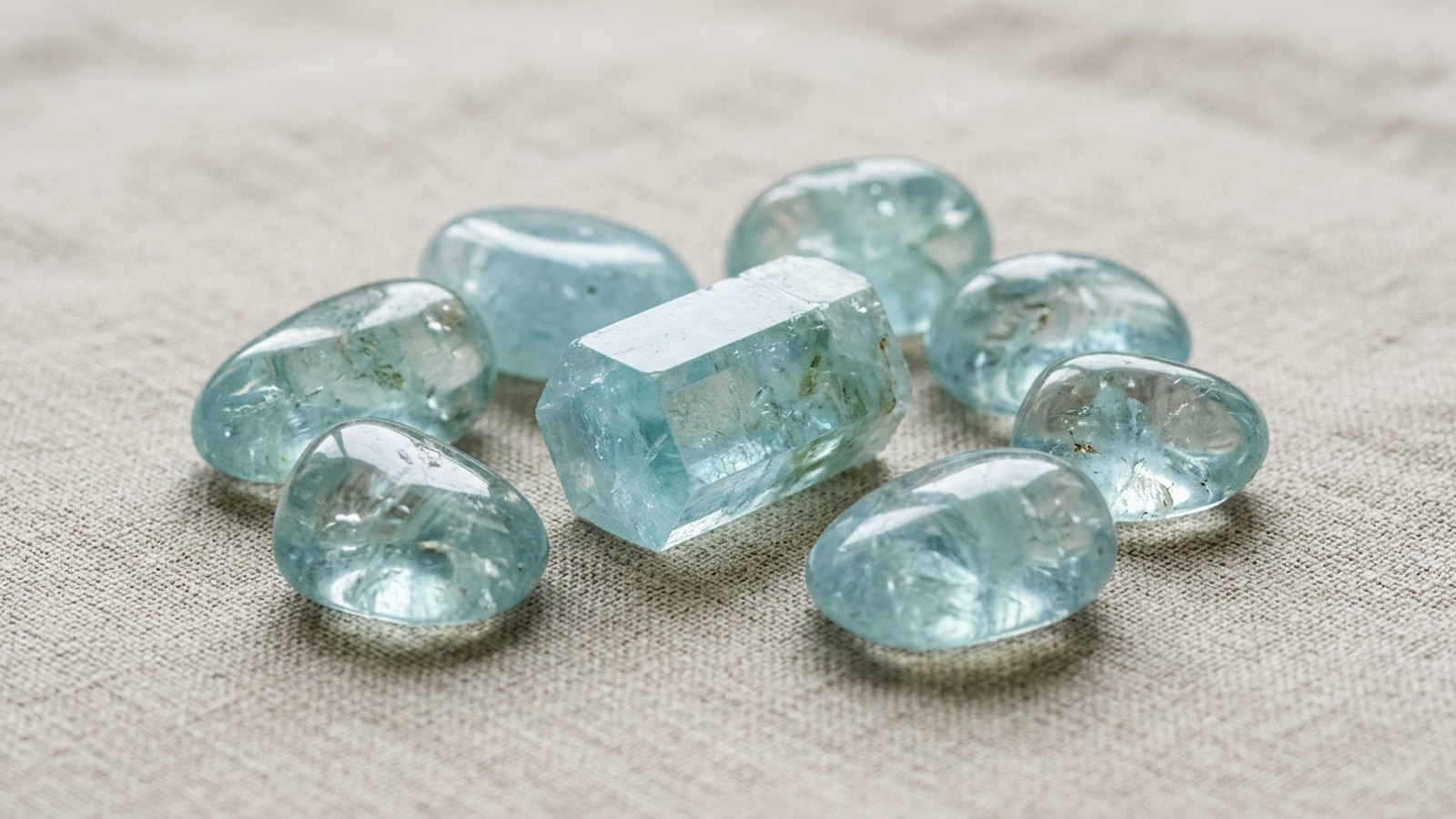
There is a moment, when you hold a good piece of aquamarine up to a window, when it stops looking like a stone and starts looking like a volume of water somebody managed to keep still. Not the deep blue of a postcard sea. The pale, greenish, sunlit blue of shallow water over sand, the kind you can see your own feet through.
Aquamarine is the sea-blue variety of beryl, and its name says exactly that: from the Latin aqua marina, water of the sea. It has been the March birthstone for generations and a sailor's talisman for a great deal longer than that. In the traditions I work in, it is the stone of calm speech and steady nerves, reached for when you have something true to say and a shaking voice to say it with.
It is also, and almost nobody selling it will tell you this, a stone that was very probably heated in a furnace to become the colour you fell in love with. That is not a scandal. But it is worth understanding, and I will get to it properly further down.
Reasons to work with aquamarine
Aquamarine is for the conversation you have been putting off. Not an argument, a conversation. The resignation letter, the diagnosis you need to tell your family about, the boundary you have rehearsed in the shower for three weeks. I keep a tumbled piece in my pocket on those days and hold it in my closed hand while the other person is still talking. The tradition says it opens the throat. What I notice is narrower and more honest than that: it gives my hands something to do, so my voice does not have to carry the whole nervous system by itself.
Aquamarine is for people who go under. Some of us panic loudly. Others go quiet, flood, and lose the thread of what we meant. If that is your pattern, this is your stone more than any of the fiery confidence stones. Its traditional reputation is cooling rather than energising, and it pairs naturally with the calmer end of the crystals for anxiety shelf rather than the stimulating end.
Aquamarine is for long crossings. Sailors did not carry it for a pleasant afternoon on the water, they carried it for the passage. Divorces, immigrations, the second year of grief, the middle stretch of a degree. It suits the part of a journey where the shore you left is gone and the one you are heading for has not appeared. There is no urgency in this stone and I think that is precisely its use.
Aquamarine is for the truth you soften too much. If you habitually round your meaning down to keep the peace, this is a good companion, and a better one than the bolder speaking stones. It does not make you blunt. Worked alongside lapis lazuli, which I find much more forthright, aquamarine is the one that keeps the sentence kind while it stays accurate.
Aquamarine meaning: the healing energy
Emotional healing
The emotional signature of aquamarine, across every tradition I have read and everything I have felt holding it, is cooling without numbing. It is associated with releasing fear, particularly the anticipatory kind that arrives days before the thing you are dreading. Where rose quartz softens, aquamarine clears. Grief workers in the crystal tradition often reach for it in the stage after the first shock, when feeling starts moving again and needs somewhere to go.
Spiritual healing
Aquamarine is traditionally a stone of surrender to what is larger, which is unsurprising for something named after the sea. Medieval scryers used polished beryl for divination, and that lineage still shows: it is a common companion stone for intuitive practice and for meditating with crystals where the aim is to receive rather than to direct.
Mental healing
This is where I find it most reliably useful. Aquamarine is linked with clarity of thought under pressure: not sharper thinking, but less panicked thinking. It is a good desk stone for anyone whose work involves saying difficult things accurately, and a good travel stone for people who catastrophise on aeroplanes.
Physical healing
Traditionally, aquamarine is associated with the throat, the thyroid, the breath, and with easing sore throats and allergic irritation. Moon Magic and several older sources call it a "breath stone" for this reason. Please treat all of that as folklore rather than medicine. A crystal is not a treatment, it does not replace a doctor, and nothing in this section should delay you seeing one.
Chakra: Throat (Vishuddha), with a secondary heart (Anahata) association Zodiac: Pisces and Aquarius, with Gemini claimed in some traditions Element: Water Numerical vibration: 1 Birthstone month: March, and the 19th wedding anniversary stone Affirmation: I speak what is true, and I stay calm while I say it.
One honest note on that chakra line. Sources genuinely disagree. The Crystal Council and Energy Muse both assign aquamarine to the heart and throat; most metaphysical retailers give throat alone. I use throat, because everything the stone is traditionally reached for is about expression, but if you work a heart-centred practice you are not doing it wrong. Our chakra crystals guide sets out how the correspondences are built in the first place, which makes disagreements like this easier to hold lightly.
Aquamarine geology
Aquamarine is a variety of beryl, chemical formula Be₃Al₂Si₆O₁₈, a beryllium aluminium silicate that crystallises in the hexagonal system as those long six-sided columns with flat ends. It sits at 7.5 to 8 on the Mohs scale, which is hard enough for daily rings, and its specific gravity is around 2.7.
Its cousins are the same mineral wearing different impurities. Add chromium or vanadium and you get emerald. Add manganese and you get pink morganite. Add more iron in a different oxidation state and you get golden heliodor. Strip the trace elements out entirely and you get colourless goshenite. One mineral, four gemstones, and the whole difference is a few atoms per thousand.
In aquamarine, the colour comes from iron, and this is the fact the rest of this article hangs on. Iron in the ferrous state, Fe²⁺, produces the blue. Iron in the ferric state, Fe³⁺, produces a yellow to green cast. Nearly all aquamarine comes out of the ground carrying both, which is why raw crystals so often look seawater green rather than sky blue.
It forms in granitic pegmatites, the coarse-grained late stage of a cooling granite where the leftover fluid is rich in water and rare elements and crystals have room and time to grow large and clean. That is why aquamarine turns up in enormous flawless pieces where most gems do not. It is also found in hydrothermal veins and, weathered out, in alluvial gravels.
Why most aquamarine was heated blue
Here is the part the meaning articles leave out. The great majority of aquamarine sold commercially, in jewellery and in tumbled crystal form, has been heat treated, typically somewhere around 400 to 450°C. The heat converts that ferric iron to the ferrous state, the yellow-green component drops away, and what is left is the clean blue everyone wants.
I want to be careful about how I frame this, because "treated" makes people think "fake", and that is not the case. The colour change is permanent, stable, and produced by ordinary heat acting on iron that was already in the crystal. Nothing is added and nothing is dyed. It is closer to firing a pot than to painting one. The trade considers it standard and generally does not disclose it stone by stone.
Two things follow that are worth knowing as a buyer.
First, if you have been searching for raw aquamarine and wondering why the rough looks so much greener than the polished pieces, now you know. The green is not lesser aquamarine. It is untreated aquamarine.
Second, most real aquamarine is pale. Deeply saturated material is genuinely uncommon and priced as such. The old Brazilian trade name Santa Maria, after the Santa Maria de Itabira mine in Minas Gerais, refers to that rare intense blue, and Santa Maria Africana to comparable Mozambican material. If you are shown a small, cheap, vividly blue "aquamarine", the colour is the thing to question first.
Telling real aquamarine from topaz and glass
Three substitutions come up constantly, and you can screen for all of them without a gemmologist.
Blue glass is the commonest problem in cheap beads and tumbles. Glass holds tiny round bubbles, which aquamarine never does, so look through it against a light. Glass also warms up fast against your lip or cheek, where a beryl stays cool for noticeably longer. Chipped edges on glass show a smooth curved fracture with no crystal structure behind it.
Blue topaz is the substitution in real jewellery, and it is the one that fools people, because it is a genuine gemstone in its own right. The tell is weight. Topaz has a specific gravity around 3.5 against aquamarine's 2.7, so for the same size it feels distinctly heavier in the palm. Topaz is also usually more brilliant and more evenly, more strongly blue, because most blue topaz is irradiated colourless topaz and the process is very good at delivering saturation cheaply.
Aqua aura quartz is clear quartz bonded with vaporised gold, and it is often shelved beside aquamarine. It is unmistakable once you know: it has an iridescent metallic sheen that no beryl has. It is not a fake so much as a different product entirely.
If none of that settles it, ask the seller directly for the species and the origin. A dealer who knows their material will answer plainly. Our guide on how to tell if a crystal is real goes further into the general tests, and the same weight-in-the-hand habit that separates sodalite from lapis lazuli works here too.
History and lore
Pliny the Elder, writing in the first century, described beryl that "reproduces the colour of the pure green of the sea", which is very likely the earliest surviving description of what we call aquamarine. Greek and Roman sailors carried it for safe passage and it was held sacred to Neptune and Poseidon. Roman amulets were sometimes engraved with the sea god in his chariot, worn as insurance against storms and against drowning.
The mermaid story is the one that lasted. Aquamarine was said to be treasure from mermaids' chests, washed out of the sea, and therefore to keep its wearer safe on the water. Sailors reportedly slept with the stone under the pillow to prevent seasickness, which is folklore rather than pharmacology but tells you plainly what the stone meant to them.
In the Middle Ages, polished beryl was used for scrying, and aquamarine picked up a reputation for reawakening affection in long-married couples. It was also, less romantically, believed to render an enemy's poison harmless.
The modern chapter is Brazilian. In 1910 a crystal weighing about 110 kilograms, roughly 243 pounds, was pulled out of a pegmatite at Marambaia in Minas Gerais and remains the largest gem aquamarine ever recorded. The most famous cut stone, the Dom Pedro, is a 10,363 carat obelisk carved by Bernd Munsteiner and now held by the Smithsonian.
Where aquamarine comes from, and caring for it
Brazil has been the dominant source for over a century, above all Minas Gerais. Pakistan and Afghanistan, particularly the Shigar and Nagar valleys of the Karakoram, produce the crisp, well-formed crystals collectors prize. Madagascar, Nigeria, Mozambique and Zambia all contribute, and Colorado, where it is the state gem, yields fine material high on Mount Antero.
For care, aquamarine is straightforward. At 7.5 to 8 it resists scratching well, and a brief rinse under cool running water does it no harm, unlike the softer stones covered in our crystals and water safety guide. Avoid ultrasonic cleaners if the stone has visible inclusions.
The one real caution is heat, not light. Aquamarine's colour is stable under normal daylight, but sustained high heat is exactly what alters it, as the treatment furnaces demonstrate. So do not leave it baking on a hot windowsill for months, and take rings off before anything involving a torch. For recharging I use moonlight or a selenite plate, both covered in how to charge crystals.
A last word
I have come to think of aquamarine as the stone for the middle of things, when the courage you need is not the loud kind. It asks very little of you. It sits in your pocket being cool and pale and unhurried while you say the thing you came to say.
If you want a companion for it, moonstone suits the receptive, intuitive side of that work, and if you need more push behind your voice than aquamarine gives, that is what the confidence stones are for. Start with a piece you can hold, not a piece that photographs well. The pale ones are the honest ones.