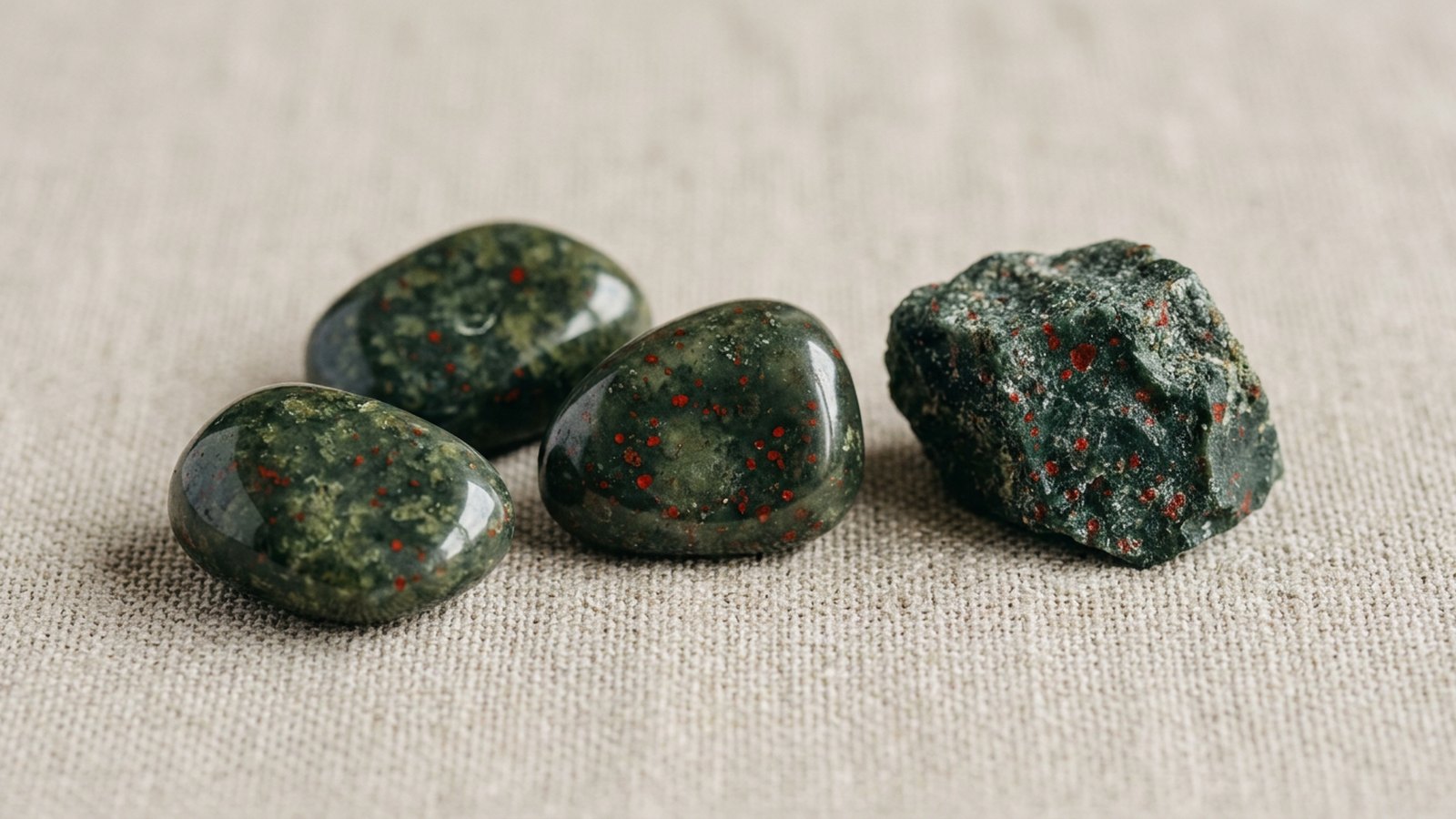
The first bloodstone I owned was a disappointment. I had read the name, pictured something dramatic, and what arrived was a dark, almost sullen green pebble that looked closer to old moss than to anything alive. It sat in a drawer for a year. Then I started carrying it through a stretch of months that asked more of me than I had, and I understood that the drabness was the point. Bloodstone is not a stone that lifts you. It is a stone that keeps you upright.
Hold one up to a window and the green stops being flat. Light finds its way a millimetre or two into the surface and the red flecks sit just under it like something suspended. Some pieces have three or four specks. Some look splashed. The best ones, to my eye, are the restrained ones.
If you are here because you want to know what bloodstone means, the short answer is courage, endurance and grounding: it is the stone traditionally carried by people who have to keep going. The longer answer includes who should probably leave it alone, and the fact that a good share of what is sold under the name is not bloodstone at all.
Reasons to Work With Bloodstone
Bloodstone is for the long middle of something hard. Not the crisis, which runs on adrenaline and gets you through on its own, but the fourth month of it, when the adrenaline is gone and the thing is still not over. A diagnosis in the family, a job you cannot leave yet, a degree you are halfway through. Tradition gives bloodstone to soldiers and athletes, and I think that is the right instinct for the wrong reason: the value is not in the charge, it is in the staying.
Bloodstone is for people whose courage runs out in private. Plenty of us can be brave where it is witnessed and then come apart in the car afterwards. The old name for this stone was the martyr's stone, and there is something in it that seems addressed to the unwitnessed part, the part that has to go back in tomorrow.
Bloodstone is for grounding that has some blood in it. Most grounding stones work by settling you down and slowing you. Bloodstone grounds the other way, into the body and its appetites, into hunger and effort and sleep. If you have gone abstract, living in your head and forgetting to eat, it is a useful weight in the pocket. I reach for it more often than for hematite when what I need is not calm but stamina.
Bloodstone is for making a decision you have been circling. It has a blunt quality. Carried for a week, it tends to make indecision uncomfortable rather than restful, which is either exactly what you need or exactly what you do not, and you usually know which.
Bloodstone Meaning and Healing Energy
Emotional. Bloodstone is traditionally held to steady the nerve rather than soften the feeling. It is not a comfort stone and it does not pair well with grief in the early weeks, when what you need is permission to stop. Later, when the task is to re-enter ordinary life, it earns its place. I find it useful for the specific fear of being found inadequate.
Spiritual. Older lore treats bloodstone as a stone of devoted service: strength given to be spent on something outside yourself. It sits well with practices that involve commitment rather than transcendence, a vow kept, a discipline repeated, a promise honoured on a day you do not feel like it.
Mental. Tradition credits it with clearing the fog of exhaustion and returning you to one next action. Where crystals for focus address attention that scatters, bloodstone addresses attention that has simply run down. It is the stone for the tired mind rather than the busy one.
Physical. For two thousand years bloodstone was the stone of the blood: staunching wounds, circulation, vitality, and in many traditions the menstrual cycle and childbirth. It was ground into powder and taken as medicine well into the Renaissance. That is history worth knowing and not advice worth following. Nothing here replaces a doctor, and bloodstone should never be taken internally or made into an elixir you drink.
| Chakra | Root, primarily. A minority of sources place it at the heart, for the green. |
| Zodiac | Aries and Scorpio most consistently; Pisces and Libra in some traditions. |
| Element | Earth, with a fire current running through it. |
| Numerical vibration | 4 and 6 |
| Affirmation | I have enough in me for today, and tomorrow will ask again. |
That chakra disagreement is worth naming rather than resolving. Colour-based systems file bloodstone under the heart because it is green. Function-based systems file it at the root because everything it is traditionally used for is survival, body and endurance. I work with it at the root and I think the colour reading is a coincidence of appearance, but you will see both, and neither camp is being dishonest.
Who Should Skip Bloodstone
This gets asked constantly and answered almost nowhere, so here is my honest attempt.
Skip it if you are already running hot. Bloodstone has a pushing quality. If you are in a burnout state where the problem is that you cannot stop, a stone traditionally associated with pressing on is the last thing you need. Reach instead for something in crystals for sleep or crystals for anxiety.
Skip it in acute grief. Endurance is not the task in the first weeks. Being allowed to fall apart is.
Skip it if a stone would become a substitute. Bloodstone's traditional association is with pushing through, and there are situations where pushing through is precisely the wrong move and the right move is to ask for help, see a doctor, or quit. A pebble that makes you feel more capable of enduring something you should not be enduring is not doing you a favour.
There is one more caution that circulates widely, from Vedic astrological practice, where certain stones are prescribed by birth chart and considered unsuitable for others. If you work inside that system, consult someone who practises it. Outside it, I know of no tradition in which bloodstone is considered harmful to wear, and none of the above is about danger. It is about fit.
The Geology of Bloodstone
Bloodstone, properly heliotrope, is a variety of chalcedony: silicon dioxide, the same SiO2 as clear quartz, but grown as microscopic fibres packed too tightly to see rather than as single crystals. It sits at 6.5 to 7 on the Mohs scale, takes a good polish, and is tough enough for daily wear in a ring, which is more than can be said for most green stones.
The green is not the silica. It comes from microscopic inclusions of chlorite and actinolite, iron silicates caught in the chalcedony as it precipitated from hot fluid. The red spots are separate concentrations of iron oxide, usually hematite, occasionally red jasper. Two different iron minerals, two different colours, one stone. Green chalcedony of the same kind with no red in it is called plasma, and it is a distinct material despite looking like a bloodstone that forgot its spots.
The name heliotrope comes from the Greek for sun-turning. Pliny the Elder, writing in the first century, explained it: dropped into a basin of water and held to the sun, the stone was said to turn the reflected sunlight blood red. Whether or not you can reproduce that, it is a better etymology than most.
Because the green ground is chalcedony and the red is an inclusion rather than a band, bloodstone behaves like a jasper more than an agate: opaque, unbanded, patchy. If you want that distinction properly, jasper vs agate walks through it with a torch.
Is Yours Actually Bloodstone?
Four things get sold as bloodstone, and only one of them is.
Plain green jasper. The commonest substitution. If there is no red at all, or the red is a single smear rather than discrete spots, you likely have green jasper or plasma. Not a scandal, not what you paid for.
Dyed material. Pale or grey chalcedony is dyed green and sometimes given red flecks. The tell is colour that is too even and too saturated, a green with no variation across the piece, and dye concentrated in cracks. Real bloodstone is uneven and slightly drab. Our guide on how to tell if a crystal is real covers the general tests.
Dragon bloodstone. This one deserves its own paragraph, because the name is close enough to mislead and the stone is not related at all. Dragon bloodstone, also sold as dragon blood jasper, is an olive green and deep red rock from Western Australia composed of green epidote and red piemontite. No chalcedony, no hematite spots, a different mineral family entirely. It is a handsome stone with its own following. It is not heliotrope, and if bloodstone's specific lore is what you are after, it will not stand in.
Glass and resin. Rare, and obvious in the hand: warm to the touch, too light, sometimes with bubbles. Real bloodstone is cold on first contact and stays cold for a beat.
The honest test for the real thing is unglamorous. Look for a green that varies across the piece, red that sits as separate discrete flecks with soft edges rather than painted dots, and weight that surprises you slightly for the size.
History and Lore
Bloodstone has one of the longest documented runs of any stone in this trade. Greek and Roman lapidaries describe it; the Leyden Papyrus, a Greek magical text from Roman Egypt, credits engraved heliotrope with extravagant powers, including opening doors and commanding respect from rulers. Roman soldiers are said to have carried it as a battle talisman, which is where the endurance association begins.
The Christian legend arrives in the Middle Ages and is the reason for the modern name. In it, blood from the crucifixion fell onto green jasper at the foot of the cross, and the stone carried the marks afterwards. It became the martyr's stone, carved into devotional objects and reliquaries throughout medieval Europe, and it is why bloodstone still reads as a stone of sacrifice and endurance rather than of victory.
Bloodstone is also the traditional birthstone for March, and it held that position alone for centuries before aquamarine was added and then largely took over in modern commercial lists. If you were born in March, both are yours by tradition. They could hardly be less alike: aquamarine is clear, cool and yielding, bloodstone is opaque, heavy and stubborn. Most March people I know have a decided preference.
Where It Comes From, and Caring for It
The great majority of bloodstone on the market today comes from India, specifically the Kathiawar peninsula in Gujarat, where it forms in gas cavities within the Deccan Traps, the vast basalt flows laid down at the end of the Cretaceous. Indian material is sold locally as pitoniya, which is why you will see "Indian bloodstone" used as though it were a grade. It usually just means ordinary bloodstone. Smaller quantities come from Brazil, Australia, Madagascar, China and the Isle of Rum in Scotland.
Care is easy, which is part of its appeal. At 6.5 to 7 it resists scratching from most household surfaces, it does not fade in sunlight the way amethyst and fluorite do, and brief contact with water is fine, so it passes the test in which crystals can go in water. Avoid prolonged soaking and avoid salt, which will not dissolve it but will dull the polish over time. Running water, smoke, or a night on the earth are all appropriate; the methods in how to cleanse and charge your crystals all suit it. To activate it, simply carry it and give it a job: bloodstone responds better to being used than to ceremony.
A Last Word
Bloodstone has never been a fashionable stone, and I have come to think that is part of what it is for. It does not photograph well, it does not sparkle, and it will not make anyone ask about it. What it does, for people who have had to keep going, is sit in a pocket like a hand on the shoulder. If you are in the long middle of something, it is worth carrying one for a month. If you are looking for lightness, look at green aventurine instead, and come back to this one when the year gets harder.