There is a particular kind of afternoon where you sit down with every intention of working, and two hours later you have read the same paragraph four times. I know it well. Somewhere in the middle of one of those afternoons, most people end up typing "crystals for focus" into a search bar, which is very likely how you arrived here.
So I did something before writing this. I read the eight most visible guides on the subject, side by side, and I wrote down every stone they recommended. Between them they named eighteen different crystals. Only two of those eighteen appeared on more than half the lists.
That is a strange result for a question people ask constantly, and it took me a while to work out why it happens. It is not that the lists are careless. It is that they are quietly answering different questions. Focus is not one problem, and the stone you want depends entirely on how your attention is breaking.
The short answer, if you only want one stone
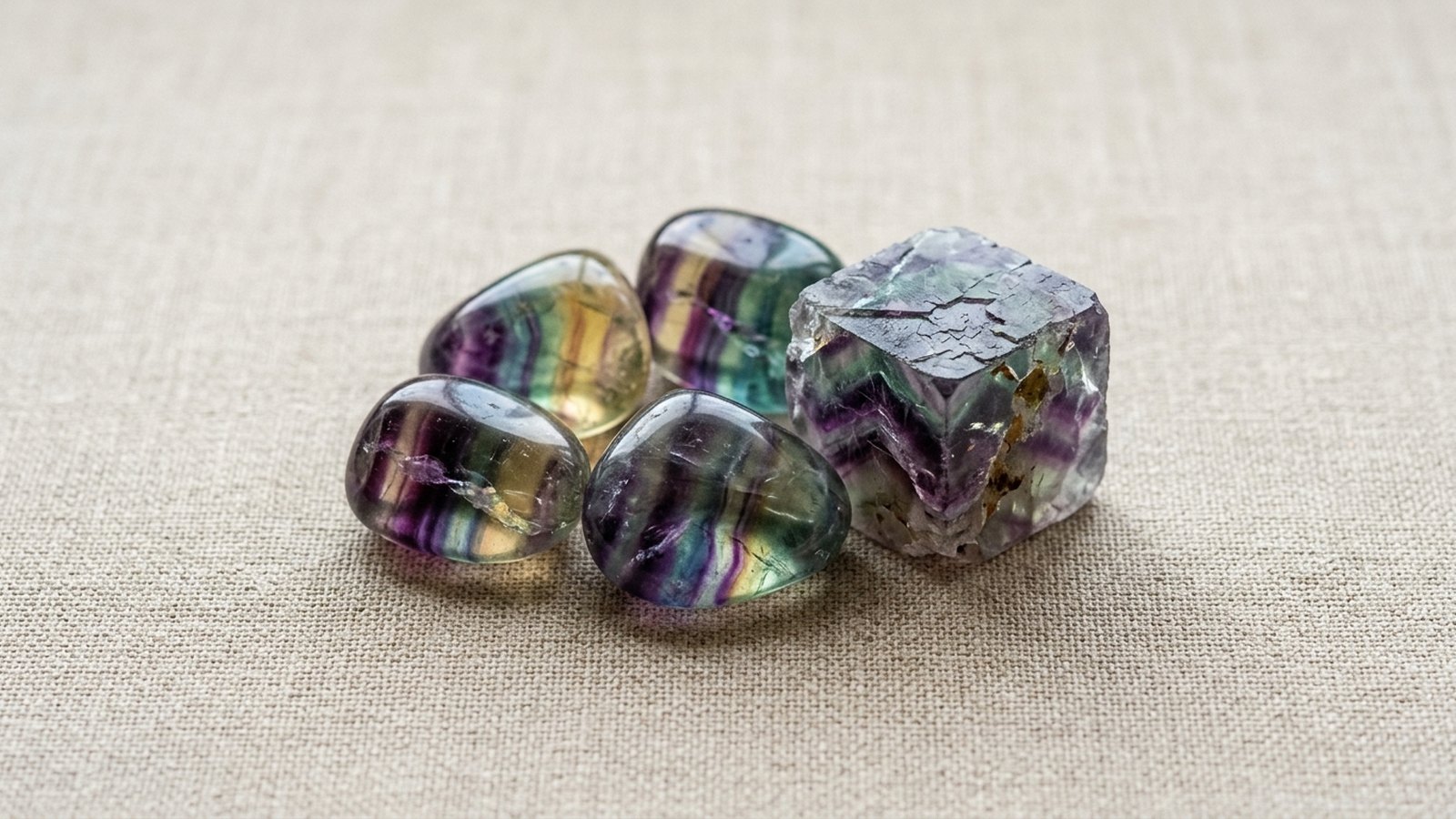
If you want a single name and nothing else, take fluorite. It appeared on six of the eight lists I read, it is the stone the tradition most consistently ties to mental order rather than to energy in general, and it is cheap and easy to find in a tumbled piece or a small cube.
Clear quartz tied it at six of eight, and I still would not lead with it. Clear quartz appears on nearly every list for nearly every purpose, because tradition treats it as an amplifier of whatever you bring to it. That makes it useful, but it tells you almost nothing about focus specifically. Fluorite is the one with the narrower reputation, and a narrow reputation is worth more here.
I counted the lists, and they barely agree
Here is the tally, because I have never seen anyone publish it and I think it explains the confusion better than any argument I could make.
| Stone | On how many of the 8 lists |
|---|---|
| Clear quartz | 6 |
| Fluorite | 6 |
| Amethyst | 4 |
| Sodalite | 4 |
| Citrine | 4 |
| Lapis lazuli | 4 |
| Hematite | 3 |
| Tiger's eye | 3 |
| Pyrite | 3 |
| Black tourmaline | 3 |
| Nine others | 1 or 2 each |
Eighteen stones, two on more than half the lists, and a long tail of stones that exactly one writer thought essential. You can also watch the same stone get justified two incompatible ways: one guide recommends green aventurine for calm, clear decision-making, another recommends it for attracting promotions and bonuses. Those are not the same claim.
The pattern I eventually saw is that each writer had a particular reader in mind, usually without saying so. The ones recommending pyrite were thinking of procrastination. The ones recommending amethyst were thinking of an overloaded mind. Both are real. They are just not the same complaint.
Focus is not one problem, it is five
So work backwards. Before you choose a stone, notice how your attention actually fails you, because the five modes below want different things. Most people recognise themselves immediately in one of them.
A word first, and I would rather say it plainly than bury it at the bottom. A stone will not fix a concentration problem. If your focus has changed sharply, or it is affecting your work or your studies in a way that frightens you, that deserves a doctor rather than a crystal, and there is no shame anywhere in that sentence. What follows is a tradition I work within and find genuinely useful, offered as what it is.
You cannot get started at all
The task is not hard. You simply cannot begin it. The tab stays open and the hours go somewhere.
For this one I reach for pyrite. Its whole traditional character is drive and follow through rather than clarity, and there is something about its blunt metallic weight that suits the problem. A close second is carnelian, which the tradition ties to momentum and courage, and which I find gentler if pyrite feels too brash.
Neither suits you if the reason you cannot start is dread rather than inertia. That is anxiety wearing a productivity costume, and it wants a calming stone instead. I have written about those separately in crystals for anxiety.
You start, then you drift
You begin properly, and twenty minutes later you are somewhere else entirely without remembering the moment you left.
This is fluorite's mode, and it is the one it genuinely earns its reputation for. The old nickname is the genius stone, which is overselling it, but the underlying association is sound: fluorite is the stone of mental order, of putting things in sequence and keeping them there. A small cube at the edge of the desk, inside your field of view but not in the way, is how I use it.
It suits you less well if your problem is stamina rather than direction. If you can hold a thread fine but simply run out of fuel after ninety minutes, citrine is the traditional choice for sustained energy through a long stretch of work.
Your mind is too loud to settle
Nothing is wrong with your attention. There is just too much in your head at once, and every thread is pulling.
Two stones, and they work in opposite directions. Amethyst quiets the noise, which is why it turns up on focus lists and sleep lists alike. Hematite does the opposite: it is iron oxide and it is genuinely heavy for its size, and holding one in your palm is a physical reminder of where you are. Tradition calls it the stone of the mind for exactly this.
Hematite suits you less well if you already feel flat and sluggish, because grounding a mind that is already on the floor helps nobody. Take amethyst in that case, or nothing at all.
Everything feels hazy
Not scattered, not loud. Just fogged, as though you are thinking through a blanket.
This is where I would use clear quartz after all, in its most defensible role: a reset rather than a sharpener. Hold it, name the one thing you are actually trying to do, put it down, start. Sodalite is the other option and is the better one for analytical work, since the tradition links it to logic and orderly reasoning rather than to energy.
Clear quartz suits you less well if you already have four other stones on the desk, since amplifying a crowded intention is not obviously an improvement.
You focus fine, but nothing sticks
You concentrate for three hours, close the book, and could not tell anyone what you read. This is a memory complaint, not an attention one, and it is the distinction the lists collapse most often.
Lapis lazuli is the traditional stone here, tied for centuries to knowledge, study and intellect rather than to concentration. Sodalite is often sold as a cheaper stand in for it and the two do look alike, which I have untangled in sodalite vs lapis lazuli. For retention specifically I would pay for the lapis.
It suits you less well if what you actually need is sleep. Memory consolidates overnight, and no stone on your desk competes with a bad night. Crystals for sleep is the more useful page in that case.
How to actually work with one at a desk
The method is unglamorous and takes about a minute.
- Cleanse it when it arrives. Whatever method you favour. Cleansing your crystals covers the options, and dry methods are safer for most of the stones above.
- Give it one job, in your words. Not "help me focus" but "you are for the two hours I write in the morning". Narrow instructions work better than broad ones. Programming an intention goes into this properly.
- Put it where your eye lands, not where your hand rests. The edge of the desk, at the top of your field of view. Under a keyboard it does nothing.
- Touch it when you catch yourself drifting. This is the part that matters. The stone is the signal to come back, and the coming back is the whole practice.
- Take it with you if the work moves. A tumbled stone in a pocket travels well. Carrying and wearing stones has more on this.
I want to be clear about the mechanism, because I think honesty here makes the practice stronger rather than weaker. What you have built is a physical cue attached to a specific intention, sitting in your line of sight, that you touch several times an hour. That is a real and useful thing, and it is most of why this works for people. The energetic reading, that the stone holds the intention and hands it back to you, is the tradition I love and work within, and I am not going to dress it up as a measured fact.
What a focus stone should not be doing in your bedroom
People ask this constantly and none of the guides I read answered it, which surprised me. The question is really about what happens when the stone you chose for work follows you to bed.
My honest answer is that the offenders are the stimulating ones. Citrine, pyrite and carnelian are all chosen precisely because they push, and a stone whose whole job is to keep you going is a strange thing to put on a nightstand. Clear quartz is the other one I would move, on the amplifier logic: if your mind is busy at midnight, amplifying is not the direction you want.
None of this is a rule, and nobody is harmed by a stone in the wrong room. But there is a simpler version of the idea that I do believe in: a stone works better when it means one thing. If the pyrite on your bedside table is the same pyrite that means "start writing", you have handed your nervous system a mixed message at exactly the wrong hour. Keep the working stones at the desk. Where to place crystals in your home works through the rest of the house.
What a desk does to a stone
Every guide tells you to put a crystal on your desk. Not one of them mentions that a desk is a slightly hostile place for several of these stones, so here is the practical part.
Fluorite is soft. It sits at 4 on the Mohs scale, well below the quartz family at 7, which means keys, a laptop foot or a dropped mug will mark it. It is also genuinely light sensitive: prolonged sunlight will pull the purple out of it over months. A sunny windowsill is the worst place you could choose, which is unfortunate, because it is where people put things they want to look at. Amethyst fades the same way, for the same reason.
Selenite should never meet a spilled drink. It is gypsum, Mohs 2, soft enough to scratch with a fingernail, and it degrades in water. A coffee accident is fatal to it. Which crystals can and cannot go in water has the full list.
Pyrite dislikes damp air. It is iron sulfide, and in humid conditions it slowly oxidises, which is a well documented headache for museum collections. A dry desk is fine. A humid conservatory over a few years is not.
Hematite, sodalite, lapis lazuli, carnelian and clear quartz are all comfortable at a desk indefinitely. If you want to keep whichever you choose working well, how to activate crystals covers the cleansing and reprogramming rhythm.
If you take one thing from all this, let it be the diagnosis rather than the shopping list. Sit with the last afternoon that got away from you and ask which of the five it was. The stone follows easily once you know that, and honestly, so does most of the fix.