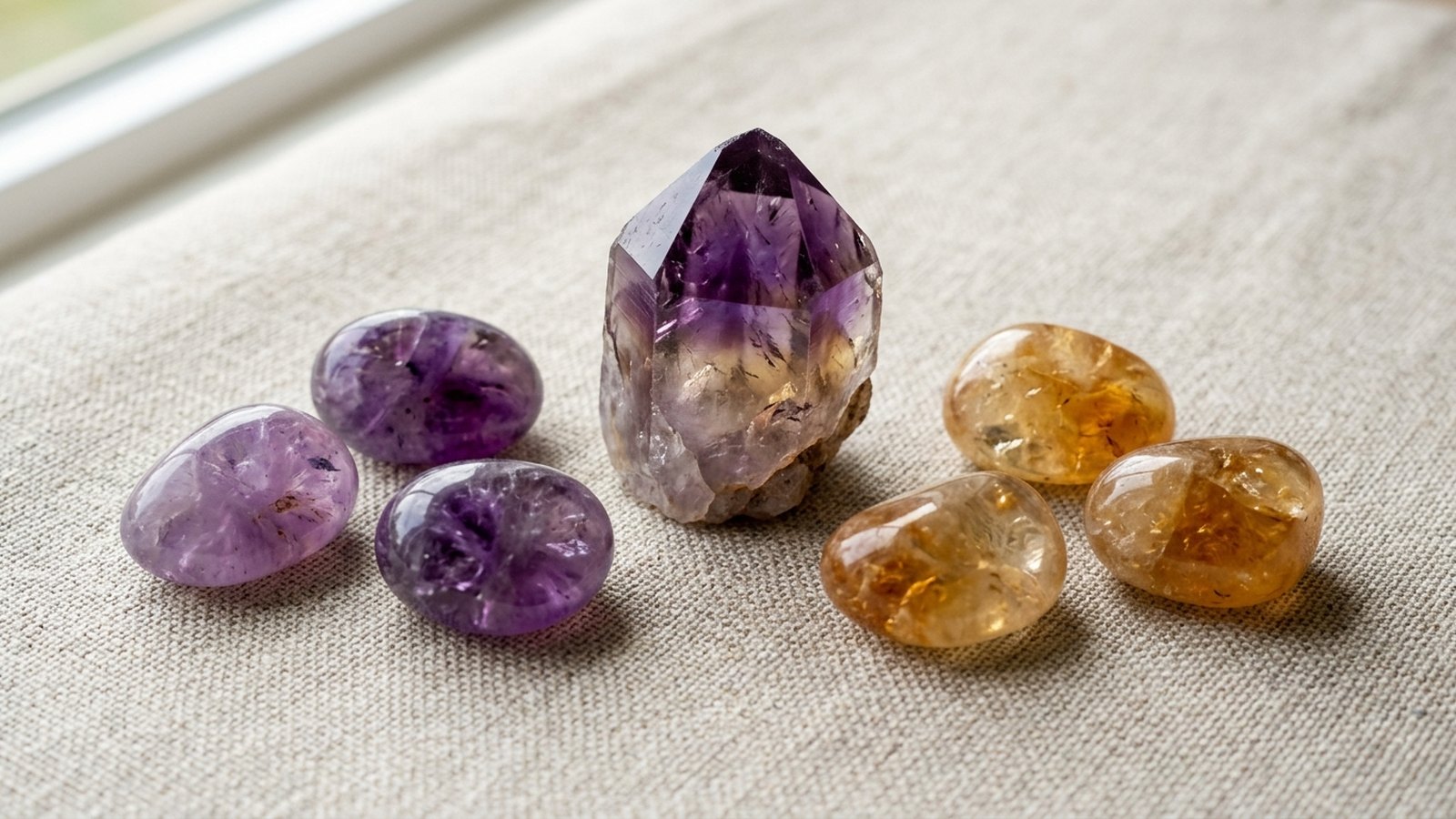
Most crystal pairings put two different minerals in your hand. This one does not, and almost nobody says so.
Amethyst and citrine are the same mineral. Both are quartz, both owe their colour to traces of iron, and the difference between purple and gold comes down to what that iron has been through. Which means that when you set them side by side on a shelf, or wear them on the same wrist, you are not really combining two stones. You are holding one stone in two states, and there is a decent chance that the golden half was made out of something that looked exactly like the purple half.
I find that far more interesting than the usual "calm meets confidence" line, and it has real consequences for what you buy, how you use the pair, and where you leave it.
The short answer
Yes, amethyst and citrine work well together. Amethyst is traditionally the stone of a quiet mind, citrine the stone of warmth and drive, and because they are the same mineral at the same hardness, they cannot damage each other in a pouch or a bracelet. The catch is that most citrine on the market is heat-treated amethyst, so a great many "amethyst and citrine" sets are chemically the same stone twice.
One mineral, two states
Quartz is silicon dioxide, SiO2, and on its own it is colourless. Amethyst gets its purple from traces of iron combined with natural irradiation deep in the ground over a very long time. Heat that same iron past a certain point and the colour centres shift: the purple leaves and a yellow, orange or amber tone arrives. That is citrine.
Both sit at 7 on the Mohs scale, both have the same chemistry, the same crystal system, the same glassy break. If you handed a specimen of each to a mineralogist with the colour stripped out, there would be nothing to separate them. You can read the longer story in my guides to amethyst and citrine.
This matters for the pairing because it quietly answers the question people are really asking when they type "amethyst and citrine" into a search box. Can these two clash? No. Their traditions differ, but their substance does not, and the usual reasons crystal pairings go wrong (a soft stone grinding against a hard one, one stone fading while the other is fine, water damaging one of the two) simply do not apply here. It is the most physically compatible pair I know of, and I say that having spent a lot of words elsewhere warning about pairs that are not.
What each one brings
Amethyst, the quiet one
Amethyst has been the stone of clear-headedness for a very long time, and the tradition puts it at the third eye and the crown. I reach for it when my thinking is loud rather than useful: the evening when a decision keeps rewriting itself, the wound-up hour before sleep. It is the stone people most often keep by the bed, and it does its best work at the end of the day rather than the start. If that is the ground you are on, my guide to crystals for anxiety sits close to this.
Citrine, the warm one
Citrine belongs to the solar plexus, the seat of will and self-trust in the traditional map. It is the stone of getting started, of asking for the thing, of the morning rather than the night. It is on nearly every list of crystals for money and abundance and it is the one stone named on every manifestation list I have looked at. Where amethyst quiets, citrine pushes.
Put simply: amethyst settles the mind, citrine moves the body. That is the whole case for the pair, and it is a good one, because most of us need both in a day.
Ametrine, the pair nature already made
Sometimes a single quartz crystal grows with purple at one end and gold at the other. That stone is called ametrine, and it is what people are looking for when they search for "amethyst and citrine in one stone".
Virtually all gem-quality ametrine on the market comes from one place: the Anahi mine in eastern Bolivia, worked commercially since the 1970s and carrying a lovely seventeenth century story about a Spanish conquistador given the deposit as a dowry. The accepted explanation for the two colours is a temperature difference across the growing crystal, leaving iron in different states in different zones. Cutters orient the rough deliberately so the finished stone shows a clean split, or a soft gradient, depending on what the material offers.
Ametrine is a quartz like any other, so it is a 7, and it takes ordinary care. If the symbolism of the pair appeals to you more than the practicality of two separate stones, this is the elegant answer, and it is honest in a way a mixed bracelet sometimes is not: the two colours really did form together.
The awkward part: your citrine may be a baked amethyst
Natural citrine is genuinely uncommon. Most of what is sold under the name is amethyst that has been heated, usually somewhere in the region of 470 to 560 degrees Celsius, until the purple turns gold. This is not a scam in itself, it is an old and disclosed practice, and plenty of people work happily with treated stones. But it is worth knowing what is in your hand, especially when you are buying the pair.
A few things I look for, in rough or point form:
- A white or colourless base. Heated amethyst points often keep a pale, milky lower section, because the colour was only ever concentrated near the tip.
- Amethyst's colour zoning showing through. Zoning survives the oven. Angular bands or patchy saturation in a yellow stone are a strong hint.
- A hard, burnt orange. Deep reddish orange, very uniform, is the classic look of treated material, particularly at the cheaper end. Natural citrine tends toward pale to golden yellow, sometimes slightly smoky, and its colour is usually less tidy.
- Geodes and big clusters. Natural citrine almost never forms as a large geode. The purple-to-gold cathedral geodes sold everywhere are amethyst geodes that went through an industrial oven.
And the honest limit: on a tumbled bead or a small faceted stone, you often cannot tell, and neither can most sellers. If certainty matters to you, buy from someone who states the treatment, or accept the uncertainty. I go into the wider question in how to tell if a crystal is real, and there is a fuller treatment section in the citrine guide.
Does the pairing still work if the citrine was heated?
This is the question the mineralogy forces, and I would rather answer it than dodge it.
The traditional view is that the colour is the point. Colour is how the old lore sorted stones long before anyone could name an oxidation state, and by that logic a golden quartz carries golden qualities regardless of the route it took. Heat is also how a great deal of the world's gem material has always been finished.
My own view is a little more practical. I do not think a stone stops working because it saw an oven, but I do think it is worth knowing that a purple and gold pairing may be one mineral wearing two faces. It makes the pair feel less like two allies and more like two moods of the same thing, which, honestly, is closer to how it behaves in use. If you want the contrast of genuinely different substances, pair your amethyst with something from another family, as in amethyst and rose quartz.
How to use them together
- Split them by time of day. Citrine in the morning, in a pocket or on your desk, for the part of the day that needs starting. Amethyst in the evening, on the bedside table or in your hand while you wind down. This is the single most useful thing I can tell you about the pair, and it beats wearing both all day.
- Wear them on the same wrist, if you like. Same mineral, same hardness, so no scratching either way. A mixed quartz bracelet is one of the few combinations I have no durability worries about.
- Place them on the body during a short meditation. Amethyst at the forehead, citrine at the solar plexus, ten minutes, nothing more elaborate. The pairing maps neatly onto two chakras that rarely compete.
- Give each a job, not one shared job. Pairs muddle when you ask both stones for the same thing. Ask amethyst for the quiet and citrine for the start, and pay attention to which one you keep reaching for.
- When not to pair them. Leave the citrine out of the bedroom. Amethyst's traditional work is settling, citrine's is activating, and setting an activating stone on your nightstand undoes the point of the other. Same goes for a study session that needs focus rather than momentum, where I would use amethyst alone or one of the focus stones.
None of this is medicine. These are traditional associations and my own habits with the stones, not treatment, and if something in your life genuinely needs help, please go and get the real kind.
Care: the one thing they both fail at
Here is the practical payoff of the same-mineral point. Two stones from different families usually fail in different ways, and you have to manage both. Amethyst and citrine fail in exactly the same way, which makes them easy, and it means one bad habit damages the whole set at once.
That habit is light. Amethyst fades in prolonged sunlight, and the fading is permanent, because the colour centres that the sun takes out do not come back. Treated citrine owes its colour to heat in the first place, so it is not a candidate for a sunny windowsill either. A purple and gold pair on a bright sill is the one arrangement I would actively talk you out of, however good it looks. Keep them somewhere shaded, as in how to store crystals.
Otherwise they are easy. Quartz at 7 is happy with brief rinsing in cool water, though avoid salt water, which is rough on the polish over time. Nothing about this pair needs the elaborate protocols some combinations do, and unlike the pairs I flag in what crystals should not be together, there is no hardness gap to manage. See also which crystals can go in water.
Who this pair suits
It suits people who swing between overthinking and inertia, which is most of us at some point. It suits Pisces and Aquarius, who have amethyst as a birthstone through February, and Sagittarius, whose November stone is citrine. And it suits anyone building a first small collection, because between them these two cover the calm end and the confident end of the range without adding a second mineral to look after.
Who might skip it: if you already work mostly with amethyst and want genuine contrast, a different family will give you more, whether that is rose quartz and moonstone for the heart or black tourmaline and selenite for grounding.
Two colours, one mineral, and a quiet reminder that the same material can hold very different moods depending on what it has been through. I have never minded that the pair is a bit of a family affair. It makes it feel less like a shopping list and more like a stone showing you both of its faces.