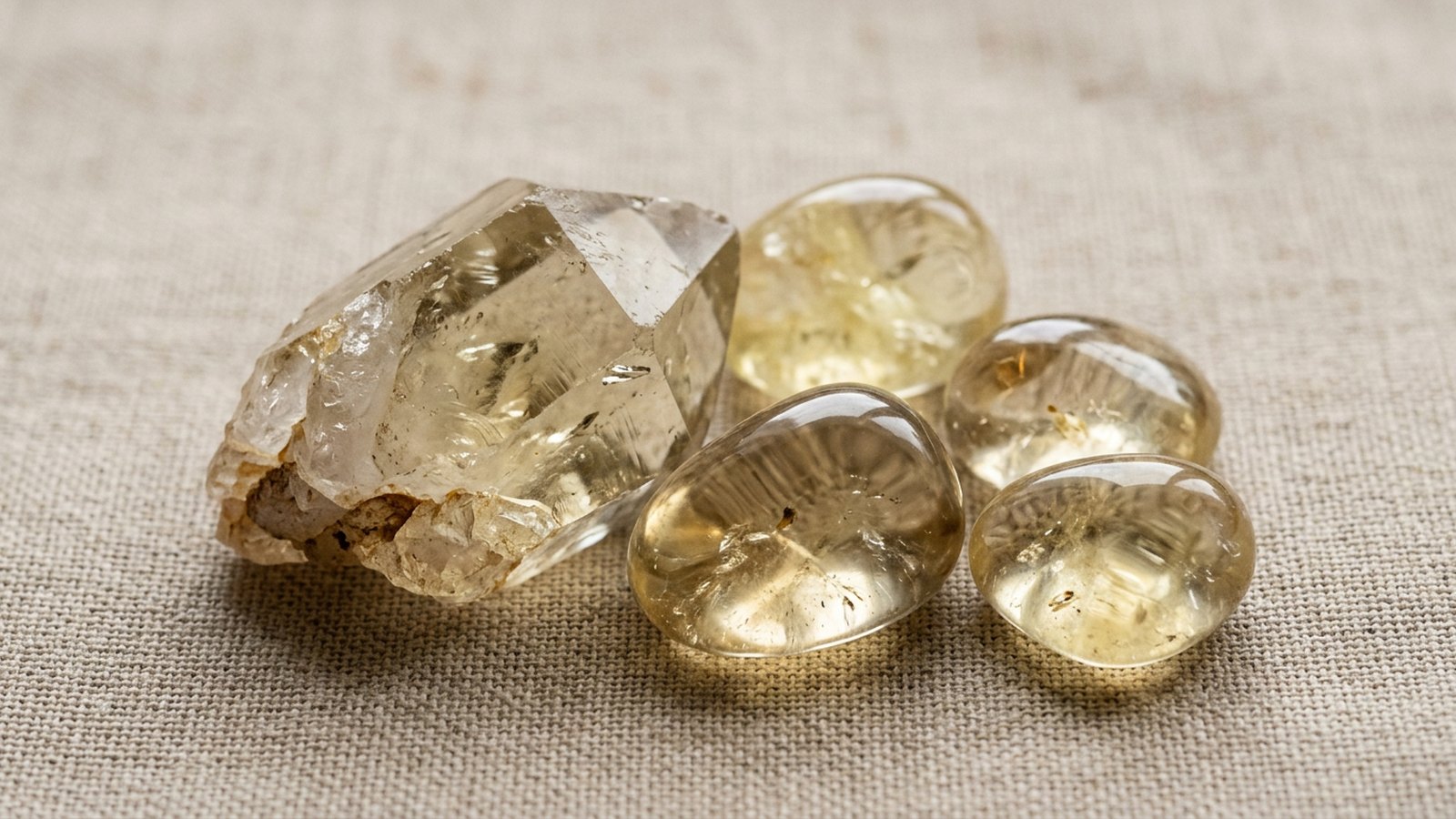
Citrine and pyrite is the pairing I get asked about more than any other money combination, and it is one of the few popular duos where the traditional logic actually holds up. Citrine is the stone of the open hand, the one associated with optimism, visibility and opportunity. Pyrite is the stone of the closed fist, associated with drive, discipline and finishing what you started. Put them together and you get the two halves of the same problem: wanting more, and doing the work.
Yes, you can absolutely wear them and work with them together. There is one real constraint, and it has nothing to do with clashing energies. It is chemical, and almost nobody selling you an abundance bracelet will mention it: pyrite and water do not get along, and pyrite is softer than citrine. Those two facts change how you should store, cleanse and string this particular pair.
So let me give you the whole thing. Why the pair is traditionally put together, what each stone actually is underneath the marketing, the one rule that protects your pyrite, four concrete ways to use them, and what to do when the combination does not seem to be doing anything at all.
Why citrine and pyrite are traditionally paired
The pairing is not ancient. It is a modern crystal-trade convention, and it makes sense on its own terms, so I would rather tell you that plainly than invent a lineage for it.
Citrine carries the nickname "merchant's stone", from the habit of keeping a piece in a till or a cash box. In the tradition it is a stone of receiving: confidence in your own worth, willingness to be seen, the sense that good things are allowed to arrive. Its lore is warm and slightly sunny, and it is the piece people reach for when the block is internal, when they are undercharging or apologising for existing.
Pyrite is the other half. Its lore is about action, structure and follow-through, and it has a distinctly protective streak: shielding your energy and your resources rather than attracting new ones. Where citrine says yes, pyrite says now, and then Tuesday, and then again next week. Practitioners often describe it as the least dreamy stone in the abundance drawer.
That is the real argument for the duo. They are not redundant. Most people who want more money are stuck on one of two things: they either cannot ask, or they cannot keep going. Citrine and pyrite sit on opposite sides of that split, and both are traditionally associated with the solar plexus chakra, the seat of will and self-definition. If you want the wider view of the intention, I have collected the rest of the family in crystals for money and abundance.
As always, this is tradition and intuition, not a financial method. A stone is a reminder you can hold, not an income stream.
What the two stones actually are
Citrine is quartz, silicon dioxide, Mohs hardness 7, trigonal. Its yellow comes from traces of iron held in the crystal structure as colour centres. Natural citrine is genuinely uncommon and tends to be pale, a soft lemon or a smoky champagne, and the finest comes from Brazil, Madagascar and Zambia.
Pyrite is iron sulfide, FeS2, Mohs 6 to 6.5, and it crystallises in the cubic system, which is why it produces those improbable natural cubes with striated faces. The best known come from Navajún in La Rioja, Spain, where the crystals grow in soft marl and come out looking machined. The name comes from the Greek pyrites lithos, stone of fire, because struck against steel it throws sparks. That is the honest origin of its reputation, long before anyone called it fool's gold.
The fool's gold nickname is worth one paragraph, because the distinction is easy. Real gold is malleable and leaves a golden streak when dragged across unglazed porcelain. Pyrite is brittle, shatters rather than dents, and leaves a greenish-black to brownish-black streak. If you want the general version of that skill, see how to tell if a crystal is real.
The one rule: they do not share water, and they do not share a drawer
Here is what the abundance bracelet listings leave out.
Pyrite oxidises. In damp air, iron sulfide reacts with oxygen and moisture to form iron sulfates and sulfuric acid. Museum conservators know this as pyrite decay, or pyrite disease: specimens develop a white or yellowish powdery bloom, they crack, and in bad cases they crumble to dust, taking their labels and their storage trays with them. It is a real, documented conservation problem, not crystal folklore. The acid produced is dilute, but it is genuinely corrosive to whatever is sitting next to it.
Citrine, being quartz, is stable in water and shrugs the whole thing off. So the two stones have opposite needs.
What this means in practice:
- Never cleanse them together in water, and do not cleanse pyrite in water at all. No soaking, no salt water, no moon water bowl. Salt is the worst of the options, because it accelerates the oxidation. My full notes on which stones tolerate a rinse are in crystals and water safety.
- Cleanse pyrite dry. Smoke, sound, a few hours on a windowsill out of direct sun, or simply a soft dry brush. Citrine can have whatever you like. The methods are laid out in how to cleanse your crystals.
- Store them apart, and store pyrite dry. Not the bathroom, not a sealed damp pouch. A dry drawer with a silica gel sachet is ideal. See how to store crystals.
- Watch the hardness gap on a single bracelet strand. Quartz is 7, pyrite is 6 to 6.5. Strung alternately on one elastic, the citrine beads will slowly abrade the polish off the pyrite beads every time you move your wrist. Two separate bracelets, one per wrist or both on the same arm, solve this completely.
That fourth point is the literal answer to a question people ask constantly in the abstract, which crystals should not touch. For this pair it is not an energetic taboo. It is just Mohs. I have written more on the mismatched-pair question in what crystals should not be together.
Prolonged skin contact with pyrite is fine, but if a piece starts blooming white powder, handle it less and wash your hands afterwards. That powder is iron sulfate, and the piece is on its way out.
Four ways to actually use the pair
On the body. The traditional rule is receiving on the left, projecting on the right: citrine on the left wrist to take in opportunity, pyrite on the right to push action outward. I am not dogmatic about it, but it gives the two stones distinct jobs instead of a blur, and the tradition behind it is explained in which hand to wear a crystal bracelet on. Remember the separate-strands rule above.
On the desk. This is where I think the pair earns its keep. Pyrite sits where you work, in your eyeline, as the stone of the next concrete step. Citrine sits where money actually arrives: near the card reader, the invoicing laptop, the till. Keeping them a metre apart rather than in a matched set is not a compromise, it reflects the fact that they do different things.
In the wealth corner. In feng shui practice the southeast sector is associated with wealth, and a pyrite cube with a citrine cluster is the classic placement there. If you want the room-by-room logic, see where to place crystals in your home.
In a short sitting. Pyrite in the non-dominant hand, citrine in the dominant one, five minutes, and one specific question: what is the smallest next action, and what would it mean to let this go well. Pair it with programming an intention if you want something more structured, or fold it into a longer practice from meditating with crystals.
If you only buy one
Buy for the block you actually have, not for the prettier stone.
Choose citrine if the stuck point is internal: you undercharge, you deflect compliments, you struggle to ask, opportunities feel like they are for other people. It is the gentler of the two and the better daily companion, and it overlaps with the work in crystals for confidence.
Choose pyrite if the stuck point is momentum: you know exactly what to do and you are not doing it, you start well and stall, you are in an ambitious stretch and losing steam. It is heavier, more literal, and it belongs with crystals for motivation.
If you have the budget for both, start with one for a month before adding the other. You will actually notice what each one does.
Buying the duo without getting caught
The citrine problem is well known and still catches people. Most bright orange-brown "citrine" on the market is heat-treated amethyst, usually Brazilian, recognisable by its saturated burnt-orange tone and often a white base where the crystal snapped off the geode. Natural citrine is paler and more evenly coloured. The treated material is not a scam if it is sold honestly, and plenty of people work with it happily. I go into the mineralogy of that transformation in amethyst and citrine together.
The pyrite problem is different, and less discussed. Pyrite is rarely faked, because it is cheap. What you get instead is a close relative sold under the wrong name. Marcasite is the same FeS2 in a different crystal system, paler and noticeably less stable, and it decays faster than pyrite in the same conditions. Most jewellery sold as marcasite is in fact pyrite, which is the harmless version of this confusion. Chalcopyrite, a copper iron sulfide, is much softer at 3.5 to 4, and the vivid "peacock ore" sold in tourist shops is usually acid-treated chalcopyrite rather than a natural rainbow. Buy pyrite with clean metallic faces and no powdery bloom, and ask how it has been stored.
When the pair does not seem to be doing anything
This is the most common private message I get about this combination, and it deserves a straight answer rather than a suggestion that you cleansed it wrong.
Sometimes it means the pair is aimed at the wrong half of the problem. People buy the abundance duo when the real issue is a job they have outgrown, or a rate they have not raised in four years, and no stone on a desk resolves that.
Sometimes it means the stones became decoration. A crystal works, to the extent that it works at all, as a physical anchor for attention. If it has been in the same spot for six months and you no longer see it, it has stopped asking you anything. Move it, or put it away for a while and bring it back.
And sometimes there is nothing to fix. I will not tell you that citrine and pyrite change your finances. What they can reasonably do is keep a specific intention in your visual field, day after day, and make it slightly harder to drift. That is worth something real, and it is not the same as a promise. If money worries are affecting your sleep or your health, please talk to a professional, human being. That is not what a stone is for.
If the pairing itself feels right but the intention needs sharpening, crystals for manifestation is the next thing I would read.
My honest take
Citrine and pyrite is one of the few duos I recommend without hedging, because the two halves really are complementary rather than decorative: one for the asking, one for the doing. Treat the pyrite like the reactive mineral it is, keep it dry and off the same strand, and the pair will outlive most of the jewellery you own.
If you want a third stone eventually, green aventurine is the gentle luck of the family rather than the drive, and it is covered in crystals for good luck. But I would sit with these two first. They ask enough.