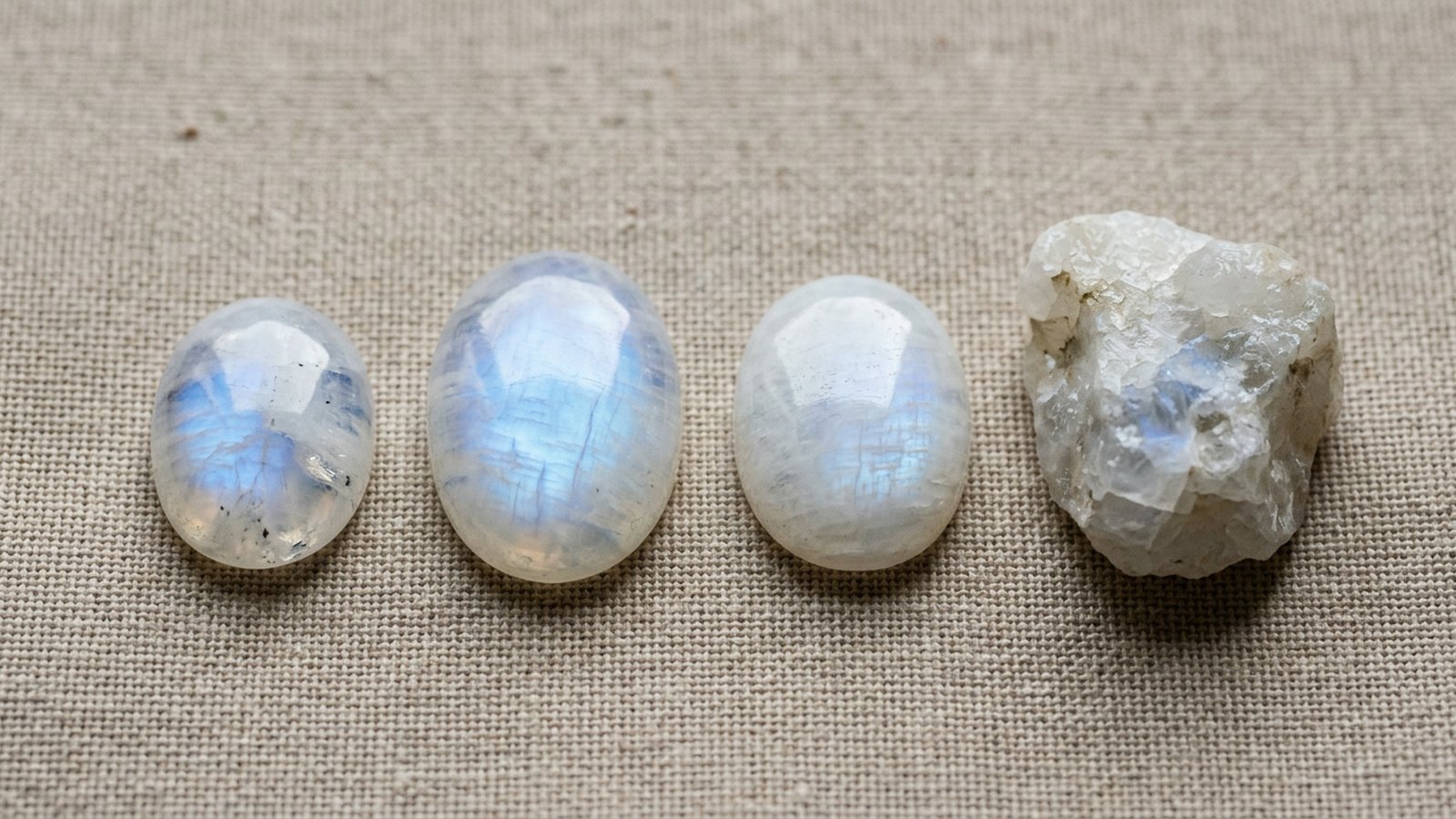
Two stones glow from the inside, and people mix them up constantly. I have watched someone hold a moonstone cabochon up to a window and ask me, quite seriously, whether they had been sold a cheap opal. They had not. The two are not related at all.
Here is the short version. Moonstone is a feldspar that shows adularescence, a soft blue or white sheen that floats across the stone as one moving sheet. Opal is hydrated silica that shows play-of-color, discrete patches of several different colours flashing at once. One glow drifts, the other fires.
That difference takes about ten seconds to see once you know what to look for. The question that actually matters, and the one almost every comparison gets backwards, is which of the two survives being worn. I will get to that, because the usual answer is wrong.
What each stone actually is
Moonstone belongs to the feldspar group, the most common mineral family in the Earth's crust. What makes a feldspar into a moonstone is not its chemistry but its architecture: as the crystal cooled, it separated into alternating microscopic layers of two feldspar species, orthoclase and albite. Light entering the stone scatters off those layer boundaries and comes back out as that drifting sheen. The formula sits around (Na,K)AlSi₃O₈, and it is a true crystal, with a defined internal order.
Opal is not a mineral at all. It is a mineraloid, hydrated amorphous silica, SiO₂·nH₂O, with no crystal structure whatsoever. It formed from silica-rich water seeping into cracks and cavities and drying slowly over a very long time. Depending on the deposit it holds anywhere from about 3 to 21 percent water by weight, which is a genuinely strange thing to carry around on your finger. In precious opal, the silica settled into a regular grid of tiny spheres, and that grid diffracts white light into its component colours. Common opal, or potch, has the same chemistry but a disordered arrangement, so it never fires.
So one is a layered crystal and the other is a water-bearing glass-like gel. They look similar for the same reason a soap bubble and an oil slick look similar: both are tricks of light, arrived at by completely different routes.
Telling them apart in your hand
Forget colour. Both come in white, grey, blue and peach. The test is movement, and it needs a single point light source, a window or a lamp, not diffuse daylight.
Pick the stone up and rock it slowly through about thirty degrees, watching one spot on the surface.
Moonstone: the glow behaves like a single sheet of light sliding underneath the surface. It stays one colour, usually blue or a milky white, and it seems to sit at a depth below the polished face, as though it were suspended in the stone. As you tilt past a certain angle it fades out and the stone goes plain and slightly cloudy. It has no edges. It bleeds.
Opal: the colour breaks into distinct patches with visible boundaries, and you get several colours in play simultaneously, green next to orange next to blue. Tilt further and the patches do not fade so much as switch, one shutting off as another lights up. The effect reads as being on or just inside the surface, not floating under it.
There is one more tell if the stone is loose. Opal is noticeably lighter in the hand than its size suggests, because of all that water. Its specific gravity runs around 2.15, against roughly 2.56 for moonstone. Two cabochons of the same size, and the opal is the one that feels slightly hollow.
If you are working through a whole drawer of unlabelled pieces, our guide on how to tell if a crystal is real or fake covers the wider set of checks.
The two lookalikes that muddy everything
Most of the moonstone and opal confusion I meet is not really about moonstone and opal. It is about two other things sitting in the middle.
Opalite is not a stone. It is manmade opalescent glass, and it is the single most common thing sold under a moon-adjacent name. It glows milky blue over a dark background and warm amber over a light one, evenly, with no structure and usually with a tiny bubble or two if you look hard. It costs almost nothing. If a "moonstone" or "opal" is flawless, cheap, and perfectly uniform, this is what you have. I wrote a full piece on opalite versus moonstone because it comes up so often.
Rainbow moonstone is not moonstone either. The GIA classifies it as labradorite, a different feldspar, and its flash is labradorescence rather than adularescence. That matters here because labradorescence does break into coloured patches, which is exactly the behaviour I just told you to read as opal. So if you are looking at a translucent white stone throwing patches of blue, green and gold, check labradorite before you conclude opal. If you own both, wearing labradorite and moonstone together covers how the pair behaves.
Durability, and why harder does not mean tougher
Here is the claim you will read on nearly every page comparing these two: moonstone is 6 to 6.5 on the Mohs scale and opal is 5.5 to 6.5, therefore moonstone is the more durable choice for daily wear.
The hardness numbers are right. The conclusion is not, and the reason is a word those pages never use: cleavage.
Mohs hardness measures only resistance to scratching. Cleavage is a mineral's tendency to split cleanly along planes where its atomic bonds are weakest, and it has nothing to do with hardness. Feldspar has two directions of cleavage, one perfect and one good, meeting at roughly ninety degrees. Moonstone therefore has built-in fracture planes running right through it. Knock a moonstone ring against a door frame and it does not scuff, it can lose a flake or split along a plane. Diamond is the hardest natural substance there is and it cleaves too; jewellers have been splitting diamonds with a blade for centuries.
Opal has no cleavage at all. Being amorphous, it has no planes to split along, and it breaks with a curved conchoidal fracture like glass. It is genuinely brittle and it does chip, but it fails from a specific impact rather than along a line waiting inside it.
In practice, for a ring worn every day, neither is a good idea and both will show wear within a year or two. If you must choose, I would rather set either one in a bezel than in prongs, and I would rather put both in a pendant or earrings. The honest ranking is that moonstone tolerates abrasion better and opal tolerates knocks slightly better, which is close to the opposite of what the hardness table alone suggests.
Opal has one failure mode moonstone does not: crazing, a network of fine surface cracks that appears when the stone loses water too quickly. It is not repairable.
Both stones want to be stored apart from harder pieces, wrapped separately. How to store crystals goes into why a shared bowl is where most damage actually happens.
Water, cleaning, and what to ignore
People ask constantly why moonstone cannot get wet. As far as I can tell, it can. Feldspar is not water soluble and a moonstone will survive being rinsed, caught in the rain, or washed in cool water with mild soap. The real risks are thermal shock from hot water, soap film dulling the sheen, and that cleavage again if you drop a wet stone in a hard sink.
Opal is the one with a genuine water problem, and only some opal. Hydrophane opal, which most Ethiopian Welo material is, is porous enough to absorb water. Submerged, it turns translucent and its colour play can vanish; as it dries it may craze permanently. Australian opal is generally non-porous and much less prone to this. If you do not know which you have, treat it as hydrophane.
So for both: a damp cloth, never a soak, and never an ultrasonic or steam cleaner. For cleansing in the energetic sense, keep both out of water and salt entirely and use moonlight, sound, or dry incense smoke instead. Our list of which crystals can and cannot go in water covers where each sits.
Price and value
Opal spans a wider price range than almost any other gem. Common opal is nearly worthless, decent white precious opal is affordable, and top black opal from Lightning Ridge in New South Wales reaches figures competitive with fine sapphire, well into thousands of dollars per carat. Value tracks the brightness, the range of colours, the pattern and the darkness of the body tone.
Moonstone is far more predictable. Ordinary grey or white cabochons cost very little. The premium sits with clear, colourless-bodied stones showing a strong centred blue sheen, historically from Sri Lanka, and even those stay modest next to fine opal.
The practical answer to "which is more valuable" is that opal has by far the higher ceiling, while a good moonstone gives you more visible effect per pound spent. If your budget is small and you want people to notice the stone, moonstone wins. If you are buying something to keep, opal is the one with real range at the top.
What each one is traditionally for
These are traditions and my own read of the stones, not established fact, and no stone substitutes for medical or psychological care.
Moonstone has been tied to the moon, to cycles and to intuition across a lot of cultures and a long stretch of time. I reach for it at the turning points: something ending, something not yet started, the part where you cannot see the shape of what comes next. It sits with the third eye and crown chakras, belongs to the element of water, and is worn by Cancer, Libra and Scorpio. It is a June birthstone, alongside pearl and alexandrite. See moonstone for the full profile, or crystals for new beginnings for how I actually use it.
Opal has the louder reputation. Tradition links it to creativity, to emotional intensity and to amplification, and that last word is the honest caution: people who work with opal often describe it as turning up whatever is already there, pleasant or not. It is October's birthstone. As for the bad-luck story, it is traceable and fairly recent. Walter Scott's 1829 novel Anne of Geierstein featured an opal whose owner met a grim end, the book was popular, and European opal sales reportedly collapsed for decades afterward. It is a piece of literary history, not a property of the stone. Full profile at opal, and crystals for creativity puts it in context.
Which one to choose
| Moonstone | Opal | |
|---|---|---|
| The effect | One sheet of blue or white, floating, drifting | Patches of many colours, switching |
| Structure | Layered feldspar crystal | Amorphous hydrated silica |
| Mohs | 6 to 6.5 | 5.5 to 6.5 |
| Real weakness | Two cleavage planes, splits on impact | Brittle, and crazing if dried out |
| Water | Rinsing is fine, avoid heat | Hydrophane types must stay dry |
| Price ceiling | Modest | Very high |
| Birthstone | June | October |
| Traditionally for | Intuition, cycles, transitions | Creativity, emotional amplification |
- A ring you wear daily. Neither, honestly. If it has to be one, moonstone in a bezel setting.
- A pendant or earrings. Either. This is where opal belongs, out of the line of fire.
- A gift where the birth month matters. June for moonstone, October for opal. This decides it more often than anything else.
- Most visible glow for a small budget. Moonstone, comfortably.
- A piece to keep and pass on. Opal, buying quality over size.
- Steadying yourself through a transition. Moonstone.
- Unsticking creative work. Opal, with the caveat that it amplifies your current state rather than improving it.
If you are still holding the stone and unsure, take it to a window and rock it. The one that drifts is moonstone. The one that fires is opal. And if it glows evenly no matter how you turn it, put it down gently, because it is glass.