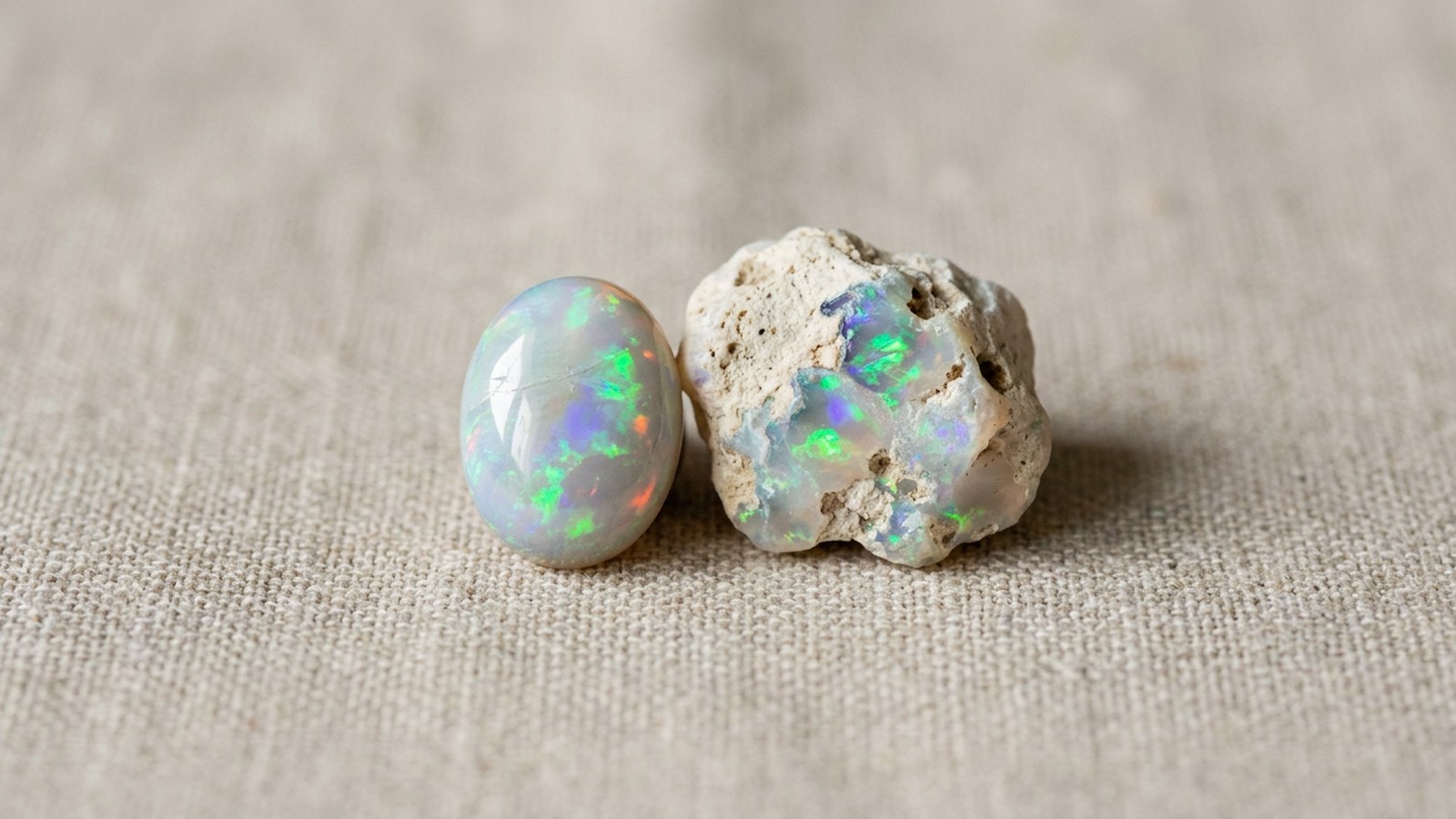
The first time I set an opal and a tourmaline side by side on my worktable, I did it for a practical reason. A friend born in late October wanted one piece of jewellery that carried both of her birthstones, and she had brought me a small white Australian opal from her mother and a pink tourmaline she had bought on holiday. Under the lamp the opal kept changing, flashing green and violet as I tilted it, while the tourmaline held one steady, saturated pink from every angle. They looked like two different answers to the same question about colour, and that turned out to be the best way I know to explain the pair.
In this guide I go through why October has two birthstones at all, what each stone really is, what crystal tradition says the combination brings, which tourmaline colour I would pair with which kind of opal, and the setting and care rules that keep the softer stone safe. I also answer the questions people ask most about the duo, including whether one is better than the other.
Opal and tourmaline in short
Opal and tourmaline are the two birthstones of October. Opal is the traditional stone and tourmaline the modern alternative, added to the American jewellers' list in 1912 and later specified as pink tourmaline. Opal is a soft, water-bearing silica (Mohs 5 to 6.5) famous for its shifting play-of-colour, while tourmaline is a hard borosilicate crystal (Mohs 7 to 7.5) found in almost every colour. In crystal tradition the opal is read as an amplifier of feeling and imagination and the tourmaline as a steadying, protective stone, so the pair is usually worn for creativity with a sense of ground under it.
Why October has two birthstones
For most of the nineteenth century opal stood alone for October, and its reputation went through a strange dip. In 1829 Sir Walter Scott published Anne of Geierstein, in which an enchanted opal belonging to the Lady Hermione loses its fire when touched by holy water and its owner dies soon after. Readers took the story to heart, and the novel is often blamed for a long slump in opal sales in Europe. Queen Victoria, who loved the stone and gave opal jewellery to her daughters, did a great deal to restore its name, and the opening of the Australian fields later in the century brought fine opal back into every jeweller's window.
When the National Association of Jewelers met in Kansas City in 1912 and drew up the standard American birthstone list, they kept opal for October and offered tourmaline as an alternative. Part of the reasoning was commercial: the list favoured transparent gems that could be faceted and set in quantity, and opal can be fragile at the bench. A later revision in 1952 named pink tourmaline specifically, which is why so many October pieces today use pink. You can see both stones, along with the red rubellite variety, on our October birthstone page.
So the honest answer to "why two?" is a mix of superstition, trade practice and taste. Many people born in October simply wear both.
Two stones that share almost nothing
What I find lovely about this pair is how differently the two stones are built. Opal is not a crystal at all. It is hydrated silica, SiO2 with water locked inside, usually somewhere between 3 and 10 percent by weight. It forms when silica-rich water seeps into cracks and cavities in rock and slowly settles out as a gel. In precious opal the silica settles as tiny spheres, roughly 150 to 300 nanometres across, stacked in orderly rows. Light diffracts through those rows and breaks into the flashes we call play-of-colour. Australia supplies most of the world's precious opal, with black opal from Lightning Ridge and boulder opal from Queensland, and Ethiopia and Mexico are the other big sources. You can read more on its lore in my opal meaning guide.
Tourmaline is the opposite kind of material: a well-ordered crystal from a large family of boron silicates, growing as long striated prisms with a rounded triangular cross-section. It forms mostly in granite pegmatites, where the last, boron-rich fluids of a cooling magma give it room to grow. Its colour comes from trace elements, with iron giving black schorl, manganese giving pink and red, chromium and vanadium giving chrome green and copper giving the neon blues of Paraíba. Brazil's Minas Gerais is the classic source, along with Afghanistan, Nigeria, Mozambique, Madagascar, Maine and California. The tourmaline meaning guide walks through each colour.
| Opal | Tourmaline | |
|---|---|---|
| Mineral nature | Hydrated amorphous silica | Crystalline borosilicate (trigonal) |
| Mohs hardness | 5 to 6.5 | 7 to 7.5 |
| Source of colour | Diffraction from silica spheres | Trace elements (Fe, Mn, Cr, Cu) |
| Name | Sanskrit upala, Latin opalus | Sinhalese toramalli, "mixed stone" |
| Main sources | Australia, Ethiopia, Mexico | Brazil, Africa, Afghanistan, USA |
| Heat | Can craze or crack | Can fracture or change colour |
| Anniversary | 14th | 8th |
| Role in tradition | Amplifier, imagination, feeling | Grounding, protection, love (by colour) |
What wearing opal and tourmaline together is said to bring
In the crystal tradition I work in, opal is the stone that turns things up. It is read as an amplifier of whatever you bring to it, which is why people reach for it in creative seasons and why some practitioners warn that it can heighten a low mood as easily as a bright one. Ancient Greek writers credited it with foresight, and medieval Europe saw it as holding the virtues of every coloured gem at once.
Tourmaline carries a steadier reputation. Each colour has its own reading: black for protection and grounding, pink for compassion and the heart chakra, green for vitality and courage. The common thread is stability. There is even a physical curiosity behind its old nickname: tourmaline is pyroelectric, so a crystal warmed in the hand or the sun develops an electric charge at its ends and can pull in dust. Dutch traders in the eighteenth century used it to draw ash out of their pipes and called it aschentrekker, the ash puller.
Put together, the pair is usually described as imagination with a floor under it. My own experience is quieter than the jewellery blogs suggest: I like holding an opal while I write and keeping a tourmaline in my pocket on days I expect to be scattered, and the two feel like a reminder to dream and then come back to the task. Please treat all of this as tradition and personal intuition. Neither stone treats anxiety, mood or any physical condition, and if you are struggling, a qualified person is the right first call.
Which tourmaline suits which opal
Since both stones come in many colours, the real choice is about which pair you put together. These are the four combinations I return to most.
White or crystal opal with pink tourmaline
This is the classic October pairing and the gentlest. A white or crystal opal with soft blue and green flashes sits beautifully next to a pale to medium pink tourmaline, and the pink picks up any pink fire in the opal. In tradition it reads as a heart pair, opal's openness with tourmaline's compassion, which makes it a thoughtful gift for someone going through a tender season. See also crystals for love.
Fire opal with black tourmaline
Mexican fire opal, orange to red and often without much play-of-colour, is linked to the sacral chakra and to warmth and creative drive. Black tourmaline, the schorl covered in my black tourmaline guide, brings the root chakra and a protective reading. I use this pair for creative work that has a deadline, the spark plus the follow-through. It also looks striking in oxidised silver.
Boulder or black opal with green tourmaline
Boulder opal keeps its ironstone backing, so its colour sits on dark brown, and black opal shows its fire against a dark body. Both look superb with a deep green or chrome tourmaline, and the pairing has a woodland, autumnal feel. Traditionally it combines opal's creativity with green tourmaline's stamina.
Ethiopian opal with watermelon or rubellite
Ethiopian Welo opal often shows bright, broad flashes on a honey or white body, and a slice of watermelon tourmaline (pink centre, green rim) or a red rubellite gives it a confident partner. This is the most expressive of the four. Read the care section first, because Ethiopian opal has a particular weakness.
How to wear them together without damaging the opal
Most October jewellery guides leave out the physical side of the pairing. Tourmaline at Mohs 7 to 7.5 will scratch opal at 5 to 6.5. If you string the two as alternating beads on one bracelet, every movement of your wrist rubs harder stone against softer, and within months the opal beads lose their polish and the play-of-colour looks dull. The same happens if you drop an opal ring and a tourmaline pendant loose in one pouch.
A few habits avoid all of that:
- Set the opal in a bezel. A metal rim around the opal protects its edge from knocks, and the tourmaline can sit in claws beside it without touching.
- Keep them on separate strands or pieces. A stacked pair of bracelets or a pendant and earrings work better than one mixed strand.
- Store them apart. Use separate soft pouches or compartments. My crystal storage guide explains why harder stones should never share a box with softer ones.
- Save opal rings for gentle days. Tourmaline is happy on an everyday ring; opal is better kept for days without gardening, gym work or washing up.
Cleansing and care for both stones
Care is where the opal sets the rules, because anything safe for opal is safe for tourmaline, while the reverse is not true.
Clean both with lukewarm water, a drop of mild soap and a soft brush, then dry them straight away. Avoid ultrasonic and steam cleaners for both: they can crack opal and can open the tiny fractures many rubellites and Paraíba tourmalines contain, which are sometimes filled with resin.
For energetic cleansing, skip salt and long soaks. Salt can scratch opal and dull its surface. Opal doublets and triplets, which are thin slices of opal glued to a backing and often capped with quartz, can delaminate if left in water. Ethiopian Welo opal is hydrophane, meaning it absorbs water: it can turn temporarily transparent and lose its fire while wet, and it will soak up oils, lotions and dyes and discolour. My crystals and water safety guide covers this in detail. Smoke, sound or moonlight are the gentle options I use for both; you will find each method in my guide to cleansing crystals.
Keep both away from heat. Opal can craze, developing fine surface cracks as it loses water, if it dries too quickly on a sunny windowsill or near a radiator. Tourmaline can fracture or shift colour under strong heat.
Fakes and look-alikes on both sides
Because both stones are popular for October jewellery, both are imitated. On the opal side, look out for lab-grown Gilson opal, which has a regular, snakeskin-like colour pattern under magnification, and for plastic or resin imitations, which feel warm and light. Opalite is a man-made glass, which I explain in opalite vs moonstone. Doublets and triplets are honest products when sold as such, so check the side of the stone for a glue line. If you are torn between opal and its pale cousin, moonstone vs opal may help.
On the tourmaline side, glass is the usual imitation in cheap beads, and red tourmaline is still sold as ruby; my rubellite vs ruby guide covers the checks. Very bright pink beads at very low prices are often dyed quartz.
If you only choose one
People often ask which October stone is better. For a ring you will wear every day, tourmaline is the more practical choice because it is harder and less sensitive to water and knocks. For a pendant or earrings that see less wear, opal gives you a moving, living colour that no other gem quite matches. In tradition, choose opal if you want to open up and tourmaline if you want to settle. If you are buying for someone else, I would go with the colour they already wear.
A last word
I still have a photo of my friend's finished pendant: the white opal in a gold bezel, the pink tourmaline in two small claws below it, never quite touching. It sums up how I think about the pair. The two stones share a month and a love of colour, and they last for decades when you give the softer one a little room. If you were born in October, I hope you get to enjoy both.