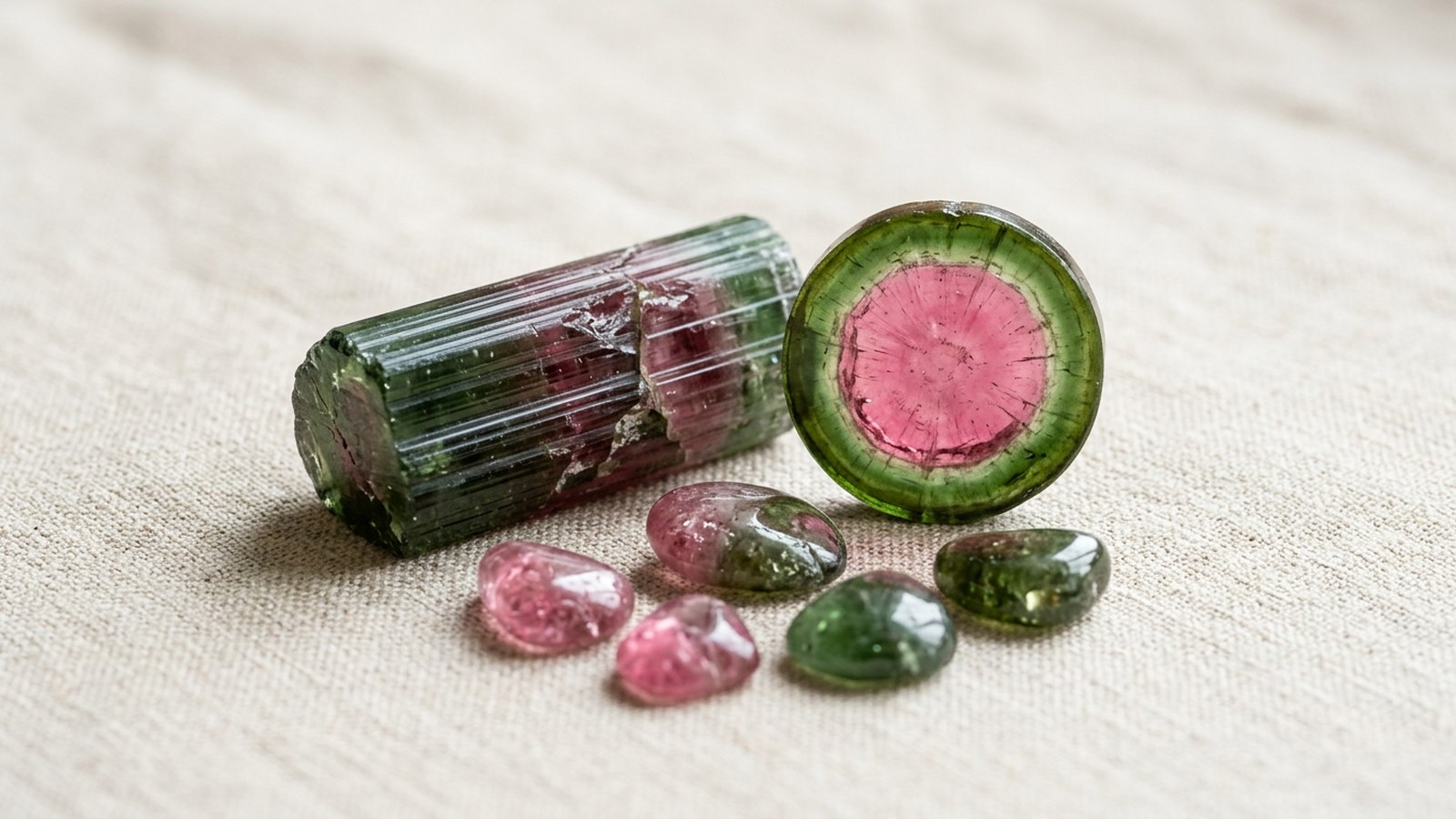
The first tourmaline I ever bought was a thin slice from Madagascar, no bigger than a coin, polished on both faces. Held up to a window it showed a pink centre, a pale ring around it, then a band of green at the edge, laid out in a rounded triangle that echoed the shape of the crystal it was cut from. I kept turning it in my hand, because a single stone that holds several colours at once is rare, and this one seemed to record its own growth like the rings of a tree.
That slice is a good way into the whole subject. Tourmaline is a family of minerals that comes in nearly every colour, and in crystal tradition each colour carries a slightly different meaning while sharing one common thread, which is protection paired with balance. This guide covers what tourmaline is said to mean, colour by colour, what the real geology says, where the stone has travelled through history, what it can honestly protect you from, and how to care for it.
What is the spiritual meaning of tourmaline? The short answer
In crystal tradition, tourmaline is a stone of protection, grounding and emotional balance. Black tourmaline is used to shield and ground, pink tourmaline to open the heart, green tourmaline for growth and vitality, and blue tourmaline for calm communication. It is linked to the root, heart and throat chakras depending on its colour, to the zodiac sign Libra, and it is a birthstone for October, alongside opal.
Reasons to work with tourmaline
Tourmaline is a steadying companion for anyone who absorbs the moods around them. If you leave a crowded office or a tense family meal feeling like you carried home other people's worries, the tradition offers black tourmaline as a stone that holds the line between what is yours and what is not. I keep a rough schorl crystal by my front door for exactly that reason, as a small cue to put the day down when I come in.
Tourmaline is a gentle stone for a heart that has closed a little. Pink tourmaline is traditionally given after a breakup, a loss or a long stretch of looking after others, as a reminder to extend some of that care back to yourself. It pairs well with the practices in our guide to crystals for self-love.
Tourmaline is often chosen during a change of direction. Green tourmaline is associated with growth, patience and fresh energy, which makes it a common pocket stone for a new job, a move or a garden project you keep postponing.
Tourmaline is a stone for people who want several things at once, and the watermelon and multicoloured pieces carry that idea most clearly. Crystal workers read them as stones of integration, holding protection, tenderness and growth in one piece.
Tourmaline meaning by colour
Because tourmaline is a group of related minerals, its meaning shifts with its colour. Here is how the tradition reads the main varieties.
Black tourmaline (schorl). The most common tourmaline and the best known in crystal practice, linked to protection and grounding at the root chakra. It has its own full guide in our black tourmaline meaning, and it is often confused with obsidian, which we untangle in black tourmaline vs obsidian.
Pink and red tourmaline (rubellite). Associated with love, compassion and emotional recovery at the heart chakra. Paler pink stones are read as soft and nurturing, the deeper raspberry rubellites as warmer and more passionate. It sits naturally beside rose quartz and kunzite.
Green tourmaline (verdelite). Linked to vitality, growth and a calm kind of courage, also at the heart chakra. Some deep green stones coloured by chromium or vanadium (chrome tourmaline) can look strikingly like emerald.
Blue tourmaline (indicolite). The rarest of the common colours, associated with honest speech and a quiet mind at the throat chakra.
Watermelon tourmaline. A pink core with a green rind, traditionally used to bring the heart and the will into agreement. It is a favourite for meditation because the colour change is so easy to focus on.
Paraíba tourmaline. A neon blue to green tourmaline coloured by copper, first found in Brazil in the 1980s. It is a collector's gem with prices to match, and in crystal practice it is read as a stone of clear expression and joy.
Tourmaline healing energy
Emotional healing. Tourmaline is traditionally used to ease fear and the sense of being scattered, replacing it with a steadier feeling of standing on your own two feet. Pink and watermelon pieces are the usual choice for grief and tenderness.
Spiritual healing. In energy work tourmaline is described as a stone that clears and organises, often placed at the start or end of a meditation to mark a boundary around the practice. Black tourmaline is a classic anchor in protective grids.
Mental healing. Many people use green or blue tourmaline as a focus stone during study or writing, a small object to hold when the mind starts to jump between tasks.
Physical healing. Folk practice links tourmaline to circulation, stamina and restful sleep. These are traditional associations and personal experience only, and no stone replaces medical care. If something in your body worries you, please see a doctor.
Tourmaline at a glance
- Chakras: root (black), heart (pink, green, watermelon), throat (blue)
- Zodiac sign: Libra, with Scorpio and Virgo often added
- Element: Earth and Water
- Numerical vibration: 2 (some sources give 8)
- Birthstone: October, with opal
- Affirmation: "I am protected, balanced and open to what helps me grow."
What does tourmaline protect against?
In the crystal tradition, tourmaline protects against negative energy: the heavy atmosphere after an argument, the drain of a crowded place, your own spiralling thoughts. That is a symbolic and personal kind of protection, and it is how I use it.
You will also read that tourmaline blocks electromagnetic fields from phones and routers, or that it fills a room with negative ions. I want to be straightforward here. Tourmaline is genuinely pyroelectric and piezoelectric, meaning a crystal develops a small electric charge when it is warmed, cooled or squeezed. The charge is tiny and fades as soon as the temperature settles. A stone on a desk does not absorb or block the radio waves from your devices, and the health claims made for ionising tourmaline products are not supported by good evidence. If you value black tourmaline near your screens as a reminder to take breaks, that is a perfectly good use.
Tourmaline geology
Tourmaline is a group of complex borosilicate minerals that share one crystal structure. The International Mineralogical Association recognises more than thirty species, and three matter most to crystal lovers: schorl (iron rich, black), elbaite (lithium rich, the source of most pink, green, blue and watermelon gems) and dravite (magnesium rich, brown to yellow). The group's general formula is XY3Z6(T6O18)(BO3)3V3W, a shorthand for how many different elements can swap into the same frame. Elbaite, for example, is roughly Na(Li1.5Al1.5)Al6(Si6O18)(BO3)3(OH)4.
Tourmaline crystallises in the trigonal system, as long prisms with grooves running along their length and a rounded triangular cross section. It rates 7 to 7.5 on the Mohs scale, has a specific gravity of about 3.0 to 3.25, and has no useful cleavage, though it can be brittle. Gem tourmaline forms mostly in granite pegmatites, the coarse final pockets of a cooling granite, where it grows alongside quartz, albite, lepidolite and spodumene, the mineral that gives us kunzite. Schorl is common in ordinary granites and metamorphic rocks, and dravite in metamorphosed limestones.
Colour comes from trace elements: manganese for pinks and reds, iron (often with titanium) for greens and blues, copper for the neon Paraíba shades, chromium and vanadium for chrome green. When the chemistry of the surrounding fluid changed while a crystal grew, the colour changed with it, which is how bicolour and watermelon crystals form. Tourmaline is also strongly pleochroic: looking down the length of a crystal you often see a darker, more saturated colour than from the side. If you are choosing a green stone, turn it slowly under a lamp and you will see this for yourself.
The name comes from the Sinhalese word turmali, usually translated as "mixed stones", the term used in Sri Lanka for the assorted coloured gem pebbles found in its river gravels.
Tourmaline history and lore
Dutch traders brought those Sri Lankan pebbles to Europe around the turn of the eighteenth century, and noticed something odd. A warm crystal left near a pipe would pull in the ash, so they called it aschentrekker, the ash puller, and reportedly used it to clean their meerschaum pipes. In 1747 Carl Linnaeus described it as lapis electricus, the electric stone, and in 1880 Pierre and Jacques Curie included tourmaline among the crystals they used to demonstrate piezoelectricity.
Before tourmaline was recognised as its own mineral in the early nineteenth century, it was routinely mistaken for other gems. Green crystals found by Spanish explorers in Brazil in the sixteenth century were taken for emeralds, and the famous Caesar's Ruby, a pendant once owned by Catherine the Great and kept with the Russian treasures, turned out to be rubellite.
In the United States, two young men, Elijah Hamlin and Ezekiel Holmes, found green tourmaline at Mount Mica in Maine in 1820, and it is now Maine's state mineral. Later in the century, California's pegmatites, especially the Himalaya Mine in San Diego County, shipped pink tourmaline to China, where the Empress Dowager Cixi treasured it for carvings and ornaments. When the Qing dynasty fell in 1912, that trade collapsed almost overnight. The modern chapter belongs to Paraíba, where Heitor Dimas Barbosa's years of digging produced the first copper-bearing tourmaline, which reached the gem market in 1989 and changed what people thought a tourmaline could look like. In 1952 the Jewelry Industry Council of America added tourmaline as a birthstone for October, beside opal.
Who should wear tourmaline?
In Western crystal practice, anyone drawn to it can wear tourmaline, and October birthdays and Libras often receive it as a gift. People who feel easily drained, sensitive people working in busy jobs, and anyone recovering from heartbreak tend to reach for it first. Some modern Vedic practitioners treat tourmaline as a substitute stone tied to a particular planet and recommend consulting your chart before wearing it. If that tradition matters to you, ask a practitioner you trust.
Where tourmaline comes from and how to care for it
Brazil is the largest source of gem tourmaline, with major deposits in Minas Gerais and the famous Paraíba finds. Madagascar, Afghanistan, Pakistan, Nigeria, Mozambique, Sri Lanka, Namibia and the United States (California and Maine) also produce fine material, and schorl turns up almost everywhere. The key data are summarised on our tourmaline stone page.
Much gem tourmaline is untreated, but heating to lighten very dark greens or remove a purple tone, irradiation to deepen pinks, and fracture filling in heavily included rubellite are all common. Ask the seller, and see our guide on how to tell if a crystal is real for broader checks.
For care, wash tourmaline in warm soapy water and dry it with a soft cloth. Avoid ultrasonic cleaners and steamers, especially with included or filled stones, and avoid sudden temperature changes, which can crack a stressed crystal. A short rinse is fine, as covered in crystals and water safety. One practical quirk: because it is pyroelectric, a tourmaline sitting under a warm display light will gather dust faster than the stones around it. For energetic cleansing, smoke, sound or a night beside a selenite plate all suit it, and our cleansing crystals guide goes through each method.
A closing thought
My Madagascar slice still lives on my desk, and I think of it as a small lesson in holding several things at once: a boundary on the outside, softness at the centre, and room to keep growing. If you are new to tourmaline, start with the colour that answers what you need right now. Black tends to suit a need for steadiness, pink a need for tenderness and green a wish to grow. If you want a companion, pair black tourmaline with smoky quartz for grounding or with amethyst for calm, and browse more crystals for protection when you are ready.