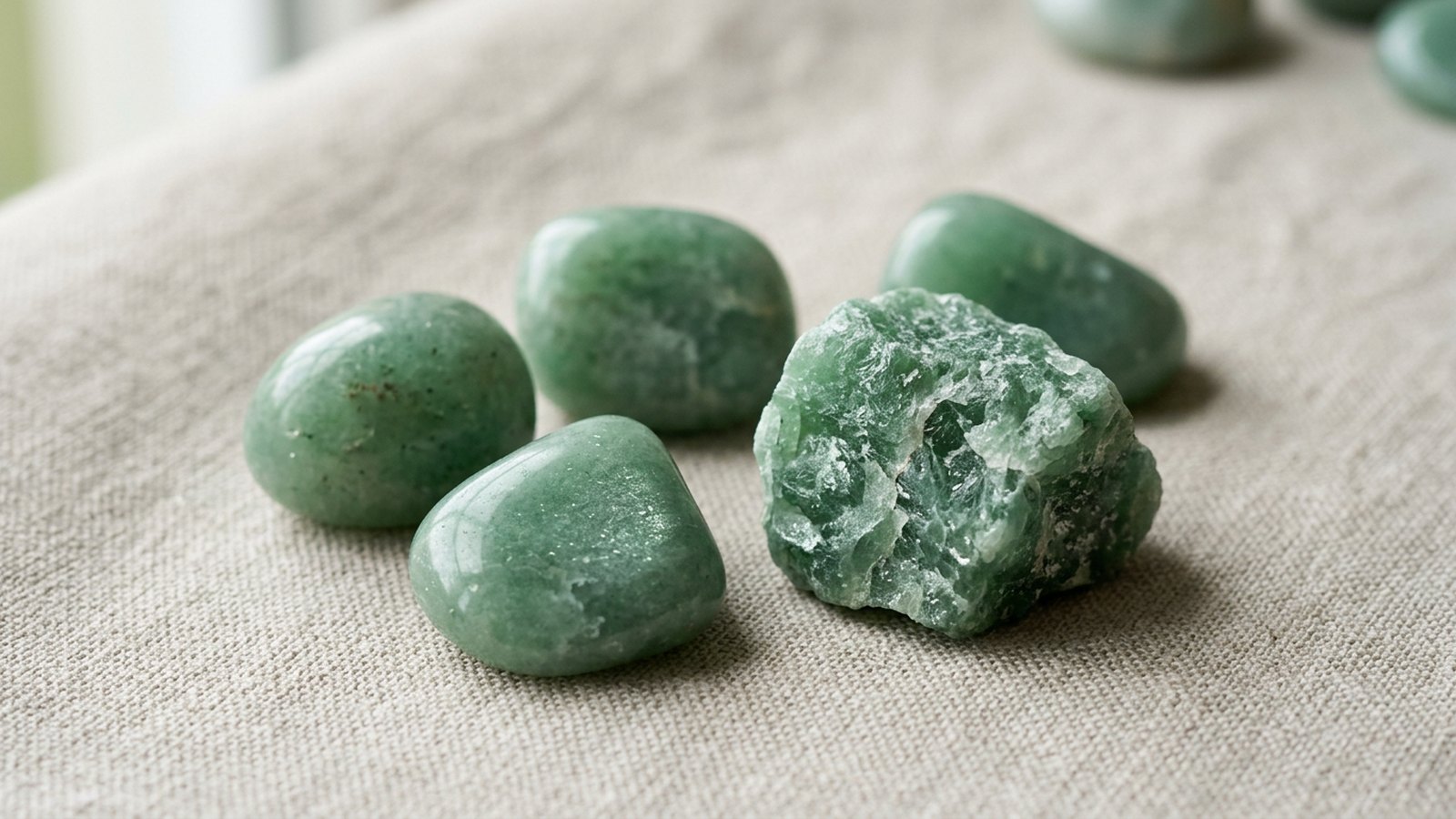
Someone asks me this almost every month, usually holding two bracelets and looking slightly guilty. They have read somewhere that green aventurine and quartz should never be combined, that the two cancel each other out, and now the pink beads live in one drawer and the green beads in another. It is one of the few crystal rules I will argue with directly, because in this particular case the mineralogy settles it.
Rose quartz and green aventurine are the pink and green of the same chakra, and they are also, quite literally, the same mineral wearing two different coats. Put them on the same wrist and nothing clashes, nothing grinds, nothing needs to be kept apart.
What follows is what the pair is genuinely good for, how I wear and place them, the one situation where I think the combination does very little, and what to look at before you buy either one. The short version: yes, wear them together.
The Short Answer, and Why the Rock Backs It Up
Yes, you can wear rose quartz and green aventurine together. There is no traditional prohibition on the pair, and there is no physical one either.
Here is the part that gets left out of almost every article on this combination. Green aventurine is not a separate mineral from quartz. It is quartz, in its massive granular form, carrying flecks of mica. The green comes from fuchsite, a chromium-rich variety of muscovite, and the faint glitter you see when you tilt a good piece toward a lamp is light bouncing off those platy mica inclusions. That shimmer has a name, aventurescence, and it is the whole reason the stone is collected.
Rose quartz is the same silicon dioxide, massive rather than in visible crystals, tinted by microscopic pink nanofibres of a borosilicate related to dumortierite. Two researchers at Caltech worked that out in 2001, and it explains why rose quartz is almost never transparent: the fibres scatter the light.
So both stones sit at 7 on the Mohs scale. Neither can scratch the other. Strung on one strand, they wear at the same rate, which is not something I can say about most pairs people ask me to put together. I made the same argument at more length in the guide on rose quartz and clear quartz, and it holds here for the same reason: stones from one mineral family are the easiest companions you will ever own.
What Each Stone Brings on Its Own
Rose Quartz
Rose quartz is the stone of unconditional love, and I think the emphasis usually lands on the wrong word. It is not romance. It is the unconditional part, the softening of the running commentary you keep about yourself. Traditionally it is worked with for grief, for reconciliation, for the long unglamorous business of forgiving someone, including yourself.
It belongs to the heart chakra and to Taurus and Libra, and it is the first stone I hand anyone starting on self-love. It is gentle to the point of being easy to dismiss. That gentleness is why it pairs with almost anything.
Green Aventurine
Green aventurine is called the stone of opportunity, and in the traditions I have read it is less about luck arriving than about being in a state to say yes when it does. It is the stone of the calm nerve: the job application sent, the conversation started, the small risk taken without the stomach drop.
It shares the heart chakra with rose quartz, which surprises people who expect green to mean money. In the older correspondences the heart is where courage lives, not just affection, and aventurine sits on that side of it. It is a mainstay of both good luck and abundance work, and it is the stone I would reach for over jade if I wanted movement rather than steadiness, a distinction I unpack in aventurine vs jade.
What the Pair Does That Neither Does Alone
Worked together, the two cover the two halves of the same chakra. Rose quartz handles the inward side, how you treat yourself, what you will tolerate, how quickly you recover from a knock. Green aventurine handles the outward side, what you are willing to attempt.
That combination is genuinely useful in a specific situation, and it is worth naming rather than leaving vague. It is for the person whose confidence problem is not really a confidence problem. If you do not apply for the thing because some part of you has already decided you would not get it, aventurine alone tends to bounce off. The obstacle is self-regard, not opportunity. Rose quartz works on the first, aventurine on the second, and the pair is a reasonable answer to "I want to try, and I am afraid of how I will talk to myself if it fails."
I should be honest about the register here. These are traditional correspondences and my own experience of working with the stones, not mechanisms. A crystal will not find you work or mend a relationship, and nothing in this pairing replaces proper support when something serious is going on. What a stone in your pocket can genuinely do is keep an intention in front of you through a day that would otherwise bury it. That is not nothing, but it is worth being clear about what it is.
The One Place This Pairing Actually Goes Wrong
The risk is not energetic. It is that you blur the intention.
When people program a stone, they tend to program the set rather than each piece, and with this pair the two intentions genuinely pull in different directions. "Be kinder to myself" and "put myself forward" are not the same instruction. Hold them as one and you get a vague warm feeling about improvement, which is the crystal equivalent of a resolution made on the first of January.
So I set them separately. Rose quartz gets the inward sentence, aventurine gets the outward one, and I say both, in that order, when I put the bracelet on. If you only want one thing at the moment, wear one stone. A pair carried without a reason is just jewellery, and I would rather say that plainly than sell you a duo.
The other honest caveat: if you are in acute grief, I would leave the aventurine off for a while. The push to act is not what that period needs. Rose quartz on its own, or the stones in the grief guide, will serve you better.
How to Wear and Place Them
On a bracelet
This is the most common form the pair takes, and it is the easiest, because equal hardness means you can alternate the beads on a single strand without the softer stone going dull. Most pairs cannot do that. If you want the stones to work on what you receive, tradition puts them on the left wrist; for what you put out into the world, the right. I go through the reasoning in which hand to wear a crystal bracelet. With this particular pair I wear the pink left and the green right when I have two separate bracelets, which matches how the two intentions actually divide.
In meditation
One stone in each hand, rose quartz in the left, aventurine in the right, palms up. Five minutes is plenty. I spend the first half simply noticing the difference in how the two feel, because they do feel different, the aventurine slightly cooler and denser in the hand, and the second half on the two sentences. It is a small practice and it survives being done badly.
Around the house
Rose quartz belongs in the bedroom or wherever the household actually talks to each other. Green aventurine belongs where decisions get made, so a desk, a hallway table by the door, a wallet. Placing them in the same spot tends to waste one of them. If you want a single arrangement that holds both, a simple heart chakra layout with the pair opposite each other works well; there is a beginner's version in crystal grids for beginners, and more on siting in where to place crystals in your home.
Cleansing, Charging, and the Windowsill Problem
Both stones are quartz, so both tolerate a quick rinse under running water and a dry with a soft cloth. Two cautions. Green aventurine's fuchsite seams are mica, which sits around 2.5 to 3 on the Mohs scale, far softer than the quartz around it. Prolonged soaking and coarse salt work at those seams, and that is how a piece loses its shimmer or chips along a plane. A short rinse, not a bath. More detail in crystals and water safety.
The second is the sunny windowsill, which is the single most common mistake made with this pair. Rose quartz fades in direct sunlight. Not over years, over a few enthusiastic summers, and the pink does not come back. Leave the pair on a south-facing sill to charge and you will return to a good green stone and a pale grey one.
Moonlight, indirect daylight, a night on a selenite plate, or simply setting your intention again all work without costing you the colour. The methods are laid out in cleansing crystals and how to charge crystals.
There is one useful side effect of this. Genuine fuchsite green is chromium colouring inside the mineral and it does not budge in sunlight. Dyed green quartzite does. If a green stone pales on a sill over a season, it was dyed.
Buying the Pair: Fuchsite, Dye and Venetian Glass
Green aventurine is one of the more heavily imitated stones on the market, and there is a neat historical reason why. The word aventurine does not come from the mineral at all. It comes from Venetian glass. Sometime in the seventeenth century a Murano glassmaker dropped copper filings into a melt by accident and produced a spangled glass that was named avventurina, from a ventura, meaning by chance. The glass came first. The mineral was named after it because it looked similar. Green glass sold as aventurine is not a modern fraud so much as the original article reasserting itself.
Three checks, in order of usefulness. Look for bubbles with a loupe, because glass traps them and quartzite does not. Look at how the sparkle is distributed: real aventurescence is uneven and directional, appearing and vanishing as you tilt the stone, while glass glitters evenly from every angle. And press it to your cheek, since quartzite stays cool noticeably longer than glass.
Dyed quartzite is the subtler fake. Look into a drill hole or a chip, where dye concentrates and the colour sits darker than on the polished face. For rose quartz, the thing to be wary of is not fakery so much as heavy dyeing on very pale material; genuine rose quartz is usually cloudy, and glassy uniform pink is a flag. The general method is in how to tell if a crystal is real.
For what it is worth, most green aventurine on the market comes from India, chiefly Karnataka, with Brazil, Chile and Russia also producing. Rose quartz comes largely from Brazil, Madagascar and South Africa. Neither is rare, so neither should be expensive, and a high price is not evidence of quality in either one.
A Last Word
If you came here because you read that these two should be kept apart, I hope the fuchsite settles it. A stone made of quartz and a stone made of quartz are not going to fight.
Wear them together, give each one its own sentence, keep them off the hot sill, and let the pair do what it is actually good at: making the kind thing and the brave thing possible on the same day. If you want to go further into either one, the full monographs on rose quartz and green aventurine are the place to start, and what crystals should not be together covers the pairs where the caution genuinely is warranted.