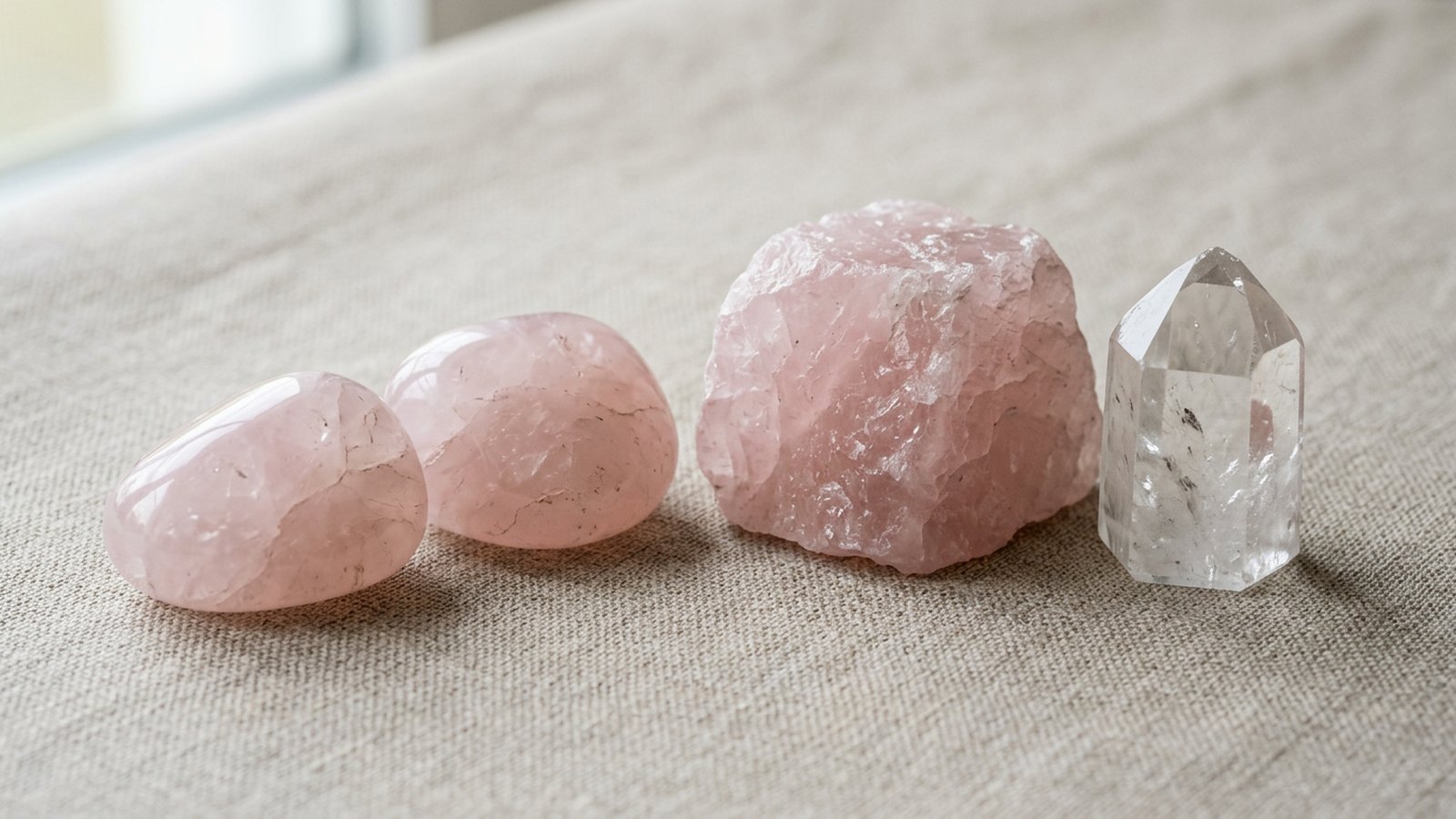
The first two stones I ever owned were a lump of rose quartz the size of a plum and a clear quartz point with a chip off one edge. I did not choose them, they were a gift, and for a long time I assumed they were a beginner's set the way a starter kit of paints is a beginner's set: two colours, picked at random.
They are not random. They are the same mineral. Rose quartz and clear quartz are both silicon dioxide, both hardness 7, both grown in the same kind of rock, and the only real difference between the pink one and the clear one is a trace of something else that got caught inside while they were forming.
That single fact answers most of what people want to know about this pair. It explains why they look so different, why they can be worn and stored together without any of the usual worries, why one of them is a cloudy chunk and the other a sharp point, and it explains the one thing you genuinely should not do with them, which nobody seems to mention.
The short answer
Rose quartz and clear quartz work well together because they are the same mineral doing two different jobs. Rose quartz is the traditional stone of the heart, gentle and slow, and clear quartz is the traditional amplifier, sharp and directional. Physically they are identical in hardness and chemistry, so they can be tumbled in one pouch, strung on one bracelet or set in one grid with no risk of one damaging the other. The one asymmetry that matters is light: a clear quartz point is indifferent to sunlight, and pink quartz is not.
One mineral, two habits
Quartz is silicon dioxide, SiO2, trigonal, hardness 7 on the Mohs scale, with no cleavage and a conchoidal fracture. Every word of that applies to both stones on your shelf. What differs is what mineralogists call habit, meaning the shape the mineral takes as it grows, and what got trapped inside it.
Clear quartz, properly called rock crystal, grows freely into six sided prisms with a pointed termination when it has room and time. That shape is the mineral's own geometry made visible. When the crystal is free of colour centres and inclusions, light passes straight through, and you get the glassy transparency the stone is named for.
Rose quartz almost never does this. It forms in massive lumps inside pegmatites, cloudy and without faces, and its pink comes from something added. In 2001, Julia Goreva, Chi Ma and George Rossman at Caltech published the answer in American Mineralogist: massive rose quartz is full of nanoscopic fibres of a borosilicate mineral closely related to dumortierite, far too small to see, and the pink is produced by iron and titanium sitting next to each other in those fibres, absorbing light around 500 nanometres. The cloudiness and the colour have the same cause. That is why you rarely see a rose quartz point that was not cut on a wheel.
There is a rarer thing called pink quartz, which does form real crystals, mostly from Minas Gerais in Brazil and from the pegmatites around Rumford in Maine. Its colour comes from a different mechanism entirely, and it behaves differently in light. Hold that thought, because it becomes the practical rule further down.
The two stones also come from overlapping places, which is part of why they are sold side by side so often. Most rose quartz on the market is Brazilian, from the pegmatite belt of Minas Gerais, with significant material out of Madagascar, Namaqualand in South Africa, and India. Clear quartz comes from Brazil and Madagascar too, alongside the famous Arkansas points from around Mount Ida and Hot Springs, and the Alpine crystal pockets that European collectors have worked for centuries. When you buy a matched pink and clear set, there is a fair chance both halves left the ground within a few hundred kilometres of each other.
Telling them apart in five seconds
| Rose quartz | Clear quartz | |
|---|---|---|
| Usual form | Massive lumps, carved shapes, tumbles | Natural six sided points, clusters, cut towers |
| Look | Translucent to milky, pink, no visible crystal faces | Transparent to milky, colourless, often with internal veils |
| Colour cause | Dumortierite-like nanofibres, Fe and Ti | None, colour appears only with other impurities |
| Hardness | 7 | 7 |
| Traditional role | Heart, tenderness, self-worth | Clarity, amplification, direction |
| Chakra | Heart | Crown, and all of them |
If a seller offers you a sharply terminated natural point in solid pink at a low price, it is either cut from massive material, which is fine and normal, or it is glass, which is not. Glass gives itself away by warmth in the hand and by tiny round bubbles inside.
What the pair is actually for
I want to be plain about the framing here. Everything that follows is tradition and my own experience of sitting with these stones. It is not a measured effect, and it is not a substitute for care you might need from a person.
When you are trying to be kinder to yourself
This is the pairing's home ground. Rose quartz is the stone people reach for when the voice in their head has gone sour, and its gift is slowness. It does not argue with you. The trouble with slow is that it can be so soft you stop noticing it. Adding clear quartz is traditionally said to give that softness a direction, the way a lens gives diffuse light a focus. If you work with self-love as an intention, this is the pair I would start with.
When a relationship needs clarity, not more feeling
The second use is almost the opposite. Sometimes what a situation lacks is not tenderness but honesty, and rose quartz on its own can encourage you to stay soft past the point where softness helps. Here the clear quartz is doing the harder work, and the rose quartz keeps it from turning cold. I find this combination useful before a conversation I have been avoiding, one stone in each hand, which is also the arrangement most of the crystals for love tradition assumes without saying so.
When you are setting an intention you actually care about
Clear quartz is the stone most associated with holding a programmed intention, and rose quartz supplies the reason you want it. Pairing them is common in manifestation practice for exactly that reason: the clear stone carries the sentence, the pink one carries the warmth behind it. If that is your use, it is worth reading how to program an intention properly first, because the pair does nothing that your own attention does not do.
Five ways to use them together
-
Two hands. Rose quartz in the left, clear quartz in the right, sitting for five to ten minutes. The traditional reading is that the left receives and the right directs. You do not have to believe the polarity for the gesture to work on you.
-
One bracelet. Alternating pink and clear beads is the most common form this pair takes, and it is a genuinely safe one because the beads are the same hardness and cannot wear each other down. Elastic, not the stones, is what fails first. Replace the cord yearly.
-
A simple grid. Rose quartz in the centre, four or six clear quartz points aimed inward around it. This is the standard arrangement in crystal grid practice, and it is the one place where the amplifier framing earns its keep, because the geometry does the explaining.
-
The bedside pair. Rose quartz on the side of the bed you sleep on, clear quartz on the far corner of the nightstand. Some people find clear quartz too activating by the pillow. If your sleep gets lighter after adding it, move the clear one across the room and keep the pink one close.
-
The pocket set. Both tumbled, both in the same pocket. Nothing is required of you beyond the reminder they give when your fingers find them, which, honestly, is most of what carrying a stone does.
The one rule about sunlight
The standard advice for recharging crystals is a windowsill and a few hours of sun. For this pair, that advice is not neutral.
Clear quartz does not care. It has no colour to lose, and a rock crystal point can sit in a south facing window for a decade with nothing happening to it.
Rose quartz is more complicated than most articles admit. The massive pink material that makes up almost all of what is sold as rose quartz is reasonably stable, because those dumortierite-like fibres hold their colour under ultraviolet light. But paling has been reported often enough in specific material that I would not gamble a piece I loved on it. And the rarer crystallised pink quartz, the kind that forms real terminated points, is genuinely light sensitive and will fade, sometimes noticeably within a season on a bright sill.
So the rule I use is simple. Charge the clear quartz in sunlight if you like that method. Charge the rose quartz in moonlight or by any of the other methods, and keep it off the windowsill for display. Faded pink does not come back.
Living with the pair
Because they are the same mineral, this is one of the very few combinations with no physical conflict at all. Neither can scratch the other in any meaningful way, which is not true of most pairs people wear together and is the whole reason the what not to store together question exists. There is one small caveat: equal hardness means they can scuff each other's polish if they rattle loose in a bag for months. A soft pouch each, in one box, solves it. There is more on that in the guide to storing crystals.
Both are safe in water. Quartz is hard, has no cleavage and does not dissolve, so a rinse under the tap is fine for either stone, with the usual caution that a piece with a visible crack can split if the temperature changes fast, and that dyed or glued items are a different question, which the note on crystals and water covers. Salt water I would skip for both, since salt creeps into fractures and dulls a polish over time.
You will read that clear quartz never needs cleansing, and that it cleanses everything around it. That is tradition, not mineralogy, and it is worth knowing that the tradition is not old or universal. I cleanse both stones the same way, on the same schedule, because the practice is for me rather than for the rock.
If you can only keep one
Keep the rose quartz if what you are carrying is emotional: a loss, a hard patch with someone, a habit of speaking badly to yourself. Keep the clear quartz if what you need is definition: a decision that will not resolve, a project without an edge, a practice that has gone vague.
If you already own rose quartz and are wondering what to add, clear quartz is the safest possible second stone. If you own clear quartz first, rose quartz will give it something to be about. For a warmer alternative to the clear one, rose quartz and moonstone is gentler, and amethyst and rose quartz is the calmer, more nocturnal version of the same idea.
A last thought
I still have both of those first stones. The point has more chips now and the pink lump has been in more pockets than I can count. What I have come to think, after years of them, is that the pairing is popular not because two energies multiply, but because it gives you the two halves of most problems in your two hands: how you feel about it, and what you are going to do about it. That is a good thing to hold while you work it out.
If you want to place them by chakra, rose quartz sits at the heart and clear quartz at the crown, which is a fair picture of the division of labour. Start there, and let the stones become specific to you.