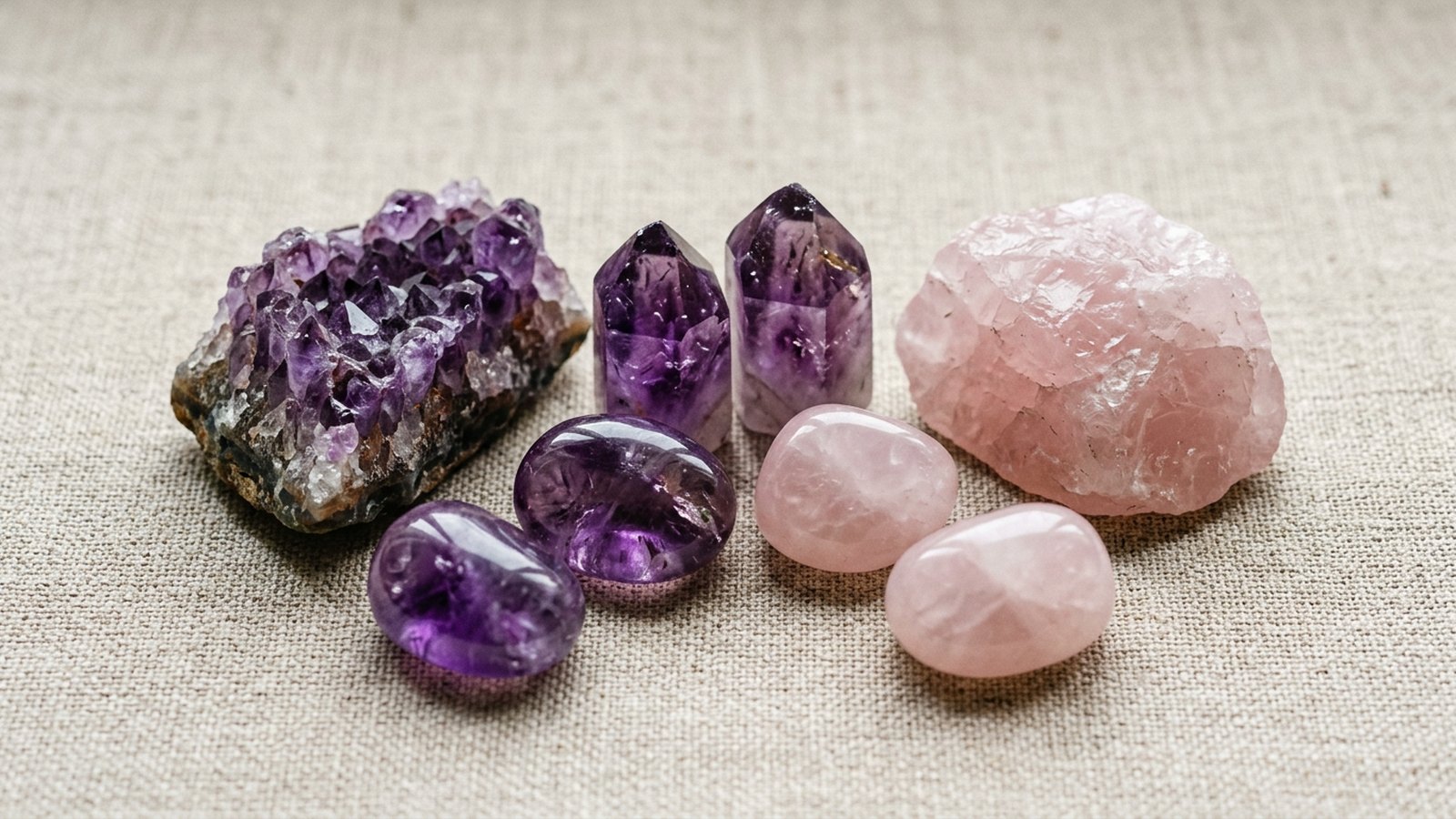
Some crystal pairings were invented by someone who needed a new thing to sell. This one was not. Amethyst and rose quartz together is the combination I see most often in the hands of people who actually use their stones rather than collect them, and there is a good reason for that. It is the pairing of the calm mind and the open heart, and most of us need both at once.
It is also, quietly, the most misunderstood pair on the internet. Nearly every guide will tell you that this is two different energies meeting. They are not two different anything. They are the same mineral wearing two colours, and once you know that, both how to use them and how to look after them get a great deal clearer.
Here is what the pair genuinely does, how I use it, what it will not do for you, and the one piece of care advice that almost every page on this subject gets wrong.
The short answer
Amethyst and rose quartz work well together because they cover different ground without competing. Rose quartz is traditionally the stone of the open heart and self compassion, while amethyst is the stone of the clear and quiet mind. Used together, the pair is reached for to steady the emotions, soften self criticism and calm an anxious head. Both are quartz at 7 on the Mohs scale, so they are also physically safe to wear, carry and store together.
One mineral, two colours
Both stones are silicon dioxide, SiO2, crystallising in the trigonal system at 7 on the Mohs scale. Chemically they are the same mineral. What differs is the reason each one is coloured, and the two reasons are not remotely alike.
Amethyst takes its violet from traces of iron sitting in the quartz lattice, activated by natural radiation from the surrounding rock over a very long stretch of time. That combination produces what mineralogists call colour centres. Hold on to this detail, because it matters later: the purple is a delicate structural effect, not a pigment.
Rose quartz is stranger, and here most crystal pages are simply out of date. You will read almost everywhere that the pink comes from titanium or manganese. Research published in American Mineralogist in 2002 by Chi Ma, Julia Goreva and George Rossman found something else. Massive rose quartz contains microscopic pink fibres, roughly 0.1 to 0.5 micrometres across, and it is those inclusions that make the stone pink. The fibres best match dumortierite, a borosilicate, though the spectra do not line up exactly, so the honest description is a dumortierite-like phase. The team found them in samples from 29 separate localities around the world.
The two also grow in different rooms of the earth. Rose quartz forms in the cores of granitic pegmatites, in massive lumps that almost never take a crystal shape, which is why a raw piece looks like a chunk rather than a point. Amethyst lines cavities in volcanic rock, growing the pointed crystals you see inside a geode. Brazil is the great source of both, from quite different geology.
What each stone brings to the pair
Rose quartz, the open heart
Rose quartz is the stone I reach for when someone is being hard on themselves. Traditionally it belongs to the heart chakra, and its reputation is unconditional love, although I think self compassion is nearer the mark than romance. Most people who buy it hoping it will deliver a partner end up quietly using it on themselves instead.
In practice it is a gentle thing. It does not announce itself when you first pick it up, and that is rather the point. It works in the register of softening rather than shifting. I use it after a difficult conversation, or on the days when the internal commentary has turned unkind. There is more in the full rose quartz meaning guide and on the rose quartz stone page, and it sits at the centre of our guide to crystals for self love.
Amethyst, the quiet mind
Amethyst belongs to the third eye and crown chakras, and tradition gives it clarity, sobriety and calm. The Greek name amethystos means not drunken, from an old belief that the stone guarded against intoxication.
Where rose quartz softens, amethyst settles. It is the one I keep by the bed, and the one I hand to people whose trouble is not sadness but a mind that will not stop narrating at eleven at night. It is also the February birthstone. The amethyst meaning guide and the amethyst stone page go further, and it appears in almost every list of crystals for anxiety.
Why the pairing works, and where it stops
The reason this pair holds together is that the two stones are not asking for the same thing. Rose quartz works on how you feel about yourself. Amethyst works on how loud your thinking is. Those are genuinely different problems, and they very often turn up in the same week.
There is a physical reason it is a sensible pairing too, and I have not seen anyone mention it. Because both are quartz at Mohs 7, neither can scratch the other. You can drop both in one pouch, wear them on the same wrist, or keep them in a bowl together for years and they will stay as they were. Try that with rose quartz and selenite, which is a 2 on the same scale, and the quartz will quietly ruin the selenite.
If I had to put the energy of it plainly, it would be this. Rose quartz makes it safe to feel something, and amethyst makes it possible to think clearly about it afterwards. That order matters. Feeling without clarity is just being overwhelmed. Clarity without feeling is just being clever about your own life.
Five ways I use them together
One in each hand. Rose quartz in the left, amethyst in the right, five slow breaths on each. Left for receiving and right for steadying is an old convention rather than a rule, so swap them if the other way round sits better. This is the simplest version and still the one I return to. Our guide to meditating with crystals goes deeper.
By the bed. A rose quartz tumble and a small amethyst cluster on the bedside table, out of direct sun. This is the placement I suggest most often to people whose sleep is broken by worry rather than by noise. See crystals for sleep and where to place crystals in your home.
Worn together. A bracelet holding both, or two tumbled stones in the same pocket. Because the hardness matches exactly, they will not wear each other down with daily handling, which is not true of most mixed bracelets. More in carrying and wearing stones.
A simple grid of three. Rose quartz at the centre for the intention, amethyst at the points for clarity, and clear quartz to tie the whole thing together. Clear quartz is once again the same mineral, which makes this the most chemically consistent grid you can build. See crystal grids for beginners.
One stated intention. Hold both stones and say what you actually want, in one plain sentence. This pair suits intentions about being kinder to yourself while still thinking straight. It does not suit make so-and-so love me, which is the request I would gently steer you away from. See programming an intention.
What this pair cannot do for you
Here is the part I would want a friend to tell me. Look at where these two stones sit: heart, third eye, crown. Everything below the heart is missing. There is nothing here for grounding, nothing for drive, and nothing for holding a boundary.
That makes amethyst and rose quartz a top heavy pairing. It is very good at opening, softening and quieting, which is exactly what you want if you are anxious and self critical. It is close to useless if your real problem is feeling scattered, unable to begin things, or unable to say no.
If that is you, add a third stone lower down the body. Smoky quartz is my first choice, partly because it is once again the same mineral, with the same hardness and the same care, and partly because it is the classic grounding quartz. Black tourmaline works if you want something firmer, and citrine if the missing piece is drive rather than steadiness.
And the honest line, which I will not skip. None of this is treatment. If anxiety, grief or low mood is genuinely affecting your life, please talk to a doctor or a therapist. A stone in your pocket is a prompt to pay attention to yourself, and that is a real and useful thing, but it is not care.
The care mistake almost every guide makes
This is the section I most want you to read, because the pages currently ranking for this exact question give advice that will damage both of your stones.
You will be told to rinse them and then set them in the sun for a few hours to recharge. Please do not.
Amethyst's purple comes from those fragile colour centres, and ultraviolet light destroys them. Prolonged sunlight fades amethyst, and once the colour centres are gone, the fading is permanent. There is no recharging it back. Heat does something even more dramatic: warm amethyst far enough and the iron shifts state and the stone turns yellow orange, which is exactly how a good deal of commercial citrine is produced.
Rose quartz is light sensitive too, and pales toward white or grey with long exposure. The rare crystallised kind, properly called pink quartz rather than rose quartz, is the most fragile of all and can lose colour noticeably fast.
So: moonlight, shade, or a dim shelf. Never a sunny windowsill. A night in indirect light does everything you need, and our guides to cleansing crystals and charging them cover the gentler methods.
Water is fine in moderation. Both stones are quartz at Mohs 7, and a brief rinse under cool running water will not hurt a tumbled piece. Skip salt water, which works its way into fractures, and do not soak an amethyst cluster that is still attached to its matrix, because the rock behind the crystals is not always as durable as the crystals themselves. Our guide to which crystals can and cannot go in water sets this alongside the stones that genuinely cannot.
What not to pair with either stone
The two questions people ask right after this one are what amethyst should not be paired with, and what cannot go with rose quartz. I will answer both honestly, because the usual answers are vague.
I do not believe crystals cancel each other out. I have never seen a convincing account of it, and the various lists of forbidden combinations contradict one another freely. What is genuinely worth avoiding falls into three real categories.
Physical damage. Quartz at 7 will scratch anything softer, so do not store amethyst or rose quartz loose against selenite (2), calcite (3), fluorite (4), malachite (3.5 to 4) or lapis lazuli (5 to 6). Separate pouches, not one shared bowl. This is also a decent way to spot a fake, since glass and dyed imitations behave differently under a scratch, as covered in how to tell if a crystal is real.
Shared light sensitivity. Do not build a windowsill display of amethyst, rose quartz, citrine, fluorite and kunzite. Every one of those fades. It makes a beautiful shelf that grows a little duller every year. There is more on how colour behaves across stones in crystal colours and their meanings.
A muddled intention. If you are carrying six stones for six purposes, the difficulty is not energetic conflict, it is that you have not decided what you are asking for. Two stones and one clear intention beats a pocket full of good ideas.
A last thought
If you are choosing one pairing to begin with, this is a good one. It is gentle, forgiving, hard to get wrong, and made of a mineral common enough that neither stone should ever cost you much. Keep them out of the sun, hold them more often than you photograph them, and let the pair do the modest, real thing it does, which is to make it a little easier to be kind to yourself and clear headed at the same time. Rose quartz also pairs with moonstone, for a different situation entirely: rose quartz and moonstone.