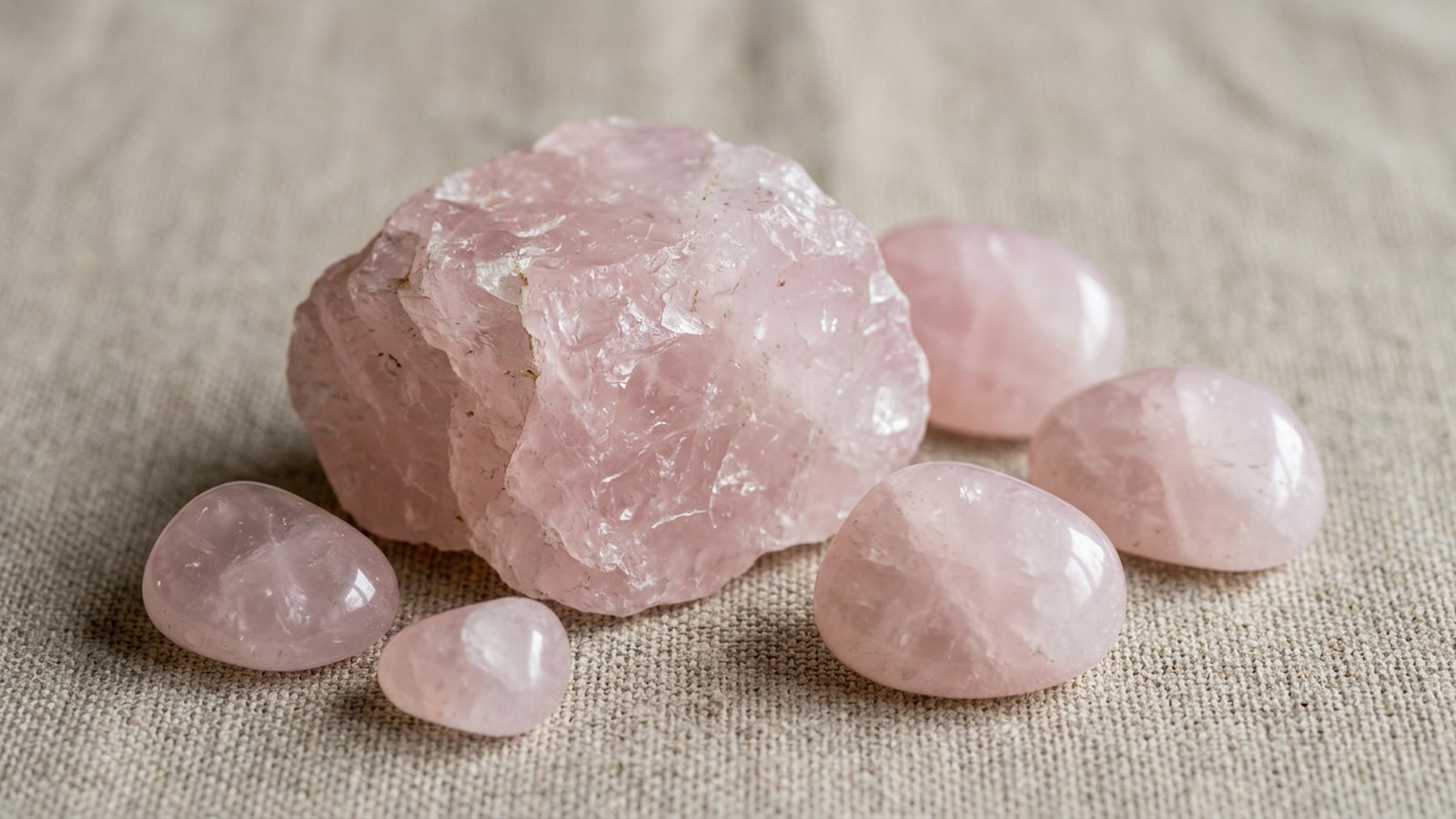
Almost every list of crystals for love starts in the same place, with a heap of pink stones and a promise. I want to start somewhere else, because in fifteen years of sitting with people and their stones I have noticed that the person asking "which crystal for love?" is almost never asking one question. Sometimes they are alone and hopeful. Sometimes they are three years past a break-up and still flinching. Sometimes they are in something good that has gone quiet, and they want to know how to warm it again.
Those are different situations, and they want different stones.
So this guide is sorted by where you are, not by what is prettiest. If you want the short answer: rose quartz is the stone to start with for love in almost any form, green aventurine and moonstone suit you when you are hoping to meet someone, rhodonite when an old hurt is still in the way, and garnet or carnelian when you are trying to bring warmth back into a relationship you already have. Everything after this is the long answer, including the parts other guides leave out. For the specific pairing of rose quartz with moonstone, and when it is the wrong choice, see rose quartz and moonstone.
What a stone can and cannot do here
Let me be straight with you, because love is the intention where crystal writing goes furthest off the rails.
A stone will not make a person love you. It will not repair a relationship that one of you has already left. It will not substitute for saying the difficult sentence out loud. Nothing I have ever held has done any of that, and anyone selling you a stone on that promise is selling you something else.
What a stone genuinely does, in my experience, is act as a physical reminder in a place where your attention keeps slipping. You put rose quartz in your pocket and you touch it, and the touching returns you to an intention you set that morning. That is small. It is also not nothing: most of what goes wrong in love goes wrong through inattention, avoidance and old habit, and a small object that interrupts those is worth carrying.
Everything below is traditional lore and my own intuition, offered as such. If you are grieving heavily, or if the sadness has stopped lifting, please talk to someone qualified. A stone can sit beside that work. It cannot do it.
If you are hoping to meet someone
This is the situation most people mean, and the honest advice is that the stones for it are less about attraction than about openness. You cannot meet anyone if you are quietly braced against being seen.
Green aventurine is my first choice here, and not for the reason usually given. It is quartz shot through with tiny flakes of fuchsite, a chromium-rich mica, which is what gives it that soft internal glitter (the effect has a name, aventurescence). Tradition calls it the stone of luck and new opportunity, and I read it as the stone of the willing yes. It suits the person who has started declining invitations. Carry it in the pocket you reach into when you are deciding whether to go out.
Moonstone suits a different temperament: the person who is not closed, but is anxious, reading too much into every message. Moonstone is a feldspar whose blue shimmer comes from light scattering off microscopic layers of two feldspars that separated as the crystal cooled. Its traditional link to cycles and beginnings is the reason I hand it to people who are dating again after a long gap. It suits you less well if you already tend to overthink and romanticise; moonstone will not talk you down, and for that I would send you to amethyst instead.
Rose quartz belongs here too, but as the base note rather than the melody. More on it below.
If an old wound is still in the way
You know this one if you have caught yourself testing someone for a fault they have not committed yet.
Rhodonite is the stone tradition assigns to exactly this, and it is the one I reach for most often. It is a manganese silicate, dusty pink and threaded with black manganese oxide, and I have always found that veining to be the point. The black is not damage in the stone. It is part of how it formed, and it is what makes a polished piece worth looking at. Sit with that for a while and it does its own work.
Rhodonite is soft, around 5.5 to 6.5 on the Mohs scale, so it scuffs in a pocket of keys. Keep it somewhere gentler. People also confuse it constantly with rhodochrosite, which is a much softer carbonate with banded stripes rather than black veins, so if you are buying, read how to tell rhodonite and rhodochrosite apart first.
Rose quartz is the companion to it, and here is where I will spend its introduction. It is ordinary quartz, silicon dioxide, hardness 7, and its pink is not a dye or a mood: analytical work in the early 2000s traced the colour in massive rose quartz to microscopic fibres of a borosilicate mineral related to dumortierite, dispersed through the crystal. I like that the softest-looking stone in the drawer is one of the harder ones, and that its tenderness is structural. Traditionally it is the heart chakra stone, tied to Venus and to Taurus and Libra, and it is the least demanding stone I know. It asks nothing. After a hard year, that is the correct amount to be asked. If grief is the larger part of what you are carrying, our guide on crystals for grief is the better door.
If you want to keep a good thing warm
Long relationships do not usually fail loudly. They cool.
Garnet is the traditional stone of devotion and physical warmth, and it is the one I suggest when a couple has become efficient with each other: good logistics, no heat. Garnet is not a single mineral but a family of silicates that share a crystal structure, most of the deep red pieces being almandine or pyrope, and it is hard enough (6.5 to 7.5) to live in a ring for decades. That durability is half the symbolism. It is January's birthstone, which makes it an easy gift with a real reason behind it.
Carnelian does something adjacent but more physical. It is a chalcedony, warm orange, tied traditionally to the sacral chakra and to appetite in the broad sense: for food, for making things, for each other. I suggest it when the tiredness in a relationship is genuinely tiredness rather than resentment. Be aware that a good deal of commercial carnelian is agate that has been heat treated or dyed to that even orange, which does not bother me for practice but should bother you at the price of untreated material.
You will also see emerald and morganite on every list in this category, and the tradition behind them is real: emerald has been the stone of loyalty since antiquity, and morganite is a pink beryl, emerald's own cousin, that the trade adopted as a softer engagement stone. My only reservation is cost. Both are gem-grade materials priced accordingly, most morganite on the market has been heated to clear the yellow out of it, and I would rather you spent that money on time together than on a stone.
Neither stone is right if what is actually happening is unspoken anger. For that, read on.
If you need to say a hard thing
The most useful love stones in my drawer are not pink at all.
Lapis lazuli is the throat stone, associated for millennia with truth and clear speech. It is a rock rather than a single mineral, mostly lazurite with white calcite and flecks of pyrite, which is why it is soft (5 to 6) and why it must never go in water: the calcite reacts and the surface dulls. Our water safety guide covers which stones tolerate a rinse. I keep lapis on the desk before a conversation I have been putting off, and I hold it while I decide what the one true sentence is.
Blue lace agate is the softer version of the same instinct, for when the thing you need to say is fair but you are afraid of sounding sharp. Both are worth more to a relationship than any amount of rose quartz, because the stone that helps you speak is the stone that changes something.
If the person to start with is you
Sometimes the honest answer to "which crystal for love" is that the love in short supply is not romantic.
Amethyst and rose quartz together are the classic pair for this, and we have written about what that pairing actually does. Amethyst brings a cooler, more spacious quality that helps when self-criticism has become a loop, and rose quartz softens the tone of the voice you use on yourself. Our guide to crystals for self-love goes deeper into that practice than I can here.
If you want to combine them
Most guides end with a crystal grid, and I will not talk you out of one, but I will narrow it. Two stones is usually the right number for love work, three at the very most, because the point of a pairing is that it names a tension you are actually living in.
The combinations I find genuinely coherent are these. Rose quartz with green aventurine, when you want to be both open and willing to go out. Rhodonite with rose quartz, when the work is forgiveness and you need the gentler stone underneath the harder one. Lapis lazuli with rose quartz, when you have something true to say and want to say it kindly, which is the pairing I recommend most and the one almost no list carries. Garnet with carnelian for warmth in a long relationship.
What I would avoid is the ten stone bowl on the bedside table. Not for any mystical reason about stones quarrelling, and you can read why the lists that claim that contradict each other, but for a practical one: a bowl of stones is a bowl, and your attention slides off it. If you do want to build something more formal, crystal grids for beginners sets out the geometry properly.
Quick reference
| Where you are | Stone | Why |
|---|---|---|
| Hoping to meet someone | Green aventurine, moonstone | Openness, saying yes, steadiness while dating |
| Carrying an old hurt | Rhodonite, rose quartz | Forgiveness, gentleness with yourself |
| Warming a long relationship | Garnet, carnelian | Devotion, appetite, physical closeness |
| Needing to speak honestly | Lapis lazuli, blue lace agate | Truthful, unsharp speech |
| Rebuilding self-regard | Rose quartz, amethyst | Kindness inward, quieter self-criticism |
How to actually use them
Cleanse first. A new stone has been handled by a dozen people and shipped across an ocean, and whether you read that energetically or simply as a fresh start, cleansing it marks the beginning of your use of it. Then set an intention, and make it specific. "Love" is not an intention. "I answer honestly when he asks me how I am" is an intention.
Then choose one of these and only one:
- Wear it. Near the heart if you can, on a pendant, or as a ring on the hand you gesture with. Carrying and wearing stones covers what survives daily wear; rose quartz and garnet do, rhodonite less so.
- Pocket it. The most underrated method. A stone you touch twenty times a day works on you more than one on a shelf.
- Place it. Bedside, or in the room where you and your partner actually talk, which in most homes is the kitchen. Our placement guide has the room by room version.
- Sit with it. Five minutes, stone in the left hand, attention on the situation rather than on the stone.
One caution nobody prints: not every stone belongs in the bedroom. Clear quartz and moldavite are both stimulating enough that light sleepers notice them, and I have had more than one person tell me their sleep improved when they moved the quartz cluster off the nightstand. If you sleep badly, keep the bedroom to rose quartz or amethyst and read crystals for sleep. Charging matters less often than people think; once a month under the full moon is plenty.
"Can a crystal make a specific person love me?"
This gets asked constantly, quietly, and almost every guide dodges it. So: no. I do not believe a stone can reach into another person and change what they feel, and I would not want to hold one that could.
There is also something worth naming here. A practice aimed at bending one particular person tends to keep you fixed on them, which is precisely what stops you healing or moving. If you find yourself buying stones with one name in mind, that is useful information about where you are, and rhodonite is a kinder purchase than another rose quartz.
Buying without being fooled
Love stones are heavily faked, because they sell.
Dyed pink glass and dyed quartz are sold as rose quartz constantly; real rose quartz is cloudy and evenly coloured rather than glassy with a suspiciously vivid pink, and it is never full of tidy bubbles. Kunzite, which you will see recommended on the bigger lists, has a real problem worth knowing: its colour genuinely fades with prolonged light exposure, which is why it is sometimes called an evening stone. Rose quartz and amethyst fade in strong sunlight too, so do not leave your windowsill charging them all summer. "Denim lapis" is usually dyed jasper or howlite, and much cheap "cherry quartz" is glass. Our guide on telling a real crystal from a fake covers the tests.
Buy the smaller honest piece. A tumbled stone you carry every day will do more than a large polished one you photograph once.
A last thought
If you take one thing from this, let it be the ordering. Work out which of the five situations above is actually yours, choose the one stone that matches it, and give it a season before adding another. Half the crystal collections I see are shelves of good stones bought in five different moods, none of them ever really used.
Love responds to attention. So does a stone. That is, I think, the whole of why they have been paired for as long as they have.