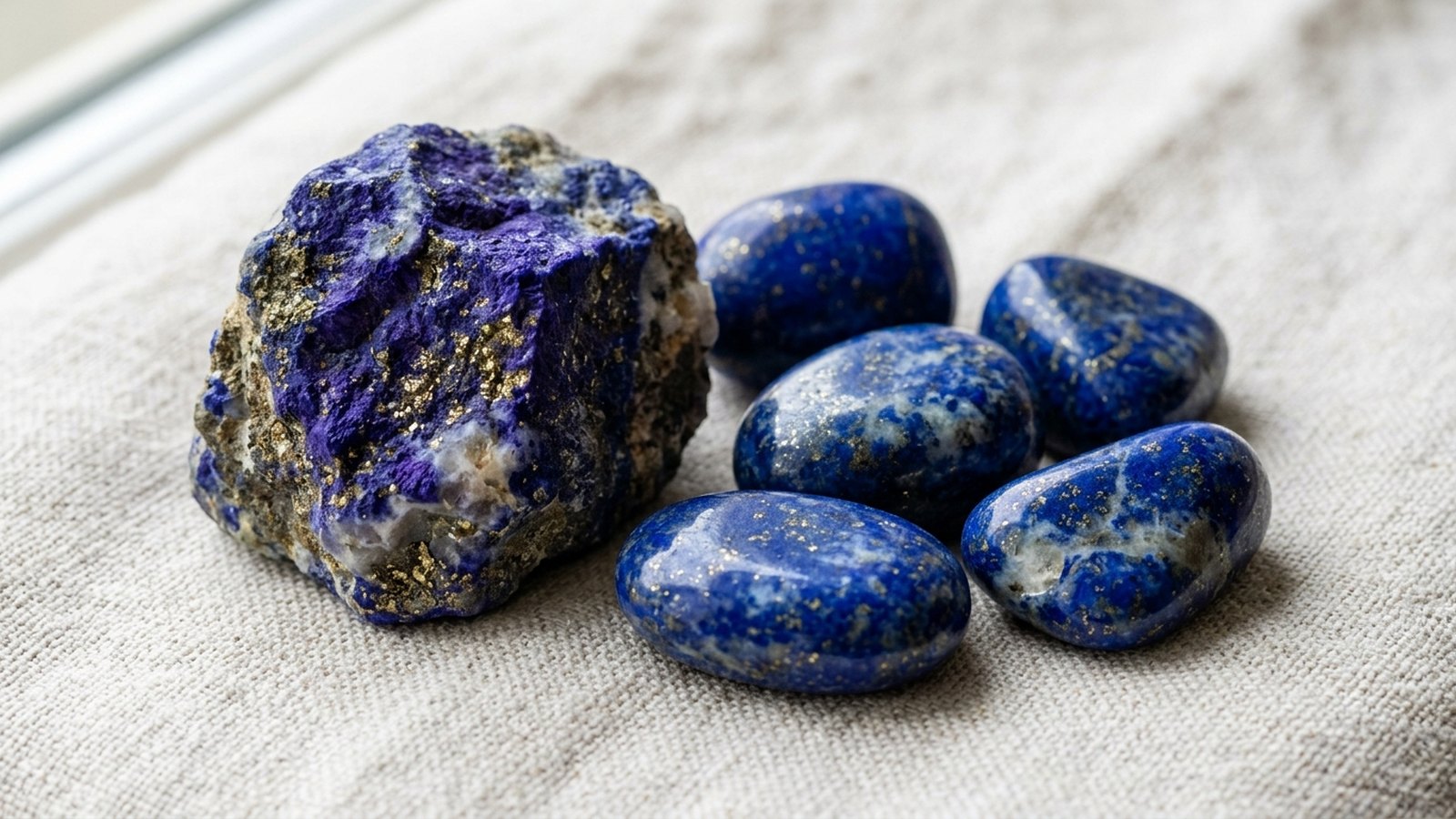
Someone hands you a blue stone. It is deep, saturated, a little mottled with white, and it might have a scatter of gold in it. Is it lapis lazuli, the stone that Renaissance painters ground into ultramarine and paid for by the gram, or is it sodalite, the stone that costs a few euros a tumble and gets called the poor man's lapis?
I get asked this more than almost any other identification question, and the usual answer online is one sentence long: look for the gold flecks. That answer is right often enough to be useful and wrong often enough to sell people the wrong stone. So here is the longer version, the one that also tells you which of the two you actually want.
The short answer
Lapis lazuli is a rock made of several minerals, mainly lazurite, with calcite and glinting pyrite mixed in. Sodalite is a single mineral. In practice, lapis is a deeper, more violet ultramarine, usually carries gold pyrite flecks, and feels noticeably heavy for its size. Sodalite is a lighter royal or denim blue, veined with sharp white calcite lines, has no gold, and feels surprisingly light in the hand.
If you only remember one thing: judge by weight and by the character of the white, not by the gold alone.
Why these two get confused in the first place
Here is the detail almost nobody mentions, and it is the one that makes the confusion make sense. Sodalite is not merely a lookalike for lapis lazuli. Sodalite is often physically inside lapis lazuli.
Lapis is a metamorphic rock, not a mineral. Its blue comes from lazurite, and lazurite belongs to the sodalite group of feldspathoids, a family of sodium-rich, silica-poor minerals that crystallise where there was not enough silica to go around. Sodalite proper turns up as an accessory mineral in plenty of lapis, sitting alongside the lazurite, the calcite and the pyrite.
So these two stones are not distant cousins that happen to share a colour. They are close relatives, and one of them is a component of the other. That is why the eye struggles. You are not being careless.
If you want the full story on each stone in its own right, I have written a lapis lazuli guide and a sodalite guide that go into the meaning and traditional use of each.
Five ways to tell them apart
1. The gold flecks, and when the rule fails
Pyrite is the classic tell. Those brassy metallic specks are iron sulfide, they form in the marble that hosts lapis, and sodalite very rarely carries them. See gold, think lapis. That much is sound, and if you want to know the mineral itself, the pyrite guide covers it.
But the rule breaks in both directions. The finest Afghan lapis, the material that commands the highest prices, is prized precisely because it is a solid, even ultramarine with almost no pyrite and no calcite at all. A top-grade lapis cabochon can be entirely gold-free. Meanwhile sodalite from some deposits does carry minor pyrite, uncommon but real.
Absence of gold is therefore not evidence of sodalite. Presence of gold is decent evidence of lapis. The test only works in one direction, which is exactly the sort of thing a one-line answer never tells you.
2. The character of the white
This one is more reliable than the gold, and it is free.
Sodalite's white is calcite in sharp, thin, web-like veins that run through the stone like cracks in ice. They have edges. They look drawn on. Lapis, when it has visible white, tends to show softer, grainier, cloudier patches of calcite that blur into the blue rather than cutting across it.
Hold both under a lamp and the difference is immediate. Sodalite looks veined. Lapis looks clouded.
3. The blue itself
Lapis leans violet. It is that dense ultramarine that reads as slightly purple in daylight, the colour that gave the pigment its name.
Sodalite leans towards a flatter royal blue, often greyer, sometimes with a denim or navy cast, and it is usually more mottled and uneven across a single piece. Where lapis is saturated, sodalite is a shade more subdued. If colour reading interests you generally, my guide to crystal colours and their meanings covers what different blues have traditionally been associated with.
Be careful with this criterion on its own, though. Low-grade lapis is genuinely pale and greyish, which brings it right into sodalite's colour range.
4. Weight in the hand
This is my favourite test because it needs no equipment and it is quantitative.
Lapis lazuli has a specific gravity of roughly 2.7 to 2.9. Sodalite sits around 2.14 to 2.30. That is a difference of about twenty five per cent, and on two tumbled stones of similar size it is genuinely perceptible. Lapis feels dense, cool and substantial. Sodalite feels light, almost disappointingly so, the way a plastic bead feels when you expected glass.
Hold one in each palm and you will feel it. This is the test I reach for first, before I look at the gold at all.
5. A UV torch, with a caveat
Sodalite frequently fluoresces a bright orange under longwave ultraviolet light. Lazurite, the blue mineral in lapis, is generally inert. So a stone that glows orange all over is very likely sodalite.
The caveat: the calcite in lapis can also fluoresce orange or pink. On a calcite-rich piece of lapis you may see orange glowing along the white patches while the blue stays dark. Whole-stone glow points to sodalite. Glow only in the white markings points to lapis with calcite. Read the pattern, not just the presence of light.
There is also hackmanite, a variety of sodalite that is tenebrescent: it darkens to a violet or pink under UV or strong sunlight, then slowly fades back in the dark. It is a genuine curiosity, and if a stone changes colour on your windowsill, you are almost certainly holding sodalite.
Side by side
| Lapis lazuli | Sodalite | |
|---|---|---|
| What it is | A rock (lazurite, calcite, pyrite, diopside) | A single mineral, Na₈Al₆Si₆O₂₄Cl₂ |
| Colour | Deep violet-toned ultramarine | Royal to greyish denim blue, mottled |
| Gold pyrite | Usually present, absent on top grades | Rarely present |
| White markings | Soft, grainy, cloudy patches | Sharp, thin, web-like veins |
| Mohs hardness | 5 to 5.5, variable because it is a rock | 5.5 to 6, more consistent |
| Specific gravity | 2.7 to 2.9, feels dense | 2.14 to 2.30, feels light |
| Longwave UV | Mostly inert, calcite may glow | Often glows bright orange |
| Main sources | Afghanistan, Chile, Russia | Canada, Namibia, Brazil, Greenland |
| Price | Higher, steeply graded by quality | Consistently inexpensive |
The stone that is neither: dyed imitations
Both stones above are honest. The thing most likely to actually fool you is a third category, and none of the identification advice so far will catch it.
Dyed sodalite sold as lapis is common. So is dyed jasper, which the trade has long sold under the names Swiss lapis and German lapis. Neither contains a speck of lapis lazuli. Dyed howlite and dyed magnesite also turn up, since both take blue dye readily. And reconstituted lapis, which is genuine lapis powder bound in resin, is sold as solid stone more often than it should be.
Three checks I use, in order of how much I trust them:
- Look at the drill hole. On a bead, dye concentrates around the drilling and often shows as a darker ring, while the exposed interior can look paler than the surface. Natural colour goes all the way through evenly.
- The acetone swab. Dab a cotton bud with acetone or nail polish remover and rub a hidden spot, the back of a cabochon or a bead end. Blue on the cotton means dye. This is the standard trade test and it is decisive.
- Judge the price honestly. A large, flawless, evenly ultramarine lapis bracelet for the price of a coffee is not lapis. High-grade lapis is genuinely expensive and always has been.
One name worth defending: denim lapis is not a fake. It is real lapis lazuli, pale and calcite-rich, mostly from Chile, sold under an honest descriptive name. It is simply low grade, and priced accordingly. My guide on how to tell if a crystal is real goes further into these tests across other stones.
Which one should you choose?
Now the part that matters more than identification, because both are worth owning.
Choose lapis lazuli if you want the weight of history. Lapis was mined at Sar-e-Sang in Badakhshan, Afghanistan for more than six thousand years, inlaid into Tutankhamun's funerary mask, and ground into ultramarine pigment that cost Renaissance workshops more per gram than gold. Traditionally it is the stone of truth and inner authority, linked to the throat and third eye chakras and to Sagittarius. I reach for it when someone needs to say a difficult true thing out loud, which is why it sits well alongside work on confidence.
Choose sodalite if you want a working stone. Sodalite was identified in 1811 from Greenland material and named for its sodium content, and the best known commercial deposit is at Bancroft in Ontario, where the material became known as Princess Blue after a royal visit in 1901. Tradition frames it as the stone of logic and clear expression rather than revelation: it is the one people keep on a desk. It shares the throat and third eye associations, and Sagittarius too, which is another reason the two get muddled. It pairs naturally with the work of settling a restless, anxious mind when scattered thinking is the problem.
Practically: sodalite is slightly harder and more consistent, which makes it the better choice for a ring or anything worn daily, and it costs little enough that losing one is not a tragedy. Lapis is softer, more variable, and better suited to pendants and earrings where it is not being knocked about. If you like these head to head comparisons, I have done the same for onyx and obsidian and for rhodonite and rhodochrosite.
As always, these energetic associations are tradition and intuition, not medicine. A stone is a good companion to a decision, never a substitute for care you actually need.
Caring for both
They ask for the same treatment, and it is gentler than most people assume.
Neither likes water for long. Lapis is calcite-bearing and porous, and calcite reacts to acid, so acidic water and household cleaners are genuinely damaging. Sodalite is softer than quartz and dislikes salt and long soaks. A brief rinse and a dry cloth is the limit for both, as covered in my notes on crystals and water safety.
Both fade in prolonged direct sunlight, sodalite especially. Cleanse them with smoke, sound or moonlight rather than a sunny windowsill, and store them away from harder stones like quartz, which will scratch either one. The general method is in my guide to cleansing crystals, and if you plan to wear yours, carrying and wearing stones has more on which settings survive daily life.
A last thought
If you already own the stone and it turns out to be sodalite rather than lapis, I would not rush to be disappointed. Sodalite is a beautiful mineral with its own quiet character, and the phrase poor man's lapis has always struck me as unfair to a stone that is simply doing a different job.
What matters is knowing which one is in your hand. Weigh it, look at the white, then look for the gold. In that order.