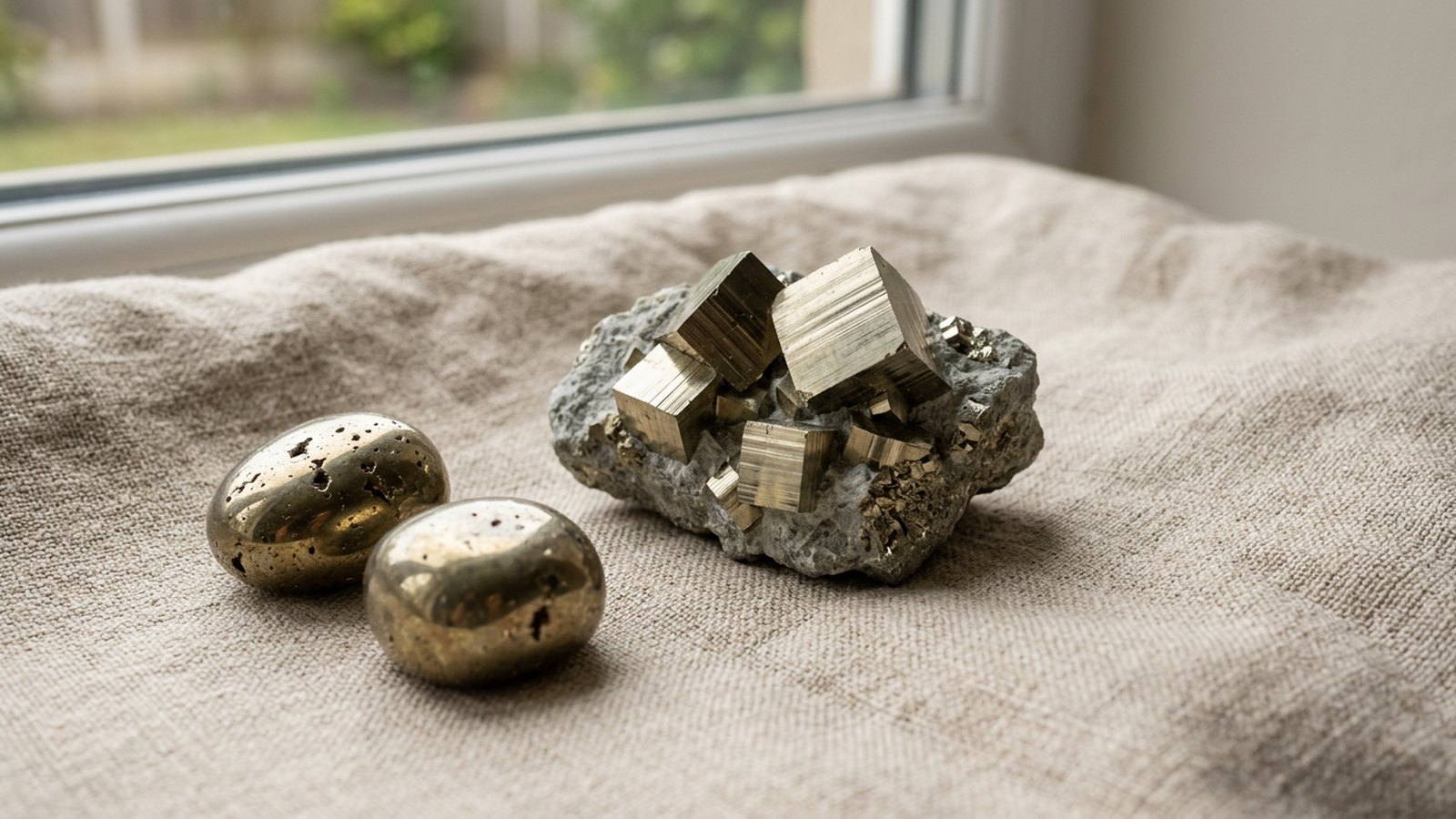
Pick up a piece of pyrite and the first thing you notice is the weight. It sits in the palm heavier than it looks, cool at first and slow to warm, with flat brassy faces that catch the light like struck metal. Some pieces arrive as perfect little cubes, as if someone had cut them. They were not cut. That is simply how the mineral grows.
Pyrite is an iron sulfide mineral, formula FeS2, nicknamed fool's gold for the brassy shine that has been mistaking itself for the real thing since at least the gold rushes of the 1800s. In crystal tradition, pyrite means drive, willpower and earned abundance. It is the stone people reach for when the problem is not a lack of ideas but a lack of momentum, and it has been read for centuries as a protector and a wealth talisman.
I keep pyrite on my desk rather than by my bed. It is not a restful stone. It has the same quality as a cold morning and a clear task list, and that is exactly what I want from it. Here is what pyrite means, what it actually is, the fire-making history behind its name, and the one care mistake that ruins more pyrite than anything else.
What pyrite symbolizes
At its core, pyrite is a stone of will made visible. Gold is the metal of arrival; pyrite is the mineral of the work that gets you there. That distinction runs through almost every tradition attached to it.
Symbolically, pyrite stands for:
- Abundance and prosperity, particularly the kind that follows effort rather than luck
- Willpower and drive, the push to begin and the stamina to continue
- Confidence, a warm, solar sense of your own capability
- Protection, a shielding, reflective quality noted since antiquity
- Clarity and honest seeing, the ability to tell real from merely shiny
That last one is my favourite, because it is written into the stone's own story. Pyrite is the mineral that taught the world to look twice. A stone nicknamed for fooling people carries an obvious lesson about discernment, and I do not think that is a coincidence in how it came to be used.
Reasons to work with pyrite
Pyrite is the stone I use for starting. Not for planning, not for dreaming, for starting. When a project has been sitting at the top of a list for three weeks, I put a piece of pyrite next to the laptop and give the thing twenty minutes. The stone is a physical anchor for an intention, and traditions built on exactly this kind of repetition are why pyrite is called a manifestation stone.
Pyrite is a money stone with a realistic attitude. It has been carried for prosperity for a very long time, and the association is easy to trace: it looks like gold. But the way pyrite is traditionally used is telling. It goes in the workspace, the cash drawer, the ledger, the place where the earning actually happens, not under a pillow. If you are building a set of stones for financial goals, pyrite is the working partner to the warmer optimism of citrine, and both sit at the heart of our guide to crystals for money and abundance.
Pyrite is a confidence stone for people who go quiet under pressure. Its traditional home is the solar plexus, the seat of self-assertion in the chakra system, and the classic use is before something that asks you to take up space: an interview, a difficult conversation, a rate you need to name out loud. I hold a piece while I rehearse the first sentence. If that is the season you are in, it belongs alongside the other crystals for confidence and courage.
Pyrite is a protective stone in an unusually practical way. Older sources describe it as a deflector, a stone that turns things back, which fits a mineral with a mirror-bright surface. Where black tourmaline feels like absorbing and grounding, pyrite feels like reflecting and standing straighter. I find it useful for the specific kind of drain that comes from other people's chaos rather than your own.
Pyrite meaning: healing energy
Emotional healing
Pyrite is traditionally used against passivity and the flat, stuck feeling of watching your own life from the outside. It is said to warm the emotional body and push back the small fears that keep people from trying. It has a bracing quality rather than a soothing one, which is worth knowing before you buy it. When I want comfort I reach for something else entirely.
Mental healing
This is where pyrite earns its keep in my collection. It is associated with focus, decision-making and cutting through the fog of too many options, and lore frames it as a stone that helps you see the real reason a situation keeps repeating. I use it as a working stone: on the desk while writing, in the pocket during a long day of decisions.
Spiritual healing
In spiritual practice, pyrite is treated as a stone of integrity and action, the reminder that intention without follow-through is just a wish. Some traditions describe it as balancing light and shadow within us, since it is a mineral that mimics something precious and asks us to know the difference. Used in meditation it tends to be energising rather than dissolving; if you would like a starting point, see our guide to meditating with crystals.
Physical healing
Traditionally, pyrite has been linked with general vitality, physical stamina and a sense of robustness. That is folklore and personal intuition, not medicine. Pyrite does not treat, cure or diagnose anything, and nothing here is a substitute for professional medical care. If something is wrong, please see a doctor, and let the stone simply be a companion while you do.
Chakra: Solar plexus (Manipura), with a secondary grounding pull toward the root. See our full guide to the seven chakras and their crystals. Zodiac: Leo above all, with Aries drawn to its drive. Element: Earth. Numerical vibration: 9. Affirmation: I have everything I need to begin.
Pyrite geology: what fool's gold really is
Pyrite is iron disulfide, FeS2, and it is the most abundant sulfide mineral on Earth. It sits at 6 to 6.5 on the Mohs scale, has a specific gravity around 5.0, no cleavage, a brittle uneven fracture and a metallic lustre in pale brass to yellow. It crystallises in the cubic system, which is why it forms those improbable shapes: cubes, twelve-faced pyritohedrons and octahedrons, often with fine parallel striations across the cube faces.
The name is ancient and literal. It comes from the Greek pyr, meaning fire, from pyrites lithos, the stone which strikes fire, because a sharp edge of flint dragged across pyrite tears off tiny particles of iron that ignite in the air. Those sparks are hot enough to catch tinder. The mineral was named for what it does, not what it looks like.
How to tell pyrite from gold
This is the question people actually arrive with, and it takes about ten seconds to answer with a stone in your hand.
| Test | Pyrite | Gold |
|---|---|---|
| Hardness | 6 to 6.5, will not scratch with a knife | 2.5 to 3, marks easily |
| Behaviour under pressure | Brittle, chips and crumbles | Malleable, bends and dents |
| Streak on unglazed tile | Greenish black to brownish black | Golden yellow |
| Shape | Cubes, octahedrons, striated faces | Irregular nuggets and flakes, no crystal faces |
| Colour | Pale brassy yellow, sometimes with a slight green cast | Deep buttery yellow |
| Weight | Heavy, around 5 times water | Extraordinarily heavy, around 19 times water |
The streak test is the decisive one and it is nearly foolproof: gold leaves gold, pyrite leaves a dark greenish smear. If you want the wider version of this skill, we cover it in how to tell if a crystal is real or fake.
One more confusion is worth clearing up. Marcasite has exactly the same chemistry as pyrite, FeS2, but crystallises in the orthorhombic system, is paler and is considerably less stable. Almost all antique and modern "marcasite" jewellery is in fact pyrite. The trade name stuck; the mineralogy never matched it.
Where pyrite forms
Pyrite is genuinely everywhere, which is part of what makes it interesting. It grows in hydrothermal veins alongside quartz, calcite, fluorite and the ores of copper, silver and gold, which is why prospectors kept finding it in exactly the places they hoped for something else. It forms in metamorphic rock, in coal seams, and abundantly in sedimentary muds where bacteria strip oxygen from sulfate in still, airless water, leaving iron and sulfur to combine into microscopic raspberry-shaped clusters called framboids.
That same reactivity has a hard edge. When pyrite-rich rock is broken open and exposed to air and water at mine sites, it oxidises and produces sulfuric acid, the cause of acid mine drainage. For most of the industrial era pyrite was mined not as a curiosity but as the world's main source of sulfur for making sulfuric acid.
Pyrite history and lore
Pyrite's documented story is a story about fire, and it begins earlier than almost any other stone in this collection.
When Otzi, the 5,300 year old iceman found in the Alps, was recovered with his equipment, his fire kit contained flint flakes and pieces of true tinder fungus. Microscopic analysis of the fungus found traces of pyrite worked into its fibres. The lump of pyrite itself was never recovered, but the residue is there: a Copper Age traveller carrying the stone that makes sparks.
Pliny the Elder, writing in the first century CE, described several stones collectively called pyrites that threw sparks when struck, one of them brass coloured and almost certainly this mineral. His account is the earliest surviving written reference, and it names the stone for its function.
During the Mesoamerican Classic period, roughly 250 to 900 CE, Maya and Aztec craftsmen cut small plates of pyrite and fitted them into mosaics on slate backings to make mirrors. These were ceremonial objects, worn on the back or belt by priests and nobles, or placed in temples and tombs. Very few survive intact, for a reason that matters to anyone who owns pyrite today: the mineral oxidised, and most of those mirrors are now a slate disc with a rust-coloured stain.
Then pyrite went to war. The wheellock, developed in Germany in the early 1500s, was the first self-igniting firearm mechanism. A spring-loaded serrated steel wheel spun against a clamped piece of pyrite, showering sparks into the powder pan. It was pyrite, not flint, that fired those guns; the flintlock replaced it a century later with a simpler design and the name confusion has persisted ever since.
The nickname came last. Nineteenth century gold rushes sent thousands of inexperienced prospectors into the field, and the brassy mineral in the pan broke enough hearts to earn a permanent insult. Fool's gold is the only stone name I know that mocks the finder rather than describing the find.
You may already own some pyrite
This is the part that surprises people. Pyrite hides in plain sight inside other stones.
Those glittering gold flecks scattered through good lapis lazuli are pyrite. They are the traditional mark of authenticity for the stone, the reason lapis was described as a night sky with stars in it.
"Healer's gold" is not a mineral at all; it is a trade name for a natural blend of pyrite and magnetite, prized for combining pyrite's brightness with magnetite's iron-heavy pull, and often compared to hematite for grounding work.
And those golden ammonites in museum cases are pyritised fossils, where mineral-rich water replaced the original shell with pyrite, atom by atom, in the anoxic mud of a Jurassic seabed. They are also the most fragile objects in many collections, for reasons the next section explains.
Where pyrite comes from today
Fine specimen pyrite comes from a handful of famous places. The perfect cubes almost everyone has seen in photographs, sharp-edged and mirror-faced on grey rock, come from the Victoria Mine near Navajun in La Rioja, Spain, where the geology of the Cameros Basin produced them at a quality found nowhere else. Peru produces superb crystallised specimens, Italy's Elba and Rio Marina have been classic sources for centuries, and pyrite "suns", flat radiating discs pressed between shale layers, come mainly from the coal measures around Sparta, Illinois. Add China, Russia, Bolivia, Brazil and much of the western United States, and you have a mineral no one needs to dig hard to find.
How to care for pyrite
Here is the part most crystal guides skip, and it is the single most important thing to know about this stone.
Keep pyrite dry. Pyrite is iron and sulfur, and in the presence of moisture and oxygen it oxidises. The reaction produces iron sulfates that take up more space than the original mineral, plus sulfuric acid and sulfur dioxide gas. The specimen swells, cracks, sheds a yellowish white powder and eventually crumbles. Museum conservators call this pyrite disease or pyrite decay, and they fight it by keeping specimens below roughly 45% relative humidity, because once it starts it cannot be reversed.
So: no water baths, no salt, no leaving it on a windowsill in a steamy bathroom, no burying it in damp garden soil. Our full reference on which crystals can and cannot go in water puts pyrite firmly in the do-not column. A dry cloth is all the cleaning it needs, and if a piece starts smelling faintly of sulfur or shedding powder, isolate it, because the acid it produces can damage the stones and the box stored beside it.
For energetic cleansing, use dry methods: smoke, sound, moonlight through a closed window, or a few hours on a piece of selenite or quartz. Our guides to cleansing crystals and charging them cover the options. Brief indirect sunlight is fine, prolonged heat is not.
Wash your hands after handling raw or freshly broken pyrite, keep the dust away from children and pets, and choose a sealed, polished piece if you want to wear it. On the question of who should avoid pyrite: energetically, nobody. Practically, anyone who wants a low-maintenance stone to keep in a damp room or take in the bath should choose something else, and clear quartz will do that job happily.
How to use pyrite
Put it where the work happens. Desk, studio, workshop, the shelf above the till. In feng shui practice it is placed in the wealth area of a home or office, and in most crystal traditions it belongs in the room where money is earned rather than the room where you sleep; our guide to where to place crystals in your home goes deeper into that logic.
Carry a small tumbled piece in a pocket or bag on days that need momentum, ideally in its own pouch so it does not scratch softer stones and so any moisture stays off it. See carrying and wearing stones for the practicalities. In meditation, hold it in the receiving hand, rest attention just below the ribs where the solar plexus sits, and let its weight do the work. It tends to sharpen rather than soften, so it suits a morning practice better than an evening one. Its metallic gold also sits in the family of warm, solar stones we map in crystal colours and their meanings.
A closing thought
Pyrite has spent two centuries being called a fake, which has always struck me as unfair to a mineral that never claimed to be anything. It made fire for the Copper Age, mirrors for Maya priests, sparks for the first self-igniting guns and the sulfuric acid that built the industrial world. Gold, for all its beauty, mostly sat in vaults.
That is the energy I take from it, and why I recommend it to anyone stuck between wanting something and doing something about it. Keep it dry, keep it where you work, and let it remind you that value is a thing you make rather than a thing you find. If you want a companion for it, the classic choice is citrine, and I have written up how that pair works, how to use it and why the two stones must never share water or a strand in citrine and pyrite. That pairing brings warmth and optimism to pyrite’s drive. You can also read the full profile on our pyrite page.
For where pyrite fits among the stones I reach for after something has gone wrong, see crystals for motivation.