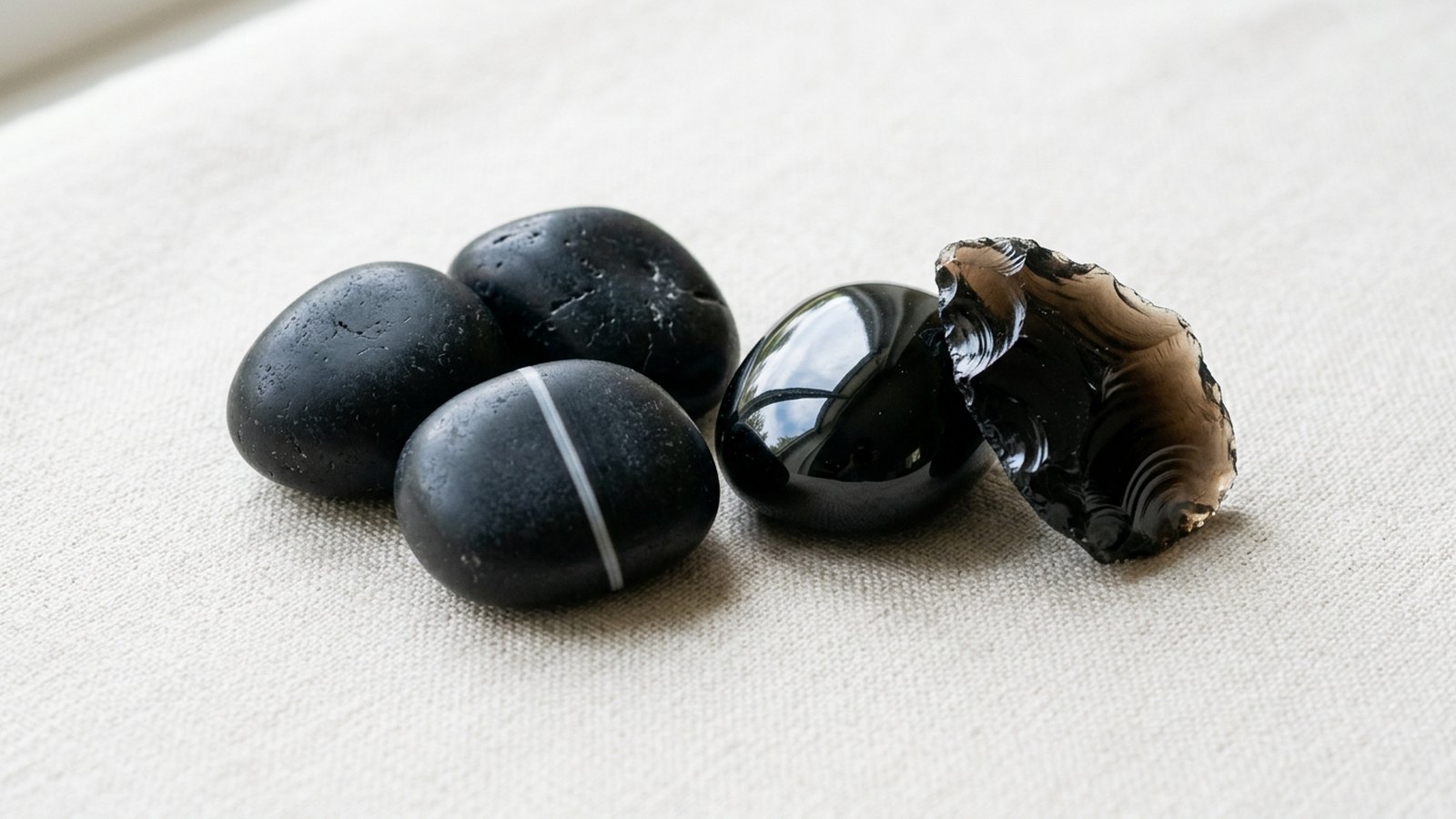
Put a tumbled black onyx and a tumbled black obsidian side by side on a table and most people cannot tell you which is which. I have watched it happen at markets more times than I can count, and the labels on the trays are wrong often enough that I stopped trusting them years ago.
So here is the short answer, and then I will show you how to prove it for yourself. Onyx is a quartz. Obsidian is a glass. Onyx is banded chalcedony, a microcrystalline form of quartz that grew slowly inside a cavity in rock, and it sits at 6.5 to 7 on the Mohs hardness scale. Obsidian is volcanic glass, lava that cooled far too fast to crystallise at all, and it sits at 5 to 5.5. Onyx reads matte and dead opaque. Obsidian reads wet, mirror bright, and glows brown or green at a thin edge held up to a lamp.
Everything else follows from that one difference: how they break, how long they last on your hand, how you should clean them, and, if you work with stones the way I do, how differently the two of them feel.
The one difference that explains all the others
Onyx is chalcedony, which is quartz built from crystals too small to see. Silica rich water seeps into a cavity in volcanic or sedimentary rock and lays down layer after layer over a very long time. Those layers are the point: onyx is defined by straight, parallel banding. When the same banding is curved or concentric you are looking at agate instead, and when the bands are black and reddish brown you have sardonyx. The name comes from the Greek onyx, meaning fingernail or claw, which is exactly what a pale band running through a dark stone looks like.
Obsidian has no layers, no bands and no crystals, because it never had time to build any. When thick, silica rich rhyolitic lava hits air or water it can freeze in days rather than millennia. The atoms stop moving before they can arrange themselves into a lattice, so what you hold is a genuine glass. Mineralogists do not even call it a mineral. It is a mineraloid, and it behaves like the volcanic cousin of a windowpane.
That is why the practical differences are so consistent. A crystal lattice, even a microscopic one, gives onyx hardness and a slightly gritty, waxy polish. An amorphous glass gives obsidian its wet shine, its conchoidal fracture, and its habit of chipping into curved, shell shaped flakes with edges you can genuinely cut yourself on. If you want the longer story on each stone on its own terms, I have written a full guide to onyx and one to obsidian.
Onyx vs obsidian at a glance
| Black onyx | Black obsidian | |
|---|---|---|
| What it is | Chalcedony, microcrystalline quartz (a mineral) | Volcanic glass (a mineraloid, not a mineral) |
| How it forms | Silica deposited in layers over long periods | Lava quenched in days, no crystal growth |
| Mohs hardness | 6.5 to 7 | 5 to 5.5 |
| Density | Around 2.65, feels heavier | Around 2.35, feels lighter |
| Lustre | Waxy to dull, fully opaque | Vitreous, mirror bright, translucent at thin edges |
| Breakage | Chips reluctantly, no cleavage | Conchoidal, razor sharp flakes |
| Usually treated? | Yes, most black onyx is dyed | No, colour is natural |
| Best worn as | Rings, daily wear | Pendants, earrings, pocket stones |
| Traditional theme | Discipline, endurance, self mastery | Truth, reflection, release |
How to tell onyx from obsidian at home
Most guides stop at "obsidian is shinier and onyx feels heavier," which is true and useless when you are holding one stone with nothing to compare it to. These five checks give you an actual answer, roughly in order of how decisive they are.
- The glass test. This is the one that settles it. Onyx is quartz at hardness 7, so it will scratch ordinary window glass, which sits around 5.5. Obsidian is glass at 5 to 5.5, so it will not, or it will only leave a smear that wipes off. Find a scrap of glass, a jam jar, anything you do not mind marking, and drag an edge of the stone across it firmly. A clean scratch line means onyx. Nothing means obsidian. No other test is this binary, and it costs you nothing.
- Hold a thin edge to a bright light. Black obsidian is almost never truly black. At a chip, an edge or a thin spot it transmits a smoky brown, olive green or grey glow. Black onyx of any thickness stays flatly opaque. Use a bare bulb or a window, not a phone torch pressed against the middle of a thick piece.
- Look at the polish, not the shine. Both take a high polish, but obsidian's is a true glassy reflection, like a puddle. Onyx has a faintly waxy, slightly softer surface that scatters light rather than mirroring it. Once you have seen the two next to each other you cannot unsee it.
- Weigh them in your hand. For pieces of similar size, onyx is noticeably the heavier one. Quartz is denser than volcanic glass by around thirteen percent, which is more than enough for your hands to notice.
- Get a loupe on it. Obsidian frequently contains tiny frozen gas bubbles, faint flow banding, or the beginnings of white crystal blooms. Onyx never contains bubbles. If you see bubbles, you are holding either obsidian or, if they are perfectly round and evenly spread, plain manufactured glass sold as neither. My guide on how to tell if a crystal is real or fake goes further into that particular trap.
Most black onyx is dyed, and that changes how you care for it
This is the part the comparison articles routinely get wrong, and it matters more than any energetic distinction. Solid, naturally jet black onyx is genuinely uncommon. The overwhelming majority of the black onyx on the market started life as ordinary grey or pale banded chalcedony and was dyed.
The standard method is not simply heating. The stone is soaked in a sugar solution so the syrup works into its microscopic pores, then treated with sulfuric acid, which carbonises the sugar into black carbon locked inside the stone. It is an old trick, described in antiquity and still the industry standard, and it produces a colour that is permanent and considered perfectly legitimate in the trade. Disclosure, however, is inconsistent, so assume your black onyx is treated unless a dealer tells you otherwise.
Why care? Because the treatment lives in the pores. That is the real reason to skip long soaks, salt baths, and household cleaners with your onyx, rather than any vague warning about "damaging its energy." A quick rinse and a dry cloth is enough. Obsidian, being solid glass with no porosity and no dye, is chemically indifferent to a brief rinse. Its danger is mechanical, not chemical. See which crystals can and cannot go in water for the full picture.
Obsidian is the younger stone, and it will not last
Here is my favourite fact about this pair, and no one on the first page of results seems to mention it. Glass is not stable. Given enough time, the silica in obsidian slowly reorganises itself into crystals, a process called devitrification, and the glass quietly stops being glass. Water working its way into the structure speeds it along.
The consequence is striking: it is rare to find obsidian older than about twenty million years, which is barely anything geologically. Older volcanic glass has almost all devitrified beyond recognition. Snowflake obsidian is that decay caught in the act, its white flecks are spherulites of cristobalite, a form of silica, blooming outward inside glass that is on its way to becoming rock.
So if you own both stones, the onyx is almost certainly the older object by a wide margin, and the obsidian is the one on a clock. I find that genuinely reframes them. One is patience made solid, the other is a moment that has not finished cooling.
Obsidian's other quirk is that it is traceable. Because each volcano leaves its own trace element signature in the glass, archaeologists can point a portable X-ray fluorescence scanner at an obsidian blade and name the mountain it came from, which is how Stone Age trade routes have been mapped across hundreds of kilometres. No such fingerprint exists for onyx.
What each stone is traditionally used for
Both are root chakra stones and both belong to the black, grounding end of the colour spectrum, which is exactly why they get muddled. The traditions attached to them are not the same, though, and I read them very differently in the hand. As always, treat this as inherited symbolism and personal intuition, not as fact and never as medicine.
Onyx is the stone of holding the line. Its traditional associations are self mastery, discipline, endurance and steadiness under pressure, the long unglamorous kind. Greek and Roman carvers prized banded onyx for cameos and signet rings, and Victorian mourning jewellery leaned on black onyx after Prince Albert's death in 1861, which gives it a genuine lineage as a stone for carrying grief with composure. I reach for onyx when someone needs to keep going through something rather than process it. It pairs naturally with the work in crystals for confidence and crystals for grief.
Obsidian is the stone of looking straight at it. Mesoamerican cultures polished it into scrying mirrors as well as blades, and the tradition that grew around it in modern crystal work is one of reflection, uncomfortable honesty and release rather than reinforcement. That has a real edge to it. Obsidian is the one I suggest people put down for a while if they are already raw, which is not a mystical warning so much as an observation that a mirror is not always what you need. If steady calm is what you are after, crystals for anxiety is the better starting point.
So which is better for protection? Neither, and the question is slightly the wrong shape. Onyx is protective in the sense of fortification, a wall you stand behind. Obsidian is protective in the sense of revelation, a light switched on. If you want a shield you can wear daily and forget about, take onyx. If you want something that will show you what you are actually dealing with, take obsidian. If you want the version of black stone protection that is simply solid and undramatic, black tourmaline or hematite may suit you better than either.
Which one should you actually wear
For a ring, a bracelet or anything that will meet doorframes and keyboards, onyx wins and it is not close. At hardness 6.5 to 7 it resists the airborne quartz dust that scratches everything softer, and it has no cleavage plane to split along.
Obsidian at 5 to 5.5 will scuff and, worse, chip. Its conchoidal fracture is the same property that made it the finest cutting material in the ancient world: a knapped obsidian edge can come down to around three nanometres, hundreds of times finer than a steel scalpel, and specialist surgeons still use obsidian blades for certain delicate work. A stone that sharp is a stone that flakes. Keep obsidian as a pendant, earrings, a bedside piece or a pocket stone, as I suggest in carrying and wearing stones.
One small correction while we are here, because it circulates widely: neither black onyx nor obsidian is a modern birthstone. Sardonyx, the banded red brown variety of onyx, is the traditional stone for August. Obsidian appears on no standard list at all.
Caring for each, side by side
Onyx. Rinse briefly in cool water, dry immediately, and keep it away from salt, ultrasonic cleaners, solvents and prolonged heat, all of which can work on the dye. Store it apart from harder stones only to protect them from it, not the reverse.
Obsidian. Water is fine, thermal shock and impact are not. Do not move it from hot to cold quickly, do not drop it, and check tumbled pieces for tiny chips before you put them in a pocket with keys. Both stones cleanse perfectly well by the dry methods in cleansing your crystals, and neither needs sunlight to recharge.
Where black tourmaline and jet fit in
Two other black stones turn up in the same confusion, so here is the quick separation.
| Stone | Give away trait |
|---|---|
| Black onyx | Waxy, opaque, heavy, scratches glass |
| Black obsidian | Glassy, brown or green glow at edges, may show bubbles |
| Black tourmaline | Lengthwise striations like a bundle of drinking straws, matte |
| Jet | Extremely light, warm to the touch, it is fossilised wood |
Weight alone will usually sort jet from the other three, and the striations on black tourmaline are unmistakable once you know to look for them. That pair has a guide of its own, since it is the commonest mix-up of the four: black tourmaline vs obsidian.
Choosing between them
If you want one stone that lasts, that you will wear every day, that carries a documented history of steadiness through hard seasons, buy the onyx and accept that it is almost certainly dyed. If you want a stone for a particular season of clearing something out, one that sits on a shelf or hangs at your chest and does its work in stillness, buy the obsidian and handle it gently.
If it were me, and someone was starting out, I would send them to onyx first. It is more forgiving in every practical sense, and obsidian tends to arrive when a person is ready for it. There is no rule that says you must choose, either. They sit together perfectly well, both being root chakra stones with no hardness conflict, in the same way the pair I wrote about in amethyst and rose quartz together do. Just do not expect them to do the same job.