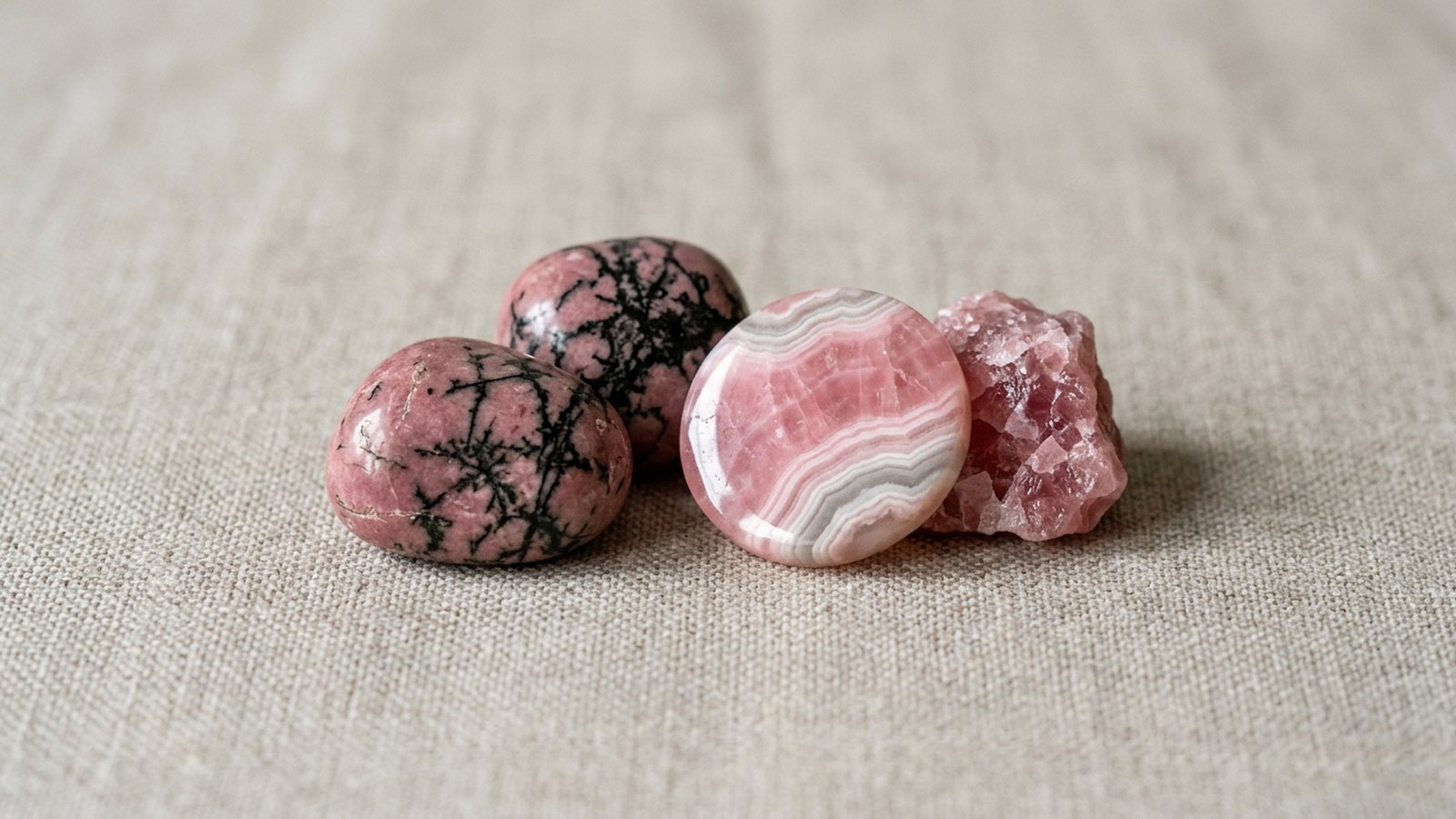
Someone hands you a pink stone with black markings and calls it rhodonite. Someone else hands you a pink stone with pale stripes and calls it rhodochrosite. At markets, and in a fair number of online shops, the label is closer to a coin flip than to a fact. I have bought both stones under the wrong name. The second time I knew better and bought the piece anyway, because it was lovely and cheap, but I would rather you knew what you were paying for.
Here is the short answer, and then I will show you how to settle it in your own hands.
Rhodonite is a manganese silicate. Rhodochrosite is a manganese carbonate. Both take their pink from the same element, and both are named after the Greek word for rose. What that manganese is bonded to is the whole difference, and it decides everything else. Rhodonite is dusty pink to rose red, cut through with black veins, and hard enough for daily wear at 5.5 to 6.5 on the Mohs scale. Rhodochrosite is a brighter raspberry pink banded in soft white and grey, and it is soft, 3.5 to 4, soft enough that a steel pin marks it and a squeeze of lemon dulls it.
The one difference that causes all the others
In rhodonite, manganese sits inside a silicate structure, chains of linked silicon and oxygen, formula (Mn,Fe,Mg,Ca)SiO3, triclinic system. Silicate chains hold. That is why rhodonite is quarried in solid masses, and why it can be cut into a ring, a bowl, or, as the Russian imperial workshops proved with a single Ural block, a seven ton sarcophagus.
In rhodochrosite, the manganese is bonded to a carbonate group instead: MnCO3, trigonal system. Carbonates are the soft touch of the mineral world. Rhodochrosite has three directions of perfect cleavage, which means it does not merely scratch, it splits along flat planes if you knock it against a table edge. It reacts with acid. It sits at 3.5 to 4 on a scale where ordinary household dust, which is mostly quartz, sits at 7.
Read that paragraph twice and you can predict the rest of this guide. Rhodonite survives a ring worn every day; rhodochrosite does not. Rhodonite gets carved into every shape a workshop can turn; rhodochrosite gets sliced and polished flat, because flat is what its structure allows. Rhodonite tolerates a quick rinse; on rhodochrosite, sweat, citrus and bathroom cleaner all etch the surface. And fine rhodochrosite costs many times what fine rhodonite costs, for reasons I will come to.
Your eye will do most of the work
Both stones are pink and both are marked, so people reach for hardness tests far too early. As with onyx and obsidian, the tell is sitting on the surface. Look first, because the markings are not only different in appearance. They have opposite origins.
Rhodonite's black veins are manganese oxide, and they formed where the mineral oxidised on contact with air and water. They are alteration. Damage, if you want to be blunt. That is why raw rhodonite so often arrives looking like a dull brown-black lump with a hint of pink at a chipped corner, and why the veining is irregular and branching, running wherever the weathering happened to run.
Rhodochrosite's pale bands are the opposite. They are growth. In the Argentinian material the stone built up layer by layer inside cavities in hydrothermal veins, frequently as stalactites, some of them more than 30 cm long. Slice one across and you get the concentric pink and white bullseye that most people picture when they hear the name. Those bands are soft edged, roughly parallel or roughly circular, and they never branch the way a vein branches.
One stone is marked by what happened to it afterwards. The other is marked by how it was built. That is a genuinely useful thing to hold on to, and not only for identification.
Colour helps once you have both in front of you. Rhodonite reads dusty, a rose with grey behind it. Rhodochrosite reads sweeter and more saturated, raspberry to candy pink, and it is often faintly translucent at a thin edge held to a lamp, where rhodonite stays flatly opaque.
The comparison at a glance
| Rhodonite | Rhodochrosite | |
|---|---|---|
| Mineral class | Manganese silicate (a pyroxenoid) | Manganese carbonate |
| Formula | (Mn,Fe,Mg,Ca)SiO3 | MnCO3 |
| Crystal system | Triclinic | Trigonal |
| Mohs hardness | 5.5 to 6.5 | 3.5 to 4 |
| Cleavage | Two directions, chips flat | Three perfect directions, splits |
| Colour | Dusty pink to rose red, opaque | Raspberry to rose pink, often translucent |
| Markings | Black manganese oxide veins, irregular | White or grey bands, parallel or concentric |
| Reaction to acid | None | Fizzes |
| Streak | White | White |
| Everyday wear | Fine, with sensible care | Pendants, pockets and shelves only |
| Main sources | Urals, Peru, Australia, Brazil, Madagascar | Argentina, Colorado, Peru, South Africa, Mexico |
| Price | Inexpensive | Cheap when banded, very costly when gem grade |
| Traditional role | Repair after someone hurt you | Warmth turned back toward yourself |
Four tests, from the safest to the one that leaves a mark
1. A UV torch, which also catches the stone nobody warns you about. Shine longwave ultraviolet on the piece in a dark room. If it answers with a vivid, almost neon pink glow, you are very probably holding mangano calcite rather than rhodochrosite, which shows little or no fluorescence. Rhodonite does not glow either. This is the only test on this list that costs the stone nothing at all, which is why I put it first.
2. A steel pin, somewhere nobody looks. A steel point sits at roughly 5.5 on the Mohs scale. Rhodochrosite at 3.5 to 4 takes a mark with almost no pressure. Rhodonite at 5.5 to 6.5 resists, or leaves nothing more than a smear of metal you can wipe away. Test on the base of a tumble or the back of a cabochon, never on the face, and press gently: you are looking for whether it marks, not how deep you can go.
3. Skip the streak test. Both minerals leave a white streak on unglazed porcelain. A page currently ranking on the first results page for this very comparison tells readers that rhodonite's streak comes out closer to its own colour. It does not, and the test separates nothing here. It is a good test for hematite, whose blood red streak gave it its name, and a waste of effort on these two.
4. Vinegar, last, and only on a piece you can afford to spoil. Carbonates react with acid. A drop of white vinegar on rhodochrosite produces a faint fizz of carbon dioxide, weak with vinegar and brisk with a stronger acid, while rhodonite sits there and does nothing. It is decisive, and it permanently etches the spot you tested. I have used it perhaps twice, both times on a broken offcut. If you would mind a dull patch, do not do it.
The third pink stone in the tray
Mangano calcite is the reason so many "rhodochrosite" tumbles feel wrong. It is a manganese bearing calcite, also a pink carbonate, also softly banded, and softer still at around 3 on the Mohs scale. It turns up under the rhodochrosite label constantly, sometimes through carelessness and sometimes not. It is a lovely stone in its own right, but it is not what you paid for, and the UV torch settles it in a second.
| Stone | Quick tell |
|---|---|
| Rhodonite | Pink with black branching veins, opaque, resists a steel pin |
| Rhodochrosite | Raspberry pink with white bands, translucent edge, fizzes in acid |
| Mangano calcite | Pale pink, glows vivid pink under UV, marks with a fingernail-hard point |
| Rose quartz | Even pale pink throughout, no bands, no veins, scratches glass |
If you are new to this kind of checking, our guide on how to tell if a crystal is real covers the general method, and crystal colours and their meanings explains why so many unrelated minerals arrive in the same shade.
Why rhodochrosite can cost so much more
This is the question underneath most of the searching, so here is the honest mechanics of it. Banded rhodochrosite slices are cheap and always have been. What costs money is transparent, gem quality crystal, and it is rare for a structural reason: a mineral at 3.5 to 4 with three perfect cleavages is close to unfaceteable. Cutters lose stones on the wheel. The finished gems mostly go to collectors who will never wear them.
The material that built the reputation came from the Sweet Home Mine at Alma, Colorado, an old silver mine that turned out to be a rhodochrosite mine. In 1992 it gave up the Alma King, a deep cherry red rhombohedron roughly 14 by 16 cm, the finest large rhodochrosite crystal known, now at the Denver Museum of Nature and Science. Rhodochrosite became Colorado's state mineral in 2002. The mine is finished.
The other great source is Capillitas, in Catamarca, Argentina, at about 3,000 metres in the Andean foothills, where the banded and stalactitic material forms in veins around seven million years old. Argentines call it rosa del Inca, Inca rose, and it is the national stone. Archaeology confirms Inca mining at Capillitas from the 1300s, though for placer gold, and the story you will hear that the pink is the blood of Inca rulers is dealer folklore rather than history. I like it anyway, as long as we call it what it is.
Rhodonite, by contrast, quarries in large solid masses, which is exactly why the Russians could think in tons. That abundance keeps it cheap, and cheap is not an insult. It is the reason you can own a piece big enough to hold in your whole hand.
What each stone is actually for
Both are heart chakra stones, and if you stop there you will pick the wrong one. Traditionally they work on different wounds, and the distinction is worth being precise about.
Rhodonite is the stone of repair after someone else hurt you. Betrayal, abandonment, the friendship that ended badly, the apology that never came. In that tradition it is associated with forgiveness, which people misread as being asked to excuse something. I read it as the work of putting yourself back together while the other person stays exactly as wrong as they were. Its black veins make the metaphor almost too neat: the stone was changed by what it went through, and the marks are what people carve it for. It carries the heart chakra with a steadying pull toward the root, and I usually suggest it alongside our guide to crystals for grief and loss. The full story is in the rhodonite meaning guide.
Rhodochrosite is turned the other way, inward. It belongs to self worth, to the part of you that is fluent in warmth toward everyone except yourself, and it is the stone most often reached for in inner child work. Where rhodonite meets an injury that came from outside, rhodochrosite meets the one you keep repeating on yourself. It sits with the heart chakra and, in many traditions, reaches down toward the solar plexus, since self worth is not only a tender matter but a matter of standing up, which is where it overlaps with crystals for confidence. If that is your season, crystals for self-love is the companion piece.
These are inherited associations and my own reading of two stones I have kept for years. They are not medicine. A stone in your pocket is a reminder of an intention you set, and if what you are carrying needs a doctor or a therapist, please go and get one. That advice has never once cost anybody anything.
Can you use them together?
Yes, and the pairing is coherent: an injury from outside and an injury from inside are usually the same story told from two ends. Keep one in each hand while you sit, as in meditating with crystals, or place them together somewhere you pass daily, the way I describe in where to place crystals in your home.
One practical caution that nobody mentions. Do not store them loose in the same pouch. Rhodonite at 5.5 to 6.5 will scratch rhodochrosite at 3.5 to 4 every time they knock together, and the damage runs one way only. Wrap the rhodochrosite separately in a soft cloth. The same logic governs any pair with a hardness gap, which is half the point of the piece on amethyst and rose quartz together, where the two stones happen to be the same mineral and cannot hurt each other at all.
Caring for them is not the same job
Almost every page comparing these two gives them one set of instructions: rinse under running water, leave out under the full moon. The moonlight is harmless. The water is not, and it is wrong for each stone in a different way.
Rhodochrosite is a carbonate, so acid is its enemy long before water is. Skin oils, sweat, perfume, citrus juice, a splash of descaler on a bathroom shelf: all of them dull the polish, and the etching does not buff out. At 3.5 to 4 it is also softer than the dust that settles on it, so wiping it dry with a rough cloth slowly scuffs the surface. Dry, soft cloth. No salt, no soaking, no ultrasonic cleaner, and take a rhodochrosite pendant off before you shower.
Rhodonite is tougher and can take a brief rinse, but it has its own weakness, and it is the same manganese that gives it the veins. Manganese keeps oxidising in damp and strong sun, so a piece left on a bright windowsill dulls and browns over time. It also has two cleavage directions meeting at about 92.5 degrees, so despite a respectable hardness it chips flat rather than rounding off when dropped. Rinse briefly, dry it, keep it out of long sunlight.
Our general notes are in which crystals can and cannot go in water, cleansing your crystals and how to charge your crystals. For these two, dry methods are the whole answer.
So which should you buy?
If you want one pink stone to live with, wear on a chain, keep in a pocket and not think about, buy the rhodonite. It is inexpensive, it is forgiving, and it holds up to being handled, which for me is most of the point of a stone you actually work with rather than display. Read carrying and wearing stones and then just carry it.
Buy the rhodochrosite when the colour stops you, or when self worth is genuinely the work in front of you, and accept that you are buying something delicate. Keep it on a shelf or in a lined box, wear it occasionally and carefully, and never let a shop tell you a soft carbonate is a practical ring stone.
And if you are still not certain which one is sitting in your hand right now: look for branches or bands, then find a UV torch. It takes ten seconds, and you will never have to ask again.