For about a year I kept a small bowl on the shelf by my front door with three stones in it: a piece of hematite, a tumbled lepidolite and a tiger's eye. Each morning I took one of them on my way out, and after a while I noticed that the choice was never random. On the days I felt scattered I reached for the hematite. On the days my mood had been swinging since breakfast it was the lepidolite. When the diary was full and I already felt behind, it was the tiger's eye. The bowl had turned into a quick way of asking myself what, exactly, was out of balance that day.
That is how I have come to think about crystals for balance. The word covers several different feelings, and the stones tradition links to balance answer them in different ways. This guide is sorted by the kind of imbalance you are living with, with the stones I would pick for each, how I use them, and an honest note on what they cannot do.
The short answer
The stones most often named for balance are hematite and smoky quartz for grounding, lepidolite and amethyst for emotional swings, tiger's eye for juggling too many demands, moonstone for living with natural cycles, fluorite for mental clutter, and green aventurine for balancing what you give and what you receive. Clear quartz is the all-round choice when you cannot name the problem yet, or when you work with all seven chakras at once.
What balance means in crystal practice
In crystal tradition, balance usually means one of three things. The first is emotional steadiness, the ability to feel what you feel without being thrown by it. The second is grounding, a sense of being present in your body and your day, which is why so many balance lists overlap with lists of grounding stones. The third is energetic balance in the chakra system, where no centre is thought to be overactive or neglected, a subject I cover at length in my chakra crystals guide.
I want to be plain about the limits before going further. A crystal does not regulate hormones, the nervous system or the inner ear. What a chosen stone does well is serve as an anchor: an object you picked for a reason, which you touch several times a day and which brings you back to the state you are working towards. I have found that reminder genuinely useful, and it works best alongside sleep, food, movement and, when you need it, professional help.
When you feel scattered and ungrounded: hematite and smoky quartz
This is the most common kind of imbalance I hear about. Your thoughts run ahead of you, you walk into rooms and forget why, and your body feels like something you are carrying around. Tradition answers this with heavy, dark stones tied to the root chakra.
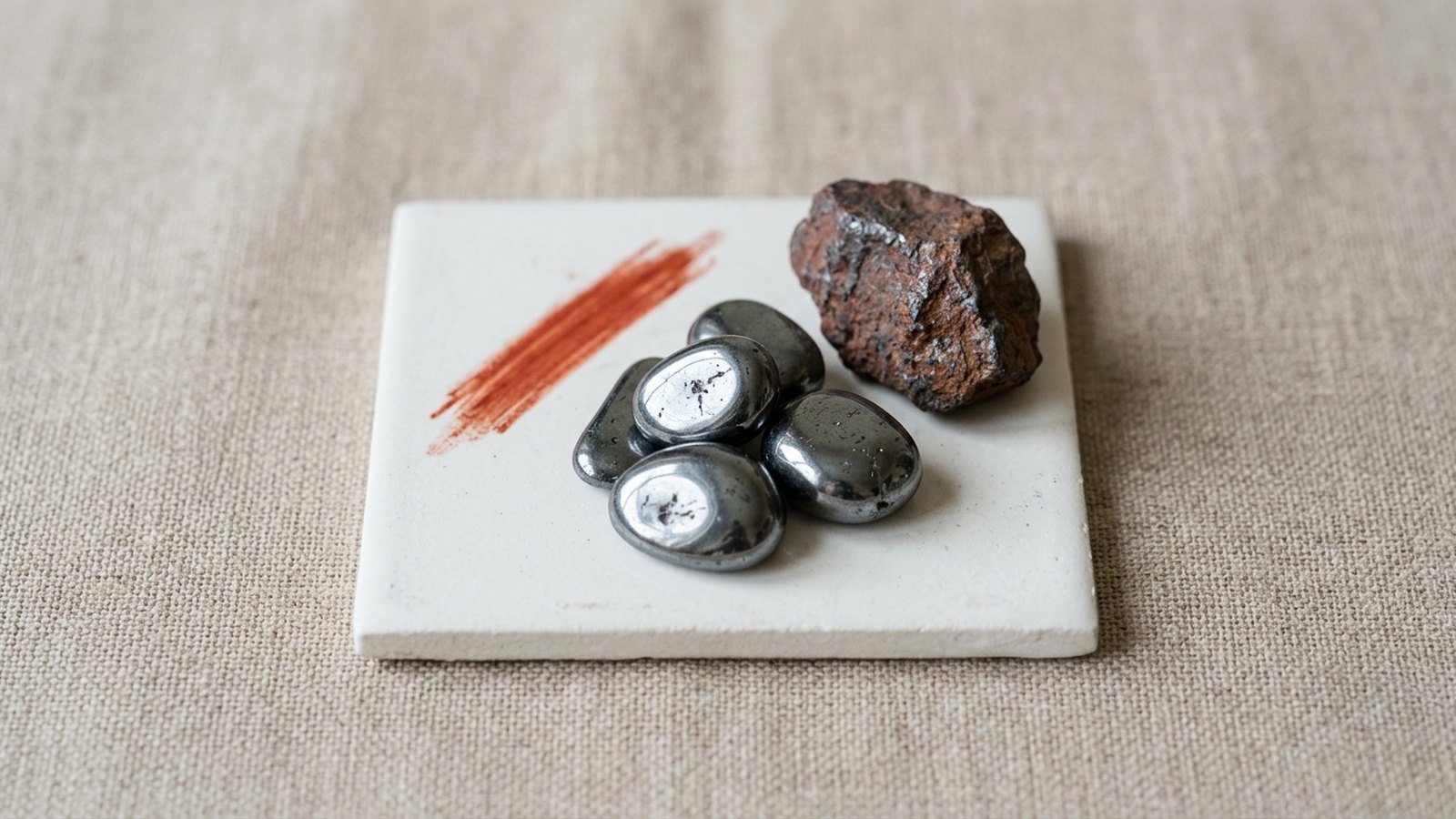
Hematite is an iron oxide, Fe₂O₃, with a hardness of about 5.5 to 6.5. Polished, it looks like dark silver, yet it leaves a rust red streak on unglazed porcelain, which is where its name comes from (haima is Greek for blood). Its weight in the hand is the whole point for me. I hold it in a closed fist for a minute before a busy day and let my attention sink into that weight.
Smoky quartz is the gentler option if hematite feels too heavy or too cold. It is ordinary quartz whose brown to grey colour comes from natural radiation acting on traces of aluminium in the crystal. I keep a smoky quartz point on my desk as a visual cue to breathe out.
Who it suits less: if you already feel sluggish and flat, the grounding stones can add to the heaviness. In that case, look at the warm stones in the fatigue section below.
When your moods swing: lepidolite and amethyst
Some imbalance is emotional weather that changes too quickly: irritable at ten, tearful at noon, fine by four and unsure why. For this, the stone most crystal workers reach for is lepidolite, a lilac mica that contains lithium. The lithium content is a real mineralogical fact, and I want to say clearly that holding the stone does not deliver lithium to the body in any meaningful way. Tradition treats lepidolite as a settling stone, and its soft, pearly sheen does feel calming to hold.
Lepidolite is soft, around 2.5 to 3 on the Mohs scale, and it flakes. Keep it dry and away from harder stones in a pouch.
Amethyst is the classic companion here, linked to the third eye and crown and to a quieter mind in the evening. If your mood swings sit close to worry and racing thoughts, my guide to crystals for anxiety goes deeper on that pattern.
Who it suits less: if the swings are severe, last for weeks, or come with thoughts of harming yourself, please see a doctor. A stone can keep you company through that process and should never stand in for it.
When too many demands pull at you: tiger's eye
Work-life balance is what many people mean when they search for this. Too many roles, not enough hours, and the constant sense of being pulled in several directions. Tiger's eye is the stone tradition gives to this situation, associated with the solar plexus chakra, willpower and clear priorities.
Geologically, tiger's eye is quartz grown in and around fibres of an amphibole mineral, crocidolite, which gives it that moving band of golden light called chatoyancy. It is hard, at about 7, and very forgiving to carry every day.
I use it with a small routine. When I sit down to plan the week, I hold the stone and write down the three things that genuinely must happen. Everything else goes on a second list. The stone gives the planning session a clear starting point, and after a few weeks I find it easier to settle into that choice. If focus itself is your struggle, my list of crystals for focus pairs well with this.
Who it suits less: people who are already overdriven and need rest more than direction.
When you want to live with your cycles: moonstone
Some people come to balance through rhythm: sleep and waking, work seasons, the menstrual cycle, the months of the year. Moonstone has been tied to the moon and to cyclical change for a very long time, and it is the stone I suggest to anyone who wants to stop fighting their own ups and downs.
Moonstone is a feldspar in which two minerals, orthoclase and albite, separate into thin alternating layers as the rock cools. Light scattering between those layers creates the blue or silver glow called adularescence. It sits at about 6 to 6.5 on the Mohs scale and has cleavage, so it can chip if knocked.
A gentle practice: note in a small journal where you are in your week or month each time you hold the stone. Over two or three months, patterns appear, and knowing them is a form of balance in itself. I describe a pairing I love for this in amethyst and moonstone. A clear note here: moonstone is not a treatment for hormonal or menstrual problems, and those deserve a doctor's attention.
When your mind is cluttered: fluorite
Mental imbalance often looks like too many open tabs. Fluorite, calcium fluoride (CaF₂), is the traditional stone for order and structure, and its natural cubic crystals and neat colour bands make that association easy to feel. I keep a fluorite on my desk and pick it up whenever I notice I have started three tasks and finished none.
Fluorite is soft, a 4 on the Mohs scale, with perfect cleavage in four directions, so it chips easily. Some pieces also fade in strong sunlight. Treat it as a desk stone and avoid carrying it loose in a bag.
Who it suits less: if the clutter comes from anxiety rather than overload, amethyst or lepidolite usually help me more.
When you give more than you receive: green aventurine
There is also a relational kind of imbalance, where you look after everyone and have little left for yourself. Green aventurine is a heart chakra stone in tradition, linked to ease, openness and a healthy flow of giving and receiving. The heart chakra is often described as the balancing point between the lower and upper chakras, which is part of why green stones appear on so many balance lists.
Green aventurine is a quartz rock whose sparkle, called aventurescence, comes from tiny flakes of a green chromium mica named fuchsite. It is hard and inexpensive, a good stone to wear. I suggest a bracelet or a pocket stone as a reminder to accept help when it is offered. For more on how to wear stones, see carrying and wearing stones.
When you cannot name it: clear quartz
Some days you simply feel off. Clear quartz is the stone tradition calls the master healer, thought to amplify whatever intention you set with it. That makes it a sensible starting point when you are unsure. Hold it, ask yourself what feels out of balance, and write the first answer down. Often that answer tells you which of the stones above to reach for next.
Physical balance, dizziness and fatigue
People searching for crystals for balance sometimes mean physical balance, and the questions show it: is there a crystal for vertigo, what crystals help with fatigue. I will answer as honestly as I can. There is no crystal that treats dizziness or vertigo. Those symptoms can come from the inner ear, blood pressure, medication or other causes a doctor should check, and sudden dizziness with other symptoms needs urgent care.
For ordinary tiredness, tradition turns to warm, red and orange stones such as carnelian and red jasper, linked to vitality and stamina. I like them as a morning reminder to move and eat properly. Tiredness that lasts for weeks is worth a medical check.
Caring for your balance stones
Several stones on this list are softer than people expect, and a few should never soak in water. Here is how I look after them.
| Stone | Mohs hardness | Water | Sunlight |
|---|---|---|---|
| Hematite | 5.5 to 6.5 | Avoid, can rust | Fine |
| Smoky quartz | 7 | Brief rinse fine | Can fade over time |
| Lepidolite | 2.5 to 3 | Avoid | Fine |
| Amethyst | 7 | Brief rinse fine | Fades, keep out of direct sun |
| Tiger's eye | 7 | Brief rinse fine | Fine |
| Moonstone | 6 to 6.5 | Brief rinse fine | Fine |
| Fluorite | 4 | Avoid soaking | Some pieces fade |
| Green aventurine | 6.5 to 7 | Brief rinse fine | Can fade slightly |
For gentle cleansing without water, smoke, sound or moonlight all work well, and my guide to cleansing crystals covers each method. The crystal and water safety guide lists many more stones.
One more practical warning. Much of the shiny grey "magnetic hematite" sold in bracelets is a manufactured material, sometimes called hematine, and natural hematite is only very weakly magnetic. If your stone snaps firmly onto a fridge magnet, it is almost certainly the manufactured version. My guide on how to tell if a crystal is real explains other simple checks.
How I use crystals for balance day to day
I keep the approach simple, since a short routine is easier to keep up over several weeks.
- Name the imbalance. Before choosing a stone, finish the sentence "Today I feel off because..." in a few words.
- Choose one stone. A single stone with a clear purpose is easy to remember.
- Tie it to a moment. Hold it at the same point each day, such as your first coffee, the commute home or before bed.
- Breathe with it. Three slow breaths while holding the stone, attention on its weight and temperature.
- Check in after two weeks. Ask whether that daily moment has changed anything. If it has not, try another stone from the list, or a different moment.
If you like working with pairs, one grounding stone with one calming stone (hematite with amethyst, for example) is a combination I return to often.
A last word
In my experience balance comes from small daily adjustments, and a stone in your pocket can make those adjustments a little easier to remember. Start with the situation that sounds most like yours, pick one stone, and give it a few weeks before you judge.