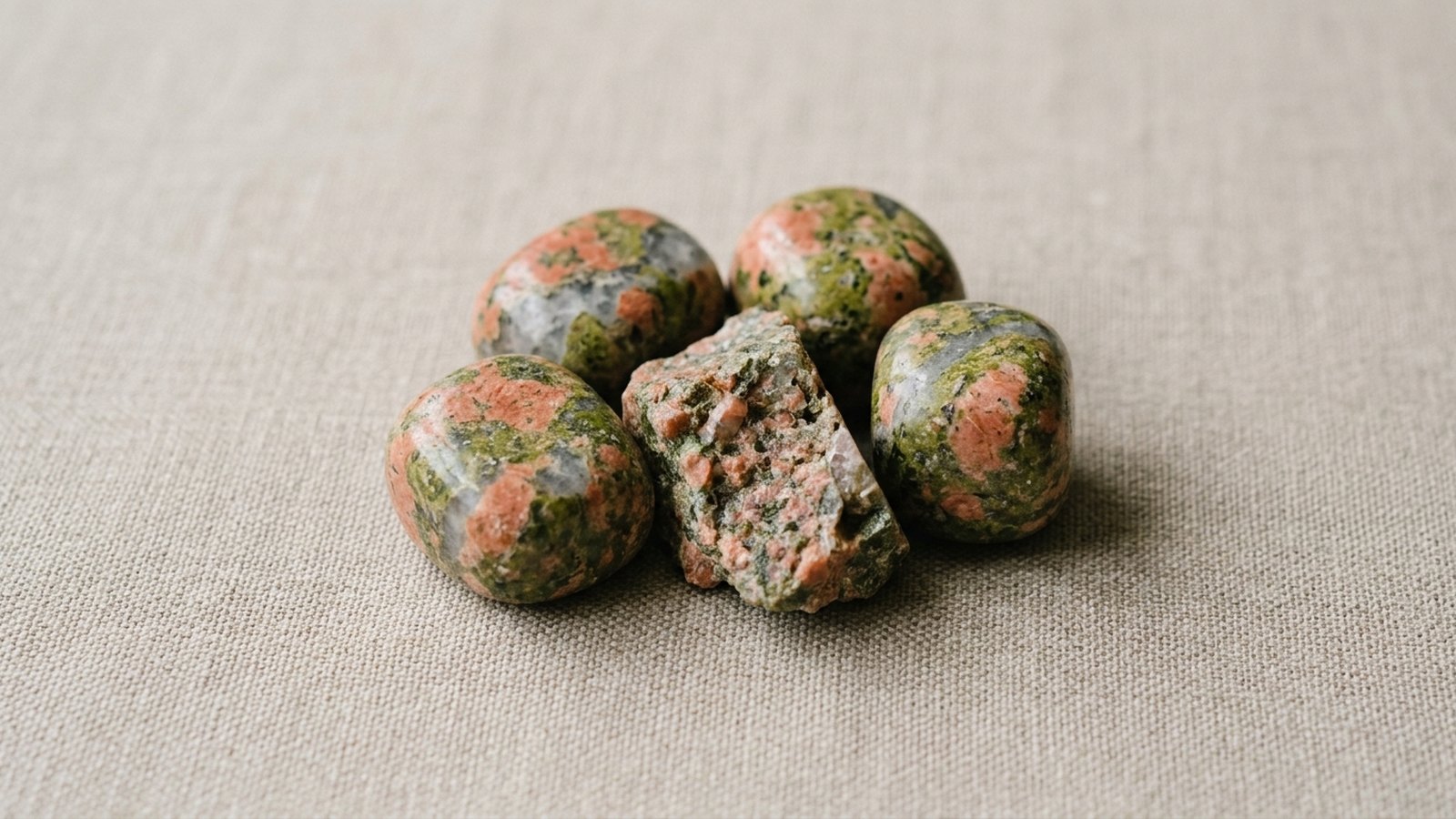
Unakite is not a mineral. It is a rock, an ordinary granite that hot water got into and quietly rebuilt, and it is made of three things you can pick out with your naked eye: salmon pink potassium feldspar, olive green epidote, and grey or colourless quartz. In crystal tradition it is a heart stone, the one people reach for when something has to be felt through slowly rather than fixed quickly.
Say it YOO-nuh-kite. Nobody on the first page of Google tells you that, and it comes up often enough that it is worth putting near the top.
I keep a tumbled piece on the windowsill above my sink, and what I notice every time is how coarse it is. Most stones in a crystal shop are smooth to the eye, one substance all the way through. Unakite is visibly a crowd. You can see where one grain stops and the next begins, and once you know what caused those grains to end up pink and green in the first place, two other things fall into place: why so many guides call it a jasper when it is nothing of the kind, and why a unakite bracelet can survive a decade of daily wear or chip in a fortnight depending on how you treat it.
What Unakite Actually Is
Unakite is an epidotized granite. The parent rock is igneous, a coarse-grained granite that crystallised at depth, and the pink and green pattern is damage, in the geological sense of the word. Hot mineral-rich fluid moved through the rock and altered it. Geologists sometimes shorthand this as metamorphic, which is why you will find sources calling it igneous and sources calling it metamorphic and both sounding confident. The honest answer is that unakite is an igneous rock that has been chemically altered, and both halves of that sentence matter.
The three components are worth naming properly, because they explain everything that follows:
- Epidote, Ca2(Al,Fe)3(SiO4)3(OH), gives the green. It runs from pistachio to a deep moss, and it is the newcomer in the rock.
- Potassium feldspar (orthoclase or microcline), KAlSi3O8, gives the pink, which ranges from pale salmon to a dusty brick red. This is the same mineral family as amazonite, just a different colouring agent.
- Quartz, SiO2, is the grey, white or glassy filler between the other two, and it is the same mineral as clear quartz.
The name comes from the Unaka Range, part of the Blue Ridge Mountains straddling the North Carolina and Tennessee border, where the rock was first described in the 1870s. Mohs hardness sits at 6 to 7. Specific gravity runs 2.8 to 3.2, noticeably denser than plain quartz, which is why a unakite bead feels a little heavier in the palm than it looks.
Why the Pink and the Green Sit Apart
Here is the part almost every guide leaves out, and it is the most interesting thing about the stone.
Granite contains two kinds of feldspar: plagioclase (calcium and sodium bearing) and potassium feldspar. When hydrothermal fluid moves through, those two do not behave the same way. The plagioclase is chemically vulnerable. It gets attacked first, clouding over as fine epidote begins to grow along its cleavage planes and twin lamellae, and with enough alteration it is replaced outright by a granular mass of epidote. The potassium feldspar largely shrugs the fluid off and stays as it was.
So the green in your unakite is not a mineral that was mixed in. It is a ghost. Each green patch is standing where a plagioclase grain used to be, keeping roughly its old shape, which is what geologists call a pseudomorph. The pink patches are the original granite that survived unchanged.
That is why the two colours sit in discrete blotches rather than swirling into each other the way banding does in moss agate. You are not looking at a pattern. You are looking at a map of which grains gave way and which did not, and I find that a hard image to forget once you have it.
Reasons to Work With Unakite
Unakite is for the slow griefs, the ones that do not resolve on a schedule. It has a reputation as a patient stone rather than a fast one, and in my experience that reputation is earned by what it does not do: it does not push. If you are working through a loss, it belongs alongside the approaches in crystals for grief rather than in place of them.
Unakite is for people who keep restarting the same habit. Traditional lore ties it to breaking cycles, and the way practitioners usually describe it is that unakite surfaces the feeling underneath the habit instead of attacking the habit itself. Whether you read that as the stone or as the ritual of holding something while you think, the reframe is a useful one.
Unakite is for the heart that has gone armoured. Rose quartz is the soft, open version of heart work. Unakite is the version for someone who is not ready to be soft yet, which is why I often suggest it to people who find rose quartz cloying. If that is you, crystals for self love covers the wider set.
Unakite is for beginnings you are ambivalent about. A new job you are not sure of, a move you half regret, a reconciliation you are approaching sideways. The green and pink together read, in tradition, as growth and gentleness at once, and that is a fair description of what an ambivalent beginning actually needs.
Unakite Meaning: Healing Energy
Everything in this section is traditional lore and personal practice, offered as tradition rather than fact. No stone treats an illness, and nothing here replaces medical or psychological care.
Emotional healing. Unakite's core reputation is emotional release at a survivable pace. It is associated with anger and resentment that have been carried too long to name easily, and with the specific work of letting something surface without being overwhelmed by it. If anxiety is the presenting problem rather than grief, crystals for anxiety is the better starting point.
Spiritual healing. Because epidote is associated with growth and increase, unakite is traditionally read as a stone of patient becoming rather than sudden insight. Several older sources also link it to the third eye and to visualisation work, which is where it turns up in practices like crystals for manifestation.
Mental healing. The pairing people describe most often is grounded perspective: enough steadiness to look at something difficult, and enough distance not to be inside it. That is a reasonable thing to ask of a stone you hold while you think.
Physical healing. Folk tradition ties unakite to pregnancy, fertility and convalescence, and I want to be plain that these are cultural associations with no clinical evidence behind them. Treat them as lore, and take real symptoms to a doctor.
The Properties Block
- Chakras: heart, primarily. Third eye as a secondary association. See the chakra crystals guide for how to place it.
- Zodiac: Scorpio, most commonly. See the note below.
- Element: Earth, in most modern listings.
- Numerical vibration: 9, where sources give one at all.
- Affirmation: I am allowed to heal at the pace healing actually takes.
Why Sources Disagree About the Zodiac
If you search "unakite zodiac" you will get a confident answer, and if you search twice you will get two. Of the pages currently ranking, four say Scorpio, one adds Taurus and Cancer, and one states outright that unakite has no zodiac association at all while simultaneously listing it as a natural birthstone for 20 April to 20 May, which is Taurus.
None of them acknowledge the others. I would rather tell you what is actually going on: unakite is a modern addition to crystal practice, too recent to have inherited a fixed classical attribution the way amethyst or garnet did. Scorpio is the majority reading and a defensible one, given the stone's association with buried emotion. Taurus is the fair reading if you weight the earthy, patient, growth-oriented side. Pick the one that matches why you bought it.
Wearing Unakite Every Day
This is the question the search results are really asking, in four different phrasings, and not one of the top pages answers it properly. Most simply quote Mohs 6 to 7 and imply that settles it.
It does not, because 6 to 7 is an average across three different minerals, and averages hide failure modes. Quartz is a 7 and has no cleavage at all: it fractures conchoidally, like glass. Potassium feldspar is a 6 and has two directions of good cleavage meeting at close to a right angle. Epidote is a 6 to 7 with one direction of perfect cleavage. So the rock as a whole has no single plane it splits along, which is good, but every individual grain in it has a preferred way of coming apart.
What that means in practice is that unakite does not scratch easily and does chip easily. A pink grain sitting at the edge of a bead can pop off along its own cleavage after one knock against a doorframe, leaving a small pale crater, while the bead beside it is untouched. Coarse grain boundaries make it worse: the rock has thousands of tiny internal interfaces for an impact to travel along.
The practical rules follow directly:
- A bracelet is fine, a ring is a bad idea. Hands hit things. Wrists mostly do not.
- Take it off for the gym, gardening, cooking and washing up. Grit and hard surfaces, not water, are the enemy.
- Store it apart from quartz and harder stones, which will mark it in a drawer over time.
- Prefer larger, rounder beads to chips. Chip bracelets have the most exposed edges per gram, and they are the ones people report losing pieces from.
For which wrist, the usual convention is the non-dominant hand for receiving and the dominant for projecting. Carrying and wearing stones goes into that properly.
Cleansing, Charging and Care
Unakite is one of the genuinely low-maintenance stones, and for a checkable reason: none of its three components is water-soluble, and neither of its colouring mechanisms is fade-prone. Epidote's green comes from iron in its crystal structure and potassium feldspar's pink from trace iron oxide, both stable. So unlike fluorite or amethyst, unakite will not pale on a sunny windowsill, and unlike selenite it will not degrade in water.
A rinse under cool running water and a soft cloth is all it needs. Skip salt water, which finds its way into grain boundaries, and skip ultrasonic cleaners, which are unkind to any coarse rock with internal fractures. Crystals and water safety has the full list of stones that cannot take this treatment.
For energetic cleansing, moonlight, smoke, sound or a night on the earth all suit it. How to charge crystals covers the methods in detail.
Where Unakite Comes From, and How to Buy It Well
The Unaka Range gave the rock its name, but very little commercial material comes from there now. Most tumbled unakite on the market originates as beach pebbles and glacial drift cobbles around Lake Superior and the Great Lakes, worn round by ice and water long before anyone polished them. There is also production from Virginia, South Africa, Brazil, China, Sierra Leone and Zimbabwe.
It is durable enough to work as architecture. The most prominent example is the Smithsonian National Museum of Natural History in Washington, where unakite trims the front steps and tiles a landing at the south entrance. Several million visitors a year walk on it, which is a reasonable argument for a bracelet.
On the "unakite jasper" label. You will see it constantly, including from one page currently ranking on the first results page. It is wrong, and the reason it is wrong is also the easiest way to identify real unakite. Jasper is microcrystalline quartz: its grains are far too small to see, so a jasper surface reads as one continuous colour, which is exactly the point made in jasper vs agate. Unakite is coarse-grained granite. If you can see individual grains with your naked eye, it is not a jasper.
Genuine unakite is rarely dyed or treated, which makes it a safe buy. Two quick checks: real unakite always shows some pink, even a little, and a cotton pad with acetone should lift no colour at all. It will also feel cold to the touch and stay cold for a moment, where a plastic imitation warms up almost at once. How to tell if a crystal is real covers the general method.
A Last Thought
What I like about unakite is the honesty of it. It does not pretend to be one clean thing. It is a rock that was altered, that kept some of what it was and let the rest be replaced, and it wears the record of that on its surface where anyone can see it. If you are in the middle of a change you did not entirely choose, that is not a bad object to have in your pocket.
If you want a companion for it, green aventurine suits the growth side and rhodonite suits the wound side. Start with whichever half you are actually working on.