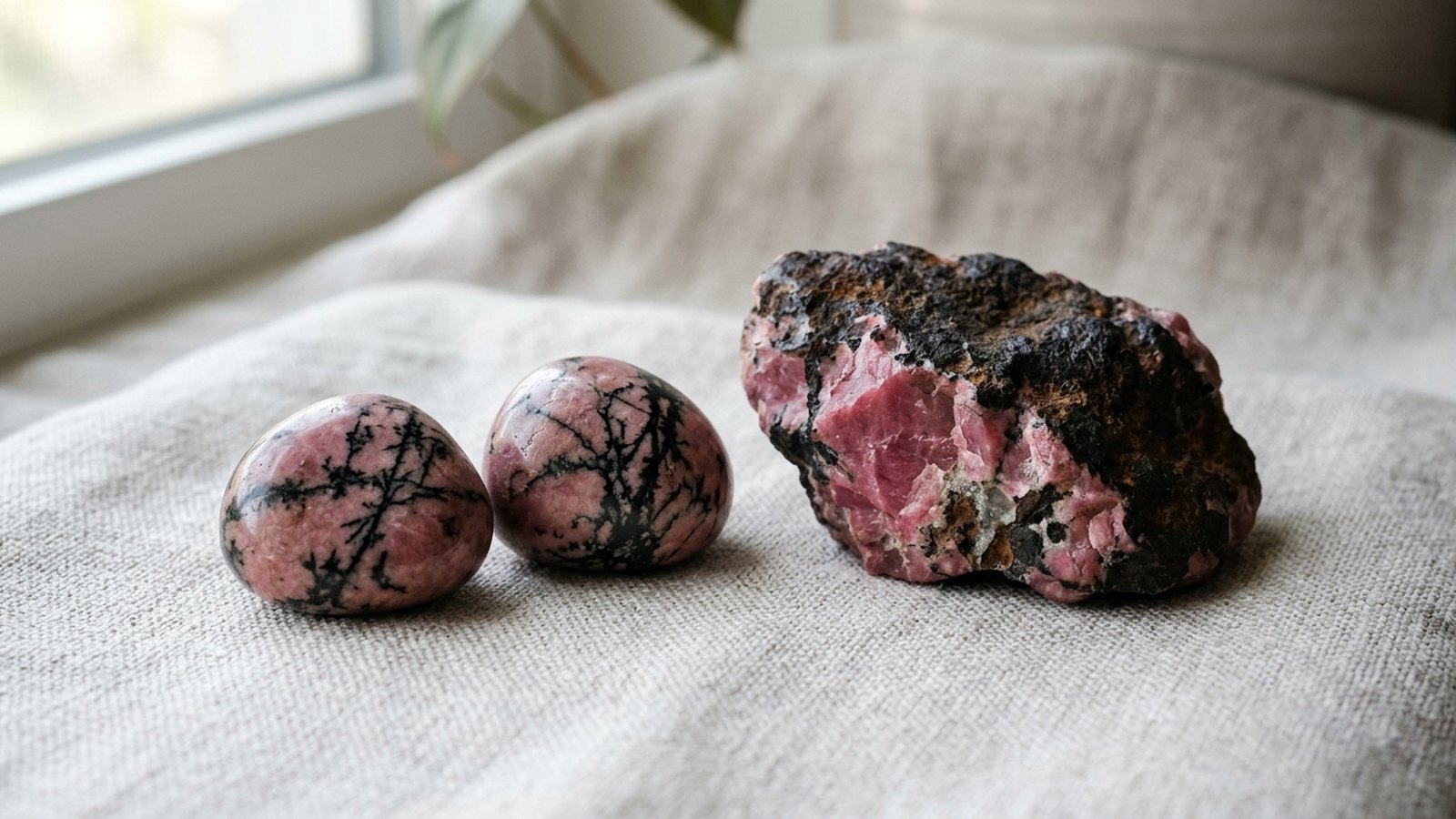
Rhodonite is easy to recognise and hard to forget. The body of the stone is a dusty rose, somewhere between raspberry and old brick, and running through it are veins of pure black that branch like ink dropped into water. No two pieces are marked the same way.
Rhodonite is a manganese silicate mineral, formula (Mn,Fe,Mg,Ca)SiO3, and in crystal tradition it means compassion, forgiveness and emotional repair. More precisely than that, it is the stone people reach for after being hurt by someone they loved. Not general sadness, not everyday stress. The specific ache of betrayal, of an ending you did not choose, of a friendship that quietly went wrong.
Here is the part that made me keep a piece of it on my desk for years. Those black veins are not decoration and they are not a flaw. They are manganese oxide, formed where the mineral was altered by exposure to air and water over a very long time. The stone was changed by what it went through, and the marks are what make it beautiful enough to carve. I have never found a better object lesson in a rock.
What rhodonite symbolizes
Rhodonite symbolizes compassion, forgiveness and the slow work of healing an emotional wound without pretending it never happened. Its name comes from the Greek rhodon, meaning rose, for its pink colour, and tradition ties it to the heart chakra with a steadying pull toward the root.
In crystal lore, rhodonite is associated with:
- Forgiveness, including the harder kind you offer yourself
- Emotional repair after betrayal, heartbreak or a friendship that ended badly
- Compassion and generosity, especially outward toward people who are difficult
- Grounded love, love with feet under it rather than love as fantasy
- Steadiness under provocation, the pause between being wronged and reacting
It has picked up a shelf of nicknames over the years: the stone of compassion, the rescue stone, and in Russia, where it has the longest documented history, orletz, the eagle stone.
Reasons to work with rhodonite
Rhodonite is the stone I suggest when someone is stuck in the replay. You know the loop: the conversation you keep re-running, the reply you should have given, the version of events where you come out better. Rhodonite does not erase that loop, and any stone that claims to is overselling. What working with it does, in my experience, is give the loop somewhere to land. Holding a stone while you let the memory run through once, deliberately, is an old technique and a surprisingly effective one.
Rhodonite is a stone for forgiving without excusing. This is the distinction most crystal writing misses. Forgiveness is often sold as deciding the thing was fine. It was not fine. The tradition around rhodonite is closer to something honest: you release your grip on the resentment because carrying it costs you more than it costs them, and you keep the knowledge of what happened. The black in the stone is not polished out. That is the whole point.
Rhodonite is the stone of the person who gives too much. If you are the friend everyone calls at 2am, the one who absorbs other people's moods and then wonders why you are exhausted by Wednesday, this is your mineral. Tradition frames it as a heart stone with a root-chakra anchor, and that combination reads as compassion that does not leak. Care for people, and stay standing. If boundaries are your live issue, rhodonite pairs naturally with black tourmaline for a firmer edge.
Rhodonite is a companion for grief that has gone quiet. Not the first weeks, when nothing helps. Later, in the long flat middle where everyone else has moved on and you are still turning it over. I find rhodonite easier to be around at that stage than the bright, opening stones. It sits with you rather than trying to lift you. Our guide to crystals for grief and loss covers that season in more depth.
Rhodonite meaning: healing energy
Emotional healing
This is where rhodonite earns its reputation. It is traditionally used for wounds with a person's name attached: betrayal, abandonment, a trust that broke. The lore describes it as working on old scars rather than fresh cuts, drawing up what was buried so it can finally be felt and set down. That can be uncomfortable. If you start working with rhodonite and old material surfaces, that is considered the stone doing its job, not going wrong, and it is also a fair signal to go slowly. For the anxious, wide-awake nights that sometimes come with this kind of processing, see crystals for anxiety.
Spiritual healing
Rhodonite is read as a stone of service and shared humanity. Where rose quartz opens the heart inward toward self-acceptance, rhodonite is described as turning it outward: altruism, generosity, the sense that your own healing is connected to everyone else's. Older texts call it a talisman for the brotherhood of humanity, which is dated language for a decent idea. It is a good stone for people whose spiritual practice is mostly practical, mostly about how you treat others.
Mental healing
Traditionally, rhodonite is credited with helping you see both sides of a conflict, which sounds bland until you are actually inside one. The reading I trust most is about interruption: it is used to create space between provocation and reaction. Anyone who has sent a message they regretted within ninety seconds understands the value of that space. It is also associated with talent and vocation, with recognising a gift you have been quietly dismissing, which is why it often shows up alongside stones for confidence and courage.
Physical healing
In traditional lore, rhodonite is associated with the heart and circulation, with the healing of wounds and marks on the skin, and with general recovery after emotional exhaustion. I want to be direct about this: these are folk associations passed down through crystal literature, not medical facts, and rhodonite treats nothing. Some popular crystal encyclopedias make specific claims about serious conditions. Please treat those as lore too. Crystals sit alongside medical and psychological care, never in place of it.
If you want a slower, more patient companion for the same heart work, unakite is the version of it that does not push.
Rhodonite properties at a glance
- Chakras: Heart (Anahata), with a secondary pull to the Root (Muladhara). More on the system in our chakra crystals guide.
- Zodiac signs: Taurus primarily, with Scorpio and Leo often listed
- Element: Fire and Earth
- Numerical vibration: 9
- Planet: Mars
- Affirmation: I release what I am carrying, and I keep what it taught me.
Rhodonite geology: what it actually is
Rhodonite is a manganese inosilicate, a chain silicate, with the formula (Mn,Fe,Mg,Ca)SiO3. Modern mineralogy often writes it as CaMn3Mn(Si5O15) to reflect the calcium in the structure. It crystallises in the triclinic system, the least symmetrical of the seven, which is part of why good crystals are rare and most rhodonite reaches us as a compact massive material rather than as points.
The vital statistics:
- Mineral class: Inosilicate (chain silicate), pyroxenoid group
- Formula: (Mn,Fe,Mg,Ca)SiO3
- Mohs hardness: 5.5 to 6.5
- Crystal system: Triclinic
- Specific gravity: 3.57 to 3.76
- Cleavage: Perfect, on two planes meeting at about 92.5 degrees
- Lustre: Vitreous to pearly
- Streak: White
The pink comes from manganese in its Mn2+ state. Colour runs from pale rose through the classic raspberry to a deep brownish red, and the richest reds usually mean more manganese and less dilution by iron, magnesium or calcium.
Rhodonite forms where manganese-rich sediments get cooked. Manganese oxides settle on ancient sea floors, then heat and pressure from metamorphism, or hot fluids moving through the rock, reorganise them into silicates. That is why rhodonite turns up in metamorphosed manganese deposits and in ore bodies alongside zinc and iron minerals, keeping company with pyroxmangite, franklinite, spessartine garnet and quartz.
The name entered the mineralogical literature in 1819, credited to the German mineralogist C. F. Jasche and published by E. F. Germar, from the Greek rhodon. A few varietal names survive from older texts: fowlerite, the zinc-bearing rhodonite from Franklin, New Jersey, and pajsbergite, the translucent crystallised material from Sweden. Even trained gemmologists get caught out here. In 2020 the GIA reported on rose-red gem material from Tanatz Alp, Switzerland, sold as rhodonite, that turned out to be intergrown rhodonite and pyroxmangite, a close relative that is very difficult to separate by eye.
Why rhodonite has black veins
The black webbing is manganese oxide. When rhodonite is exposed to air and water at or near the surface, the manganese in it oxidises, and the resulting oxides concentrate along fractures and grain boundaries. Wikipedia's mineral data notes it plainly: the exterior of weathered rhodonite is commonly black from manganese oxides.
So the veining is the record of the stone's own alteration. The material was pink all the way through; the dark lines are where it met the world and changed. Every piece of veined rhodonite on a shelf is a mineral that got weathered and came out more interesting. I have handed that fact to a lot of people going through something, and it lands better than any affirmation I could write.
One practical consequence worth knowing: unpolished rhodonite in the ground often looks like a dull brown-black lump, because that oxidised skin covers it. The rose only appears when you break or cut it. Plenty of good rhodonite has been walked past.
Rhodonite vs rhodochrosite, rose quartz and rhodolite
Four pink stones with confusingly similar names. Here is how they actually differ:
| Stone | What it is | Mohs | How to tell |
|---|---|---|---|
| Rhodonite | Manganese silicate | 5.5 to 6.5 | Opaque rose pink with black dendritic veins; scratches glass |
| Rhodochrosite | Manganese carbonate | 3.5 to 4 | Soft, banded in pink and white stripes; fizzes in dilute acid |
| Rose quartz | Quartz, SiO2 | 7 | Translucent, milky, no black veining, glassy break |
| Rhodolite | A garnet variety | 7 to 7.5 | A transparent purple-red gemstone, not an opaque carving stone |
The rhodonite and rhodochrosite mix-up is the common one, and the test is easy: rhodochrosite is soft enough to scratch with a steel knife and shows soft concentric banding, while rhodonite resists the knife and shows sharp black branching veins. Rhodolite is a garnet, a different family entirely, so if you searched for one and landed on the other, that is why. Our guide on how to tell if a crystal is real or fake covers the general tests.
Against rose quartz, the difference in tradition matches the difference in look. Rose quartz is soft, diffuse and forgiving, the stone of gentle self-love. Rhodonite is denser and more contrasted, and its lore is about repair after damage rather than tenderness in general.
Rhodonite history and lore: the eagle stone of the Urals
Rhodonite's real history is Russian, and it is a better story than the one most crystal pages tell.
In the 1790s, pink stone was found near the village of Maloe Sidelnikovo in the central Ural Mountains, not far from Yekaterinburg. Local people called it orletz, from the Russian for eagle. The folk explanation, repeated for two centuries and impossible to verify, is that mountain eagles were seen carrying small pieces of the pink stone to their nests, and that a nest was where villagers first found it. Whether or not any eagle ever did this, the name stuck, and rhodonite has been the eagle stone in Russian ever since.
What is documented is what the Russians did with it. Ural rhodonite quarries in enormous solid masses, unlike malachite, which comes in cavity linings and has to be assembled in a veneer. That meant rhodonite could be carved monumentally, and the imperial lapidary workshops did exactly that. The State Hermitage Museum in St Petersburg holds rhodonite floor lamps around three metres tall, a two-metre vase, and table tops cut from the stone.
The centrepiece is a tomb. In 1887, Tsar Alexander III ordered that the marble sarcophagus of his mother, Empress Maria Alexandrovna, be replaced with one hewn from a single block of Ural rhodonite. The block that was quarried for it weighed roughly 47 tons. Carving it took the Peterhof Lapidary Works the better part of two decades, and the sarcophagus was not completed until 1906. The finished piece weighs about seven tons and stands in the Peter and Paul Cathedral in St Petersburg, beside the white marble tomb of Alexander II. It remains the largest rhodonite object ever made.
I find that a fitting monument for this particular stone. It took nineteen years, it was made for a grief, and it is covered in black veins.
Beyond Russia, rhodonite's cultural footprint is more modest but real. It has been a lapidary and jewellery material across Europe since the nineteenth century, showing up as beads, cabochons and inlay, and in the United States, Massachusetts named rhodonite its official state gem in 1979.
Where rhodonite comes from today
The classic Ural material is largely historical now, and high-grade Russian carving stone is scarce. Current sources include:
- Australia, particularly Broken Hill in New South Wales, discovered in 1883, which produces deep red tabular crystals in galena
- Peru, where the Huanzala mine in the Andes has yielded some of the finest bladed pink crystal clusters ever mined
- Sweden, the historic Pajsberg and Långban mines, sources of the crystallised material that early mineralogists studied
- Brazil, Madagascar, India and Mexico, which supply most of the tumbled and beaded rhodonite on the market
- United States, notably Massachusetts, New Jersey, North Carolina and Colorado
Almost all rhodonite you will meet in a shop is honest, untreated stone, because it is opaque and inexpensive enough that there is little incentive to fake it. Dyed pink howlite and pink-dyed magnesite do occasionally get mislabelled, and the tell is the veining: dyed material tends to have grey, cloudy, uniformly distributed lines, while rhodonite's black is genuinely black and branches irregularly.
How to care for rhodonite
Rhodonite is harder than it is tough, and this catches people out. At 5.5 to 6.5 on the Mohs scale it will resist a steel knife, but it has perfect cleavage on two planes meeting at about 92.5 degrees, meaning a sharp knock can pop a clean flat chip off it. Treat a rhodonite cabochon as more fragile than its hardness suggests, and store it away from quartz and harder stones.
The other risk is the manganese itself. The same element that makes the stone pink is the element that oxidises, and prolonged sun, heat and damp will gradually dull and brown a polished surface. Keep rhodonite out of direct sunlight on a windowsill.
- Water: a brief rinse in cool water and an immediate dry is fine. Do not soak it, and never use salt water, which gets into the cleavage planes and the veining. Our crystals and water safety guide has the full list.
- Never: ultrasonic cleaners, steam, or household chemicals
- Cleansing: dry methods suit it best. Smoke, sound, a night on a bed of dry rice or under moonlight. See how to cleanse and charge your crystals.
- Recharging: moonlight rather than sunlight, always. More options in how to charge your crystals.
How to use rhodonite
Rhodonite rewards contact more than display. The three ways I have found genuinely useful:
Carry it. A tumbled piece in a pocket, reached for in the moment you feel the flare of irritation or the pull of the replay. That physical cue is most of the benefit. See carrying and wearing stones.
Hold it over the heart. Lying down, stone on the sternum, ten minutes, letting whatever comes up come up. This is the traditional heart-chakra placement and the simplest way to work with it. Our guide on meditating with crystals has a longer version.
Place it where the friction is. The kitchen table where the difficult conversations happen, or a desk shared with someone hard to work with. Where to place crystals in your home covers the reasoning.
For pairings, rhodonite and rose quartz is the classic combination: rhodonite for the specific wound, rose quartz for the general softening around it. Green aventurine suits the stage where you are ready to try again, and if you need to feel more solid while you do the work, hematite or smoky quartz will hold the floor. The one combination I would go slowly with is rhodonite alongside strongly stimulating stones during an intense emotional stretch. If a pairing is bringing up more than you can sit with, that is a reason to simplify, not to push.
A closing note
Rhodonite is not a comforting stone in the soft sense. It does not tell you the thing that happened was fine, and it will not hand you a version of forgiveness that skips the part where you were hurt. What it offers, in the tradition and in my own experience of it, is the possibility of carrying something without being defined by it.
The stone is proof of concept. Pink mineral, altered by long exposure, veined with the evidence, and valuable enough that an emperor spent nineteen years carving a tomb from it. If you are somewhere in the middle of your own version of that, rhodonite is good company. You can find more on the stone itself on our rhodonite page, and if you are building a heart-centred set, crystals for self-love and the heart is the natural next read.