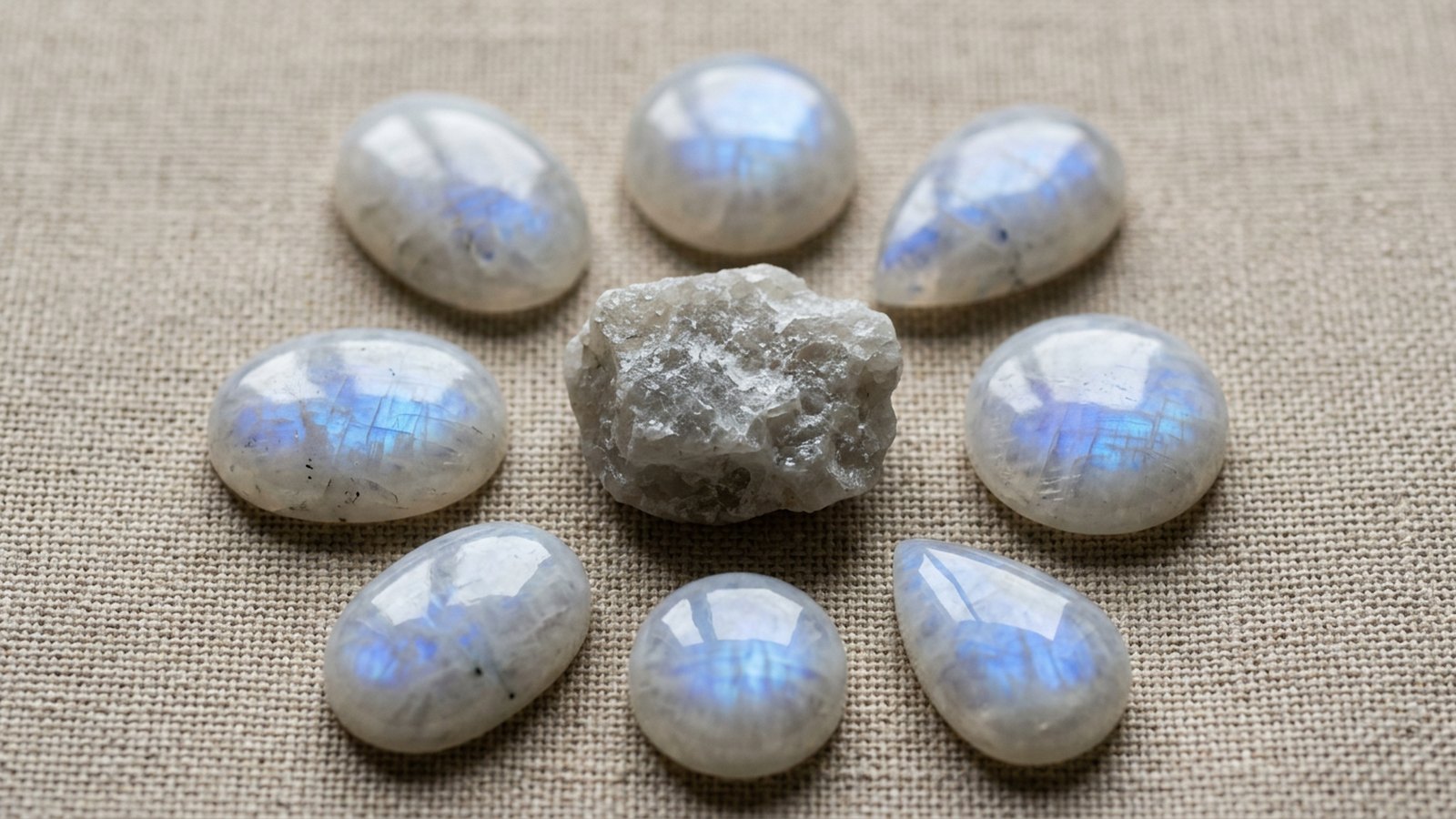
I keep these two in the same small dish by the bed, and for years I kept them there without really thinking about it. Amethyst and moonstone are the pair most people end up with by accident. They arrive separately, they both get described as calming, and one evening you notice they have found each other on the nightstand.
Then someone tells you that you are not supposed to wear them together, and the whole thing gets confusing.
So here is the honest version, in three parts. Energetically this is one of the easiest pairs on the shelf, and I think it is genuinely well matched. Physically it is one of the fussiest, for a reason that has nothing to do with energy and everything to do with how feldspar breaks. And the rumour that the combination is forbidden is real, but it comes from a tradition that is probably not the one you are practising. All three deserve a straight answer.
The short answer
Yes, you can wear amethyst and moonstone together. In Western crystal practice they are a traditional match: both are kept for calm, intuition and the end of the day rather than for drive, so the set is coherent rather than contradictory.
The only serious caution is physical. Amethyst is a 7 on the Mohs scale and moonstone is a 6 to 6.5 with cleavage, so amethyst will scratch and chip moonstone if the two are stored loose in one pouch or strung as alternating beads on a single bracelet. Keep them on separate strands and the pairing looks after itself.
What each stone actually is
Amethyst
Amethyst is quartz, silicon dioxide, coloured purple by traces of iron in the crystal lattice that natural radiation in the surrounding rock has nudged into what mineralogists call a colour centre. It sits at 7 on the Mohs scale, it has no cleavage, and it is about as forgiving as a stone gets. You can wear it daily in a ring and it will still look right in ten years.
Its one weakness is light. Long hours of strong direct sun fade the purple slowly and permanently, so a sunny windowsill is the wrong home for it. Heat does something more dramatic: take amethyst past roughly 470 degrees Celsius and those iron centres shift again and the stone turns yellow to orange. That is how most of the citrine on the market is made, which is worth knowing if you own both. There is more in the amethyst guide and in the guide to amethyst and citrine together.
Moonstone
Moonstone is not quartz at all, and that difference drives everything else on this page. It is a potassium feldspar, and the floating blue light that makes a piece worth owning, properly called adularescence, is not a colour. It is an optical effect: microscopically thin alternating layers of two feldspars inside the stone scatter light back at you.
That sheen sits just under the surface and travels as the stone turns, which is why moonstone looks alive in the hand and disappointingly flat in a photograph, and why a moonstone shut in a drawer is doing nothing at all. Worth knowing early: rainbow moonstone, the piece with blue and gold flashes, is classified as labradorite rather than true adularia. It is lovely material, honestly sold, and a different feldspar. The moonstone guide goes through the varieties, and moonstone vs opal covers the other look-alike people trip over.
Why I think the two agree
Most pairings are built on contrast: something active set against something steady. This one is not, and that is what makes it interesting.
Amethyst, in the tradition I work in, handles the stopping. It is the stone I associate with the moment the working day is declared over, screens go down and the room gets quieter. It is kept for the third eye and crown chakras, and its old reputation is for a mind that will not sit still.
Moonstone handles what comes after the stopping: rest, dreams, and the sense of a cycle turning rather than a task being ticked off. Where amethyst quiets the analysing, moonstone is traditionally kept for the part of you that is not analysing at all.
Put together they cover a sequence rather than a balance. Put the day down, then let the night do its own work. That is a narrow brief, and the narrowness is exactly why the set is good at it. Two stones pointed at the same moment do more than two stones pointed in different directions.
It follows that there is a lot this pair is not for. Neither stone carries weight or drive. If your trouble is getting started rather than switching off, look at crystals for motivation instead. If the evening is the problem, crystals for sleep and crystals for anxiety are the fuller versions of what this pair is reaching for. As always, these are traditional and intuitive associations offered for reflection, not treatments, and a stone is not a substitute for real help when something needs it.
The one real conflict, and it is physical
| Amethyst | Moonstone | |
|---|---|---|
| Mineral | Quartz, iron colour centres | Potassium feldspar |
| Hardness | 7 Mohs, no cleavage | 6 to 6.5 Mohs, two cleavages |
| What you are buying | Depth and evenness of purple | Strength and travel of the sheen |
| Best format | Anything, including daily rings | Pendant or bracelet, where it moves |
| Avoid | Prolonged direct sun, heat | Ultrasonics, steam, knocks |
The number everyone quotes is the hardness gap, and it is real. But on its own it undersells the problem, because a hardness gap only predicts scratches, and moonstone has a second and worse vulnerability.
Feldspar cleaves. Moonstone has two directions of cleavage meeting at close to a right angle, which is where the name orthoclase comes from. So when moonstone fails it does not abrade the way scratched quartz does. A knock in the wrong direction lifts a clean flat plane off the stone, and that flat cannot be polished back without reshaping the piece. This is not a cosmetic risk, it is a structural one.
Which brings me to the single arrangement I would talk someone out of. A bracelet with amethyst and moonstone beads alternating on one strand is the worst possible version of this pair. Every moonstone bead touches an amethyst bead, your wrist moves a few thousand times a day, and the harder stone wins every one of those contacts. Give it a year and the moonstones go from glassy to hazy, and the sheen goes with the polish, because adularescence depends on light getting cleanly in and back out through the surface.
The fixes cost nothing:
- Wear two bracelets, one stone each, rather than one mixed strand.
- If you want them on a single strand, put metal or wood spacers between every crystal bead.
- Store them apart, in separate pouches or separate compartments. How to store crystals covers the rest.
- Never put moonstone in an ultrasonic or steam cleaner. Vibration and cleavage are a bad combination.
How I actually use the pair
Nothing here is elaborate, and almost all of it happens at home.
Both at the bedside. The most common arrangement by a wide margin, and the one I keep coming back to. On the table, not in the bedding, where a hard object simply wakes you up.
Amethyst held, moonstone worn. Amethyst in the hand for the few minutes that mark the transition, moonstone left on overnight. The division of labour matches the way I read the two stones.
Moonstone by the calendar or journal. Its oldest association is with cycles rather than moments, so it earns its place near whatever you use to track them.
Amethyst in the room, moonstone on you. Moonstone needs movement and daylight to show anything at all, so it is far better worn than displayed. Amethyst is indifferent to that and happy sitting still.
For cleansing, moonlight suits both and is the gentlest option physically. Skip long sun, which is unkind to amethyst, and skip salt water, which does neither stone any favours. Cleansing crystals has the full method.
Who should think twice, and where that rumour comes from
If you have searched this pairing, you have probably met the claim that amethyst and moonstone must not be worn together, often phrased as a warning about who is allowed to wear which. It is not invented, and it is not Western crystal practice either. It comes from Vedic astrology, which is a different system with different rules.
In that tradition, moonstone (chandrakant) carries the energy of the Moon, and amethyst (jamunia) is worn as an affordable substitute for blue sapphire, which belongs to Saturn. The Moon and Saturn are not considered friendly to each other in jyotish, and gemstones there are prescribed to an individual chart by an astrologer rather than chosen off a shelf. Under those rules, combining the two is discouraged, and so is wearing either one without a reading.
That is a coherent position inside its own system. It is simply not the system most crystal practice in English is working in, where stones are chosen by feel and intention and nobody assigns you one. So the honest answer is: if you follow jyotish, take it seriously and ask your astrologer. If you do not, the prohibition does not apply to you, and you can stop worrying about it.
Two smaller cautions that do apply to everyone. Amethyst is genuinely poor at anything demanding stimulation, so if you already find yourself sluggish in the evening, this pair will not help. And if you are drawn to the combination for a physical or hormonal concern, please treat it as something you do alongside proper care and not instead of it.
For pairs that really do argue with each other, what crystals should not be together is the guide I would send you to next.
Buying the pair, and keeping it honest
Moonstone varies enormously and the difference is easy to see once you know the test. Tilt a piece slowly under a single light source, not a spread of ceiling lights, and watch the sheen travel. A good stone shows a broad glow that moves across most of the surface. A weak one shows a narrow band that flashes at one angle and vanishes at the next, or a flat milkiness that never moves. Both are real moonstone, so this is a question of quality, not authenticity.
One confusion worth clearing up, because it comes up constantly: purple moonstone and amethyst are not the same thing. Feldspar does occur in soft lavender and grey-violet tones, and it is sold honestly as such, but it is still feldspar, still softer, and it should still show a sheen rather than a transparent purple body colour. If a "purple moonstone" is glassy, evenly coloured and has no float to it, you are probably looking at quartz.
Beyond that, both stones are cheap, widely available and not rare, which makes this a sensible first pairing for anyone who wants an evening practice without spending much. Warm water, mild soap, a soft cloth and a proper dry suits both. Neither needs anything more elaborate, and neither should ever meet a household cleaner.
If you want other partners for either half, rose quartz and moonstone is the warmer version of this set, and labradorite and moonstone is the one to read if you suspect your two feldspars are secretly the same stone.
A last thought
I like this pair because it is modest. It does not claim to fix a day, it just marks the end of one, and then hands you over to whatever the night is going to be. If that is the hour you keep struggling with, it is a good place to start, and it will cost you very little to find out.
Keep the amethyst out of the sun, keep the moonstone off the concrete, and keep them in separate pouches. That is the whole maintenance manual.