I once flew to Lisbon with a piece of raw selenite in my carry on because someone told me it would keep the flight calm. It arrived as three pieces and a quantity of fine white grit in the bottom of my bag. The trip was fine. The stone was not.
That was the moment I understood that packing crystals is a different question from choosing crystals. Almost every travel list you will read is written as though the stone will be sitting on a shelf in a quiet room. A trip is not a quiet room. It is a bag being thrown into an overhead locker, a pocket against a sweaty hip for fourteen hours, a dashboard in full August sun, a hotel sink at midnight.
So this guide answers two questions at once. Which stones actually help with what travel does to you, and which ones will still be in one piece when you get home.
The short answer
If you want five stones that both earn their place and survive the journey, carry black tourmaline for crowded transit, tiger's eye for nerve in an unfamiliar place, smoky quartz for the anxious hours of the journey itself, red jasper for steadiness on long days, and clear quartz as the all purpose one. All five are hard, tough and cheap enough that losing one in a taxi is an annoyance rather than a grief.
None of them will make a plane safer. What they do, in my experience and in long tradition, is give your hands something to do and your attention somewhere to go at the exact moments travel makes you feel least like yourself.
What a trip actually does to a stone
Two different properties matter here, and most crystal writing confuses them.
Hardness is resistance to scratching, measured on the Mohs scale. Toughness is resistance to breaking, and it is not the same thing at all. Moonstone is reasonably hard at 6 to 6.5, yet it has perfect cleavage in two directions, which means it splits along flat internal planes if you knock it. Jade is softer and nearly unbreakable. A suitcase punishes poor toughness far more than poor hardness.
Then there is water and sweat, which is why I keep pointing people at our guide on crystals and water safety. And there is light. Several popular stones fade with prolonged ultraviolet exposure, and a car dashboard is the harshest UV environment most of us own.
| Stone | Mohs | Travels well? | The risk |
|---|---|---|---|
| Black tourmaline | 7 to 7.5 | Yes | Raw prisms chip at the ends |
| Tiger's eye | 7 | Yes | Almost none, tumbled |
| Red jasper, agate | 6.5 to 7 | Yes | Almost none, no cleavage |
| Smoky quartz | 7 | Yes | Some colour loss in fierce sun |
| Clear quartz | 7 | Yes | Points snap at the tip |
| Hematite | 5 to 6 | With care | Heavy, and rusts if stored damp |
| Carnelian | 6.5 to 7 | With care | Pales over months of direct sun |
| Obsidian | 5 to 5.5 | With care | Chips into genuinely sharp flakes |
| Moonstone, labradorite | 6 to 6.5 | Poorly | Perfect cleavage, flakes and splits |
| Lapis lazuli | 5 to 5.5 | Poorly | Porous, dulls with sweat and oils |
| Malachite | 3.5 to 4 | No | Soft, water sensitive, dust worth avoiding |
| Lepidolite | 2.5 to 3 | No | Layered mica, crumbles |
| Selenite, satin spar | 2 | No | Dissolves in water, dents with a fingernail |
The stones that hold up
Black tourmaline is the one I never travel without. It is schorl, a sodium iron aluminium borosilicate, hard at 7 to 7.5, and its traditional job is the oldest one in the book: standing between you and a churn of energy you did not choose. Airports, night buses, a packed platform. I keep a tumbled piece in a front pocket, not a raw prism, because raw tourmaline is striated along its length and the ends do chip. If you want more on why this stone anchors so many protection practices, the monograph goes deeper.
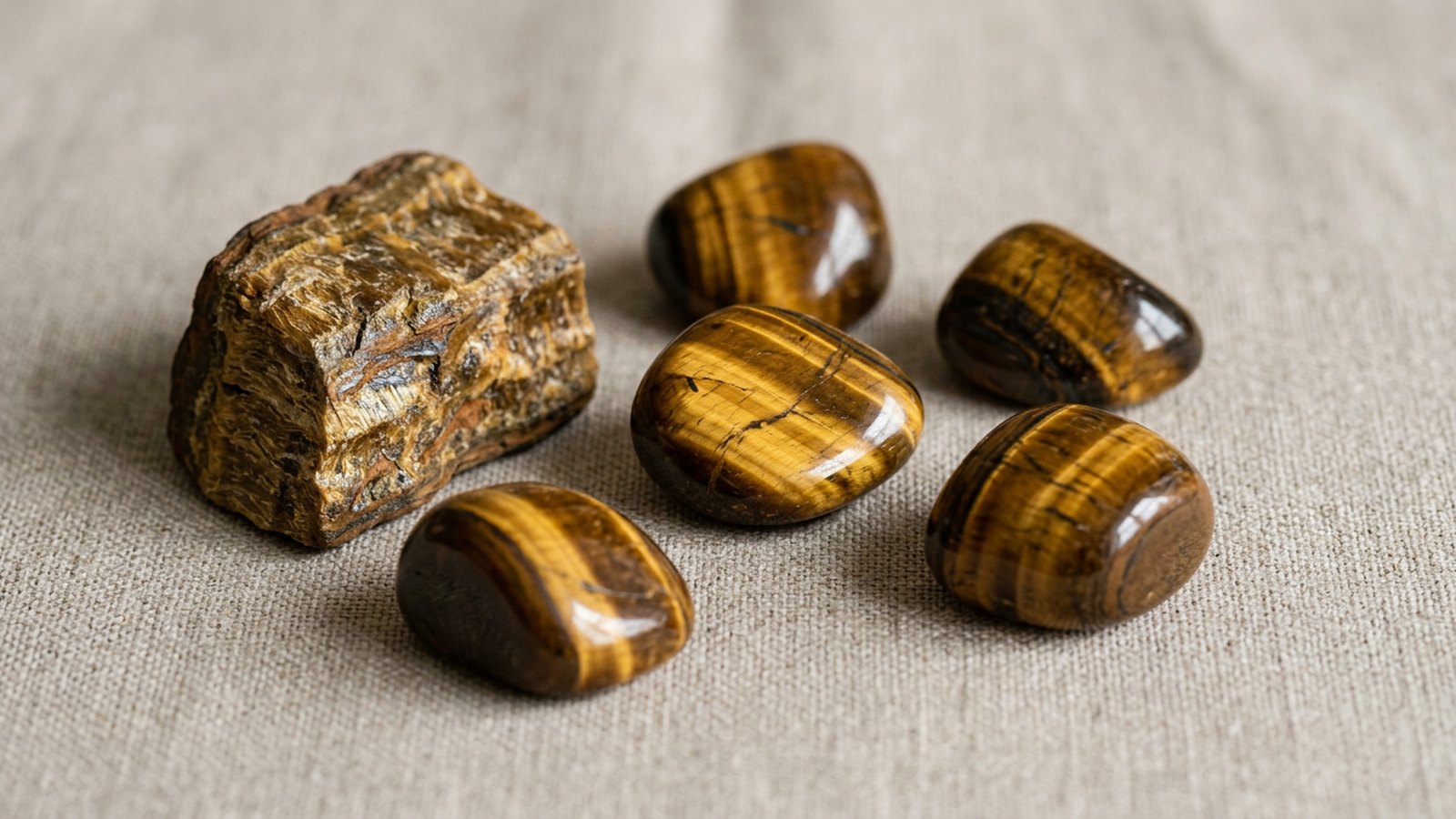
Tiger's eye travels beautifully. It is quartz that has replaced fibrous crocidolite, which is what produces that band of moving light, and at Mohs 7 with no cleavage it simply does not care what your luggage does. Tradition gives it courage and clear sight, and I find that honest: it is the stone for the first morning in a city where you cannot read the signs and are pretending you know where you are going.
Smoky quartz earns its place on the journey itself. The colour comes from natural irradiation acting on trace aluminium in the quartz lattice, and it is the stone I hand people who hate flying. It is traditionally grounding rather than soothing, which is a useful distinction when your body is convinced something is wrong and nothing actually is. One honest note: very strong prolonged sunlight can lighten smoky quartz, so it is not a dashboard stone.
Red jasper is the workhorse. Opaque chalcedony, cryptocrystalline, no cleavage planes at all, which makes it one of the toughest things you can put in a bag. Its lore is endurance and steady physical energy, and it suits the unglamorous part of travel: the fourth hour of walking, the day three slump. If you are choosing between it and its warmer cousin, we compared carnelian and red jasper in detail.
Hematite is iron oxide, dense enough that you feel it the moment you pick it up, and that weight is the point. Traditionally it is the heaviest anchor in the kit. Two cautions. It is only 5 to 6 on Mohs, so it scuffs, and it will develop rust spots if you store it damp. Dry it after a sweaty day.
Clear quartz rounds out the kit because it takes an intention well and asks nothing of you. If you like to set one before a trip, our guide on programming an intention covers the method I use.
The ones I leave at home
This is where I part company with every list on this search.
Malachite appears on almost every travel page, usually called the traveller's stone, and I understand why. The name comes from the Greek for mallow, after the leaf green colour, and European and Russian tradition did give it to travellers, with the old belief that it would break to warn of danger. The trouble is that a copper carbonate hydroxide at Mohs 3.5 to 4 will happily do that without any danger present. It scratches against keys, it reacts to acids, and its dust is not something to be casually breathing in a hotel room. Beautiful stone, wrong context. Keep malachite on the shelf and read it there.
Moonstone is the other classic traveller's talisman, genuinely carried by sailors and merchants for centuries. But feldspars cleave. Two directions of perfect cleavage mean a decent knock takes a flake off, and travel is made of knocks. If you love the association, wear moonstone as a bezel set pendant where the setting takes the impact, not loose in a pocket. The same warning applies to labradorite.
Selenite, as I learned in Lisbon, is gypsum at Mohs 2. It dissolves in water and dents under a fingernail. Lepidolite is a lithium mica that comes apart in sheets. Kyanite has such perfect cleavage that it splits into blades. Lapis lazuli is porous and slowly goes dull against skin oils. All of them are wonderful stones at home. None of them belong in a bag.
Amethyst deserves its own line because it is the single most recommended travel stone anywhere, it is hard at 7, and it still has a travel weakness: its colour fades under prolonged ultraviolet light. A tumbled amethyst that lives in a pocket is completely fine. An amethyst on a rental car dashboard for a fortnight will come home noticeably paler. That is a real, documented property of the stone, not superstition.
What to carry for each part of the trip
The search results all treat travel as one thing. It is not. These are the moments that actually ask something different of you.
The airport or the station. This is a crowd problem, not an anxiety problem. Too many people, too much noise, decisions under time pressure. Black tourmaline in a pocket where your hand can reach it while you queue.
The flight or the long drive. Now it is anxiety and confinement. Smoky quartz held in a closed hand does more for me than anything else, partly through the simple physical fact of gripping something cool and solid. If flying frightens you properly, read our fuller guide to crystals for anxiety, and please treat a real phobia as something worth proper help rather than a stone.
The first night in a strange bed. Unfamiliar rooms are the most common reason travel sleep collapses. I put a small tumbled stone on the bedside table, which functions as a portable signal that this is my space now. Our crystals for sleep guide has the fuller version.
The first morning in a new place. Tiger's eye. This is the moment for nerve, not calm.
Arriving somewhere that marks a change. A new job in a new city, a move, a trip that is really a threshold. That is closer to crystals for new beginnings territory, and worth choosing deliberately rather than grabbing whatever is on the shelf.
Packing them
Three stones. Occasionally four. I have never once wanted more than that on a trip, and every extra stone is another thing to lose.
Choose tumbled over raw wherever you can. Rounded stones have no thin edges to snap and nothing to snag on a lining. Wrap each one separately, in a small drawstring pouch or a square of soft cloth, because the main thing that scratches a stone is another stone. A quartz at 7 will mark a hematite at 5 without any effort at all.
Carry on, not checked. Partly because checked bags occasionally go to a different country than you do, and mostly because the point of the stone is that you can reach it during the journey, which is when you want it. If you prefer to wear rather than carry, carrying and wearing stones covers the trade offs, and a bracelet solves the losing problem better than a pocket ever will.
And take the one you can afford to lose. This is the most useful travel advice I have about crystals. Stones get left in hotel rooms, dropped down gaps and forgotten in the tray at security. Bring the five pound tumble, not the specimen you drove two hours to buy.
When you get home
Look at them before you put them away. Chips, dulling, rust spots on hematite: a trip leaves marks, and catching them early tells you what to pack differently next time.
Then clean them in whatever way you normally do, keeping the water sensitive ones dry. Our cleansing crystals guide runs through the methods that are safe for which minerals. I am not making a claim about what the stone absorbed. I am saying that a stone that has been through three airports and your pocket is physically dirty, and that marking the end of a journey deliberately is worth something.
A last word
The stones are not what keeps you safe. Your seatbelt, your insurance and your sense of where your passport is do that. What a well chosen stone gives you is a small, solid, familiar object in a week where nothing else is familiar, and a reason to stop for ten seconds in the middle of a day that is moving too fast.
Pick the tough ones, pick few, and let the beautiful fragile ones keep your shelf warm until you get back.