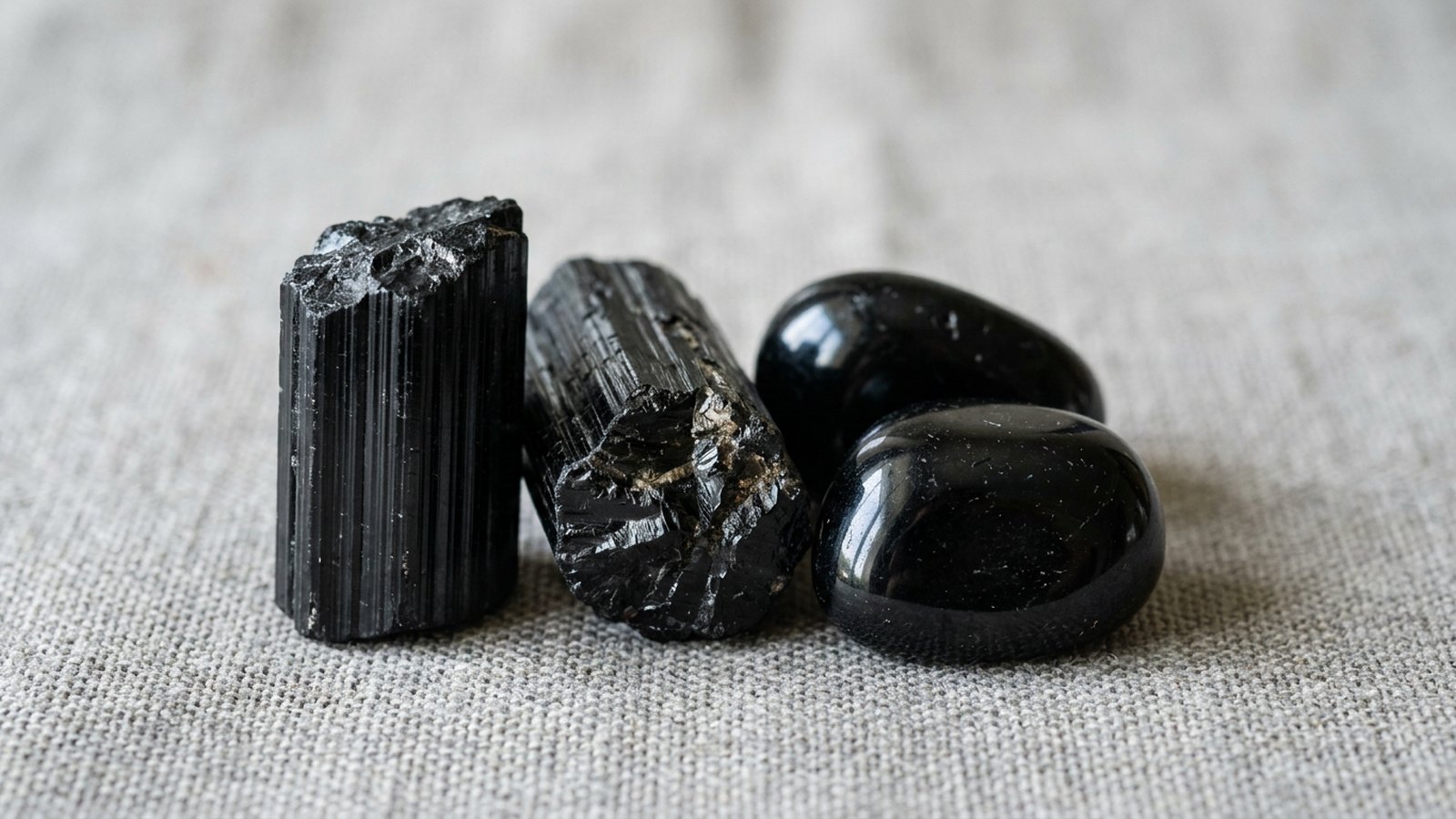
Almost every time someone asks me for a protection stone, they open with the same sentence: "I just need something to protect me." Then there is a pause, and if I wait long enough, the real thing comes out. A manager who leaves them hollow by Thursday. A brother going through something they cannot fix. A flat that has not felt right since the break in. A commute that makes their chest tight before the day has even started.
Those are four completely different problems, and the honest answer is that there is no single best crystal for protection, because protection is not one thing.
If you want the short version: the stones most often worked with for protection are black tourmaline, obsidian, hematite, black onyx, smoky quartz, amethyst, tiger's eye and labradorite. Black tourmaline is the traditional first choice for a general shield, obsidian for the home, hematite for holding your ground in crowds, and amethyst for when the thing you need protection from is your own mind at three in the morning.
The rest of this guide is about matching the stone to the situation you are actually in. That choice matters far more than owning the correct list. I will also tell you which piece of care advice, repeated on almost every protection guide I have read, will quietly ruin the stones it recommends.
First, what are you actually protecting yourself from?
In practice, nearly everything people bring me falls into one of four buckets, and they call for different stones.
Other people. Moods that are not yours, a colleague who drains you, a crowded train, a family member in crisis. This is a boundary problem, not a danger problem.
Yourself. Rumination, the 3am spiral, the thought loop you cannot put down. Nothing external is attacking you here, which is exactly why a "shield" stone often does nothing.
A place. A home, a doorway, a desk, a car. Here the work is really about marking a threshold and noticing when you cross it.
A moment. An interview, a court date, a difficult conversation you have been rehearsing for a week.
One quiet note before we go further. If what you are facing is genuine harm, harassment or a mental health crisis, please treat a stone as the small comfort in your pocket while you get real help, never as the plan. I would say the same to a friend.
When other people's moods land on you
This is the most common request I get, and black tourmaline is the traditional answer for good reason. In the lore it does not reflect anything back at anyone. It is described as grounding difficult energy downward and out, the way a lightning rod gives a charge somewhere harmless to go. That framing suits people who feel guilty about wanting distance, because nothing in it is aggressive.
Carry a tumbled piece in the pocket on the side you sit nearest other people, or keep one on your desk between you and the room.
If you leave crowded places feeling scattered rather than drained, try hematite instead. It is iron oxide, unexpectedly heavy for its size, and that weight does the work: it is a stone you feel in your hand, which is a real and unmystical way of coming back to your own body. Both link naturally to the root chakra and the site's wider protection family.
When your own thoughts are the thing to guard against
No stone can shield you from yourself, and any guide that tells you otherwise is selling something. What a stone can do is interrupt a loop, because holding an object and naming what you are doing takes attention back from the spiral.
Amethyst is the stone I reach for here, and it is the one I keep by my own bed. Tradition ties it to a calm, clear head rather than to a wall, which is the right shape for this problem. It pairs well with rose quartz when the loop is self-critical rather than anxious.
Smoky quartz suits the heavier version, the days that feel weighted rather than fast. It is quartz darkened by natural irradiation over geological time, and it is worked with as a stone of release rather than defence. Our crystals for anxiety guide goes deeper if this is your main reason for being here.
When you are walking into something you are dreading
For a specific moment with a start time, you want a stone with some spine in it.
Tiger's eye is the classic choice: golden, banded, and traditionally carried for courage and clear sight in situations where you need to stay alert without becoming reactive. Roman soldiers are often said to have carried it into battle, and while I have never found a solid primary source for that claim, the stone has certainly been worn as an amulet for a very long time.
Black onyx is the quieter alternative. It is the stone of self-mastery in the tradition, associated with holding your composure rather than winning. That is the one I would choose for a difficult conversation where the goal is to stay steady, not to prevail.
Hold whichever you choose in your fist for a moment before you walk in. That pause is doing at least as much as the mineral.
When you want the house to hold a boundary
Home protection is where obsidian earns its reputation. It is volcanic glass, cooled too fast to crystallise, and the tradition treats it as revealing rather than blocking: it shows you what is going on rather than walling it off. Place a piece near the entrance you actually use, not the front door you never open.
If you want the fortress feeling instead of the mirror, use black tourmaline at the thresholds. If you are unsure which of these two black stones you are even holding, our onyx vs obsidian guide covers the home test, and black tourmaline vs obsidian does the same for the pair people confuse most often.
For a whole room, four stones in the corners is the traditional arrangement, and crystal grids formalise it. Our guide on where to place crystals in your home has room by room suggestions.
When you are travelling or on the road
Turquoise is the genuine traveller's stone, worn for safe passage from ancient Egypt through Persia to the American Southwest, and it has one of the longest unbroken amulet histories of any stone. It is also the one most likely to be damaged by being carried badly, which I will come back to.
Tiger's eye is the practical alternative for a car, because it is quartz hard and does not mind being knocked about in a glovebox. Whatever you use, wedge it somewhere it cannot become a projectile.
When you feel exposed rather than attacked
Some people do not describe a threat at all. They describe being too open, too readable, too easy to reach. Nothing is coming at them, they are just standing in the wind.
Labradorite is the stone for this, and it is my favourite of the group. It looks like a dull grey slab until you turn it to the light and a sheet of blue or gold flashes across it, a real optical effect called labradorescence caused by light bouncing off microscopic layers inside the feldspar. That is the whole idea in one object: unremarkable until it chooses to be seen. Tradition calls it an aura strengthener, and I think the appeal is really that it gives people permission to keep something back.
Lapis lazuli is the alternative if the exposure is about speech, the meetings where you say more than you meant to. It has been carried for honest and measured words since Mesopotamia.
The stones at a glance
| Stone | What it actually is | Traditionally carried for | Mohs | Water |
|---|---|---|---|---|
| Black tourmaline | Schorl, a boron silicate | A general shield, grounding | 7 to 7.5 | Brief rinse fine |
| Obsidian | Volcanic glass | The home, revealing what is hidden | 5 to 5.5 | Brief rinse, chips easily |
| Black onyx | Banded chalcedony, usually dyed | Composure, self-mastery | 6.5 to 7 | No soaking, the dye lifts |
| Hematite | Iron oxide | Grounding in crowds | 5.5 to 6.5 | Keep dry, it rusts |
| Smoky quartz | Irradiated quartz | Release, heaviness | 7 | Fine, but fades in sun |
| Amethyst | Quartz | A calm head | 7 | Fine, but fades in sun |
| Tiger's eye | Quartz | Courage, travel | 7 | Brief rinse fine |
| Labradorite | Feldspar | Feeling less exposed | 6 to 6.5 | Brief rinse, chips |
| Turquoise | Hydrated copper aluminium phosphate | Safe passage | 5 to 6 | Porous, keep dry |
| Selenite | Gypsum | Clearing a space | 2 | Never, it dissolves |
How to actually use one
There is no ceremony required, and four habits cover almost everything people do.
Carry it. A tumbled stone in a pocket you reach into often. The point is the contact, so choose the pocket you already use rather than the one that seems more meaningful.
Wear it. A bracelet or pendant removes the step of remembering, which is the step most people fail at. Just check the hardness first: turquoise at 5 and obsidian at 5.5 will scuff against everyday wear, while quartz stones at 7 shrug it off. More in carrying and wearing stones.
Place it. By the door you use, on the desk between you and the room, in the four corners of a space you want held.
Set it. Hold it, say plainly what you want it to remind you of, and put it where you will meet it. Clear quartz is traditionally used alongside another stone here, as an amplifier of whatever you have decided.
Do one of these properly rather than all four badly.
The care advice on most protection lists is wrong
This is the part I most want you to take away, because it is the one that costs money.
Two of the guides currently ranking for this exact search recommend a rinse under running water for a list that includes pyrite, and one recommends leaving crystals in a glass of drinking water overnight. Pyrite is iron sulfide. In the presence of moisture and oxygen it oxidises into iron sulfates and sulfuric acid, expanding and cracking as it goes. Museums hold pyrite specimens below roughly 45 percent humidity for this reason. The damage is not reversible.
Selenite is gypsum, hardness 2 on a scale where your fingernail is 2, which is why the classic pairing of black tourmaline and selenite needs a little more care than it is usually given.5, and it is soluble. Water will visibly dull it and standing water will destroy it. Hematite is iron and it rusts. Turquoise is porous enough to drink up oils, soap and sweat and shift colour permanently. Black onyx is nearly always dyed grey chalcedony, so a long soak lifts the colour.
And the sunny windowsill charge that everyone recommends will fade amethyst and smoky quartz, because their colour comes from irradiation induced colour centres that light undoes.
Dry cleansing is almost always the right answer: sound, smoke, breath, moonlight, or simply setting the stone down with attention. Our water safety guide lists what can and cannot be rinsed, and cleansing and charging covers the methods.
About the EMF claims
You will see it everywhere: black tourmaline blocks EMF, wifi, 5G. I want to be straight with you, because this one is unusual in that it makes a testable physical claim.
Tourmaline genuinely is piezoelectric and pyroelectric. Squeeze it or heat it and it develops an electrical charge across its length, which is real, documented physics, and it is why Dutch traders in the 1700s used it to pull ash out of pipes. That true fact is what has been stretched into the EMF story.
The leap does not hold. There is no evidence that a stone on your desk absorbs or blocks radio frequency radiation, and no mainstream research supports it. If keeping tourmaline by your laptop makes you close it earlier, that is a genuinely good outcome, and it does not require the physics to be true.
I would rather tell you this and keep your trust for the parts of the tradition I do find meaningful.
Where the black stone tradition comes from
There is a reason nearly every protection list is dominated by black stones, and it is more interesting than "dark equals powerful". Opaque stones stop light. Tradition read that literally: something light cannot pass through became the natural symbol for something harm cannot pass through.
The documented history is stranger than the modern lists suggest. The nazar, the blue glass eye hung in doorways across Turkey, Greece and the Levant since at least the 3rd century BCE, is glass, not a crystal. The stone actually used against the evil eye in Spanish and Latin American custom is azabache, polished black jet, pinned to a baby's clothes. Pliny the Elder describes Roman children given a fascinum, a phallic charm, as a medicus invidiae, a doctor against envy. Jet turns up again in Victorian mourning jewellery, and black onyx alongside it.
So the tradition is real, old and cross cultural. It is also, historically, about wearing a visible sign rather than carrying a hidden mineral, which is worth knowing when you decide whether to wear your stone or pocket it.
What I will not promise you
A stone will not stop anyone from behaving badly toward you. It will not clear a debt, mend a family, or substitute for a lock on the door. Everything in the energy tradition here is exactly that, tradition and intuition, and I have tried to flag where I am telling you lore rather than fact.
What I have watched a stone do, repeatedly, is give someone a physical reminder of a decision they had already made. You put it in your pocket, and at the moment your hand finds it, you remember you meant to leave at six, or not to answer that message. If you want to make that explicit, our guide on programming an intention is the natural next step.
Start with one stone, not eight. Black tourmaline if you want the classic, labradorite if you tend to feel porous rather than attacked, obsidian if it is the house. Learn how that one feels before you add another.