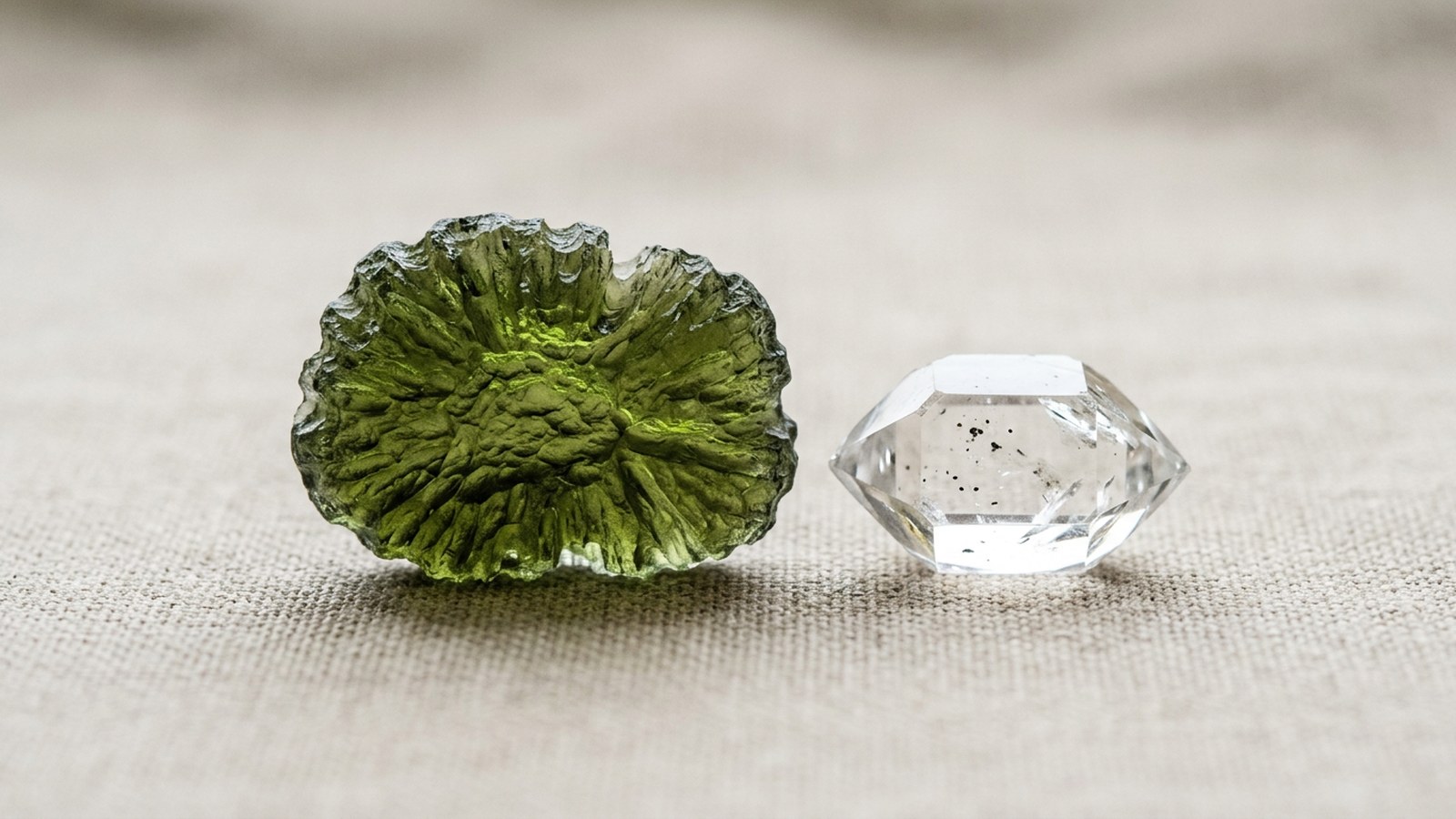
The first time I put a Herkimer diamond next to a piece of moldavite, I did it on a folded white cloth by a north window, mostly to look at them. The Herkimer was a stubby, water-clear crystal the size of a thumbnail, pointed at both ends, with one tiny black fleck of carbon floating inside it. The moldavite was a wrinkled, bottle-green shard that turned the light olive when I lifted it. One had grown slowly in a cavity in New York rock, and the other had been melted and thrown across Europe in the space of a few minutes. I have kept them together on my meditation shelf ever since, with a little care about how they touch.
This pairing is everywhere in crystal jewellery, and almost nobody explains it. In this guide I go through what each stone really is, why practitioners put them together, who the pair suits and who might want to wait, three simple ways to work with it, the one physical rule that keeps both stones looking good, how to avoid fakes on both sides, and how to care for them.
Herkimer diamond and moldavite: the short answer
Herkimer diamond is a naturally double-terminated quartz crystal from Herkimer County in New York, unusually clear and bright, with a hardness of 7. Moldavite is a green natural glass, a tektite formed by a meteorite impact in southern Germany about 14.8 million years ago and found mainly in the Czech Republic, with a hardness of about 5.5 to 6. In crystal tradition, moldavite is the stone of fast and sometimes intense change, and Herkimer is said to amplify and clarify whatever it sits beside. Paired, they are used for meditation, intuition and dream work, mostly on the third eye and crown chakras. Keep them from rubbing against each other, because the Herkimer will scratch the moldavite.
| Herkimer diamond | Moldavite | |
|---|---|---|
| What it is | Quartz crystal, SiO2 | Silica-rich natural glass (tektite) |
| Origin | Herkimer County and the Mohawk Valley, New York | Ries impact, Bavaria; found in Bohemia and Moravia |
| Hardness | 7 | 5.5 to 6 |
| Look | Clear, glassy, pointed at both ends | Green, translucent, wrinkled and etched |
| Traditional role | Amplifier, clarity, dreams | Transformation, change, awakening |
| Chakras | Crown, third eye | Heart, third eye, crown |
What each stone actually is
Herkimer diamonds are quartz, the same mineral as an ordinary clear quartz point, and no relation to real diamond. They come from small cavities, called vugs, in the Little Falls Dolostone, a layer of Cambrian rock roughly 500 million years old that runs through the Mohawk River valley. Silica-bearing water seeped into those cavities and deposited quartz so slowly, and with so little to anchor to, that many crystals grew free on all sides and finished with a point at each end. A classic Herkimer shows eighteen faces: six around the middle and six at each termination. Many carry tiny inclusions of black anthraxolite, a solid hydrocarbon, and a few hold a pocket of ancient fluid with a bubble that moves when you tilt the crystal. The name is a trade name from the nineteenth century, when farmers and canal workers in the valley picked these sparkling crystals out of ploughed fields. You can still dig for them yourself at fee-to-dig mines near Middleville.
Moldavite has a far more violent story, which I tell in full in my moldavite meaning guide. A stony asteroid struck what is now the Nördlingen Ries in Bavaria and left a crater about 24 kilometres wide. Surface sediments melted, were flung up to a few hundred kilometres east, and cooled in flight into droplets and splashes of green glass that fell across Bohemia and Moravia. Centuries in the soil then etched their surfaces into the ridges and pits collectors love. The name comes from the Vltava river, Moldau in German.
So the two share their raw material. Both are mostly silicon dioxide. In the Herkimer the atoms had millions of years to stack into an orderly crystal lattice, and in moldavite they were frozen before they could arrange themselves at all. I find that a lovely thing to hold in two hands, and it is a fair answer to the question of whether Herkimer diamonds are quartz: they are, and moldavite is the same chemistry in glass form.
Why the two are paired
The pairing comes from modern crystal practice, and I know of no older folk tradition behind it. In the crystal books of the last few decades, Herkimer diamond is described as an attunement and amplifying stone, a crystal of clear dreams and inner sight. Moldavite is described as a catalyst, a stone that speeds up personal change and opens the heart and the higher chakras.
The logic practitioners give is simple. Moldavite is said to bring the impulse for change, and the Herkimer is said to bring it into focus and make it easier to put into words. People who meditate with the pair often describe the Herkimer as a lens, sharpening impressions that moldavite alone leaves vague. Online, the same idea appears again and again: Herkimer amplifies moldavite.
I treat all of this as tradition and personal experience, which is what it is. Nothing measurable passes between two pieces of silica on a cloth. What I can say from my own practice is that the pair makes a good focus for a meditation on a specific question, and that the clarity people report is very consistent across accounts.
Who the pair suits, and when to wait
The pair tends to suit people who already work with moldavite comfortably, people who keep a dream journal, and anyone using meditation to think through a decision or a new chapter (the pair sits naturally with new beginnings and intuition).
I would hold off in a few situations. If moldavite already feels like a lot for you, with the warmth, light-headedness or restlessness people call the moldavite flush, then adding a stone whose whole reputation is amplification makes little sense. In that case the traditional advice is to pair moldavite with something grounding instead, such as smoky quartz or black tourmaline. I also leave this pair out of the bedroom for the first few weeks, because many people report vivid dreams and broken sleep with moldavite, and Herkimer is a dream stone in its own right.
And I would never use it as a substitute for real support. If you are going through anxiety, grief or a crisis, a stone can be a calming ritual, and it should sit alongside a doctor, a therapist or someone you trust.
Three ways to work with Herkimer diamond and moldavite
1. A ten-minute meditation
- Cleanse both stones gently (see the care section below) and sit somewhere quiet.
- Hold the moldavite in your left hand, the hand traditionally linked with receiving, and the Herkimer in your right, or rest the Herkimer at the top of your head if you are lying down.
- Set one clear question or intention, in a sentence (my guide to programming an intention goes into this).
- Breathe slowly and stay for five to ten minutes. Keep it short at first, because moldavite tends to feel stronger the longer you sit with it.
- Put both stones down, drink some water and write a few lines before you get up.
You will know it went well if you come out calm and holding one clear thought. If you feel dizzy or unsettled, stop, and next time add a grounding stone at your feet. My general guide to meditating with crystals has more on posture and timing.
2. A dream practice, once moldavite feels comfortable
Keep a small Herkimer by the bed and the moldavite on a shelf in the same room rather than under the pillow. Note your dreams each morning for two or three weeks. If sleep gets lighter, move the moldavite out of the bedroom. My guide to crystals for dreams has a longer routine.
3. Wearing them
The most common format is a pendant, often with a Herkimer above a piece of moldavite, worn near the heart. Rings and bracelets combining both are everywhere too. Wear the pair for a day or a specific event first and see how you feel before making it daily jewellery.
The one physical rule: keep the Herkimer off the moldavite
This is the part no jewellery listing mentions. Quartz has a hardness of 7 and moldavite sits around 5.5 to 6, so a Herkimer point will scratch moldavite whenever the two rub together. The etched, sculpted surface is most of what makes a moldavite valuable, and once it is scuffed it does not come back.
In practice, that means a few habits:
- Store them in separate pouches or separate compartments, never loose together in a bowl or bag.
- On a shelf or altar, let them sit close without touching.
- In jewellery, choose settings where the two stones are held apart by metal. On a beaded bracelet, look for spacers between Herkimer beads and moldavite.
- Do not wear a Herkimer ring on the same hand as a moldavite ring.
None of this affects the pairing itself. It is the same reason I keep stones of different hardness apart everywhere in my collection.
Fakes on both sides, and what the pair costs
Moldavite is one of the most faked stones on the market. The usual fakes are cast or tumbled green glass with too even a colour, round bubbles and a surface that looks moulded rather than etched. Real moldavite is a softer, more olive or bottle green, has elongated or irregular bubbles and fine swirls under magnification, and its sculpting varies from piece to piece. I go through the checks in detail in my moldavite guide and in how to tell if a crystal is real.
Herkimer diamonds get imitated too, mostly by double-terminated quartz from Pakistan and China sold under the Herkimer name. Those crystals are real quartz and pleasant stones, but they are often longer, cloudier or full of brown clay inclusions, while a true Herkimer is short, very clear and brilliant straight out of the rock. Glass imitations exist as well. A seller who can name the mine or at least the county is a good sign.
Price is the clearest warning. Genuine moldavite is sold by the gram, and in shops I trust ordinary small pieces tend to run around five to twenty-five dollars a gram, with well-formed or deeply etched pieces costing several times that. Prices jumped after a social media surge in 2021, so treat any figure as a snapshot. Small clear Herkimers cost a few dollars, and large flawless ones much more. A Herkimer and moldavite bracelet for twenty dollars almost certainly contains neither.
You will often see the pair sold as a trio with phenakite or Libyan desert glass. That grouping comes from retailers, and the same checks apply to every stone in it.
Caring for Herkimer diamond and moldavite
Both stones tolerate a quick rinse in cool water, but each has its own weak point.
- Herkimer: avoid sudden temperature changes. Crystals with fluid inclusions can crack from thermal shock, so never take one straight from a cold windowsill into hot water. Sunlight is fine for clear quartz.
- Moldavite: never scrub it, never soak it in salt water and never put it in an ultrasonic cleaner. A soft brush and a rinse are all it needs.
- Both: smoke, sound or a night on a windowsill are gentle ways to cleanse them, as I explain in my guide to cleansing crystals. My water safety guide covers the rest of a collection.
A last word
I keep this pair for the days when I need to think clearly about something that is changing. If you are new to moldavite, get to know it on its own first, then add the Herkimer when you feel ready. Look at them often, keep them from rubbing, and pay attention to what you notice when they sit together.