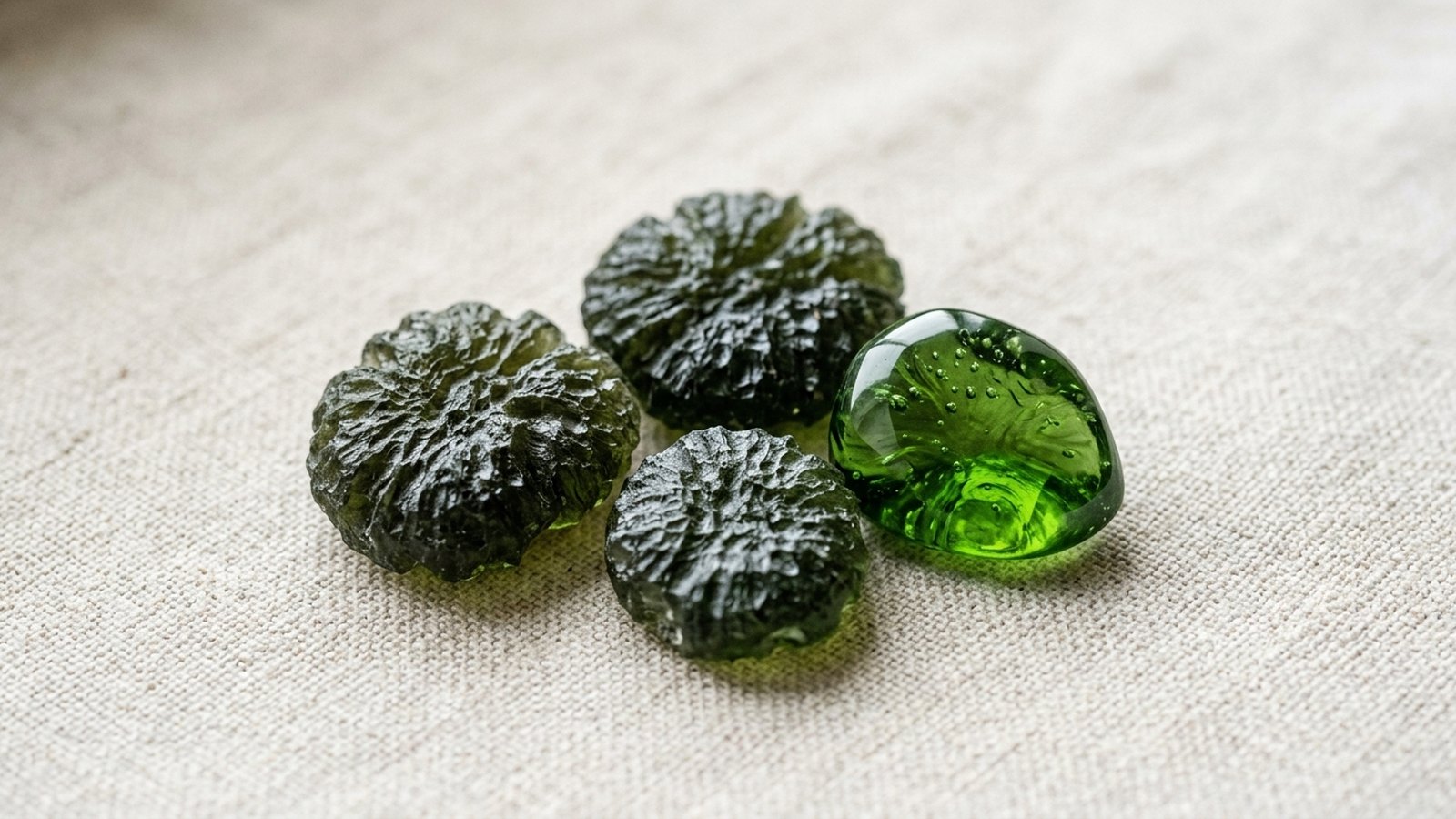
Moldavite is a natural glass, olive to bottle green, formed about 14.8 million years ago when an asteroid struck what is now southern Germany and threw molten earth hundreds of kilometres through the sky. It is classified as a tektite, and it is found almost nowhere but the Czech Republic. In crystal tradition it is called the Stone of Transformation, and it is worked with for rapid change, spiritual opening and the sense of being connected to something much larger than one life.
That is the short version, and most pages say roughly that much. What they leave out is what actually matters when you are holding a green pebble that cost more per gram than silver: moldavite is not a crystal, it is not made of the meteorite, and a great deal of what is sold under its name is bottle glass. This is one of the few stones where being wrong is expensive.
What Moldavite Actually Is
Here is the thing nobody in the crystal world says plainly. Moldavite has no crystal structure at all.
A crystal, mineralogically, is a solid whose atoms sit in a repeating, orderly lattice. That lattice is why amethyst grows in points and why fluorite cleaves into octahedra. Moldavite has none of it: it cooled too fast for its atoms to organise, so they froze where they were, jumbled. That makes it a glass.
So moldavite is the one piece on your shelf that is not, strictly speaking, a crystal. Its closest relative in the shop is obsidian, which is also a natural glass, also formed by heat and sudden cooling, also breaking in those curved conchoidal chips. The difference is where the heat came from. Obsidian is volcanic, born from the Earth's own furnace. Moldavite was made by something arriving from outside. If you want that contrast in detail, our onyx and obsidian comparison works through what being a glass rather than a mineral actually changes.
This is not merely pedantic. If moldavite feels different in the hand from your other stones, part of the answer is that it is a different kind of material: lighter than it looks, and with no internal order at all. It is chaos, cooled.
Where It Came From: One Afternoon, 14.8 Million Years Ago
The story usually gets told as "a meteorite fell in the Czech Republic". That is not quite right, and the true version is better.
About 14.8 million years ago, in the Miocene, an asteroid roughly a kilometre and a half across hit what is now Bavaria in southern Germany. It left the Nördlinger Ries, a crater around 24 kilometres wide that you can still see today as a suspiciously circular basin with a town sitting in the middle of it. A smaller companion crater, the Steinheim basin, formed in the same event, which is why many geologists think the impactor was a binary asteroid.
Now the part that matters. Moldavite is not made of the meteorite. It is made of Earth.
The impact melted the sandy sediments lying at the surface and flung them upward at enormous speed. That molten material travelled above the atmosphere on a ballistic arc and came down 250 to 450 kilometres to the east and north east, in what is now South Bohemia and Moravia, with smaller scatters in Lusatia, the Cheb basin, and the Waldviertel in Austria. It cooled in flight. By the time it landed it was already glass.
This is why moldavite is never found in the crater that made it, why the pieces are small, and why so many have that wrinkled, sculpted surface: the shapes formed in the air, then were etched over millions of years by groundwater in the sediments where they came to rest.
One page currently ranking for this stone says the impact "passed completely through the Earth's crust into the planet's core". It did not. The melt came from the topmost sediments, and the crater is a shallow bowl by planetary standards. The honest version loses nothing: Earth, thrown into the sky by something from space, and frozen on the way down.
The name comes from the Moldau, the German name for the river the Czechs call the Vltava, along whose gravels the first pieces were collected. In Czech the stone is simply vltavín.
What It Is Made Of
Moldavite is roughly 75 to 80 percent silica, with aluminium, potassium, calcium, magnesium and iron making up the rest. The iron is where the green comes from, which is why moldavite is always green, from pale olive to deep bottle green to the browner shades more common in Moravian material. If colour is how you choose your stones, our guide to crystal colours covers what green traditionally carries.
Its density is 2.32 to 2.38 grams per cubic centimetre, noticeably lighter than quartz, and its refractive index runs about 1.48 to 1.51. On the Mohs scale it sits around 5.5 to 6, which is worth pausing over: ordinary household dust contains quartz at Mohs 7, so the dust on your shelf is harder than your moldavite. It scratches easily and chips on impact, because glass has no cleavage planes to absorb a blow.
Then the single most useful number in this guide. Moldavite contains almost no water, typically under 0.02 percent by weight. That is extraordinarily dry, drier than volcanic glass and drier than anything made in a furnace, because it was melted hot enough to drive the water off entirely and then cooled in near vacuum. Remember that. It is why the fakes can be caught.
Moldavite Meaning: Transformation, and What That Word Is Doing
In crystal tradition moldavite is the Stone of Transformation, and I want to be precise about what people mean, because it is not the gentle self improvement the phrase suggests elsewhere.
Most stones are worked with as supports. Rose quartz softens, black tourmaline steadies, smoky quartz grounds. Moldavite is not described that way by anyone who works with it. It is described as an accelerant: the tradition holds that it does not smooth your path, it shortens it, and that the shortening is often uncomfortable. Relationships that were already over end. Jobs that were already wrong get left.
I offer that as tradition and as the consistent report of people who use it, not as a claim about what the glass does. But it is rare in this field for a stone's reputation to be so unanimously unflattering. Nobody sells moldavite as relaxing, and that consistency is at least interesting.
Chakras. Heart primarily, which surprises people who expect a stone this cosmic to be filed under crown. Tradition places it at the heart because the change it is associated with is emotional before it is spiritual, then extends it upward through the third eye and the crown. Our guide to the seven chakras lays out the framework.
Zodiac. Most commonly Scorpio and Aquarius: Scorpio for death and rebirth, Aquarius for sudden change. Some sources give it to all twelve signs, which I read as a polite way of saying the tradition here is modern and unsettled.
Element. Fire and Air. You will also see it listed as Storm, a category some modern practitioners reserve for stones of abrupt change.
Vibration. Usually given as 2, though I would treat the numerology layer as a recent addition rather than old lore.
Affirmation. I am willing to be changed.
As for older stories, moldavite is genuinely tangled up with the Holy Grail legend and the Cintamani stone of Buddhist and Hindu tradition, both sometimes described as green stones fallen from the sky. You will also read everywhere that moldavite amulets were found with the Venus of Willendorf. Moldavite really was worked by Palaeolithic people in that region, which is well established, but the tidy version where amulets were buried alongside the figurine is repeated far past what the archaeology supports. Enjoy these as stories.
The Moldavite Flush, and Why People Tell You to Be Careful
The "moldavite flush" is the sensation many people report on first handling the stone: heat rising in the face and chest, a pulse in the palm, lightheadedness, sometimes an urge to cry.
I am going to be straightforward. This is a widely reported subjective experience, and it is not a measured property of the glass. Moldavite emits nothing detectable, it is not radioactive, and it is not warm to the touch. What it is, is famous, expensive, and surrounded by warnings before you ever touch it, which is a great deal of expectation to carry into a first encounter. That does not make the experience false. Feelings are real events. It means the honest sentence is "people reliably feel this" rather than "the stone does this".
Either way the practical advice is the same, so take it. Start with short sessions of a few minutes. Sit down. Do not wear it to sleep in the first weeks. Keep a grounding stone in your other hand or your pocket, which is the one piece of moldavite advice everyone agrees on: black tourmaline, smoky quartz or hematite all serve, and our guide to carrying and wearing stones covers the practicalities. If protection is the reason you reached for it, our guide to crystals for protection is a better starting point than this one.
So why do people say be careful? The genuine risks are not mystical. The first is financial: this is the most counterfeited stone in the trade. The second is that "moldavite made me quit my job" is a story that can be used to justify a decision you have not thought through. A stone is a fine companion to a change. It is a poor reason for one. And if you are going through something heavy, please talk to someone who can actually help. Nothing on this shelf is a substitute for that.
Is Yours Real?
Moldavite is faked at a scale no other stone approaches, because it is small, expensive, and green glass is cheap. Here are the tests, in the order I would use them.
1. Look for lechatelierite. This is the one that cannot be faked. Lechatelierite is pure silica glass that forms only above roughly 1700 degrees Celsius, hotter than any bottle furnace reaches. In moldavite it appears as fine wavy wires or thread like streaks inside the stone, best seen against a bright light with a loupe. If you find them, you have moldavite.
2. Look at the bubbles. Real moldavite has abundant bubbles that are stretched and distorted, frozen mid movement while the glass was still flying. Manufactured glass has round, evenly sized bubbles, because it cooled sitting still.
3. Do not stop at the surface texture. Every guide tells you real moldavite has a wrinkled, etched skin and fakes are smooth. That was true. It no longer holds on its own: Chinese workshops now etch small pieces with hydrofluoric acid to reproduce the texture convincingly. Texture is a first filter, not a verdict.
4. Check the colour. Moldavite is always green and always transparent to translucent. If it is opaque, or blue, or black, it is not moldavite.
5. Refractive index, if you have a gemmologist. Genuine material reads about 1.48 to 1.51. The common imitation reads around 1.52.
And one test to refuse. A page ranking on the first results page offers "an energetic buzz or heat" as a way to confirm authenticity. Please do not authenticate a purchase this way. Expectation produces that sensation reliably in people holding what they have been told is moldavite, including when it is glass. Use the loupe.
| What you have | Colour | Bubbles | Lechatelierite | Tell |
|---|---|---|---|---|
| Moldavite | Green only, translucent | Elongated, stretched | Present | Wavy silica wires under a loupe |
| Manufactured green glass | Uniform, often too bright | Round, even | Absent | Too consistent, often too large |
| Acid etched fake | Green, close match | Round if any | Absent | Texture right, interior wrong |
| "Black moldavite" | Black | Variable | Absent | Not moldavite at all |
That last row deserves a note, because people search for it. There is no such thing as black moldavite. Material sold under that name is usually agni manitite, an Indonesian glass whose status as a true tektite is disputed even among dealers, some of whose own descriptions concede it is closer to obsidian. It may be a perfectly nice stone. It is not this one.
What Moldavite Costs, and Why
Moldavite is sold by the gram. Around 2020, good material ran roughly 8 to 16 dollars per gram. Then it went viral on TikTok in 2021, on exactly the "it will upend your life" reputation described above, and prices roughly tripled. Quality pieces now commonly sit above 40 dollars per gram.
The supply is finite in the strictest sense. All the moldavite that will ever exist was made in a few minutes 14.8 million years ago, and no geological process is replenishing it. The famous Besednice material, the spiky "hedgehog" pieces from a small field in the Český Krumlov district, has been scarce since around 2012 because that source is worked out.
Czech law also requires a permit to dig for moldavite, including on your own land, and South Bohemia has a documented and growing problem with illegal digging. So buy from someone who will tell you the locality, and be sceptical of anyone offering large flawless pieces cheaply. Our guide on how to tell if a crystal is real or fake covers the principles that apply here too.
How to Use Moldavite, and How to Look After It
The tradition is consistent and simple: less is more. Hold it in meditation for short sessions rather than long ones, and see our guide to meditating with crystals for a structure. Wear it as a pendant near the heart if you want it in your day, ideally after a few weeks of shorter contact. Place it on your altar or workspace rather than beside your bed, at least at first, and our guide to where to place crystals covers the rest of the house. If you are building a set, moldavite is not a beginner's first stone; our guide to building your first set suggests better starting points.
Care is where I want to correct two pieces of advice currently ranking on page one, wrong in opposite directions.
One tells you to soak moldavite overnight in salt water and give it four to six hours of direct sunlight every month. Do not. Salt is an abrasive, and the sculpted, etched surface is the entire aesthetic and monetary value of the piece.
Another tells you moldavite will deteriorate and eventually dissolve in water. Also untrue. It is a chemically durable silicate glass, and a brief rinse in cool water will not harm it. Our crystals and water safety guide sets out which stones genuinely cannot take it.
The real risks are mechanical: scratching, chipping, and being knocked against harder stones. Store it separately in a soft pouch or lined box, not loose in a bowl with your quartz. Clean it with a soft brush and cool water, nothing more. To cleanse it energetically, use smoke, sound, or a night of moonlight rather than salt or sun, as described in our guide to cleansing crystals and how to charge your crystals.
Moldavite is a strange thing to own: melted Earth, thrown into the sky by an accident from space, and now sitting in your palm. Whether or not it moves anything in your life, that much is true, and I think it is enough. If you want its green without its reputation, peridot carries a quieter version of the same story, and green aventurine is gentler company altogether.