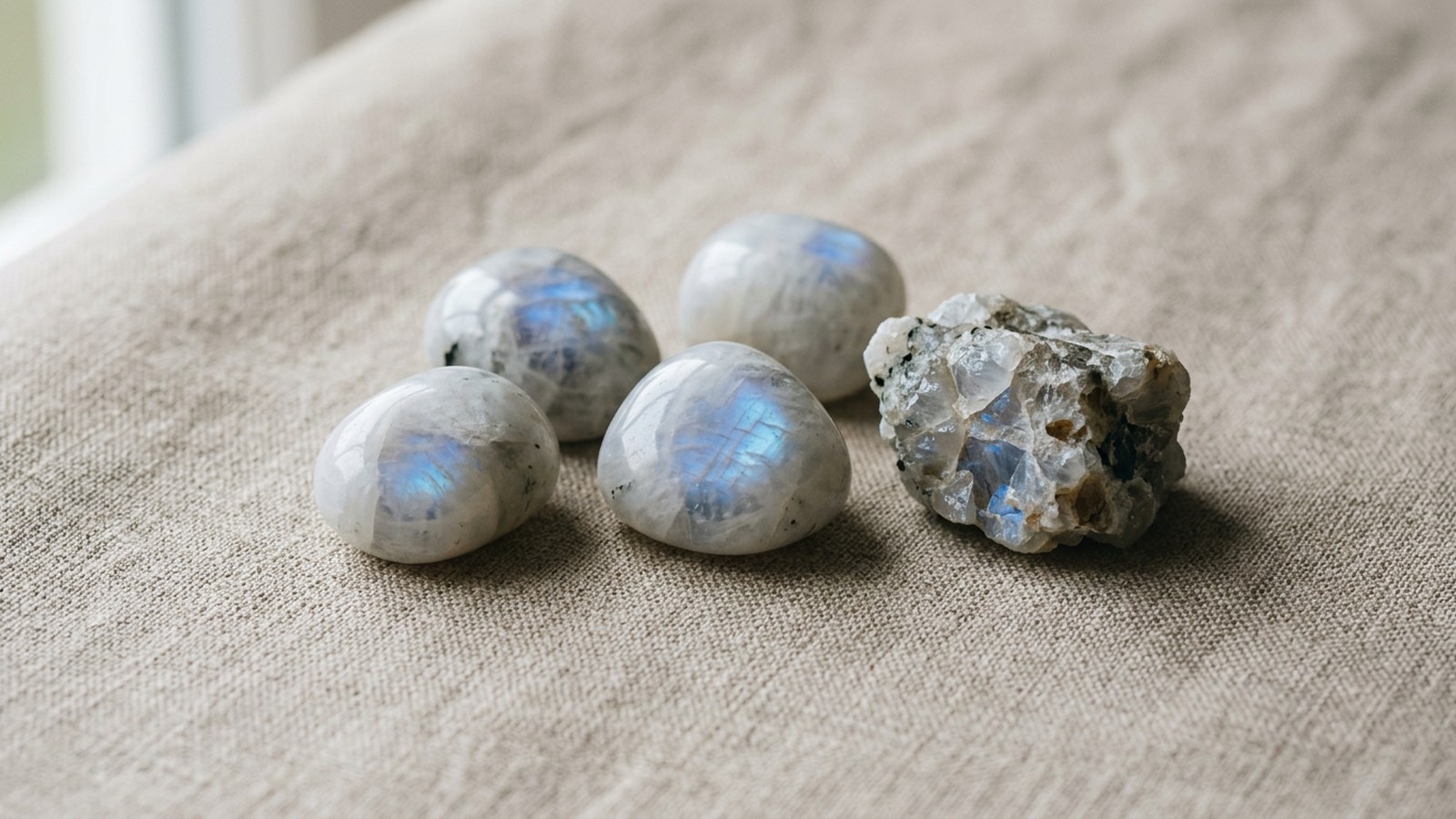
I have kept a notebook by my bed for longer than I have kept crystals there, and the two arrived in my life for the same reason. I wanted to hold on to my dreams a little longer. For years I would wake with a vivid scene still in front of me, reach for my phone, and watch it dissolve before I had read the first notification. The notebook helped. The stone on the nightstand, a small moonstone I had been given, helped in a quieter way, because it became the thing I touched first, before anything else, and that small habit gave my memory a few extra seconds to work.
This guide is about crystals for dreams in that practical spirit. The stones are sorted by what you actually want from your nights, whether that is remembering more, dreaming lucidly, softening hard dreams or simply dreaming less intensely, followed by a 21 night practice, a bedside care table and an honest word on what a stone can and cannot change.
Which crystal is best for dreams? The short answer
In crystal tradition the stone most associated with dreams is moonstone, followed closely by amethyst and labradorite. Moonstone is the classic choice for remembering dreams, amethyst for calmer and more peaceful nights, and labradorite for vivid, symbolic dreaming. Keep one tumbled stone on your nightstand or under your pillow, set a short intention before sleep, and touch it on waking before you write down whatever you remember.
What a stone can do for your dreams, and when to talk to someone
I think of a dream stone as an anchor for attention. Dream researchers such as Michael Schredl have shown again and again that the strongest predictor of dream recall is simply how much interest you pay to your dreams, and that keeping a dream journal raises recall within a couple of weeks. A crystal you hold while setting an intention, and touch again on waking, turns that interest into a ritual your body recognises. The traditional energies of each stone, which I describe below, belong to crystal lore and personal experience, and I share them in that spirit.
Some nights deserve more than a stone. Nightmares that recur several times a week, that wake you in panic or that replay a frightening event are worth raising with a doctor or therapist, because they respond well to treatment. Imagery rehearsal therapy, where you rewrite a recurring nightmare while awake and rehearse the new version, is recommended by the American Academy of Sleep Medicine for nightmare disorder. Loud snoring, gasping awake or daytime exhaustion can point to a sleep disorder, and a crystal is never a substitute for having that checked.
Crystals for dreams, sorted by what you want from your nights
Most lists give you eight stones in a row and leave you to guess. In my experience the right choice depends on the problem you are trying to solve, so I have grouped them that way. Pick one stone from the group that fits you and give it a few weeks before you add another. All ten stones are also gathered on the crystals for dreams page of the site.
To remember your dreams: moonstone and prehnite
If you wake knowing you dreamed but holding nothing, start with moonstone. It is a feldspar whose soft blue or white glow, called adularescence, comes from light scattering between thin layers inside the crystal, and tradition has linked it to the moon, the night and the tides of the unconscious for a very long time. It sits on the third eye and crown in most chakra systems. In practice I find its value lies in being gentle enough to keep by the bed every night without feeling stimulating. Moonstone has perfect cleavage, so it can chip if it falls from a nightstand onto a hard floor, and a tumbled piece is safer than a carved one under a pillow.
Prehnite, a pale green silicate, is the second recall stone I would suggest. Crystal healers have long called it a stone of "remembering", and many people pair it with moonstone for dreamwork. It is hard enough (6 to 6.5 on the Mohs scale) to sit in a pillowcase without worry. Prehnite suits you less well if you are looking for a soothing stone, because people often describe its feel as brightening rather than sedating.
For lucid dreaming: Herkimer diamond and kyanite
A lucid dream is one where you realise you are dreaming while the dream continues. The stones most often named for it are Herkimer diamonds, the double terminated quartz crystals found in dolostone in Herkimer County, New York, and kyanite, the blue bladed mineral that tradition associates with clear communication between the waking and sleeping mind. Herkimer diamonds are quartz, so they are hard (Mohs 7) and easy to care for. Kyanite is unusual because its hardness changes with direction, around 4.5 along the blade and nearly 7 across it, and its blades split easily, so I keep it on the nightstand and never under a pillow.
Lucid dreaming is a skill as much as a gift, so the stone works best alongside a method. The technique with the best research behind it is called MILD (mnemonic induction of lucid dreams), developed by Stephen LaBerge and tested more recently by Denholm Aspy at the University of Adelaide: as you fall asleep, you repeat an intention such as "next time I am dreaming, I will notice I am dreaming" while picturing yourself becoming lucid in a recent dream. Holding a Herkimer while you repeat it is a lovely way to give the words a physical home.
For vivid, symbolic dreams: labradorite and lapis lazuli
When people ask what is good for vivid dreams, the answer in crystal tradition is usually labradorite. It is another feldspar, and its flashes of blue, green and gold (called labradorescence) appear only when light strikes it at the right angle, which is a fitting image for dreams that reveal themselves in glimpses. It is linked with intuition and the third eye, and you can read more about its pairing with moonstone in my guide to labradorite and moonstone.
Lapis lazuli, the deep blue rock flecked with golden pyrite, was carved into amulets and seals in ancient Egypt and Mesopotamia and later ground into ultramarine pigment, and modern crystal tradition links it with insight and prophetic dreams. If the "prophetic dreams" side of dreamwork draws you, lapis is the traditional choice. Both stones can feel too lively for anyone whose main goal is deep rest, so I would start with them only if your sleep itself is good.
For calmer dreams and nightmares: amethyst, smoky quartz and black tourmaline
Amethyst is the stone most often recommended for peaceful sleep, and some sellers even market it as "dream amethyst". Its name comes from the Greek amethystos, "not intoxicated", and tradition extended that sobering quality to a mind that will not settle at night. Some crystal writers debate whether a quartz stone is too energising for the bedroom. My own answer is that a small tumbled amethyst feels soft to most people, while a large cluster beside the bed can feel busy. Amethyst fades in strong sunlight, so keep it away from a sunny windowsill.
For dreams that feel threatening, tradition turns to protective stones. Smoky quartz is the gentler of the two, a brown to grey quartz coloured by natural irradiation, and black tourmaline is the classic shield stone, often placed at the foot of the bed or by the door. Both are hard and easy to live with. If you like the idea of combining calm and protection, my guide to black tourmaline and amethyst explains where to place each one. This is also what most people mean when they search for crystals for dream protection, and more stones in that family are gathered in crystals for protection.
For quieter nights when dreaming exhausts you: howlite and lepidolite
This section is for a reader the usual lists leave out. Some people dream too much: long, busy, problem solving dreams that leave them waking tired. For them I suggest a stone that tradition associates with slowing down. Howlite is a white borate with grey veining, soft at Mohs 3.5, and it is the stone I hand to friends whose minds keep working all night. Be aware that it is often dyed blue and sold as turquoise.
Lepidolite is a lilac mica that contains lithium, which is where its calming reputation partly comes from. The lithium in the stone stays locked in the mineral and does nothing pharmacological when you hold it, so think of lepidolite as a calming cue in the crystal tradition and nothing more. It is very soft (2.5 to 3) and flakes, so a polished palm stone on the nightstand works better than a raw piece in the bed. For more stones in this calming family, see my guide to calming crystals.
A 21 night dream practice with your stone
This is the routine I come back to whenever my dream life goes quiet. It combines what dream researchers know about recall with the ritual side of crystal work.
- Choose one stone from the group above that matches your goal, and cleanse it in whatever way you prefer. My guide to cleansing crystals lists methods that are safe for soft stones.
- Put a notebook and pen within reach of the bed, close enough that you can write without getting up or picking up your phone.
- At bedtime, hold the stone for a minute and repeat a single intention, such as "I will remember my dreams" or, for lucid work, the MILD phrase above.
- Place the stone on your nightstand or in your pillowcase, depending on the care table below.
- When you wake, stay still for a moment with your eyes closed. Moving quickly scatters dream memories, so let the images return first.
- Touch the stone, then write anything you remember, even a single word, a colour or a feeling. A fragment written down often brings back the rest.
- Once a week, read through your notes. Repeating places, people or feelings are the beginning of your personal dream vocabulary.
Give it the full three weeks before you judge the stone. Recall usually improves within the first ten days simply because you are paying attention, and the stone is what keeps that attention coming back each night.
Under your pillow or on the nightstand? A bedside care table
A pillowcase is a demanding place for a mineral. It gets warm, slightly damp and pressed by your weight for hours, so only hard, smooth, tumbled stones belong there. Everything else is happier on the nightstand. If you are unsure about water, my guide to crystals and water safety goes into more detail.
| Stone | Mohs hardness | Under the pillow? | Care note |
|---|---|---|---|
| Moonstone | 6 to 6.5 | Yes, tumbled | Perfect cleavage, avoid drops |
| Prehnite | 6 to 6.5 | Yes | Brief rinse is fine |
| Herkimer diamond | 7 | Yes | Very easy care |
| Kyanite | 4.5 to 7 | No | Blades split easily |
| Labradorite | 6 to 6.5 | Yes, tumbled | Avoid harsh cleaners |
| Lapis lazuli | 5 to 5.5 | Nightstand is better | Porous, keep dry |
| Amethyst | 7 | Yes | Fades in strong sun |
| Smoky quartz | 7 | Yes | Fades slowly in sun |
| Black tourmaline | 7 to 7.5 | Yes | Raw pieces shed fibres |
| Howlite | 3.5 | Nightstand is better | Scratches, often dyed |
| Lepidolite | 2.5 to 3 | No | Flakes, keep dry |
| Selenite | 2 | No | Dissolves with moisture |
A few stones that appear on other dream lists stay out of my bed entirely. Covellite is a copper sulfide with a hardness of 1.5 to 2, and I would handle it, wash my hands and keep it in a box rather than sleep with it. Scolecite forms fragile needles that break into small splinters. Selenite and celestite are soft and sensitive to moisture, so they belong on a shelf. Moldavite has sharp natural edges and is widely faked, and many people describe its energy as far too intense for sleep. Keep every small stone out of reach of children and pets, who may put them in their mouths.
Bringing it together
If you only try one thing, put a tumbled moonstone or amethyst by your bed, keep a notebook beside it and give yourself three weeks. The stone gives your nights a small ritual and your mornings a moment of attention, and for many people that is enough for dreams to start staying with them. If you want to go further, my guide to crystals for intuition explores how dreams fit into intuitive work, and crystals for sleep covers rest itself. I hope your nights become a little more memorable, and a little kinder.