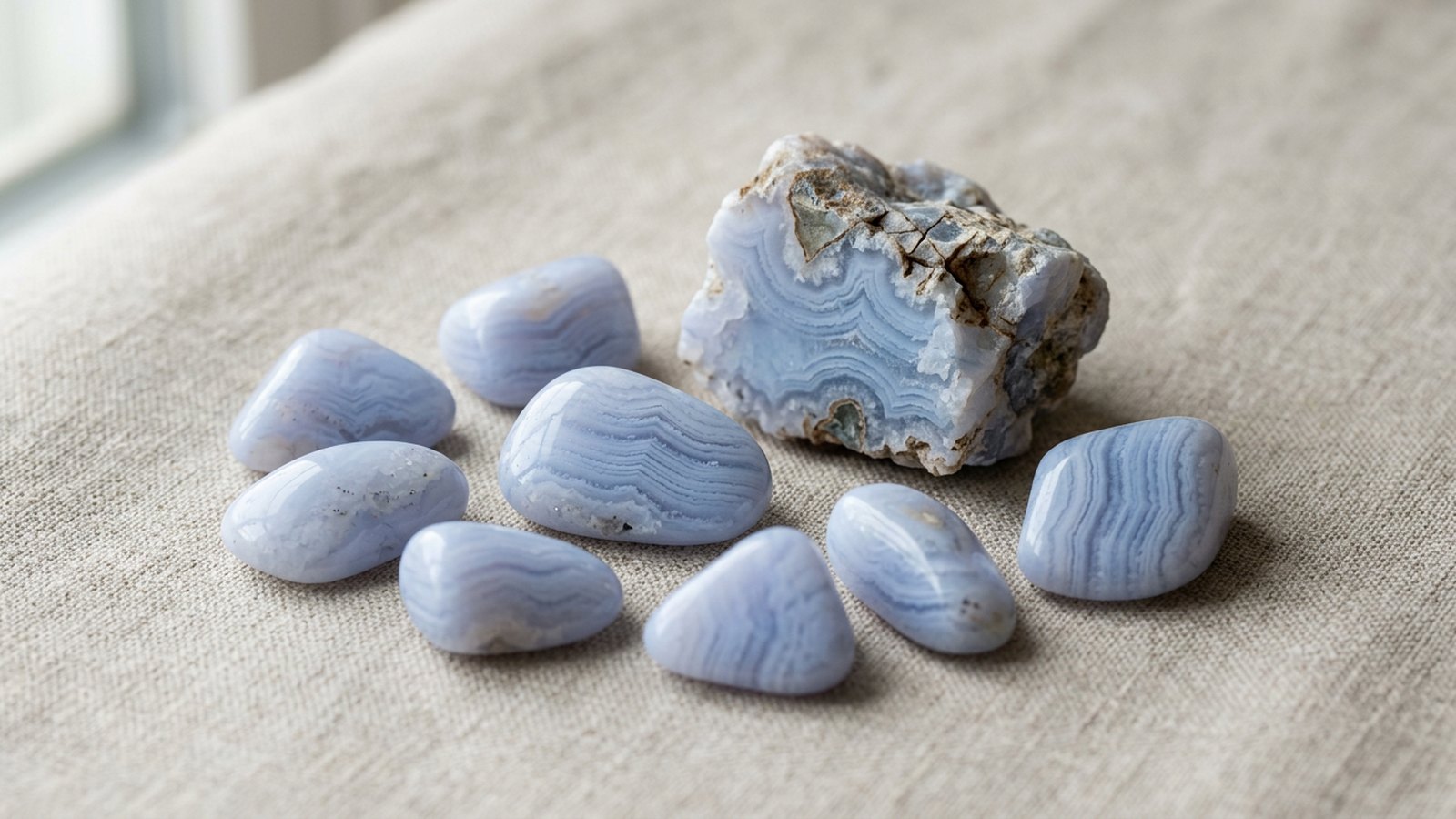
If you have read three of these lists already, you have met the same twenty blue stones three times, each with a paragraph that could be swapped for any other. Blue lace agate soothes. Aquamarine clarifies. Sodalite brings truth. All of it is true, and none of it helps you choose.
So here is the short answer, and then the useful one. The stones most consistently tied to communication are blue lace agate, aquamarine, sodalite, lapis lazuli, amazonite, blue kyanite and chrysocolla, all worked with through the throat chakra. But "I want to communicate better" hides at least four different problems, and they do not want the same stone. Pick by what actually goes wrong when you open your mouth.
First, which kind of communication do you mean?
Two very different people search this phrase, and almost nobody separates them.
Most of you mean talking to other humans: the meeting, the difficult conversation with a partner, the presentation, the boundary you keep failing to say out loud. That is the throat chakra, and it is what most of this guide is about.
Some of you mean the other thing: communication with guides, with the departed, with your own intuition. Google's own related searches show it, and so does the recurring question about telepathy. That is a different set of stones and a different chakra, and I have given it its own section further down so it does not get muddled in with public speaking nerves.
Before either, one honest line. In the tradition these stones come from, the throat is where truth moves from feeling into words, and blue stones open that gate. That is the lore, and I find it genuinely useful. What I can also tell you plainly, from years of keeping a stone in my pocket before hard conversations, is more ordinary: a stone you have chosen for a specific conversation is a physical reminder of what you decided to say. It slows your hand, it slows your breath, and it buys you the second you needed. That is real. It is also not a substitute for preparing, for therapy, or for a speech coach if you have a genuine phobia of speaking. A crystal sits beside those things. It does not replace them.
Break one: the words will not come out
This is the freeze. You know exactly what you think, and your throat closes anyway. It happens in meetings, at family dinners, and to almost everyone in the ninety seconds before speaking to a room.
Blue lace agate is the classic here, and it deserves the reputation. It is banded chalcedony, a microcrystalline quartz, and the pale blue and white lacing is the softest look in the whole throat family. Modern crystal lore calls it the stone of articulation, and the association I trust is with lowering the stakes rather than raising the volume. It is the stone for the person who goes quiet, not for the person who needs to be louder. It is also genuinely uncommon in good quality, mostly from the Ysterputs mine in Namibia, which is worth knowing before you pay for a suspiciously vivid piece. My full blue lace agate guide covers how to spot a dyed one.
Aquamarine is the one I hand to people who freeze specifically under pressure. It is a beryl, the same mineral family as emerald, hard at 7.5 to 8 on the Mohs scale and therefore the only stone in this section you can wear daily without thinking about it. Traditionally it is the sailor's stone, carried for calm passage, and that is roughly how it behaves on a nervous morning: cool rather than energising. Worth knowing that most commercial aquamarine has been gently heated to drive off the green, which is standard practice and does not make it fake. More on that in the aquamarine guide.
If the freeze is really anxiety wearing a communication costume, be honest about that and start with the crystals for anxiety guide instead. Different problem, different stones.
Break two: you speak, and it does not land
You said the thing. Nobody understood it, or they understood something you did not mean. This is the muddle: too many words, the point arriving last, or a thought that was never clear before it left.
Sodalite is my first choice, because the tradition attaches it to rational thought rather than to soothing. It is a deep royal blue with white calcite veining, softer than it looks at 5.5 to 6, and it is the stone I associate with getting your own thinking straight before you inflict it on anyone. If your problem is that you talk in order to find out what you think, this is the one to sit with beforehand.
Blue apatite is the sharper, more demanding cousin, and it comes with a warning built into its name: apatite is from the Greek for "to deceive", because it was so often mistaken for other minerals. At a Mohs 5 it is a genuinely fragile stone that does not belong on a keyring. Its traditional association with clarity and with cutting through your own confusion is strong, and my apatite guide goes into the four ways it still lives up to its name.
Lapis lazuli sits here too, and it is the heavyweight. Strictly it is a rock rather than a single mineral, lazurite with calcite and flecks of pyrite, mined at Sar-e-Sang in Afghanistan for something like six thousand years and ground into ultramarine for Renaissance painters. Its lore is about speaking with authority, which makes it the stone for the conversation where you need to be taken seriously rather than merely understood. If you are unsure whether yours is lapis or sodalite, that is a common and expensive confusion: sodalite vs lapis lazuli settles it.
Break three: too much, too fast, too sharp
The opposite failure, and much less written about. You have no trouble speaking. That is the trouble. You interrupt, you over-explain, or you say the true thing in the cruellest available way and watch it land.
Amazonite is the one I reach for. It is a microcline feldspar with a lovely blue-green colour that comes from traces of lead, and it has two directions of perfect cleavage, which is a polite way of saying it will split cleanly if you drop it. Traditionally it is called a stone of truth with tact, and that pairing is exactly the point: it is not for finding your courage, it is for keeping your honesty kind. See the amazonite guide for the full picture.
Chrysocolla carries a similar association, tied more to the teacher than the negotiator, the person who has to explain something patiently for the fourth time. It is a hydrated copper silicate and it is soft, often somewhere between 2 and 4 unless it is intergrown with quartz, so it wants to be a desk stone rather than a ring.
Rose quartz belongs in this section more than most lists admit. If the sharpness in your voice is really hurt talking, the throat is not where the work is. Start at the heart, with the rose quartz guide, and expect the words to soften afterwards.
Break four: the conversation has another person in it
Conflict with a partner, a repair after something went badly, a talk where being right is worth less than staying connected. This is where the pure throat stones underperform, because clarity alone can make a fight worse.
The pairing I actually use is lapis lazuli with rose quartz: something to say it clearly, something to say it kindly. Blue kyanite is the other one worth knowing. It is aluminium silicate with a genuinely strange property, an anisotropic hardness of about 4.5 along the blade and closer to 7 across it, and it splits into blades along a perfect cleavage. Tradition holds it aligns the chakras and opens a channel between people, and it carries an old claim that it never needs cleansing because it holds no negative energy. I am agnostic about that claim, and I say so in the kyanite guide. If you like tidy pairings, check what crystals should not be together first: the rules there contradict each other more than anyone admits.
The other communication: guides, intuition, the departed
For this branch the work moves upward, from the throat to the third eye and crown.
Angelite is the traditional stone for contact with guides. It is anhydrite, calcium sulfate, and it has a genuine quirk: it absorbs water and slowly reverts toward gypsum, so it must never be soaked or left damp. Celestite carries the same association in a lighter register, a pale blue strontium sulfate that grows in the famous Madagascan geodes and fades in direct sunlight. Selenite is used to clear the channel rather than to open it, and being gypsum at a Mohs 2 it dissolves in water, which is why the water safety guide exists.
I will be careful here rather than encouraging. What these stones reliably do is mark a quiet, deliberate space in which you listen to yourself. Whatever else you experience in that space is yours to interpret, and I am not going to tell you what it is.
The part no other list tells you: half of these cannot be worn
Almost every page on this keyword tells you to wear your communication stone as a pendant at the throat. Then it recommends a line-up in which most stones will not survive that. Here is the honest table.
| Stone | Mohs | Daily pendant? | The catch |
|---|---|---|---|
| Aquamarine | 7.5 to 8 | Yes | Usually heat treated, which is normal |
| Blue lace agate | 6.5 to 7 | Yes | Commonly dyed, check the price |
| Amazonite | 6 to 6.5 | With care | Perfect cleavage, chips if dropped |
| Sodalite | 5.5 to 6 | With care | Scratches, keep off keyrings |
| Turquoise | 5 to 6 | With care | Porous, absorbs oils and perfume |
| Lapis lazuli | 5 to 5.5 | Occasional | Porous, never soak it |
| Blue apatite | 5 | Occasional | Brittle, chips easily |
| Blue kyanite | 4.5 across the blade | No | Splits along its cleavage |
| Angelite | 3.5 | No | Water damages it permanently |
| Celestite | 3 to 3.5 | No | Fades in sunlight |
| Chrysocolla | 2 to 4 | No | Too soft unless quartz-bearing |
If you want one stone you can genuinely wear at your throat every day and stop thinking about, it is aquamarine, with blue lace agate a close second. Everything below sodalite on that table wants to live on a desk or a bedside shelf. Carrying and wearing stones has the practical side, and how to store crystals covers keeping the soft ones intact.
A practice that fits in the two minutes you actually have
Meditating on your throat chakra for twenty minutes is lovely advice for a day you are not having. This is the version I use.
- Before the conversation, not during. Pick the stone by which break you are facing, using the four sections above.
- Two minutes, sitting, stone in your closed hand. Not on your throat. In your hand, where you can feel its weight and its temperature.
- Say the sentence out loud, once. The actual sentence you are afraid to say. Not a theme, not an intention. The words, in the order you plan to use them. This is the whole practice, and hearing your own voice produce the sentence once is most of the benefit.
- Put the stone in a pocket where your hand will find it. When you touch it in the room, you are touching the sentence you already said.
- Afterwards, put it down deliberately. Cleansing it if that is your habit, but at minimum, set it down and let the conversation be over.
If you want the stone tied to a specific outcome rather than a general mood, programming an intention is the method.
Where I would start
If you are not sure which of the four breaks is yours, sit with the last conversation that went badly and ask what specifically failed. Did you not speak, did you speak unclearly, did you speak too harshly, or did you win the point and lose the person? The stone follows from that, and so does the work, which was never really about the stone.
Blue lace agate is the safest first purchase, for what it is worth. Aquamarine is the one you will still be wearing in ten years. And if you find yourself drawn to the whole blue family at once, the chakra guide is a good next stop, because the throat rarely needs attention on its own.