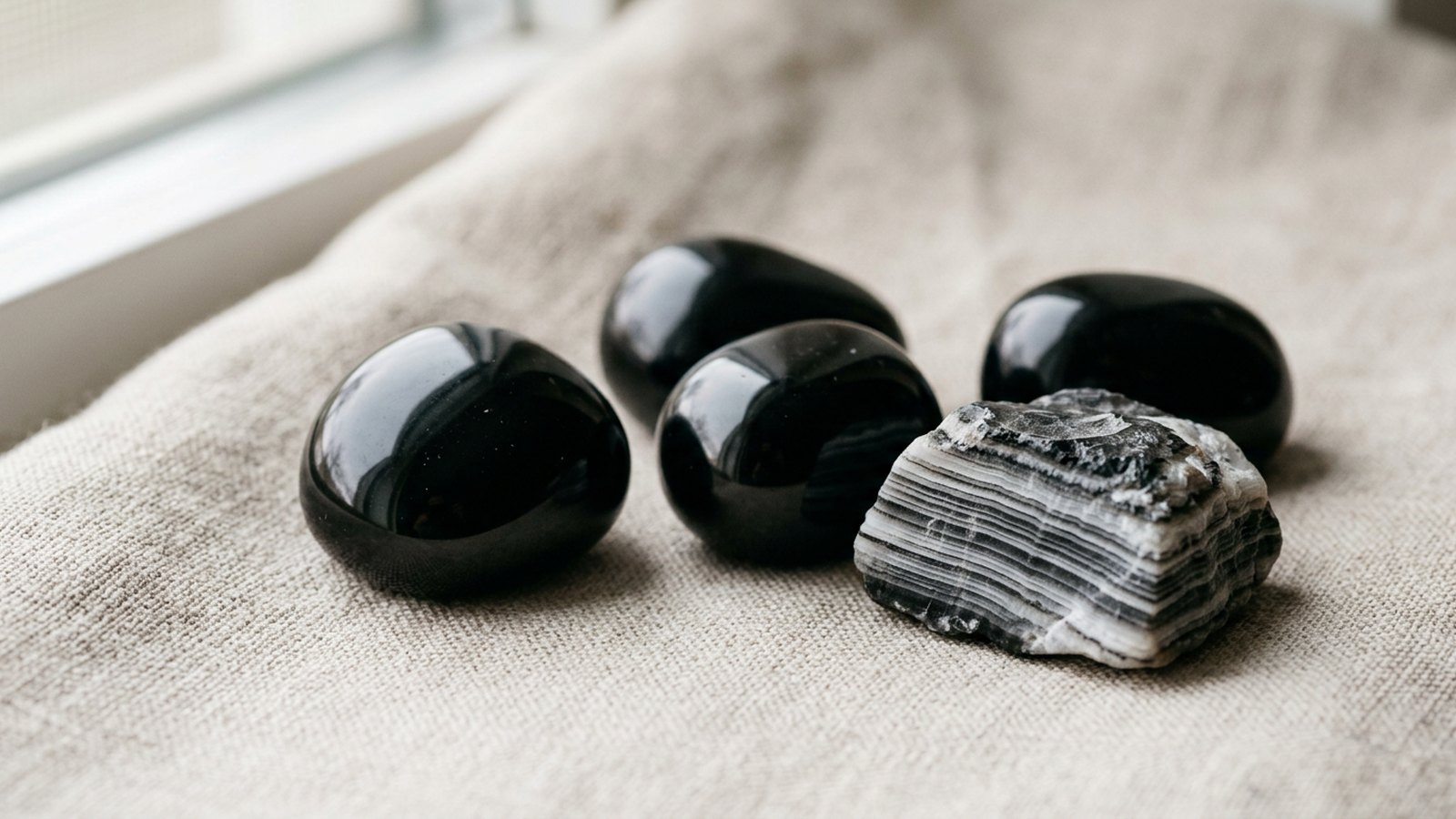
Onyx meaning comes down to one steady idea: self-mastery. This deep black, mirror-polished stone has been carried, carved, and worn for thousands of years as a symbol of strength, protection, and quiet self-control. Its glossy darkness looks bold and modern, yet its story reaches back to ancient Greece and Rome. If you are drawn to onyx and its calm, grounding weight, this guide explains what onyx means, what the stone actually is, its long history, and how people use and care for it today.
What Onyx Means
At its heart, the meaning of onyx is about steadiness under pressure. Where a bright crystal point feels light and expansive, onyx feels dense, still, and closed like a held breath. It is traditionally seen as a grounding and protective stone, one that draws scattered energy back down into the body and helps you stay composed when life feels chaotic.
Onyx is often called a stone of willpower and discipline. It is linked with focus, decision-making, and the patience to see hard tasks through, which is why it has long been described as a stone for people carrying heavy responsibility. Many traditions also treat it as a stone of endurance in difficult seasons, including the slow work of mourning and letting go.
Because black is the colour most associated with protection and the root chakra, onyx sits naturally alongside stones like obsidian, black tourmaline, and hematite. If you are new to matching stones to their colours, our guide to crystal colours and their meanings is a helpful place to start.
What Onyx Actually Is
Onyx is not a mineral in its own right. It is a banded variety of chalcedony, which is a microcrystalline form of quartz (silicon dioxide, SiO2). It sits at roughly 6.5 to 7 on the Mohs hardness scale, which makes it durable enough for everyday rings and beads.
The detail that sets onyx apart from ordinary agate is the shape of its bands. True onyx has straight, parallel layers, while agate shows curved or concentric banding. That single difference is the traditional dividing line between the two stones. When the bands alternate black with a reddish-brown layer of sard, the stone is called sardonyx, named in part after the ancient Lydian city of Sardis.
Here is the fact most buyers never hear: naturally solid black onyx is genuinely rare. The overwhelming majority of the deep black onyx sold today is pale grey chalcedony that has been permanently dyed. The classic method, used since Roman times, is to soak the stone in a sugar solution for weeks, then treat it with sulfuric acid. The acid carbonises the sugar trapped in the stone's microscopic pores, turning it a stable, lasting black. This treatment is old, widely accepted, and considered the industry standard, though disclosure at the point of sale is not always consistent. Knowing this is part of learning how to tell if a crystal is real or treated.
A Short History of Onyx
Few stones have as long a working history as onyx. The name itself comes from the Ancient Greek word for "claw" or "fingernail," a nod to the pale, nail-like banding of some varieties. One charming Greek myth says that Eros trimmed the sleeping Aphrodite's nails and the divine clippings, too sacred to vanish, fell to earth and turned to stone.
The Greeks and Romans prized layered onyx and sardonyx above almost any other material for carving. Its parallel bands were perfect for cameos, where an artist cut a pale portrait in relief against a dark ground, and for intaglios, the reverse-carved seals used to stamp wax. Because warm sealing wax does not stick to the polished surface, onyx made an ideal signet stone for the ancient world.
Much later, black onyx became the defining stone of Victorian mourning jewellery. After the death of Prince Albert in 1861, Queen Victoria's long public grief made jet and black onyx the accepted materials for remembrance pieces worn in memory of the dead. That association with dignified grief is one reason onyx still appears in crystals chosen for grief and loss today. In the twentieth century, its clean geometry made it a favourite of Art Deco designers.
How to Use Onyx
Onyx is an easy stone to live with, and most people use it in simple, practical ways.
Carry or wear it. A tumbled onyx in your pocket or a ring on your hand is a quiet reminder to stay steady through a demanding day. See carrying and wearing stones for more on keeping a stone close.
Place it in your space. Set onyx near a desk or entryway where you want a sense of focus and protection. Our guide on where to place crystals in your home has room-by-room ideas.
Meditate with it. Held in the hand, onyx suits slow, grounding practice. If you tend toward a racing mind, pair it with the calming stones in our crystals for anxiety guide, or use it in a root-focused session from our guide to the chakras and their crystals. For technique, see meditating with crystals.
Lean on it for resolve. Because onyx is tied to willpower, many people reach for it when building a new habit or facing a test of nerve, much as they would the stones in our crystals for confidence and courage guide.
How to Care for Onyx
Onyx is hard enough for daily wear but needs a little thought, mostly because so much of it is dyed. A quick rinse under cool water is fine, but avoid long soaks, salt, and harsh chemicals, which can dull the polish or, over time, affect dyed material. Our crystals and water safety guide covers this in detail.
To keep it feeling clear, cleanse onyx with smoke, sound, or a night beside a larger stone rather than water, following our guide to cleansing crystals. You can restore its sense of vitality using any of the gentle methods in how to charge your crystals. Store it away from harder stones so the polished surface does not scratch.
The Takeaway
Onyx means steadiness, self-control, and quiet strength. It is a banded chalcedony with an ancient life as a carving stone and a modern one as a symbol of grounded resolve, and most of it is dyed to reach that famous deep black. Whether you keep it on your desk, wear it as a ring, or hold it in meditation, onyx is a calm anchor for anyone who wants to feel a little more composed and a little more in charge of their own direction.
If you are ever unsure whether a chalcedony piece in your collection is really an agate or a jasper, our guide to jasper vs agate gives the one test that settles it.