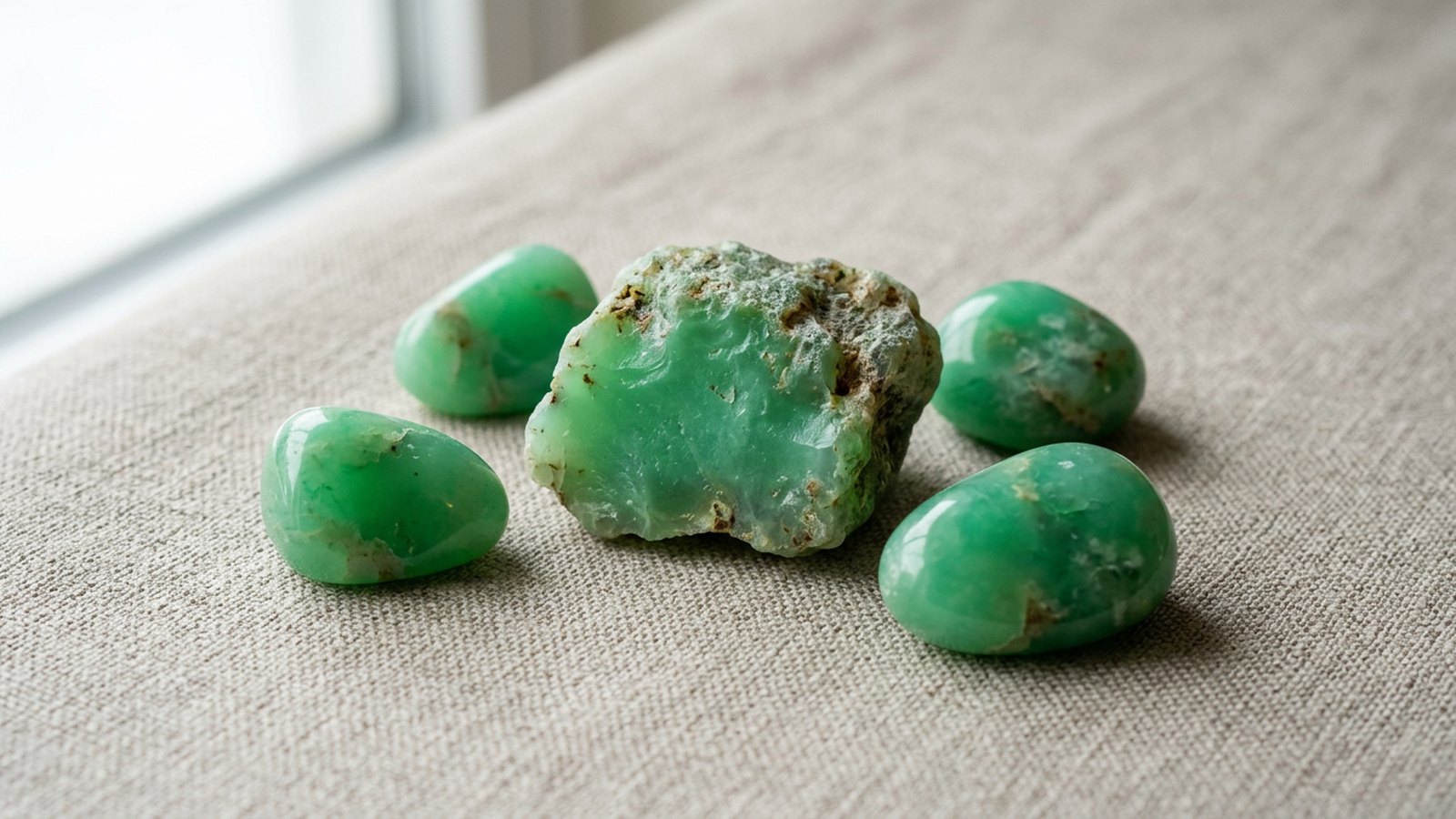
The first piece of chrysoprase I owned was a small tumbled pebble the colour of a green apple held up to a window, and I spent about a year assuming it was jade. It is not jade. It is not even related to jade. It is quartz, of the same quiet family as carnelian and agate, and the green comes from nickel that leached out of a rock that used to be something else entirely.
Chrysoprase is an apple-green variety of chalcedony, a cryptocrystalline form of quartz coloured by trace nickel, and it is traditionally worked with as a heart stone for joy, self-forgiveness and hope. That is the short answer, and it is accurate as far as it goes. But it leaves out the part I find most interesting, which is who this stone is actually for.
In my experience it is not for people who are sad. It is for people who are hard on themselves. There is a specific kind of person who is generous with everyone else and merciless in their own direction, who forgives a friend in an afternoon and is still turning over something they said in 2019. Chrysoprase is the stone I reach for with them. It is the gentlest heart stone I know, and gentleness is exactly what that person will not give themselves.
Reasons to work with chrysoprase
Chrysoprase is for self-forgiveness. Not the large, dramatic kind, but the daily kind: letting go of the clumsy sentence, the email tone, the thing you should have noticed sooner. Traditionally it is worked with to loosen the grip of old self-criticism, and where rhodonite is the stone people reach for when forgiving someone else is the hard part, chrysoprase points the same energy back at the person holding it.
Chrysoprase is for coming out the other side. It has a long association with hope and renewal, and I find it most useful in the stretch after something difficult has ended, when you are technically fine and do not yet feel it. That is a real and badly served moment. Our guide to crystals for grief covers the acute part; this stone is for the slow return afterwards.
Chrysoprase is for softening a defended heart. People who have been let down develop a reasonable habit of bracing. Chrysoprase is traditionally used to open the heart without forcing it, which is why it pairs so naturally with the work in crystals for self-love. It does not ask you to trust anyone. It asks you to stop pre-flinching.
Chrysoprase is for beginnings that are not exciting yet. New job, new city, new phase you chose and are not enjoying. It sits well alongside the stones in crystals for new beginnings, with a quieter tone than most of them.
Chrysoprase meaning and healing energy
Emotional healing
This is where chrysoprase does its main work. Tradition places it firmly on the emotional heart: forgiveness, acceptance, the release of resentment (including resentment of yourself), and a sort of ordinary cheerfulness that has nothing to do with forced positivity. Old lithotherapy texts call it a stone of joy, which I think overstates it. What I notice is closer to relief.
Spiritual healing
Chrysoprase is often called the Stone of Venus, linked to love, beauty and the receptive side of things. In practice, people who work with it spiritually tend to use it for compassion practices rather than for insight or vision. It is not a stone that shows you things. It is a stone that makes you kinder while you look.
Mental healing
Traditionally it is worked with to interrupt looping thoughts, particularly the replay loop where you rehearse a past conversation. If that is your pattern, it is worth reading our guide to crystals for anxiety alongside this one, since chrysoprase is a soft entry point rather than a strong grounding stone.
Physical healing
Folk tradition associates chrysoprase with the skin, with fertility and with the detoxifying organs, mostly by colour association with growth and greenness. I pass this on as lore, not as fact. No stone treats anything, and if something in your body concerns you, please see a doctor rather than a crystal.
Chakra: heart, with a secondary link to the sacral Zodiac: Taurus and Libra (both Venus-ruled), with Cancer often added Element: Water Numerical vibration: 5 Affirmation: I forgive myself as easily as I forgive other people.
Green stones that are not chrysoprase
Most of the confusion around this stone happens in a shop. Apple green is a crowded colour, and several of the look-alikes are cheaper.
| Stone | How to tell it apart |
|---|---|
| Green aventurine | Sparkles. Tiny reflective fuchsite flakes catch the light; chrysoprase never glitters. See green aventurine |
| Jade (jadeite or nephrite) | Tougher and more fibrous, often with a slightly greasier surface, and usually priced well above chrysoprase |
| Chrome chalcedony | Genuinely close, same family, but coloured by chromium instead of nickel. Usually a deeper, cooler green |
| Dyed green agate or quartzite | Colour pools in cracks and banding. Chrysoprase colour is even through the body of the stone |
| Variscite | A phosphate, softer, more blue-green, often with brown veining |
Two more traps are worth naming. Lemon chrysoprase is not chrysoprase. It is a nickel-bearing magnesite from Australia, a different mineral entirely, and although it is a lovely stone it will not behave like chalcedony. And prase is not a synonym either: it is used both for the darker green varieties of chrysoprase and for chlorite-included quartz, so the word tells you almost nothing on its own. If you are unsure about a piece in general, our guide on how to tell if a crystal is real covers the basic tests.
The geology of chrysoprase
Chrysoprase is chalcedony: silicon dioxide, SiO2, in a cryptocrystalline form, meaning the quartz crystals are too fine to see even under normal magnification. That puts it in the same structural family as agate, carnelian and onyx, which is why it takes a waxy polish rather than a glassy one. Its hardness is 6 to 7 on the Mohs scale, and it breaks with a conchoidal fracture like flint.
The colour is the interesting part. Unlike emerald, which is green because of chromium, chrysoprase is green because of nickel, present as extremely fine inclusions of nickel silicates such as kerolite and pimelite. Older references credited the nickel oxide bunsenite; that attribution has since been corrected, which tells you something about how recently this stone has been properly studied.
Where it comes from is the part I find genuinely moving. Chrysoprase forms through deep weathering, or lateritisation, of nickel-bearing serpentinite and other ultramafic rocks. In plain terms: a body of serpentine rock sits in a hot, wet climate for a very long time, rots chemically from the top down, and the nickel released by that breakdown gets picked up by silica-rich fluids that fill the cracks and cavities below. In the Australian deposits it occurs as veins and nodules alongside brown goethite in a magnesite-rich layer beneath an iron and silica cap.
So the stone is, quite literally, made from the ruins of another rock. If you have read our guide to jade vs serpentine, you have already met the parent material. I find it hard not to read something into that when the stone's whole traditional job is recovery.
The name is Greek: chrysos, gold, and prason, leek, for that golden-green colour. It has been called chrysophrase and chrysoprasus over the centuries, which is why the older sources look inconsistent.
History and lore
Chrysoprase has a longer documented history than most stones on the shelf. The Greeks and Romans carved it into seals and intaglios, and it appears in classical descriptions of green gems well before the mineralogy was understood.
It is one of the twelve foundation stones of the New Jerusalem in Revelation 21:20, where it is listed tenth. That single line is why the question "what is chrysoprase in the Bible" comes up constantly, and it is worth saying plainly that the Greek gem names in that passage do not map cleanly onto modern mineral species, so the tenth stone may or may not have been what we now call chrysoprase.
The European story runs through Szklary in Lower Silesia, in present-day Poland, probably the largest chrysoprase deposit ever worked in Europe. Frederick the Great of Prussia is the name most attached to it; he had a genuine fondness for the stone and used Silesian chrysoprase in his own commissions. Earlier and more spectacularly, chrysoprase from the region decorates the walls of the Saint Wenceslas Chapel in Prague's Saint Vitus Cathedral, where it has sat since the fourteenth century.
There is also a persistent legend that Alexander the Great carried a chrysoprase in his belt through his campaigns and lost his luck when a serpent snatched it while he bathed in the Euphrates. It is a story rather than a record, and I repeat it as one. The stone also had a brief, very loud fashion moment in the 1980s, which is why some of the best cut Australian material turns up in vintage jewellery.
Why chrysoprase fades, and how to care for it
This is the part I wish someone had told me first. Chrysoprase fades. Prolonged sunlight and heat dull that apple green, sometimes noticeably within a season on a sunny windowsill, and the change is not always fully reversible.
The mechanism is dehydration. Chalcedony holds a small amount of water in its microstructure, and heat drives it off, which shifts how the stone handles light. Collectors have long stored faded pieces in a damp cloth or a closed container with a little moisture, and pale stones often recover some depth of colour that way over weeks. Treat that as a plausible repair, not a guarantee.
Practically, this means three things. Do not display chrysoprase on a windowsill. Do not charge it in direct sun, which rules out the method most people default to; use moonlight, or one of the gentler approaches in how to charge your crystals instead. And take rings off before hot water and before anything involving heat.
Water itself is fine. At 6 to 7 on the Mohs scale with no cleavage, chrysoprase handles a brief rinse without trouble, unlike the stones listed in which crystals can and cannot go in water. Skip salt, which scratches and dulls the polish over time, and skip ultrasonic cleaners if the piece has any fractures. For routine cleansing, smoke, sound or a night on a selenite plate all work well; our guide to cleansing your crystals goes through the options.
One question I get asked and almost never see answered: if you have a nickel allergy, is chrysoprase safe to wear? The nickel in the stone is locked into silicate inclusions, not present as free metallic nickel, so contact dermatitis from the stone itself is not something I have seen reported. The clasp, the chain and the setting are the usual culprits. If you react to jewellery, look at the metal first.
Buying chrysoprase
Good material is genuinely scarce, which is why prices surprise people. The most prized comes from Marlborough in Queensland and from Western Australia, sold as gem-grade and sometimes as "Australian jade", a trade name that has caused a hundred years of confusion. Central Tanzania has produced steadily since 1986, and there is material from Indonesia, Brazil, Poland, Russia, Arizona and California.
Value tracks colour and translucency: even, saturated apple green with no brown or grey, and enough translucency to glow at the edge of a cabochon. Opaque, mottled or pale material is common and cheap. Because good chrysoprase is expensive, dyed green chalcedony is sold in its place more often than for almost any other green stone, so buy translucent pieces from sellers who will tell you the origin. As with everything in this family, described in jasper vs agate, the family names are loose and the seller's honesty matters more than the label.
A last word
Chrysoprase is not a dramatic stone, and I would not recommend it to someone who wants to feel a jolt. It is slow, mild and a little forgiving, and it asks very little. If that sounds underwhelming, notice whether you just dismissed something for being gentle. That reaction is more or less the reason the stone exists.
If you want a companion for it, prehnite sits beside it well for the same soft heart work, and moss agate is the one I would add if the thing you are recovering from was a long winter rather than a single blow.