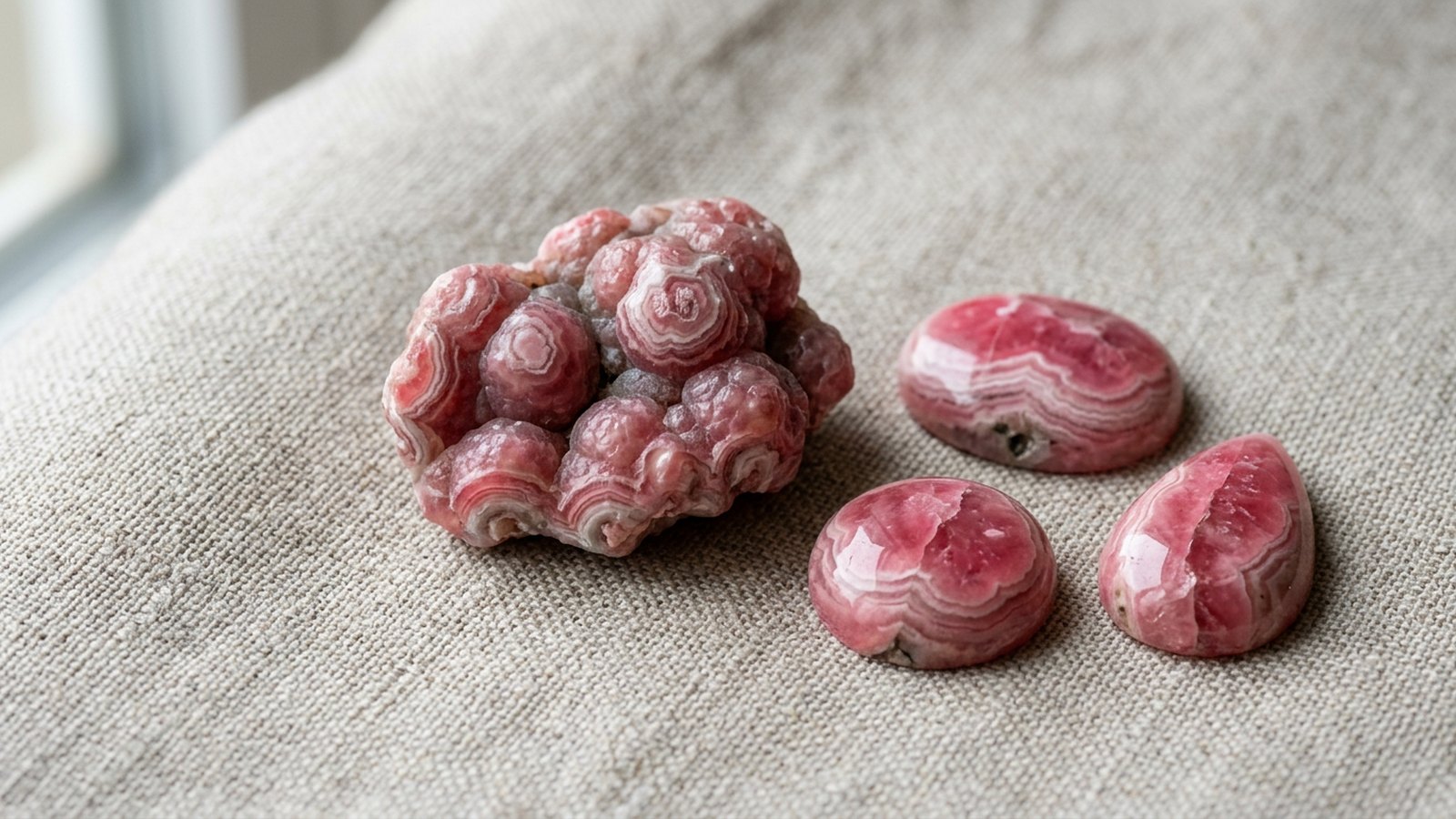
The first piece of rhodochrosite I ever held was a thin polished slice, about the size of a coaster, cut across a stalactite that had grown drop by drop in a cave in the Argentine Andes. Held up to a window it looked like the rings of a tree, except the rings were rose pink and cream, softening outward from a dark centre. It was warm to look at in a way few pink stones manage. Rose quartz is milky and diffuse. This was banded, deliberate, layered.
That layering is the whole story of the stone, geologically and, I think, emotionally. Rhodochrosite did not arrive pink. It built itself pink, one thin film of manganese carbonate at a time, over a very long period, in the dark.
People come to this stone for a specific kind of work. Not the open hearted, everyone welcome warmth of rose quartz, and not the boundary setting of a protective stone. Rhodochrosite is for the person who is generous, patient and forgiving with everybody except themselves.
The short answer
Rhodochrosite is a rose pink manganese carbonate (MnCO3) traditionally used as a stone of self love, emotional healing and inner child work. It is associated with the heart chakra, with Leo and Scorpio, and with turning compassion inward. At Mohs 3.5 to 4 it is soft, and being a carbonate it is damaged permanently by water, sweat and anything acidic.
Reasons to work with rhodochrosite
Rhodochrosite is for the inner critic that never takes a day off. Most of us carry a voice that speaks to us in a tone we would never use on a friend. This is the stone traditionally reached for when that voice gets loud: not to silence it, which no rock can do, but to notice the gap between how you treat other people and how you treat yourself. I keep a slice on my desk for exactly this. It does not fix the day. It interrupts it.
Rhodochrosite is for old material that has gone quiet but not away. In crystal tradition it is the classic inner child stone, associated with the parts of a person that formed early and stopped updating. That is heavy territory, and I want to be plain about it: a stone is a companion to that work, never a substitute for a therapist. But as a physical object to hold while you sit with something difficult, it has been doing that job for people for a long time. If grief is the shape your difficulty takes, our guide to crystals for grief sits alongside this one.
Rhodochrosite is for people who give too easily. Carers, eldest daughters, the friend everyone calls at midnight. The traditional reading here is not about giving less. It is about the return path being open, so that some of the warmth you send out comes back around to you. This is why it appears in almost every list of crystals for self love worth reading.
Rhodochrosite is for reconnecting with what you used to enjoy. Older texts associate it with joy, play and spontaneity, the light end of the heart rather than the tender end. If you have noticed that nothing has been fun for a while and you cannot say when that started, this is the traditional stone for that particular flatness.
Rhodochrosite meaning and healing energy
Emotional healing
Rhodochrosite's emotional reputation is the whole reason people search for it. It is traditionally used for self worth, self forgiveness, and the specific ache of having been hard on yourself for a long time. Where a stone like rhodonite is reached for after somebody else has hurt you, rhodochrosite is turned inward, toward the wounds you keep reopening yourself. The two are so often confused that we wrote a whole guide on telling rhodonite and rhodochrosite apart.
Spiritual healing
Spiritually, the tradition places rhodochrosite at a bridge rather than at a single point. Most pages will tell you it is a heart chakra stone and stop there. In practice it is usually worked with as a heart stone whose roots reach down into the solar plexus, because self worth is not purely a feeling, it is also a matter of standing. That bridge is what people describe when they say it feels warmer and more solid than other pink stones. Our chakra crystals guide covers how these centres relate.
Mental healing
Mentally, it is associated with softening perfectionism and the exhausting mental habit of rehearsing your own mistakes. I would frame this honestly: what the stone offers is a cue, an object that reminds you what you decided to practise. That is not nothing. Most change is made of reminders.
Physical healing
Traditional lore links rhodochrosite to the heart, the circulation and the nervous system, largely by colour association and by its manganese content. This is folklore, not medicine, and manganese in a carbonate crystal is chemically locked into the lattice and does not pass through skin. Please treat physical claims as tradition and see a doctor for anything physical.
Chakras: Heart, with a bridge to the Solar Plexus Zodiac signs: Leo and Scorpio Element: Fire Numerical vibration: 4 Affirmation: I offer myself the tenderness I give away so easily.
Two very different stones are sold as rhodochrosite
This is the part almost nobody explains, and it decides both what you paid and how you should treat your piece.
Banded rhodochrosite is the pink and white striped material, sold as slices, cabochons, tumbles, spheres and beads. It grows in layers on cave walls and in old mine workings, often as stalactites, and a cut across one of those gives the concentric bullseye people love. This is what more than nine out of ten buyers own. It is genuinely inexpensive, a few pounds or dollars for a tumble, and it is the material Argentina calls rosa del Inca.
Crystalline rhodochrosite is something else entirely: transparent to translucent rhombohedra in deep raspberry red, grown in hydrothermal veins. These are collector specimens. Good ones run to four and five figures, and faceted stones are effectively museum curiosities, because the mineral is too soft and too cleavable to survive being cut and worn.
So when someone asks whether rhodochrosite is worth anything, the honest answer is that it depends entirely on which of these two you mean, and the energetic tradition makes no distinction between them at all.
Rhodochrosite geology
Rhodochrosite is manganese carbonate, MnCO3, a member of the calcite group. Its trigonal structure is the same architecture as calcite, with manganese sitting where calcium would be, and that substitution is the entire reason for the colour: divalent manganese is what makes it pink. Iron and calcium routinely swap in as well, which is why so much material drifts toward brownish or pale rose rather than the vivid raspberry of the best specimens.
It sits at 3.5 to 4 on the Mohs scale, softer than a copper coin is hard, and it has three directions of perfect rhombohedral cleavage. That combination matters practically: it is not only scratchable, it splits along flat planes if you drop it. It leaves a white streak, and a drop of acid on it will fizz, which is the definitive carbonate test.
The name is older than most people assume. Johann Friedrich Ludwig Hausmann named it in 1813, from the Greek rhodon, rose, and chros, colour. Miners had been calling it raspberry spar and manganese spar long before that.
History and lore
Rhodochrosite's oldest story belongs to Argentina. The banded material comes from Capillitas, a mining district at around 3,000 metres in the Andean foothills of Catamarca province, and it is known there as rosa del Inca, the Inca rose. The tradition, repeated widely though difficult to document firmly, holds that the Inca treasured it and understood it as the blood of their former rulers turned to stone. Argentina today treats it as a national stone.
Its second life is North American and much more recent. The Sweet Home Mine near Alma, in Park County, Colorado, opened in 1873 as a silver mine and was a commercial disappointment for a century. What it did contain was rhodochrosite of a quality found almost nowhere else. In 1992 miners there uncovered the Alma King, a cherry red rhombohedron roughly 14 by 16 centimetres, still the finest known rhodochrosite crystal in the world. It sits in the Denver Museum of Nature and Science. Colorado made rhodochrosite its official state mineral in 2002.
Where rhodochrosite comes from
Capillitas in Argentina remains the source for banded Inca rose material, and it is effectively the only one. Colorado's Sweet Home Mine produced the great crystalline specimens and is now closed. The N'Chwaning and Wessels mines in the Kalahari manganese field of South Africa produce superb deep red crystals, and Peru, Mexico, Romania, China and Montana all contribute material of varying quality. If the seller can tell you which of these your piece came from, that is usually a good sign about the seller.
Caring for a carbonate
Nearly every crystal page tells you to keep rhodochrosite out of water. Very few say why, and the reason is worth knowing because it tells you what else to avoid.
Rhodochrosite is a carbonate, and carbonates react with acid. Not dramatically, but steadily. Sweat is mildly acidic. So is citrus juice, so is vinegar, so are most household cleaners, and so is the acid in tap water in some regions. Each contact etches the polished surface very slightly, and etching does not buff out. Combine that with hardness 3.5 to 4 and three perfect cleavages and you have a stone that is soft, splittable and chemically vulnerable all at once. Our guide to crystals and water safety puts it in context with other water sensitive stones like malachite, which is also a carbonate and fails the same way.
In practice: never soak it, never use salt, never use an ultrasonic cleaner, take a pendant off before you shower or swim, and wipe it with a dry soft cloth. Cleanse it and recharge it by dry methods only, so moonlight, smoke, sound or a bed of dry quartz. And when you store it, keep it away from harder stones, because at hardness 4 almost everything in your collection can scratch it.
How to tell if your rhodochrosite is real
The common fake is dyed banded calcite or aragonite, which is convincing at a glance because it is chemically a close cousin and takes pink dye readily. Look at the banding geometry. Real rhodochrosite bands are growth layers, so they run in smooth concentric rings or gentle parallel curves and the pink tone varies subtly from band to band. Dyed material tends to show colour pooling in cracks and along the edges, with a flat uniform pink elsewhere. Reconstituted pieces, made from powder and resin, feel slightly warm and light in the hand and often show tiny bubbles.
A carbonate test settles it, though it will mark your stone: a drop of vinegar on an inconspicuous spot will fizz faintly on real rhodochrosite and on real calcite, and do nothing on resin. Our guide on how to tell if a crystal is real covers the non destructive checks first.
A last thought
Of all the pink stones, this is the one I recommend least casually, because the work it is traditionally associated with is real work and the stone is only ever the reminder. But if you recognised yourself in the description of somebody who is kind to everyone else by default, a banded slice on a desk is a small and inexpensive thing to try. Keep it dry, keep it away from your harder tumbles, and let it do the one job it does well: catching your eye at the moment you were about to be unfair to yourself.