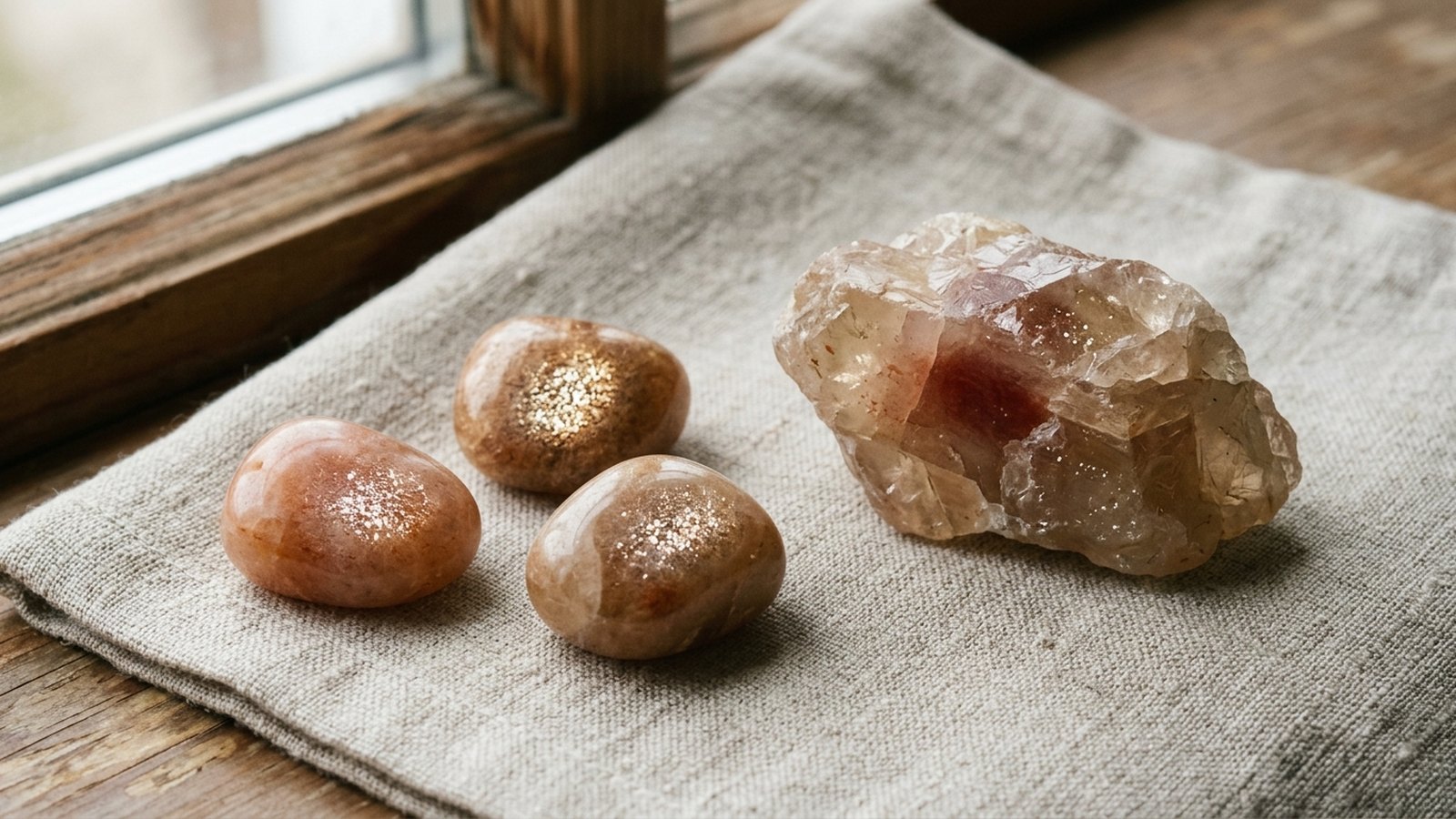
The first Oregon sunstone I handled looked like nothing much. A cloudy pebble the colour of weak tea, slightly greasy in the hand, the sort of thing you would step over on a beach. Then I turned it toward the window and a plane inside the stone lit up copper, as though someone had struck a match behind it. Turn it back and the light was gone again.
That is sunstone, and it is also the reason people reach for it. Sunstone is a feldspar carrying tiny flat inclusions of metal, and in crystal tradition it means joy, confidence, personal power and the kind of abundance you have actually earned. Its glitter has a proper name, aventurescence, and it only appears when the stone is held at the right angle to the light.
I think of sunstone as the stone of taking up space. Not the stone for grief, and not really the stone for anxiety either. It is for the person who has quietly made themselves smaller, who apologises before speaking, who has been the reliable one for so long that they have forgotten what they wanted. If that is a familiar description, this is your stone.
What sunstone symbolizes
Sunstone symbolizes joy, vitality, confidence and personal power. It is traditionally called a stone of leadership and good fortune, linked to the sun in almost every culture that has worked with it, and associated with the sacral and solar plexus chakras, the two energy centres tradition connects to creativity and willpower.
In crystal lore, sunstone is associated with:
- Warmth and optimism, the return of good humour after a flat stretch
- Confidence and leadership, particularly the willingness to be visible
- Personal power, meaning your own will rather than power over anyone else
- Abundance and good luck, in the sense of doors opening rather than money appearing
- Boundaries, the ability to be generous without being drained
Its older names carry the same idea. Mineralogists once called it heliolite, from the Greek helios for sun and lithos for stone, and the trade still occasionally calls it aventurine feldspar for its resemblance to green aventurine.
Reasons to work with sunstone
Sunstone is the stone I suggest for people who have gone quiet. There is a particular dimming that happens after a long stretch of putting other people first, or after a job that slowly taught you not to speak up. Nothing is wrong, exactly. You are just smaller than you used to be. Sunstone will not fix that on its own, and any stone described as fixing it is being oversold, but it makes an unusually good physical reminder. Touching one in your pocket before you say the thing you were about to swallow is a small ritual that works because you are the one doing the work.
Sunstone is a stone for generosity that does not empty you. This is where it separates from the other warm stones. Carnelian pushes you forward and citrine lifts the mood, but sunstone's traditional territory is the balance between giving and keeping. Old lore calls it a barrier stone, something that lets warmth out without letting other people's demands all the way in.
Sunstone is the stone of being seen on purpose. Presentations, interviews, first dates, the conversation you have rehearsed eleven times. Tradition ties it to leadership, but I read it more usefully as visibility: the willingness to be looked at while you are still uncertain. I have handed pieces of it to more than one person heading into a room they were dreading, and the report back is always that having something warm and heavy to hold gives the nerves somewhere to go. Our guide to crystals for confidence covers the wider set.
Sunstone is the daylight half of a pair. Its natural companion is moonstone, and this is not just a poetic pairing invented by shops. Both are feldspars, close chemical relatives, and both are prized for an optical trick. Moonstone glows with a soft blue sheen called adularescence, produced by microscopic layers of two feldspars scattering light. Sunstone flashes with metallic glitter from solid inclusions. One diffuses light, the other reflects it. Working with them together, moonstone at night and sunstone by day, is a rhythm I have kept for years. I describe that routine, and what the "sunstone moonstone" stone sold in shops really is, in my guide to sunstone and moonstone.
Sunstone is a working stone for motivation, not for calm. Be honest about which you need. If you are frayed and overstimulated, this is the wrong stone and amethyst or sodalite would serve you better. Sunstone is for the flat mornings, the stalled project, the fourth week of a job search, and it belongs with crystals for money and abundance rather than with the calming stones.
Sunstone meaning: healing energy
Emotional healing
The emotional territory of sunstone is self-worth, specifically the version that has been eroded rather than the version that was never there. Tradition holds that it lifts the low, grey mood that follows a long season of self-denial, and that it makes it easier to say what you want without dressing it up as what would be convenient for everyone. I find it useful in the exact moment before you back down.
Spiritual healing
Spiritually, sunstone is read as a solar stone. Where lunar stones ask you to receive, listen and wait, sunstone is associated with action, expression and the movement of energy outward. It carries the traditional idea of the divine masculine, understood not as gender but as the active, initiating principle that every person holds some measure of. Many people work with it to clear a sense of heaviness or stagnation before setting an intention.
Mental healing
Sunstone's mental reputation is for decisiveness: the stone people reach for when the problem is not a lack of options but an unwillingness to choose one. Tradition links it to independent thinking, the confidence to back your own read of a situation rather than polling everyone you know first.
Physical healing
Traditionally, sunstone is associated with vitality, warmth and the sense of physical energy returning, and older texts connect it to the low mood of dark winters. That is folklore and personal intuition, not medicine. No crystal treats, cures or manages any physical or mental health condition, and nothing here should replace the care of a doctor or therapist. You will find pages claiming sunstone helps arthritis, ulcers or fertility. Those claims are not supported by evidence, and I will not repeat them.
Chakras: sacral (Svadhisthana) and solar plexus (Manipura), with red and brown pieces also read to the root. See our full chakra and crystal guide. Zodiac signs: Leo above all, with Libra and Aries commonly listed. Element: Fire. Planet: the Sun. Numerical vibration: 1. Affirmation: I am allowed to take up space, and my warmth is not a debt.
Sunstone geology
Here is the thing most crystal pages get slightly wrong, including some ranking above this one. Sunstone is not a single mineral species. It is a trade name for any feldspar that shows aventurescence, and feldspars are a large family.
That family splits two ways. Plagioclase feldspars run in a continuous series from sodium-rich to calcium-rich, and sunstone from Norway and India is usually oligoclase, while Oregon material is labradorite, the same species that produces labradorite with its flashing blue sheen. Potassium feldspars, orthoclase and microcline, also produce sunstone, most spectacularly in Australia. So when a page prints one formula for sunstone, treat it with suspicion: plagioclase runs between NaAlSi3O8 and CaAl2Si2O8, while orthoclase sunstone is KAlSi3O8.
What every sunstone shares is hardness and structure. All feldspars sit at 6 to 6.5 on the Mohs scale and cleave cleanly in two directions meeting at close to ninety degrees. Feldspar does not shatter randomly. It splits along flat planes, which is why a dropped sunstone tends to lose a clean chip rather than crack.
What actually makes it flash
The glitter comes from inclusions: thousands of microscopic flat plates that grew inside the crystal as it cooled, all lying parallel to the same internal plane. When light strikes them together, they act like a shoal of tiny mirrors. Three different minerals do this job in three different places.
- Hematite, iron oxide, gives the classic bright metallic spangle of Indian and Tanzanian sunstone
- Goethite, an iron hydroxide, produces softer golden and orange shimmer
- Native copper, actual metallic copper, is the signature of Oregon sunstone and occurs almost nowhere else in gem material
That last one is genuinely unusual. Copper is not a normal passenger in a feldspar crystal, and its presence is what makes Oregon sunstone a mineralogical curiosity rather than just a pretty gem. The colour follows the copper directly: more copper means deeper red, less means pale champagne, and single stones often shade from one to the other because the copper was not evenly distributed. Our guide to crystal colours explains why colour matters symbolically, but here the colour has a very literal cause.
The rarest sunstone of all is rainbow lattice sunstone, found in one small claim in the Harts Range of Australia's Northern Territory, an area of roughly 500 by 600 metres. It is an orthoclase feldspar carrying hematite and magnetite platelets arranged in a geometric lattice, and it shows aventurescence and a moonstone-like sheen at the same time. It was recognised as a new gem variety in 1989 and remains scarce enough that most people will only ever see photographs.
Sunstone history and lore
Sunstone has been linked to sun worship for as long as people have written about stones, though the associations are broad rather than precise: solar deities in Greek, Egyptian and Vedic traditions, amulets carried for strength, stones worn to hold the light of long summers. Norway's Tvedestrand deposit was the best known European source for generations.
Oregon sunstone has its own body of lore. Local tradition, repeated on almost every page about the stone, holds that Indigenous peoples of the region regarded the red pieces as coloured by the blood of a wounded warrior. I include it because it is part of the stone's story, and I flag it because it is oral tradition passed through gem dealers rather than documented history. Treat it as lore, not fact.
The Viking sunstone was probably not sunstone
This is the claim I would most like to correct, because you will find it stated as history on nearly every page ranking for this keyword: that Norse navigators used sunstone to find the sun through cloud.
The sagas do mention a sólarsteinn. In Rauðúlfs þáttr a stone is held up and reveals where light comes from under a fully overcast sky. The problem is that gem sunstone cannot do that. The trick, if it happened, depends on polarised light, and the minerals that polarise light usefully are Iceland spar, a transparent calcite, and cordierite. Feldspar sunstone is not a practical polariser, and its metallic inclusions block light rather than transmit it. When a sixteenth century Elizabethan wreck near Alderney gave up a crystal in 2002 that fit the theory, it was Iceland spar, not sunstone. The two share a name and nothing else, and the gem's charm does not need borrowed history.
Sunstone, goldstone and "blue sunstone"
If you shop for sunstone you will meet goldstone, and you should know the difference before you spend money.
| What it is | How to tell | |
|---|---|---|
| Sunstone | Natural feldspar with hematite, goethite or copper platelets | Glitter is irregular, appears only at certain angles, stone often cloudy or included |
| Goldstone | Man-made glass with copper crystals grown in the melt | Glitter is even, dense and visible from every angle, glass is flawless with occasional round bubbles |
| Blue or purple goldstone | The same glass with cobalt or manganese instead of copper | Sold as "blue sunstone", though no natural blue sunstone exists |
Goldstone is a lovely material with a real history. It was developed by Murano glassmakers, most credibly the Miotti family in seventeenth century Venice, who kept the recipe secret: copper oxide is dissolved in molten glass, then reduced as it cools so that metallic copper crystallises out. What it is not is a mineral, and pages listing "goldstone" as another name for sunstone are simply wrong. "Black sunstone", meanwhile, usually means dark Oregon material with heavy schiller rather than a separate species. Our guide on how to tell if a crystal is real or fake covers the general tests.
One more caution. In the early 2000s large quantities of vivid red "andesine" feldspar reached the market as a sunstone-type gem, and much of it turned out to have been artificially coloured by copper diffusion. Genuine untreated red andesine does exist, but the episode is a good reason to buy vivid red feldspar from sellers who will state the origin in writing.
Where sunstone comes from
The historic source is Tvedestrand in southern Norway. Today most tumbled and beaded sunstone comes from India and Tanzania, with material also from Sri Lanka, Russia around Lake Baikal, Canada and Mexico, and older American occurrences in Pennsylvania, North Carolina, New York and at Sunstone Knoll in Utah.
The famous deposit is in south central Oregon, where sunstone crystals weathered out of Pleistocene basalt lava flows in Harney County and eastern Lake County, near the small town of Plush. Oregon named it the state gemstone by joint resolution on 4 August 1987.
Here is the part almost nobody writing about sunstone mentions: you can go and dig your own, legally and for free. The Bureau of Land Management maintains the Oregon Sunstone Public Collection Area in Rabbit Basin, managed from the Lakeview District office. There is no fee, the personal-use limit is 25 pounds plus one piece per day and 250 pounds per year, and collecting for commercial resale is not allowed. Private claims surround and even sit inside the public area, so check boundaries before you dig. I know of no other well-known gemstone you can collect this easily on public land.
Caring for sunstone
Sunstone is more robust than its shimmer suggests, and the usual advice given for it is mostly aimed at the wrong risk.
Water. Feldspar is not water soluble. A brief rinse in cool water and an immediate dry is fine. Avoid long soaks, and avoid salt water entirely, since salt works into cleavage planes and jewellery settings. Our guide to which crystals can go in water has the wider list.
Light. Here I disagree with most of the internet. Sunstone's colour comes from metallic and iron oxide inclusions, which are stable, not from the colour centres that make amethyst and smoky quartz fade. Sunstone does not bleach in daylight the way those do, so a windowsill is not a problem.
Impact and heat. These are the real risks. Two cleavage directions at roughly ninety degrees mean a knock can take a flat chip off an edge, so store sunstone apart from harder stones and take rings off before rough work. Skip ultrasonic and steam cleaners, both because of the cleavage and because sudden temperature change stresses included stones.
Cleansing. Dry methods suit it well: smoke, sound, or a night on a bed of dry rice or clear quartz chips. For charging, morning sunlight is the traditional and fitting choice. Our guides to cleansing crystals and charging them go further.
Sunstone does its best work where you will see it: a ring you glance at during meetings, a piece on the desk rather than the altar, a stone in the pocket for a day you are dreading. See carrying and wearing stones and where to place crystals for more.
A last thought
What I like about sunstone is that it is honest about how it works. The flash is not always there. You have to turn the stone, catch the angle, meet the light halfway. Nothing happens if you leave it face down in a drawer.
That is a fair description of the quality it is supposed to encourage. Not permanent radiance, not relentless positivity, just the willingness to turn toward the light often enough to catch it. Keep a piece of sunstone somewhere you will pick it up, pair it with moonstone if you like the symmetry, and see what a year of small turnings does.
If your reluctance to start has a low mood underneath it, sunstone is the one I would reach for first, and I explain why in crystals for motivation.