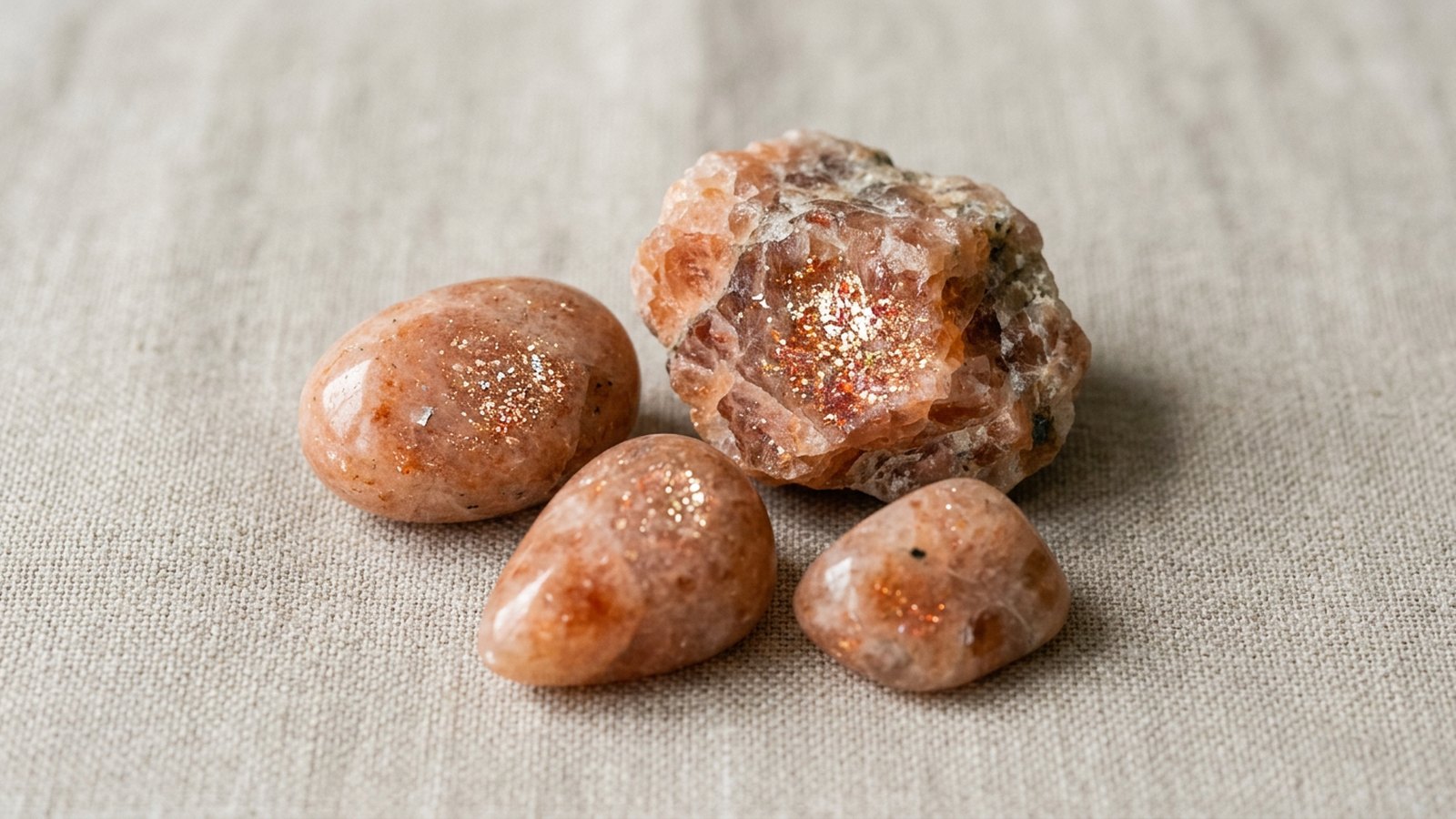
The first sunstone and moonstone bracelet I owned was a gift, strung on elastic, with warm glittering beads alternating with pale ones that seemed to hold a little light inside them. I wore it for a whole winter before I thought to ask why the two stones were so often sold together. The answer turned out to be more interesting than the label on the card: they are close mineral cousins, they catch light in two opposite ways, and people have been reading them as a sun and moon pair for a very long time.
This guide covers what sunstone and moonstone mean together, why the pairing holds up, what the "sunstone moonstone" stone you see in shops actually is, how I use the two through a day, how to wear and care for them, and the few situations where I would choose something else.
Sunstone and moonstone together: the short answer
Yes, you can wear and work with sunstone and moonstone together, and they are one of the most comfortable pairings in a collection. Both are feldspars with the same hardness (6 to 6.5 on the Mohs scale), so neither will scratch the other on a bracelet. In crystal tradition, sunstone carries warmth, confidence and forward movement, while moonstone carries intuition, rest and the sense of moving in cycles. Together they are read as a day and night balance: energy to act, and the quiet to know when to stop.
That is the tradition. What I can say from experience is that the pair is easy to live with, looks lovely side by side, and gives you a simple rhythm to hang a daily practice on.
Why the two agree: one mineral family, two kinds of light
The pairing also has a geological logic, which is part of why I trust it.
Feldspars are the most abundant mineral group in the Earth's crust, and both stones belong to it. Moonstone is usually an orthoclase feldspar in which thin layers of albite separated out as the crystal cooled. Those layers are so fine that they scatter light, and the result is adularescence, the soft bluish or silvery glow that seems to float just under the surface as you turn the stone. Sunstone is most often oligoclase, a plagioclase feldspar, and in the case of Oregon sunstone it is labradorite. Its glitter, called aventurescence, comes from tiny flat plates of hematite, goethite or native copper that reflect light like sequins.
So the pair shares a family, a hardness and a similar polish, while each stone handles light in its own way: moonstone diffuses it, sunstone reflects it. I find that a satisfying physical echo of the traditional reading, where one stone turns you outward and the other draws you in.
The energetic mapping on this site follows the same line. Sunstone is linked to the sacral and solar plexus chakras, the centres of creativity, will and self-confidence. Moonstone is linked to the third eye and crown, the centres of intuition and quiet awareness. Sunstone is traditionally a Fire stone and moonstone a Water stone. Astrologically they meet in Libra, the sign of balance, which both stones are associated with, while sunstone also belongs to Aries and Leo and moonstone to Cancer and Scorpio. If you enjoy a chakra layout, the pair gives you one lower and one upper centre in two small stones.
What "sunstone moonstone" really is
Search for this pairing and you will quickly find single stones sold as "sunstone moonstone" or "sunstone-moonstone": towers, palm stones and spheres, mostly from India, showing a pale body with patches of orange glitter and sometimes a blue sheen. They are beautiful, and it helps to understand them before you buy.
The name is a trade label. It does not describe a natural fusion of two separate minerals. Most of this material is a feldspar that happens to show more than one optical effect, and some of it is peristerite, a plagioclase intergrowth whose sheen resembles moonstone's glow. A piece can genuinely display glitter from metal inclusions alongside a floating shimmer, and that is lovely to see, but a gemologist would not call it moonstone plus sunstone.
My practical advice is to judge these pieces by what they show in your hand. Tilt them under a single lamp: glitter that flashes point by point is the sunstone-like effect, and a broad glow that glides across the surface is the moonstone-like one. If you are drawn to the stone, enjoy it as one feldspar with both qualities, and if you want the classic pairing, buy one true piece of each. A related naming trap is covered in my guide to labradorite and moonstone: most "rainbow moonstone" is white labradorite, which means your "moonstone" bracelet may already hold a third feldspar.
What the pair is traditionally used for, by situation
These are the situations where I find the combination useful. They come from crystal tradition and my own practice, and none of them replaces rest, support from people around you, or professional help when life is genuinely heavy.
When energy returns after a hard stretch. After illness, grief or burnout, the first burst of motivation can feel jittery. Sunstone is traditionally the stone of getting moving again, and moonstone is kept alongside it so that the return to activity stays gentle. I think of it as permission to start without sprinting.
Before being seen, when you are also sensitive. Some people need a nudge of confidence for an interview or a presentation, and are then drained for the rest of the day. Sunstone is the stone to touch before you speak, and moonstone the one to hold on the way home.
During a transition. A move, a new job, a relationship ending: moonstone is a traditional stone of new beginnings and phases, and sunstone adds the optimism to act on what you have decided. The pair suits the stretch when you know what has to change and need both the nerve and the patience to do it.
For creative work. Sunstone's link with the sacral chakra and moonstone's link with intuition make the pair a natural desk companion for writing, drawing or any work that needs ideas and output in equal measure.
For a simple sense of rhythm. People who find their days blur together often like having a physical cue for the shift from doing to resting. This is the use I return to most often.
How I use them through a day
The routine I have settled on is simple enough to keep up.
- Morning. I hold the sunstone for a minute with coffee, set one clear intention for the day, and keep it in a pocket or on my desk until mid-afternoon. On flat mornings, when motivation is low, it helps to name one small task and touch the stone when I start it.
- Evening. When work ends, I put the sunstone away and pick up the moonstone. I keep it by the lamp where I read and let the glow give me something slow to look at while I think back over the day.
- Night. Only the moonstone goes to the bedroom. Sunstone is traditionally an activating stone, so I leave it out of any sleep practice and pair moonstone with the calmer stones in my guide to crystals for sleep instead.
- Once a month. On a full moon I lay both on the windowsill as part of a full moon ritual, and on a bright morning I give the sunstone a few minutes of early light. Neither stone fades in daylight, since their effects come from their structure and inclusions.
If you prefer a bracelet, a mixed strand works well, and you can follow the traditional logic of which hand to wear a crystal bracelet on: many people wear a receiving stone like moonstone on the left and a projecting stone like sunstone on the right when they wear them separately.
Wearing and caring for sunstone and moonstone
Equal hardness is the practical gift of this pairing. At 6 to 6.5, neither stone scratches the other, so a mixed bracelet ages evenly. Both stones do have a weakness, which is cleavage: feldspars split cleanly along two directions, and a hard knock on a tabletop can crack a bead or chip a cabochon. For that reason I prefer these stones in bracelets, pendants and earrings, and I am cautious with rings worn every day. My guide to carrying and wearing stones covers the everyday handling in more detail.
For cleaning, a quick rinse in cool water and an immediate dry are fine. Avoid long soaks, salt water, steam and ultrasonic cleaners, which can work into cleavage planes and weaken elastic or settings; the detail is in my note on crystals and water safety. Store the pair apart from quartz and other harder stones, which will scratch feldspar, following the tips in how to store crystals. For energetic cleansing, any of the gentle methods in cleansing crystals suit both.
Fakes and mix-ups to watch for
Both stones have common stand-ins, and pairs sold cheaply online often contain one of them.
- Goldstone sold as sunstone. Goldstone is glass with copper crystals grown in the melt, a technique associated with Venetian glassmakers since the seventeenth century. Its glitter is very even and very dense, and it often shows tiny bubbles. Natural sunstone sparkles in patches and zones.
- Opalite sold as moonstone. Opalite is man-made glass with a bluish milky glow that looks almost the same from every angle. Real moonstone shows its sheen only when light hits it at the right angle. My guide to opalite vs moonstone walks through the checks.
- Rainbow moonstone. As mentioned above, this is usually white labradorite. It is a natural feldspar in its own right, with its own page in the collection.
For the general checks, see how to tell if a crystal is real.
A little history on both stones
Moonstone has one of the longest reputations of any gem. Roman writers linked it to the moon, and the belief that it held moonlight inside it survived for centuries. It had a strong revival in the Art Nouveau jewellery of the late nineteenth and early twentieth centuries, and it remains a traditional birthstone for June. The finest blue-sheen material has long come from Sri Lanka, with India, Madagascar and Myanmar also important sources.
Sunstone's story is more tangled. The "sunstone" of the Norse sagas, used to find the sun on overcast days, was probably a transparent crystal such as Iceland spar (a clear calcite), and a calcite crystal recovered from a sixteenth-century shipwreck off Alderney supports that idea. Feldspar sunstone is a separate stone that shares the name. Modern feldspar sunstone comes mainly from India, Norway, Tanzania and Oregon, where the copper-bearing variety became the state gemstone in 1987.
When the pair is the wrong choice
I would not reach for this combination if you are already restless, overstimulated or struggling to sleep. In that case moonstone alone, or with a calming companion as in amethyst and moonstone or rose quartz and moonstone, is the better fit. The pair also does little for grounding: if your problem is feeling scattered, a heavy dark stone will do more.
On the question of stones that should not be paired with moonstone, there is no mineral conflict to worry about. The cautions are traditional ones, usually about combining it with strongly stimulating or strongly grounding stones that pull in a different direction. I go through the reasoning in what crystals should not be together.
Where I would start
If you are new to both, start with one tumbled piece of each, keep them on the same dish, and use them in the morning and evening rhythm above for a month. You will know quickly whether the pair suits you. You can also browse the individual pages for sunstone and moonstone to see which one you are more drawn to, since for many people one half of the pair ends up doing most of the work.