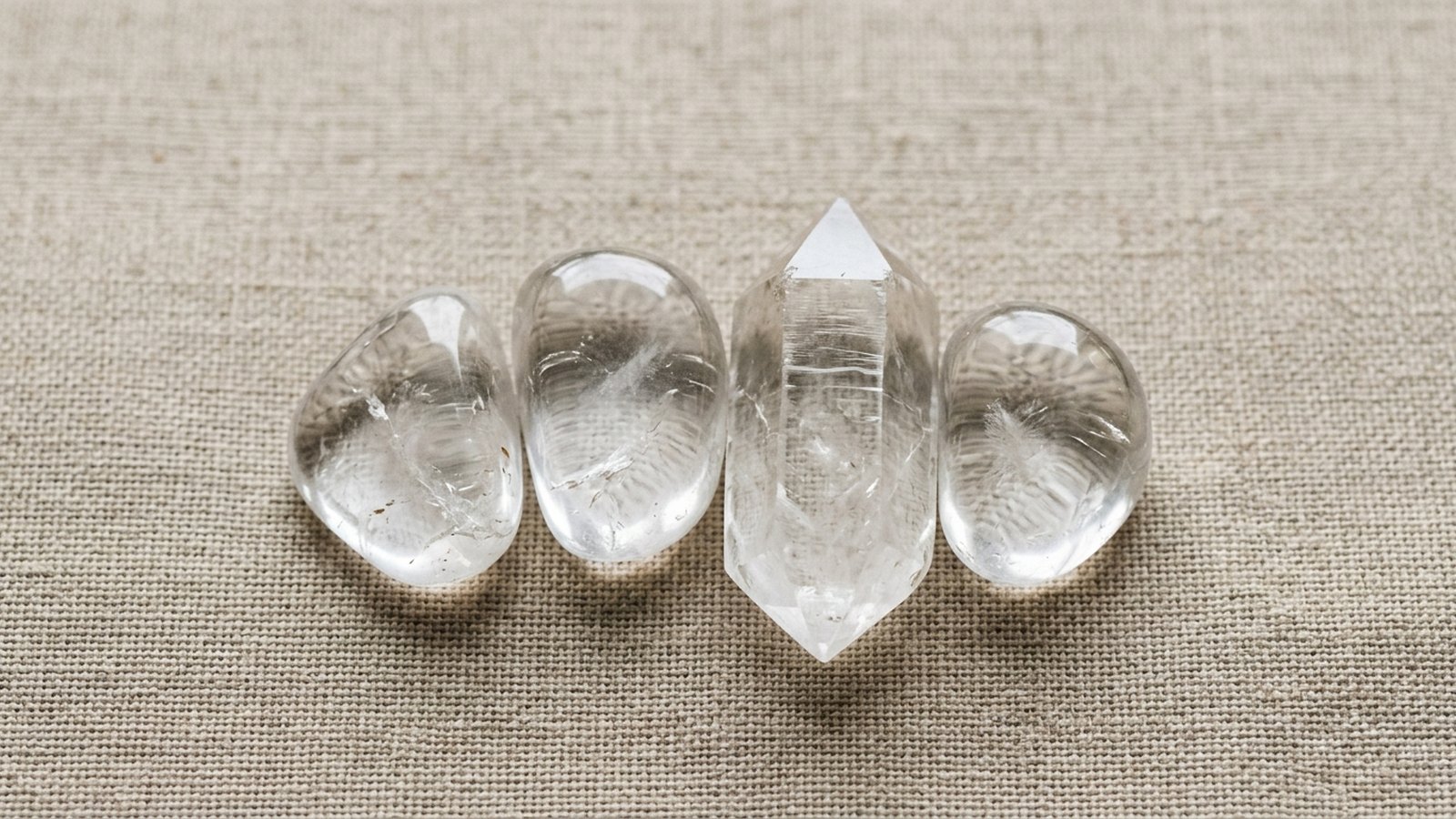
You have a new stone in your hand. Someone told you that before you use it, you have to activate it. So you looked up how, and that is probably why you are here.
I want to save you the afternoon I lost to this question. I read six of the most visible guides on activating crystals, side by side, and they gave five different answers. One says activation means holding the stone until you feel a bond, and warns you specifically not to set an intention while you do it. Another says activation is setting the intention. A third says the words cleanse, charge and activate all mean the same thing anyway. A fourth puts activation last, after cleansing and charging. A fifth makes it the umbrella term for all of it.
They cannot all be right, and the disagreement is not a small one. So here is what I have come to after years of doing this: activating a crystal means waking it into a job you have chosen for it, and the word covers four separate gestures that most guides blur together. Once you can see the four, the contradictions dissolve, and the practice gets much simpler than the internet makes it look.
The four jobs hidden inside one word
When someone tells you to activate your crystal, they are asking you to do one of these four things. Sometimes all four. Usually they have not said which.
Cleansing is clearing the stone of whatever it has picked up. It is the one gesture almost everyone agrees comes first, and it is about the stone's past.
Charging is leaving the stone somewhere you consider a source of energy, most often moonlight, and letting it sit. It is passive, it takes hours, and you are not really involved.
Programming is telling the stone what it is for. You hold it, you state an intention, you are entirely involved, and it takes about a minute.
Bonding is the slow, unglamorous one. It is carrying the stone for a fortnight until it stops being an object you bought and starts being yours.
Bonding is the gesture that gets left out, and I think that is because it cannot be sold as a ritual. There is nothing to buy and no correct way to do it. You put the stone in a pocket, and over a couple of weeks your hand learns its weight, its temperature, the one chipped corner. Ask me to pick my own tumbled carnelian out of a bowl of twenty and I could do it blind. That familiarity is what people are chasing when they say a stone does not feel activated yet, and no amount of moonlight substitutes for it.
Look back at my six sources with that list in hand and they stop contradicting each other. The guide that forbids intention-setting during activation is describing bonding. The guide that says activation is intention-setting is describing programming. They are both right about different gestures and both using one word for it.
| The gesture | What it does | How long |
|---|---|---|
| Cleansing | clears what the stone carried before you | 1 minute to overnight |
| Charging | leaves it in moonlight or daylight to sit | 4 to 12 hours |
| Programming | gives it a specific job in your words | about a minute |
| Bonding | makes it familiar through daily contact | 2 weeks of carrying |
If you want the detail on the first two, I have written them up properly: cleansing your crystals and seven ways to charge them. This guide is about the third and fourth, because those are the ones people mean when they say a stone has not been activated yet, and they are the two nobody explains carefully.
How to activate a crystal for the first time
This is the method I use, and it is the one worth learning first because it works on any stone.
What you need: the stone, ten quiet minutes, and one sentence you have thought about in advance. That last item is the one people skip, and it is the only one that is hard. Everything else on the internet's activation shopping list, the candles, the incense, the singing bowl, the selenite plate, is optional scenery. If you do use a plate, the pairing of black tourmaline and selenite is worth reading first. Lovely scenery, and I use some of it, but if you have a stone and a closed door you have enough.
- Cleanse it. Smoke, sound, a few hours on a windowsill, or a rinse if the stone tolerates water. Check the next section before you reach for the tap or the salt, because that is where most stones get damaged.
- Find somewhere you will not be interrupted. Ten minutes with the phone face down is enough. The quiet is not superstition, it is the whole working part.
- Hold the stone in both hands. Let it warm to your skin. Quartz takes a surprisingly long time to reach body temperature, and noticing that is a good way to arrive in your own hands.
- Take three slow breaths. Longer out than in. You are settling your own attention, not doing anything to the stone.
- Say what it is for, out loud if you can. One sentence, present tense, specific. Then sit with it for a minute.
- Put it where you will see it. A pocket, a desk, a bedside table. A programmed stone left in a drawer does nothing, and that is not the stone's fault.
That is it. If a guide has sold you a forty minute ritual with four candles, they have added the candles. The steps that matter are the holding, the breathing and the sentence.
What to say
The exact words matter less than people fear, but they are not arbitrary either. Two things make a real difference.
Say it in the present tense. "I am steady in difficult conversations" gives your mind something to recognise. "I will one day be less anxious" points at a future that never arrives.
Say something small enough to be true this week. The most common mistake I see is a stone loaded with an entire life ("this crystal brings me abundance, love, health and protection"), which is really a stone with no job at all. One stone, one job.
A few that work, to borrow or adapt:
- "I carry this to remember to slow down before I answer."
- "This stone holds my focus for the hours I am at this desk."
- "I keep this for the walk home, when the day is still in my chest."
If naming an intention is the part you want to go deeper on, I have a whole guide on programming an intention. And if you would rather do this on a date that means something, the full moon ritual is a good frame, though the moon is a calendar here and not an ingredient.
What not to do
This is the section most activation guides skip, and it is the one that will actually cost you a stone. The advice to cleanse in salt water before activating is everywhere, and for several common stones it is destructive. Not "may dull over time" destructive. Gone.
Salt is abrasive and it draws water. Selenite is gypsum, Mohs hardness 2, softer than a fingernail, and it genuinely dissolves in water. Salt water is worse than plain water. A selenite wand left in a bowl of salt overnight comes out pitted and cloudy, and it does not come back.
Copper minerals react. Malachite is a copper carbonate. Water and salt attack the surface, and malachite dust is genuinely not something you want in a wet sink or on your hands. Keep it dry, always. Lapis lazuli is a rock rather than a single mineral, with pyrite and calcite in the mix, and soaking breaks it down along those boundaries. Pyrite rusts.
Sunlight fades colour, and it is not reversible. Amethyst, rose quartz, citrine and fluorite all owe their colour to colour centres, tiny lattice defects created by natural irradiation over geological time. Ultraviolet light relaxes those defects, the colour drains toward grey or beige, and no amount of moonlight brings it back. A deep purple amethyst on a sunny windowsill is a pale one within a season. Charge those in moonlight instead. I keep a fuller list in which crystals can and cannot go in water.
Dyed stones bleed. A great deal of what sells as turquoise is dyed howlite, and a great deal of vivid blue banded agate is dyed too, including much of what is sold as blue lace agate. Dye sits in the porous parts of the stone, so a soak in warm water can lift colour out of it and tint the water faintly blue. If that happens, you have learned something useful about your stone, but you have also spoiled it. When you do not know a stone's identity for certain, cleanse it with smoke or sound and keep it out of the bowl.
Do not sleep with a stone you have not met. The traditional caution is around the intense ones, moldavite above all, which has a reputation for disturbed nights that I think is earned. Carry a new stone in daylight for a week before it comes to bed.
And one honest line, because this is where wellbeing gets discussed: none of this is medical treatment. A stone is a good companion to care and a poor substitute for it. If something in your body or your mind needs real attention, please get it.
How do you know it worked?
Here I would rather be honest than reassuring. There is no test. Some people feel warmth, a pulse, a settling in the chest. Plenty of steady, experienced practitioners feel nothing at all in their hands and get a great deal out of the practice anyway. Feeling nothing is not a failed activation and it says nothing about you.
What I look for instead is behavioural. About a week in, does the stone come to mind at the moment it was meant for? Does your hand find it in your pocket when the meeting turns tense? That is the mechanism doing its work. What activation genuinely changes is not the lattice, it is your attention: you have attached a clear intention to a physical object you touch several times a day, and the object keeps handing the intention back to you. That is a real effect, and it is quite enough. The energetic reading of it, that the stone carries and returns the intention, is the tradition I work within and love, and I am not going to pretend it is a measured fact.
If nothing lands after a fortnight, the usual cause is a fuzzy intention rather than a stubborn stone. Cleanse it, pick a smaller job, and start again. Sometimes the stone is simply not for this, and putting it down is allowed.
How often to repeat it
Less often than you would think. Programming holds until you change it or the stone goes through something that muddies it. In practice I reprogram when the job changes, when a stone has been handled by other people, or after I have leaned on it through something heavy. That works out to every couple of months for a stone in daily use, and never for one that sits quietly on a shelf doing one thing.
Cleansing is the part that benefits from rhythm. Once a month is plenty for most stones, and the full moon is as good a reminder as any.
A last thought. The reason the guides contradict each other is that nobody owns the vocabulary here, and the practice is older and looser than the blog posts about it. So take the four gestures, use the ones that serve you, and let the word activate mean whichever of them you are actually doing. When you are ready to put the stone to work, how to use crystals picks up where this leaves off, and if you want a stone that takes a program cleanly and holds it, start with clear quartz. It is the one I hand to everybody who asks me this question.