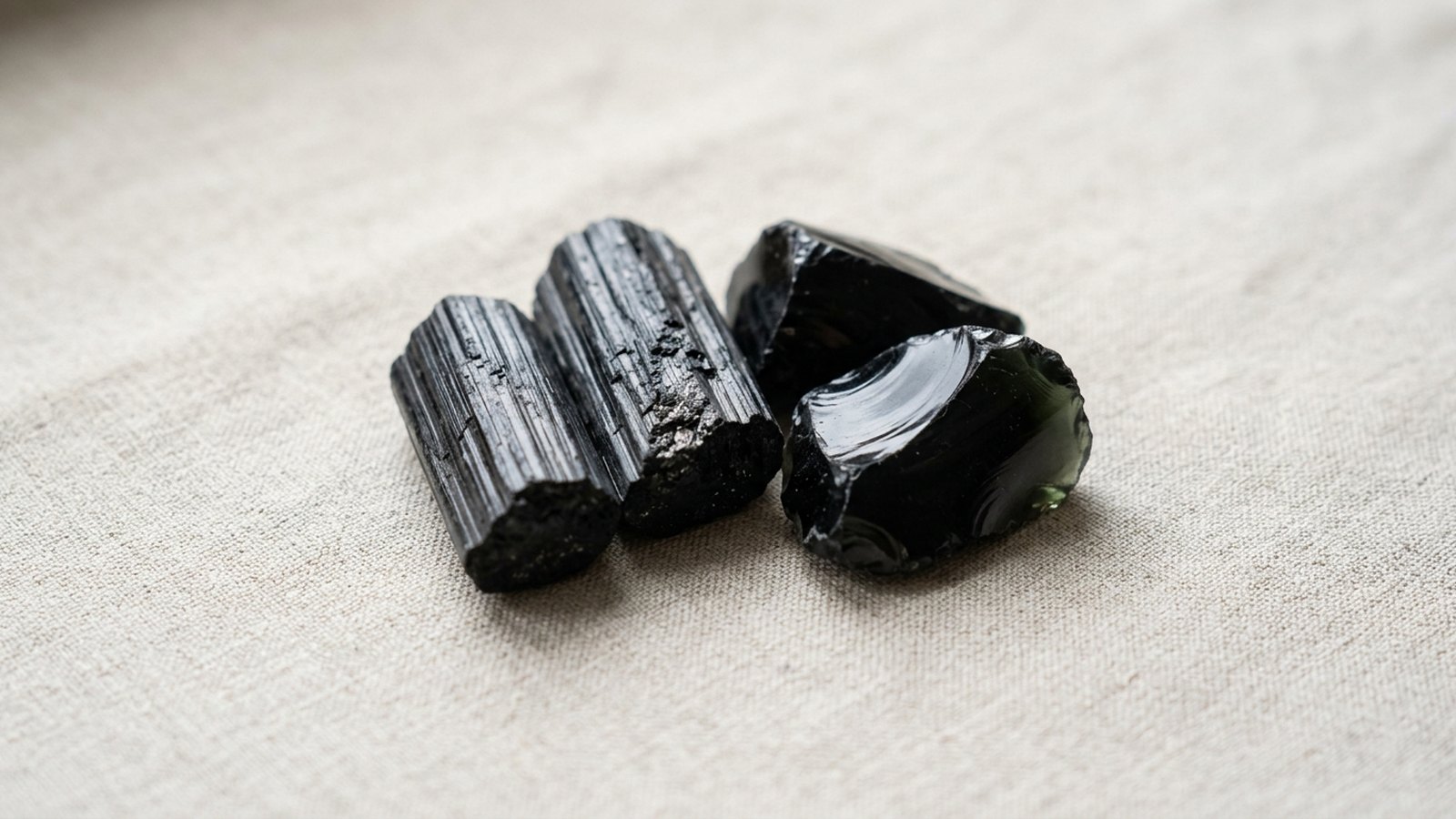
Two black stones, both sold for protection, both about the same size, both cool in the palm. One cost eight pounds and one cost twenty two, and the labels came off in the drawer months ago. This is the exact drawer I have been staring into, and it is why the forums are full of people photographing a black pebble and asking strangers to identify it.
The good news is that these two are not a subtle pair. Once you know which tests actually settle it, telling black tourmaline from black obsidian takes under a minute, and one of the tests is a small piece of physics that nobody in the crystal world seems to mention.
So this guide does identification first, because that is where the real confusion sits, then the choice. If you already know what you own, skip ahead to which one to choose.
The short answer
Black tourmaline is a hard crystalline mineral with fine parallel grooves running along its length, and it is noticeably heavier than it looks. Black obsidian is volcanic glass: smooth, glossy, sometimes faintly translucent at a thin edge, and softer. Tourmaline sits at 7 to 7.5 on the Mohs scale with a specific gravity around 3.06. Obsidian sits at 5 to 5.5 with a specific gravity of roughly 2.3 to 2.6. That density difference is about a quarter, and it is the one tell that survives polishing.
For traditional use, the split is just as clean. Black tourmaline is the everyday boundary stone: steady, unglamorous, the one people keep in a pocket or by the front door. Black obsidian is the mirror: sharper, more confronting, traditionally used for looking at what you would rather not look at.
The thirty second version
| Black tourmaline (schorl) | Black obsidian | |
|---|---|---|
| What it is | Boron silicate mineral, trigonal crystal | Volcanic glass, no crystal structure |
| Surface | Fine parallel striations, matte to slightly glassy | Smooth, glossy, mirror-like |
| Break | Uneven, splintery along the length | Conchoidal, curved shell-like scoops |
| Mohs hardness | 7 to 7.5 | 5 to 5.5 |
| Specific gravity | around 3.06 | 2.3 to 2.6 |
| Light through a thin edge | Opaque | Often faintly translucent |
| Traditional role | Daily grounding and boundaries | Shadow work, truth telling, release |
| Best worn as | Rings, bracelets, daily wear | Pendants, pocket stones, shelf pieces |
What each one actually is
Black tourmaline is properly called schorl, and it is not a rare curiosity. Schorl accounts for something like ninety five percent of all tourmaline on Earth, which is why the black variety is cheap while pink and green tourmaline are not. Chemically it is a sodium iron boron silicate, and it grows as long prismatic crystals that are triangular in cross section, with curved striated faces. Those striations are not damage. They are the crystal's growth pattern, ridges running the length of the prism, and on a raw stick you can feel them with a thumbnail.
Obsidian is not a mineral at all. It is a glass, formed when felsic lava cools so fast that atoms never get time to organise into a lattice. There is no crystal structure, no cleavage, no striations, nothing to grow along. That amorphous nature is what gives it the glassy shine and the conchoidal fracture, the curved scooped break you see on flint and on a chipped bottle. It is also why obsidian edges go genuinely sharp, sharp enough that knapped obsidian blades were traded across the ancient world, from Anatolia to Mesoamerica, long before metal.
That single difference, crystal versus glass, produces every other difference on the list. Hold onto it and the tests below stop feeling like trivia.
Five tests, ranked by how much they settle
1. The ash test, which settles it outright
Tourmaline is pyroelectric. Warm a tourmaline crystal and the two ends of it develop opposite electrical charges, strongly enough to pick up light dust, lint or ash. It is a documented property of the mineral, and it earned tourmaline the old trade name the Ceylonese Magnet, from eighteenth century reports of stones that attracted hot ashes and then flung them off again.
To try it, leave a raw terminated tourmaline crystal in a warm spot, a sunny windowsill or near a lamp, for fifteen minutes. Then hold it a centimetre above a scatter of fine ash, cigarette ash or the dust from a pencil sharpener. A good crystal will lift a few specks. Obsidian is glass with no crystal lattice and no polarity, so it can do nothing of the sort, at any temperature, ever.
Caveat, and it matters: this works best on a raw crystal with its natural terminations, because the effect depends on the crystal's axis. On a tumbled bead it is weak to absent, and a null result there proves nothing. When it does fire, though, it is conclusive.
2. Weigh it, because density survives polishing
This is the test I actually reach for, and it is the one that works on the tumbled pebble in the drawer. Schorl has a specific gravity around 3.06. Obsidian ranges 2.3 to 2.6. In practice that means a tourmaline pebble is roughly twenty five percent heavier than an obsidian pebble of the same size, which is enough to feel if you hold one in each hand.
If you want a number rather than an impression, do it with a kitchen scale and a glass of water. Weigh the dry stone in grams. Then part fill a glass, note the level, lower the stone in on a thread and note the rise in millilitres. Grams divided by millilitres gives you the specific gravity. Around 2.4 is obsidian. Around 3.0 or above is tourmaline. Nothing else in the black stone drawer sits between those two figures by accident, and unlike surface texture, density cannot be polished away.
3. Look along the length, not at the face
On any piece that keeps some of its natural form, tourmaline shows fine parallel lines running the same direction along the crystal, like the grain in a stick of celery. Obsidian never has them. If you see parallel grooves, you are done.
4. Find a chip and read the break
Look at any damaged corner under a lamp. Obsidian breaks in smooth curved scoops, like the inside of a shell. Tourmaline breaks unevenly and tends to splinter along its length. This is one of the more reliable tells on a piece that has been knocked about, and there is more on separating obsidian from its other look-alikes in the guide on onyx versus obsidian.
5. Hold a thin edge to a bright light
Obsidian is often faintly translucent where it thins out, glowing a deep brown or grey green at the very edge. Black tourmaline is fully opaque. Useful, but only on a thin piece, which is the limitation the next section is about.
The tells that stop working
Most comparison articles hand you a list of criteria and never mention that half of them fail on the stone you are actually holding. Here is where each one breaks down.
Striations vanish on a tumbled bead. Tumbling grinds the grooves away along with everything else, which is why the bracelet on your wrist is harder to call than a raw stick.
Translucency fails on a thick piece. A chunky obsidian sphere will look as dead opaque as any tourmaline. The test only speaks when it says yes.
The streak test separates nothing. Dragging both across unglazed porcelain gives you a white streak either way. It is a fine test for hematite, useless here.
Both feel cool. Their thermal conductivity is close enough that the classic "cool to the touch" line tells you only that you are not holding plastic.
Do not scratch a nice piece. The hardness gap is decisive, but it leaves a permanent mark on a stone you paid for. If you must, test a hidden base with a steel knife point: steel around 5.5 marks obsidian and skids off tourmaline. I would weigh it first. More on testing without damage in how to tell if a crystal is real.
Which one to choose
I do not think this ends in a tie, so here is the honest split.
Choose black tourmaline if you want something you can forget about. It is the stone for daily wear, for the pocket of the coat you actually leave the house in, for the desk, for the shelf by the door. In tradition it is the boundary stone rather than the transformation stone: it does not ask anything of you, and it is the one I hand to people who are new to crystals for protection and want one stone rather than a system. It also survives being a ring, which obsidian does not. It is associated with the root chakra and traditionally with Capricorn and Scorpio.
Choose black obsidian if you are working on something specific and you are ready for it. The old name for it is the mirror stone, and the tradition around it is consistent across centuries and cultures: it shows you what is there rather than shielding you from it. That makes it a poor choice for background protection and a good one for a defined piece of work, grief, an ending, a habit you keep circling. It is a shelf and meditation stone more than a daily wear one. Also root chakra, traditionally linked with Scorpio and Sagittarius.
If you are buying one and you are not sure: buy the tourmaline. It is cheaper, tougher, and less likely to sit unused. Obsidian is a second stone, not a first one.
None of this is medicine. A stone is a physical object that helps you hold an intention, and where anxiety, grief or anything else is genuinely weighing on you, the stone belongs alongside real support, not instead of it.
Wearing them together
Yes, and the pairing is coherent rather than merely permitted. Tourmaline holds a steady daily boundary; obsidian does episodic, specific work. They are not asking for the same thing at the same time, which is exactly what makes a pair work rather than compete. See the guide on what crystals should not be together for pairs that genuinely pull against each other.
In practice I would keep the tourmaline on the body, in a pocket or as a bracelet, and let the obsidian stay somewhere deliberate, a bedside table or a meditation spot, so that picking it up is a decision. Pairing them with smoky quartz or hematite keeps the whole set in the grounding register.
Living with them
Durability. Tourmaline at 7 to 7.5 handles daily wear and a knock against a doorframe. Obsidian at 5 to 5.5 is glass: it chips, and a chipped edge is genuinely sharp. Never store the two loose together, because the tourmaline will win.
Water. Both tolerate a brief rinse in cool water and neither is water soluble. Skip salt water for both: it works into fractures in tourmaline and dulls a polished obsidian face. The crystals and water safety guide has the full list of what must stay dry.
Cleansing and charging. Neither needs anything elaborate: smoke, sound, moonlight or a few hours on a quartz cluster all work. See cleansing crystals and how to charge crystals. Both are safe in full sunlight, unlike amethyst or fluorite, so a windowsill is legitimate here.
One honest note on EMF. Black tourmaline is sold constantly as a shield against wifi routers and phones. There is no evidence that any stone alters an electromagnetic field, and I would not buy it for that. Buy it for what it does do, which is sit in your pocket and remind you where your edges are.
Frequently asked questions
Which is stronger, black tourmaline or black obsidian? Physically, tourmaline, decisively: 7 to 7.5 on the Mohs scale against 5 to 5.5. Energetically the traditions do not rank them, they assign different jobs: tourmaline steady and defensive, obsidian sharp and revealing.
How do you tell if it is obsidian or tourmaline? Look for parallel grooves running along the stone, which only tourmaline has, then weigh it: tourmaline is about a quarter denser. On a tumbled piece where the grooves are gone, the weight test is the one that still works.
Who should not wear black tourmaline? There is no group it is contraindicated for. If you are drawn to it because you are struggling, treat it as a companion to real support rather than a substitute. Some people find any grounding stone flattening if worn constantly, in which case take it off for a few days.
Can I sleep with black tourmaline? Many people do, and it is one of the few protection stones that rarely feels disruptive at night. Obsidian has a reputation for busy dreams, so I would keep it out of the bedroom until you know how you respond. The guide on crystals for anxiety covers gentler bedside options.
Where is the best place to put black tourmaline? By the front door, or wherever the household's traffic and noise come in. A piece in each corner of a room is the traditional layout. More placements are in where to place crystals in your home.
What should you not mix with black tourmaline? Nothing is truly forbidden, though a heavy grounding stone can flatten a high energy stone you were using to lift or stimulate. Physically, do not store it loose against softer stones like obsidian, selenite or malachite. That last one matters more than it sounds, because black tourmaline and selenite is the pairing almost everyone ends up owning.
How do you activate black tourmaline? Clean it, hold it, and say plainly what you want it for. That is the whole method, and it is set out step by step in programming an intention and how to activate crystals.
What zodiac is black tourmaline good for? Traditionally Capricorn, with Scorpio and Libra also named. Obsidian is usually assigned to Scorpio and Sagittarius. These attributions are traditional rather than fixed; the chakra crystals guide covers how they are built.
What I would actually do
Pick up the stone. If it has parallel lines along its length, it is tourmaline and you are finished. If it does not, put it on a kitchen scale, then in a glass of water, and do the small division. Around 2.4, you have volcanic glass. Around 3.0, you have schorl.
And then, whichever it turns out to be, use it. The identification matters because a stone you cannot name is a stone you never quite trust, and one you trust is one you actually carry. Both of these have been carried, for a very long time, for reasons that have not much changed.