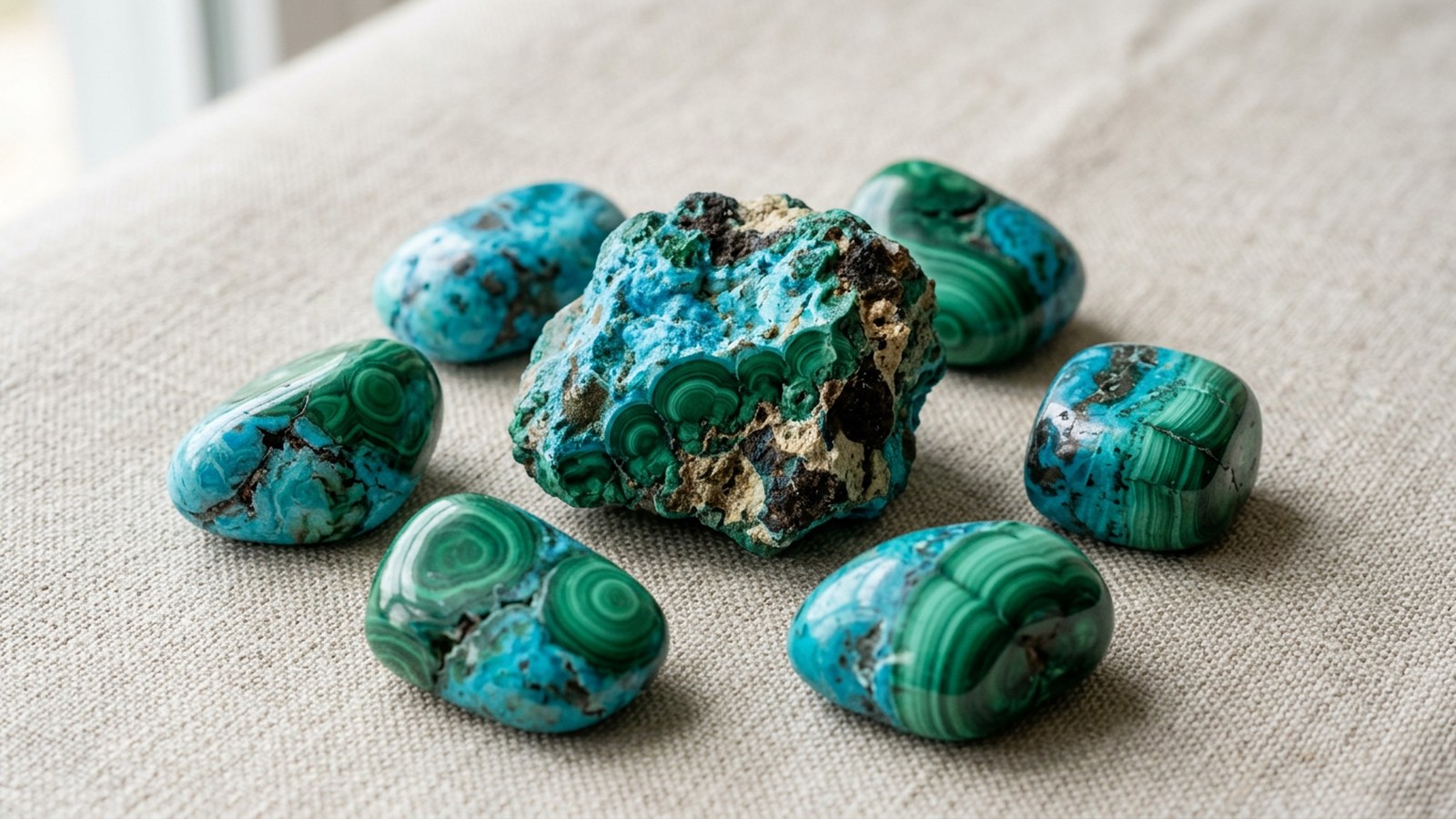
The piece that taught me to tell these two apart was a palm-sized slab I bought at a rock fair in Tucson, labelled only "copper ore, Arizona". One end was a deep, banded green, the other a patchy sky blue, and for a week I called the whole thing chrysocolla. Then I picked up a pure malachite tumble from my shelf, held one in each hand, and felt the difference before I saw it: the malachite was almost twice as heavy for its size. That slab held both minerals, which is exactly why so many people end up asking which one they have.
Chrysocolla vs malachite: the short answer
Malachite is a copper carbonate that is almost always green, with sharp concentric bands in light and dark green, and it feels heavy and cool in the hand. Chrysocolla is a hydrated copper silicate that leans blue to blue-green, with a mottled, cloudy pattern and no crisp bands, and it feels surprisingly light. Both are soft copper minerals that form in the same weathered zones of copper deposits, so they often grow side by side in one rock.
In crystal tradition, malachite is the bold stone of change and protection at the heart chakra, and chrysocolla is the calmer stone of honest, gentle speech at the throat chakra and heart. If you want a stone that pushes, malachite is the usual choice. If you want one that soothes, people reach for chrysocolla.
| Malachite | Chrysocolla | |
|---|---|---|
| Mineral type | Copper carbonate hydroxide | Hydrated copper silicate (often amorphous) |
| Formula | Cu2CO3(OH)2 | roughly (Cu,Al)2H2Si2O5(OH)4·nH2O |
| Usual colour | Green, light to almost black-green | Cyan, sky blue, blue-green, sometimes green |
| Pattern | Sharp concentric bands, bullseyes | Mottled, cloudy, veined with brown or black |
| Hardness (Mohs) | 3.5 to 4 | 2 to 4 pure, 5 to 7 when silicified |
| Weight in hand | Heavy (specific gravity about 3.6 to 4.0) | Light (about 1.9 to 2.4) |
| Polished lustre | Silky to glassy | Waxy to dull, glassy in gem silica |
| Fizzes in acid | Yes | No |
| Traditional chakras | Heart | Throat and heart |
| Usual price | Low to moderate | Low, except gem silica |
Why they turn up in the same rock
Both minerals are what geologists call secondary copper minerals. Deep underground, copper sits in sulfide ores such as chalcopyrite. When those ores are lifted close to the surface and rainwater, oxygen and carbon dioxide seep through them over thousands of years, the sulfides break down and the copper moves with the water and settles out again as new, colourful minerals. Where the water carries carbonate, you get malachite and its blue cousin azurite. Where it carries dissolved silica, you get chrysocolla. In a real deposit both conditions shift from one crack to the next, so the same hand specimen can hold green banded malachite, blue chrysocolla, black tenorite veins and red cuprite together.
That shared origin explains why the AI summaries and the rock forums all describe them as relatives. It also explains the confusion: a seller who digs a mixed lump out of an Arizona or Congolese copper mine rarely has a reason to separate the two, and the piece goes to market under whichever name sells better that week. If you have ever seen the famous blue-and-green azurite malachite, you have already seen this kind of mixing in action, with two carbonates sharing one stone.
How to tell chrysocolla from malachite without damaging the stone
I work through these tests in order, from the gentlest to the one I only use on rough pieces. The first three settle most cases.
1. Look at the pattern before the colour
Colour overlaps more than people expect, because chrysocolla can be quite green when iron or other impurities are present, and pale malachite can look minty. Pattern is far more reliable. Malachite grows in rounded, layered crusts, so a cut surface shows tight concentric rings, wavy stripes or eye-shaped bullseyes with clean edges between light and dark green. Chrysocolla has no layered crystal habit to show, so its colour sits in patches and clouds, often broken by brown or black host rock. If the green has crisp bands, you are almost certainly looking at malachite.
2. Weigh it in your hand
This is the test I trust most, and it costs nothing. Malachite is dense, with a specific gravity close to 4, which puts it in the same range as many metal ores. Pure chrysocolla sits around 2, about the same as chalk. Hold a piece of each that is roughly the same size, or hold your mystery stone next to a quartz tumble of similar size: malachite feels clearly heavier than the quartz, while chrysocolla feels the same or lighter. A mixed piece will be heavier on its malachite side, which is how my Tucson slab gave itself away.
3. Check the lustre and the surface
Polished malachite takes a silky, almost satin shine that moves across the bands as you tilt it. Polished chrysocolla tends to look waxy or slightly matte, because pure chrysocolla is porous and does not hold a high polish. On a raw piece, a drop of water placed on chrysocolla may darken the spot and soak in slowly, while on malachite it beads and sits on the surface. The exception is gem silica, which I cover below, and which shines like glass.
4. The streak, for rough pieces only
Rub an unpolished corner across the back of a white ceramic tile. Malachite leaves a pale green streak. Chrysocolla leaves a white to very pale blue or bluish-green streak. Do this only on raw material, since it removes a little of the stone.
5. Acid, only if you are sure you can sacrifice a spot
Malachite is a carbonate, so a drop of dilute acid makes it fizz gently, and even household vinegar will slowly etch it. Chrysocolla is a silicate and does not react. Geologists use this test, but it marks the stone permanently, so I never use it on anything polished, and with the weight and pattern tests available I rarely need it at all. Hardness scratching is also a poor tool here, because both minerals are soft enough that you will damage the piece without learning much.
When one stone holds both
Many tumbles, towers and cabochons are sold as "chrysocolla malachite" or "malachite with chrysocolla", and they are genuine mixed specimens from the same copper deposits, most often in the Democratic Republic of the Congo, Arizona, Mexico, Peru and Chile. Treat each colour zone as its own mineral: the green banded parts carry malachite's weight and care needs, and the blue patches behave like chrysocolla.
The best known mixed stone is Eilat stone from the old copper workings near Eilat and Timna in southern Israel, a blend of chrysocolla, malachite, turquoise and azurite that is treated as a national stone there. If you also own blue copper stones, my guide to chrysocolla vs turquoise covers the other half of this family.
Why chrysocolla is sometimes so expensive
This question puzzles people because ordinary chrysocolla is inexpensive, a by-product of copper mining. The pieces that cost a lot are gem silica, also called chrysocolla chalcedony: chalcedony that has been coloured an even, translucent blue by chrysocolla during formation. It is hard, around Mohs 6.5 to 7, takes a glassy polish, and fine material is scarce. Most of the classic gem silica came from Arizona copper mines such as Inspiration and Ray, with later finds in Peru and elsewhere, and it is valued per carat like a precious gem. Malachite has no equivalent, which is why a malachite cabochon and a gem silica cabochon of the same size can differ in price by a factor of ten or more.
Fakes and treatments you will meet
Malachite imitations are mostly resin or plastic with printed or poured bands. They feel light and warm, their bands repeat too regularly, and you may see a mould seam or tiny air bubbles under a loupe. Reconstituted malachite is real malachite powder bound in resin; its bands look blurred or broken into small fragments, and it weighs noticeably less than solid stone. The weight test from earlier catches both.
Chrysocolla is imitated with dyed stones, most often howlite or magnesite, which take blue dye well (my comparison of howlite vs magnesite explains why). Dyed pieces show colour pooled in cracks and an oddly even tint. Real chrysocolla is also frequently stabilised with resin to stop it crumbling, which is an accepted treatment as long as the seller says so. My general guide on how to tell if a crystal is real walks through the loupe and weight checks in more detail.
Is malachite toxic, and who should not wear it?
Malachite contains a lot of copper, and copper compounds are harmful when swallowed or breathed in as fine dust. That is where the stone's reputation comes from, and it is a real concern for lapidaries, who cut and sand it wet and wear masks for that reason. A polished, finished piece that you hold or wear is a different situation: it releases almost nothing through normal skin contact. Chrysocolla is also a copper mineral and deserves the same common sense.
In practice, I would keep both stones away from small children and pets who might chew or swallow them, never make a gem elixir by soaking them in drinking water, avoid raw or crumbly pieces against broken skin, and wash my hands after handling rough specimens. Some people with sensitive skin notice irritation from copper minerals, and they are better off with a pendant set behind metal. In crystal tradition, malachite is also described as intense, and some practitioners suggest people who feel easily overwhelmed start with a small piece or with chrysocolla instead. My guide to crystals and water safety lists other stones that should stay dry.
Energy and tradition
What follows describes traditional and intuitive use, the way I work with these stones myself, and it makes no medical claim.
Malachite is called a stone of transformation. It is associated with the heart chakra, with protection during change, and with facing patterns you would rather not look at, which is why people keep it near them through breakups, job changes and big decisions. In modern crystal lists it is linked with Scorpio and Capricorn, and it often appears among crystals for protection. I find it a demanding companion and keep it on my desk more than in my pocket.
Chrysocolla is linked with the throat and heart chakras, with calm communication, patience and emotional balance, and with Taurus, Gemini and Virgo. It shows up among crystals for communication because its traditional role is helping you say a difficult thing kindly. Its energy is usually described as softer and more watery than malachite's.
Can malachite and chrysocolla be used together?
Yes, and it is one of the more natural pairings in the crystal world, since the two so often grow together. People who combine them usually want malachite's push toward change alongside chrysocolla's calm, for example before a hard conversation that will change a relationship. If you want to place them on the body, malachite goes over the heart and chrysocolla at the throat. I would skip the pairing if what you need is pure rest, since malachite is not a sleeping stone for most people. For pairings that work less well, see what crystals should not be together.
Caring for both stones
Both are soft, so store them apart from quartz and other hard stones, in a cloth pouch or lined box. Keep them out of salt, vinegar, ultrasonic cleaners and long soaks. Clean them with a dry or barely damp soft cloth. For energetic cleansing, I use smoke, sound or a night on a windowsill, all of which are gentle on soft minerals; my guide to cleansing crystals lists which methods suit which stones. Malachite can lose its polish over the years from skin oils, and a jeweller can restore it.
Which one should you choose?
Choose malachite if you are in the middle of a change you have been resisting, want a protective stone for your workspace, or love bold green patterns and a stone with real weight. Choose chrysocolla if your intention is to speak more calmly and honestly, to soften tension at home, or if blue and turquoise colours draw you more than deep green. Choose gem silica if you want a durable blue stone for a ring, since it is the only one of these hard enough for daily wear. If you cannot decide, a mixed chrysocolla malachite piece gives you both, and it is how the earth tends to make them anyway.
When I hold my Tucson slab now, I still turn it over to feel which end is heavier. That small habit has saved me from more mislabelled stones than any chart, and I hope it does the same for you.