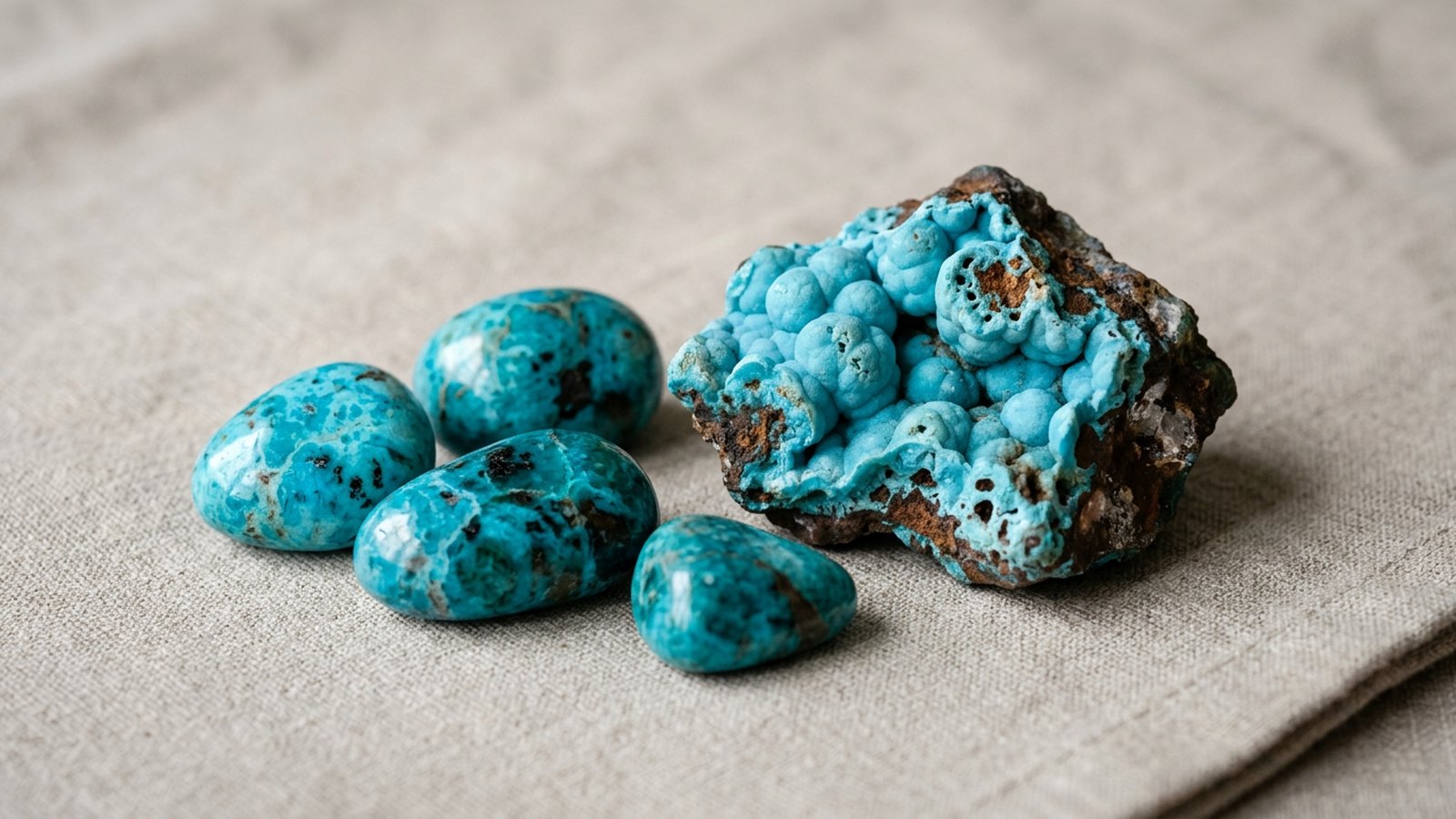
The first piece of chrysocolla I owned was a small tumbled stone the colour of a swimming pool, and I very nearly sold it on as turquoise. It had that same soft, chalky blue, the same dark web of veining, the same slightly waxy surface that catches the light without shining. What gave it away was the weight. It sat in my palm too lightly for what it looked like, the way a hollow thing does.
That lightness turned out to be the honest introduction to this stone. Chrysocolla is soft, porous, easily mistaken for something else, and quietly persistent about telling the truth anyway. It is the stone I reach for when I have something difficult to say and want to say it without my voice climbing.
Chrysocolla meaning, in short: it is the stone of calm truth-telling. In crystal tradition it is associated with clear, unhurried communication, with the courage to speak honestly under pressure, and with emotional balance during conflict or grief. It is worked with mainly at the throat chakra and the heart chakra, which is exactly the pairing you need when the honest thing and the kind thing have to arrive in the same sentence.
Reasons to Work With Chrysocolla
Chrysocolla is for the conversation you have been rehearsing in the shower for a week. Not the argument you want to win, the conversation you keep postponing because you know it will hurt somebody. Tradition calls it a stone of diplomacy, and I think the word is well chosen: diplomacy is not softness, it is saying the true thing in a form the other person can actually receive. I keep a piece on my desk before those calls, and what I notice is less courage than pacing. I talk more slowly. I leave gaps.
Chrysocolla is for people who over-explain. If you have ever finished a sentence and then added three more to justify it, this stone is a good companion. Where sodalite sharpens the thinking behind your words and blue lace agate takes the tremble out of them, chrysocolla works on the volume of them. It is traditionally the stone of the person who needs to say less, and mean it more.
Chrysocolla is for grief that has gone quiet and stayed. Its heart chakra association is not about romance. It is the compassion end of the heart, the part that has to forgive somebody, or forgive yourself, or simply sit with a loss that no longer has any words attached. If that is where you are, our guide to crystals for grief puts it in company with stones that do similar work.
Chrysocolla is for teachers, carers, managers, anybody whose job is mostly other people's feelings. It has a long-standing reputation as a stone of feminine wisdom and nurturing authority, and while I hold the gendered framing loosely, the underlying quality is real enough: holding a room without dominating it. If your working week is one difficult exchange after another, it belongs in your bag more than on your shelf.
Chrysocolla Meaning and Healing Energy
Emotional Healing
Chrysocolla is traditionally used to steady the emotional weather during conflict. Not to suppress the feeling, which is a distinction I care about, but to slow the gap between feeling it and acting on it. People who work with it often describe it as cooling, in the way that stepping outside cools a heated room.
Spiritual Healing
In the older lore, chrysocolla is a stone of the wise woman, the truth-teller, the person who speaks for the community. Working with it is framed as an invitation to align what you say with what you actually believe. It is not a comfortable energy if you have been going along with something.
Mental Healing
For the mind, tradition gives it discernment: the ability to notice which thought is worth speaking. I find it useful alongside journaling before a hard week, and it sits well with the practical stones covered in crystals for communication.
Physical Healing
Chrysocolla is traditionally linked with the throat, the voice, and with easing tension carried in the jaw and shoulders. Some sources connect it to the menstrual cycle and to menopause. All of that is folklore rather than medicine. It is not a treatment, it does not replace a doctor, and no stone should ever delay care you need.
Chakras: throat (primary), heart (secondary) Zodiac signs: Taurus, Gemini, Virgo Element: Water Numerical vibration: 5 Affirmation: I say the true thing, calmly, and I let it land.
Who Chrysocolla Suits Less Well
I would not hand this stone to somebody who needs to get louder. If your difficulty is that you go silent in meetings, that you swallow the objection and resent it afterwards, chrysocolla's calming register can reinforce the habit rather than break it. In that situation I would reach for carnelian or sunstone first, and bring chrysocolla in once you are speaking up and want to do it without heat. It is also the wrong choice as an everyday ring stone, for reasons the geology makes obvious.
The Geology of Chrysocolla
Chrysocolla is a hydrated copper silicate, usually written as (Cu,Al)2H2Si2O5(OH)4 with variable water content. That vagueness is not sloppiness on my part: chrysocolla is famously poorly crystalline, often more or less amorphous, and mineralogists have argued for a century about how to classify it properly. Some pieces are closer to a mineral gel that hardened than to a tidy crystal.
It forms in the oxidation zone of copper deposits, where copper-bearing water percolates down through silica-rich rock and precipitates whatever the chemistry allows. That is why chrysocolla so rarely turns up alone. Its usual companions are malachite, azurite, cuprite, limonite and quartz, and the beautiful specimens are often mixtures of several of them at once.
The colour comes from copper, the same element that makes malachite green and azurite deep blue. In chrysocolla it lands somewhere between: sky blue, cyan, teal, sea green, sometimes all four across one cabochon, usually with dark brown or black matrix running through it.
Hardness is where the confusion starts, so here are the three numbers rather than one. Pure chrysocolla is soft, Mohs 2.5 to 3.5, roughly a fingernail to a copper coin. Chrysocolla intergrown with quartz or chalcedony, which is most of what is sold as jewellery, runs 5 to 6. Gem silica, chrysocolla-coloured chalcedony and the most valuable form by a wide margin, reaches about 7. Density follows the same story: pure chrysocolla is light, around 2.0 to 2.4, noticeably lighter than turquoise.
Is Your Chrysocolla Really Chrysocolla?
Google's own "people also ask" box for this stone is almost entirely turquoise questions, which tells you how common the mix-up is. Chrysocolla gets confused with turquoise, with dyed howlite, with malachite in its greener patches (my chrysocolla vs malachite guide covers that pair), and with Eilat stone, a mottled Israeli material that is itself a natural blend of chrysocolla, malachite and turquoise. Here is the order I check, gentlest test first, and if turquoise is your real question, my chrysocolla vs turquoise guide goes through the two side by side.
- Weight. Pick it up. Pure chrysocolla feels light for its size. Turquoise feels denser and more solid in the hand.
- Look at the veining. Chrysocolla tends to mottle and swirl, with colour bleeding from blue to green across a single piece. Turquoise more often shows discrete veins of matrix against an even ground.
- A single drop of water on an inconspicuous spot. Porous, untreated chrysocolla darkens quickly as it drinks. Gem silica and quartz-hosted material barely change. Dry it immediately.
- Hardness, and only on a hidden surface. A steel pin scratches soft chrysocolla easily. If nothing marks it, you likely have a quartz-hosted piece or gem silica, which is good news.
What I would not do is trust price alone, or a seller's certificate on a tumbled stone. If you buy a lot of stones, the general method in how to tell if a crystal is real applies here too. And "black chrysocolla", which people ask about often, is not a separate mineral. It is ordinary chrysocolla with heavy dark matrix, or in some listings a shungite-like material sold under a borrowed name.
History and Lore
The name is genuinely ancient and pleasingly practical. It comes from the Greek chrysos, gold, and kolla, glue, and was recorded by Theophrastus around 315 BC for the materials goldsmiths used to solder gold. Copper minerals really do work as a soldering flux, so for once the etymology describes a job rather than a legend.
The stone shows up in the copper country of the ancient Near East. Eilat stone, that chrysocolla and malachite and turquoise blend, comes from the old workings near Timna that tradition calls King Solomon's mines, and it is treated as a national stone in Israel today. That connection is well documented.
Pliny the Elder, writing in the first century AD, describes a green copper material used by goldsmiths under a related name, and Egyptian and Roman workings in Sinai and the eastern desert produced copper minerals of exactly this family. So the ancient world certainly knew the stone. What it did not do, as far as any record shows, was treat it as a talisman for public speaking. That reading of chrysocolla is modern, and it belongs mostly to twentieth century crystal writers rather than to antiquity.
The Cleopatra story is not documented either. You will read on many crystal sites that Cleopatra carried chrysocolla everywhere to keep her calm in negotiation. I have never managed to trace it to a primary source, and I would rather tell you that than repeat it as fact. It is a lovely story about the stone's reputation for diplomacy, and it is probably no older than the twentieth century.
Where It Comes From, and How to Care for It
Most chrysocolla on the market today comes from Arizona, especially the Globe-Miami, Ray and Morenci copper districts, and from Peru, whose material is prized for a deep even blue. The Democratic Republic of the Congo, Mexico, Chile and Russia all produce it as well. Because it is a by-product of industrial copper mining rather than a target in its own right, it is generally inexpensive, with gem silica the sharp exception.
Care is simple once you know which form you have. Keep pure chrysocolla out of water and out of salt entirely. It is soft and porous, water can dull and weaken it, and salt will wreck the surface. Quartz-hosted pieces tolerate a brief rinse, though I still do not soak them. Our guide to crystals and water safety covers the wider rule. For cleansing, use smoke, sound, moonlight or a bed of dry selenite, all of which are described in how to cleanse and charge your crystals.
On copper: handling chrysocolla is fine. Do not make elixirs by soaking it in drinking water, do not sand or grind it without a mask, and wash your hands after handling dusty raw specimens. That is the whole of the safety story, and it is worth saying plainly rather than leaving people to worry.
How I Actually Use It
Before a hard conversation, I put a piece in my left pocket, and I set one sentence: what is the true thing I need to say, in one sentence. Not the case for it, not the evidence, the sentence. Then I let the stone be the reminder to say that sentence and stop talking. Ten seconds of silence afterwards feels enormous and is almost always the useful part.
In meditation it works well held at the throat or resting on the sternum, and it pairs naturally with amazonite for the same territory, or with lapis lazuli when the truth you need is one you have been hiding from yourself rather than from somebody else. If anxiety is the bigger part of the problem, start instead with crystals for anxiety and come back to this one.
Chrysocolla will not make a hard conversation easy. Nothing does. What I have found is that it makes me slower, and slower is usually kinder, and kinder usually gets heard. If you have a stone that looks like a swimming pool and weighs almost nothing in your hand, that is a good thing to carry.