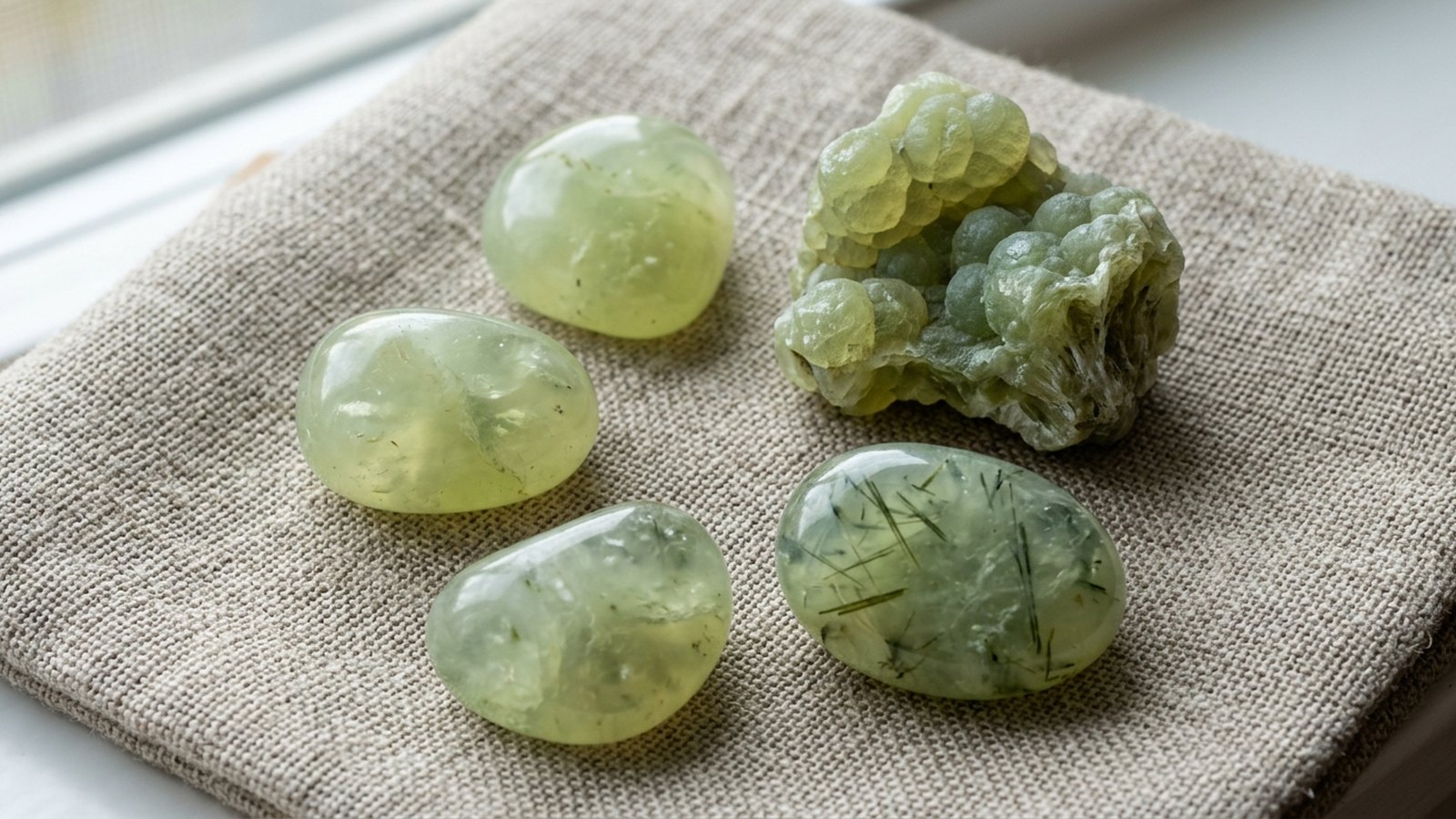
The first time somebody hands you a piece of prehnite, you probably will not know how to say its name. Almost nobody does. You turn the stone over, you like it immediately, and then you look up at the person who gave it to you and quietly hope they say the word first.
Prehnite is a pale green calcium aluminium silicate that grows in rounded, grape-like bunches, and in the crystal tradition its meaning is preparation. Not action, not manifestation, just the settled feeling that arrives before you have decided anything. It is the stone people reach for when they are the one holding everyone else together, which is why it is so often called the stone that heals the healer.
It is also, as far as mineral historians can tell, the first mineral ever named after a real person. That single fact turns out to explain almost everything strange about prehnite: why you cannot spell it, why the trade sold it under three other stones' names, and why one of the pages ranking on page one of Google right now assigns it to entirely the wrong chakra. So let me start with the stone itself, and then tell you about the colonel.
Reasons to work with prehnite
Prehnite is for the person who has too many open loops. There is a particular kind of tiredness that comes from unfinished things rather than hard ones, and prehnite belongs to it. The traditional reading of this stone is decluttering, in the widest sense: the drawer, the inbox, the half-finished conversation. I keep one on the desk where I do the admin I dislike, and what it seems to offer is not motivation but permission to deal with small things in a small way.
Prehnite is for people who look after other people. Nurses, teachers, therapists, parents, the friend everyone calls. The nickname "the stone that heals the healer" is worn out from overuse, but it survives because it names something real: the giving is not the problem, the not-refilling is. If you recognise yourself there, prehnite pairs naturally with the work in our guide to crystals for self-love.
Prehnite is for the gap between anxiety and intuition. This is the distinction I find most useful about it. Anxiety is loud and repetitive and full of what-ifs, and it keeps talking. A genuine hunch tends to say its piece once, quietly, and then let you get on with your day. Prehnite's traditional job is to make that second voice easier to hear, which is not the same as making the first one stop. If it is the first one you are dealing with, start instead with crystals for anxiety, and please treat real anxiety as something worth real help.
Prehnite is for the beginning of things, which is where its reputation for foresight actually sits. It suits a move, a new job, a first week of anything, and it sits comfortably alongside the stones in crystals for new beginnings.
Prehnite meaning: healing energy
Emotional healing
Prehnite's emotional reputation is for lowering the volume rather than lifting the mood. Tradition gives it to people who are braced, waiting for the next demand. Held for a while, its association is with the moment your shoulders come down and you notice you had been holding them up.
Spiritual healing
This is where prehnite is known as the stone of prophecy, and I want to be careful with that phrase. Prehnite has been associated with foresight and inner guidance, and in practice that means trusting the quiet answer you already have. It works well in the kind of sitting described in meditating with crystals.
Mental healing
Prehnite is traditionally a stone of order rather than of sharpness. If you want the mental gear that cuts through a task, that is closer to the stones in crystals for focus. Prehnite is the one for deciding what deserves attention in the first place.
Physical healing
In older lore prehnite is linked to the kidneys, the bladder and the connective tissue, and it appears in traditions concerned with rest and recovery. That is inherited folklore, not medicine, and no stone treats anything. If something in your body is asking for attention, ask a doctor.
Chakras: heart, with a secondary link to the solar plexus Zodiac: Libra is nearly universal, with Virgo often added Element: Water Numerical vibration: 5 Affirmation: I am ready, and I have nothing to prove.
The man in the name, and how to say it
Say it PRAY-nite. Two syllables, a long first vowel, and the h is silent. Once you know the reason, the spelling stops fighting you.
The reason is that Prehn is a surname. Hendrik von Prehn (1733 to 1785) was a Dutch colonel stationed at the Cape of Good Hope, and briefly its governor around 1779 and 1780, until he was dismissed from the post. He collected minerals, and among the specimens he carried back to Europe was a pale green stone nobody had described. In 1788 the German mineralogist Abraham Gottlob Werner named it after him, three years after Prehn had died.
That is generally held to be the first time a mineral species was named for an individual, and it opened a door that has never closed since. Not everyone was pleased. In 1813 the chemist Richard Chenevix published an attack on the whole practice of hanging people's names on minerals, and prehnite was the case that provoked it. Two centuries later, mineral names honouring people are so ordinary that the objection reads as quaint.
Here is why the name still matters to you as a buyer. Because "prehnite" looks like nothing else in English, it gets mistyped, and the most common mistype is "phrenite". That misspelling accidentally lands on a real Greek root, phren, meaning mind, the one buried inside words like phrenology. At least one page ranking on the first page of Google for this stone has taken that accident as an etymology, concluded that prehnite is a stone of mental acuity, and filed it under the third eye and crown chakras. Every other source, and the whole tradition, puts it at the heart. A spelling error turned into an etymology, and the etymology moved the stone. It is a good reminder to check where a claim came from, which is the same habit our guide to how to tell if a crystal is real asks of you.
Prehnite geology
Prehnite is Ca2Al(AlSi3O10)(OH)2, a calcium aluminium silicate with hydroxyl in the structure. It crystallises in the orthorhombic system, sits at 6 to 6.5 on the Mohs scale, has a specific gravity around 2.80 to 2.95 and a refractive index of roughly 1.61 to 1.67. The green comes from a small amount of iron standing in for aluminium, which is why the colour ranges from almost colourless through pale apple green to a warm yellow-green, and why no two parcels quite match.
What makes it recognisable is the habit. Well formed single crystals are uncommon. Prehnite normally grows as botryoidal masses, meaning rounded bunched surfaces like a cluster of grapes, built from tightly packed fibres radiating outward from many centres at once. Break one open and you can see the fibres. That radiating internal structure is the reason polished prehnite glows softly from within instead of being clear like glass, and it is the single most useful thing to know when you are deciding whether a stone is real.
It forms at low temperature in cavities in basalt, filling old gas bubbles alongside zeolites and calcite, and it also forms during very mild metamorphism. That second habit gave it an honour no other crystal-shop stone can claim: geologists named a whole band of the metamorphic map after it. The prehnite-pumpellyite facies covers the conditions, very roughly 250 to 350 degrees Celsius, where rock has been changed but only just. When a geologist finds prehnite in a rock, it is being read as a thermometer.
Grape jade, Cape emerald, Cape chrysolite
A surname is hard to sell, so the trade gave prehnite other stones' names instead, and all three still circulate.
"Grape jade" describes the botryoidal habit honestly enough, but prehnite is not jade. Jade means jadeite or nephrite, both far tougher and quite different minerals, and if you want the real distinction our guide to aventurine vs jade walks through the whole green-stone muddle, including the serpentine sold as "new jade".
"Cape emerald" points at the Cape of Good Hope, where von Prehn found it. It is not beryl and it never was.
"Cape chrysolite" is the interesting one, because it is the direct cause of a question people still type into Google: is prehnite the same as peridot? No. But chrysolite was for centuries the ordinary English name for what we now call peridot, a fact our peridot guide goes into properly. So a nineteenth century trade name borrowed peridot's old name for a completely unrelated mineral, and the confusion outlived the name that caused it. Peridot is magnesium iron silicate, Mohs 6.5 to 7, and looks olive and lit from inside. Prehnite is cloudier, cooler and softer.
How to tell if your prehnite is real
Look through it towards a light. Real prehnite is translucent rather than transparent, slightly cloudy, and the cloudiness has direction to it: you can often make out the faint radiating fibre bundles described above. A stone that is perfectly clear or perfectly even is more likely to be glass, and glass usually gives itself away with round bubbles and swirls.
Distrust perfection in the colour. Prehnite's green is uneven because the iron is unevenly distributed. Colour that is intense, uniform and slightly too saturated suggests dye, and dye tends to gather in cracks, so look for green concentrated along a fracture line. This is the same test we use on dyed howlite.
Welcome the black needles. Fine dark green to black needles crossing the inside of a prehnite are almost always epidote, and prehnite with epidote is a natural, desirable and hard to fake combination. Epidote is the same mineral that gives unakite its mottled look.
Check the hardness if you can do it safely on an unimportant edge. Prehnite at 6 to 6.5 resists a steel blade. Green fluorite, which is often mistaken for it, is only 4 and cleaves into flat triangular steps, so a chipped fluorite bead looks quite different from a chipped prehnite.
Where prehnite comes from, and how to keep it
The type locality is still the Cape of Good Hope in South Africa, and the N'chwaning mines there produced a famous pocket of rare orange prehnite that collectors say ran out early this century. Most of what you will actually meet comes from Mali, whose material carries the finest epidote needles, from Australia, China, Scotland, the Bay of Fundy in Canada, and the old basalt quarries around Paterson, New Jersey.
Now the care, because the advice you will read elsewhere is mostly aimed at the wrong risk. Prehnite is an insoluble silicate. Water does not harm it, and a rinse in cool water with a soft cloth is fine, whatever the "keep water contact brief" line on half the crystal shops suggests. Our guide to crystals and water safety lists the stones that genuinely cannot take it, and prehnite is not among them.
The real risk is mechanical. Prehnite is brittle and has one good cleavage plane, so it does not scratch easily but it does chip and it will split cleanly if you knock it hard on an edge. Keep it away from quartz, topaz and anything harder in a jewellery box, skip the ultrasonic cleaner entirely, and give it its own soft pouch, along the lines of how to store crystals. To cleanse it, running water or a night in moonlight both suit it well, as set out in cleansing crystals.
A last word
I am wary of stones sold as answers, and prehnite has never felt like one. It feels like the pause before the answer, which is a smaller and more useful thing. If you want to give it company, green aventurine shares its steadiness without its softness.
And when someone asks what it is, you can tell them it is named after a Dutch colonel who has been dead since 1785, that he was the first person ever to have a mineral named after him, and that it is pronounced PRAY-nite. Nobody expects that from a pale green stone.