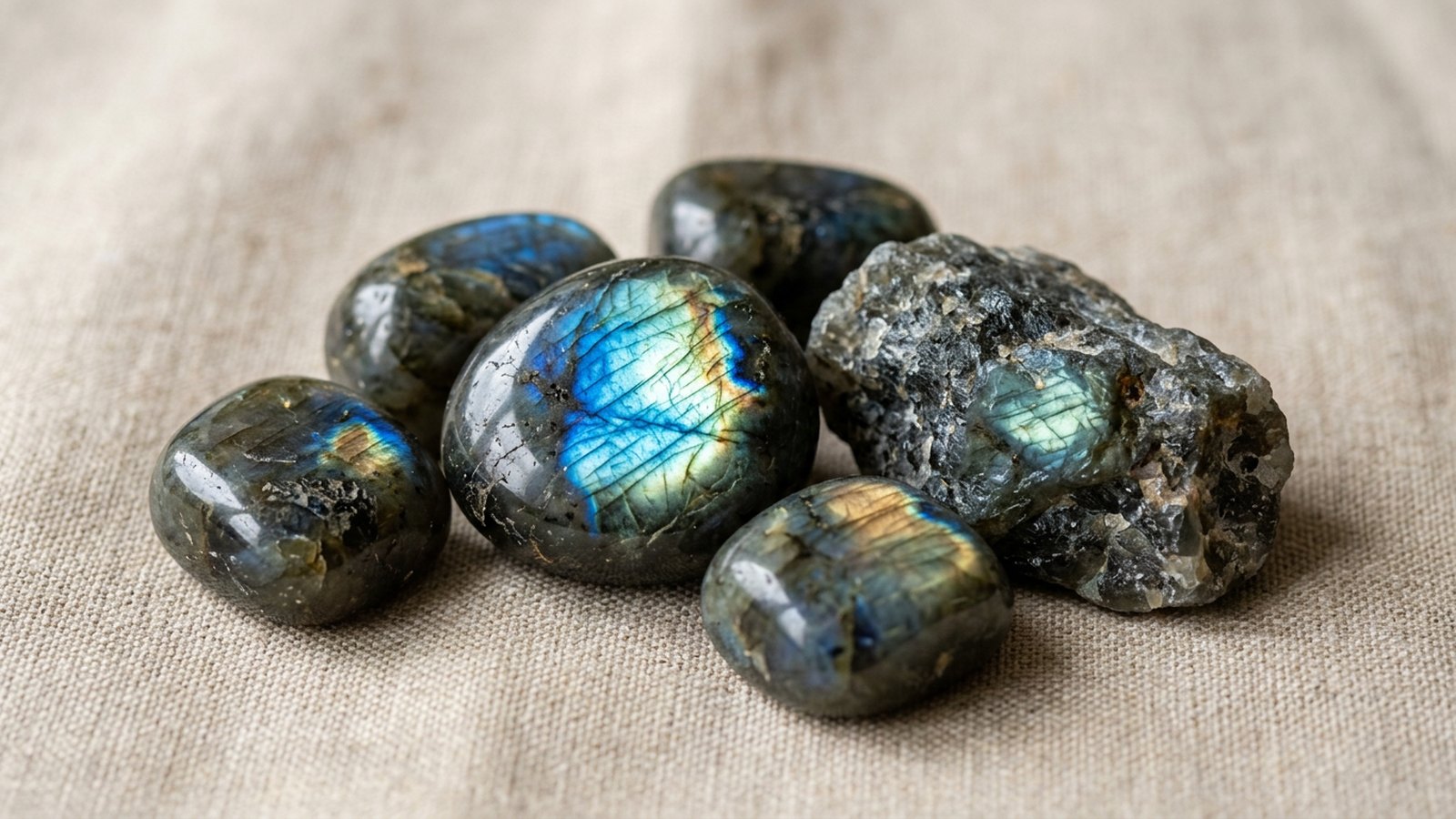
A few years ago I started keeping a small notebook next to the labradorite palm stone on my desk. Whenever I had a hunch about something (a person I had just met, a job offer, a route home that felt wrong for no clear reason) I picked up the stone, wrote the hunch down in one line, and added a mark from one to five for how sure I felt. A few weeks later I went back and wrote what had actually happened. The notebook taught me more about my own intuition than any list of stones ever did, and the stone became the cue that made me stop and listen long enough to write anything down at all.
That is the spirit of this guide. Intuition speaks in different ways to different people: some feel it in the stomach, some get it in dreams, some simply know how a conversation is going to end. The stones tradition links to intuition are sorted here by the way your inner voice tends to reach you, with how I use each one, who it suits less well, and an honest word on what a crystal can and cannot do.
The short answer
The three stones most often named for intuition are amethyst, labradorite and moonstone. Labradorite is the usual choice for gut feelings in the moment, amethyst for dreams and quiet reflection, and moonstone for emotional knowing that follows natural cycles. Lapis lazuli and sodalite are the classic third eye chakra stones for reading people and for decisions where head and gut disagree. Fluorite helps when you cannot tell a hunch from a worry, and clear quartz is the all-purpose starting point. All of these are traditional associations, and they work best alongside a simple practice of noticing and checking your hunches.
What intuition is, and what a stone can add
Psychologists have studied intuition for decades, and their findings are more encouraging than you might expect. In a well known 2009 paper, Daniel Kahneman and Gary Klein agreed that intuitive judgements are often reliable when two conditions are met: the situation has regular patterns, and the person has had enough practice with clear feedback to learn them. A nurse who senses that a patient is about to decline, or a firefighter who feels a floor is unsafe, is recognising patterns faster than they can explain them. The same research also found that a feeling of certainty proves nothing by itself. People feel just as sure about hunches in situations where they have had no real feedback, and those hunches are often wrong.
In crystal tradition, intuition belongs mainly to the third eye, the energy centre between the eyebrows, with the crown linked to wider spiritual guidance and the sacral chakra to gut instinct. In my practice a stone serves as a physical anchor for the habit that makes intuition trustworthy: pausing, noticing what you sense, and later checking it. I treat my intuition stones as a bookmark for that pause.
Intuition or anxiety?
Few of the lists I read before writing this guide spend more than a line on this question, and I think it deserves a full section before any choice of stone. Many people who search for crystals for intuition are really trying to work out whether a strong feeling deserves their trust.
In my experience, and in the descriptions of people who work with intuition professionally, the two tend to feel different. An intuitive signal is usually quiet, brief and specific. It points in one direction and then stays the same when you come back to it the next day. Anxiety tends to be loud and urgent, it imagines the worst outcome, and it loops, offering a new frightening scenario every time you answer the last one. Intuition often feels neutral even when it brings bad news, while anxiety comes with a racing heart and a need to act right now.
If most of your strong feelings belong to the second group, a stone for intuition is the wrong tool to start with. My guide to crystals for anxiety is a better place to begin, and if anxiety is shaping your days, a doctor or therapist is the right next step. Crystals are a companion to that care and never a replacement for it.
Crystals for intuition, sorted by how your inner voice speaks
For gut feelings in the moment: labradorite
If your intuition arrives as a sudden pull in the stomach during a meeting or a first conversation, labradorite is the stone I would choose. It is a plagioclase feldspar named after Labrador in Canada, where Europeans described it in the 1770s, and its flashes of blue, green and gold come from light bouncing between microscopic layers inside the crystal. Most of the time the stone looks grey, and the colour only appears when the light hits at the right angle. Many people see in that a picture of intuition itself, present all the time and visible only in brief moments.
How I use it: a small tumbled piece in a pocket, which I touch when I notice a reaction I cannot yet explain. That touch is my signal to note the feeling before my reasoning talks me out of it. Tradition also calls labradorite a protective stone for sensitive people, which is why it appears in my guide to crystals for protection.
Who it suits less well: labradorite has a hardness of 6 to 6.5 and splits easily along its cleavage planes, so a labradorite ring worn on a busy hand will chip. A pendant or a pocket stone lasts far longer.
For dreams and night-time insight: amethyst
Some people receive their clearest hunches while asleep or in the drowsy minutes before waking. Amethyst is the traditional dream stone, and I keep a cluster on my nightstand alongside a notebook for writing dreams down before they fade. Amethyst is quartz coloured by traces of iron and natural radiation in the rock, with a hardness of 7, and its Greek name, amethystos, means "not intoxicated", a link to clarity that has followed it for more than two thousand years.
How I use it: on the nightstand, or held for a few slow breaths before sleep while I ask one simple question. What comes back is usually a feeling about the question the next morning, and the notebook catches it.
Who it suits less well: if you sleep lightly and find that focusing on dreams keeps you awake, start with the gentler stones in my guide to crystals for sleep. And keep amethyst off a sunny windowsill, since its purple can fade after long exposure to strong light.
For emotional knowing and cycles: moonstone
Moonstone suits the kind of intuition that comes as a mood or a sense of timing, the feeling that now is the right moment to speak, or that a plan needs another month. It is an orthoclase feldspar, and its soft blue glow, called adularescence, comes from thin alternating layers of two feldspars that scatter light. Moonstone has long been linked with the moon, with feminine cycles and with the third eye and crown chakras, and it is one of the birthstones of June.
How I use it: I wear it on days when I want to stay close to my feelings, and some people keep one by the window on the night of the full moon as part of a monthly check-in with themselves. If you like working with two stones, my guide to labradorite and moonstone explains how the two are paired.
Who it suits less well: if your feelings already swamp you, moonstone can feel like more of the same. A grounding stone such as smoky quartz is a steadier companion in that case.
For reading people and hearing the truth: lapis lazuli
Lapis lazuli is a rock made mostly of the blue mineral lazurite, with white calcite and golden flecks of pyrite. It has been mined at Sar-e-Sang in Afghanistan for around six thousand years, and it was ground into the ultramarine pigment of Renaissance paintings. In crystal tradition it belongs to both the third eye and the throat, which is why it is the stone people reach for when they want to sense what others mean behind what they say.
How I use it: I hold it for a minute before a conversation where I expect polite answers, and I pay attention afterwards to which words stayed with me. It also sits well in a meditation focused on the third eye, which I describe in my guide to meditating with crystals.
Who it suits less well: lapis is soft (5 to 5.5) and porous, so it dislikes water, salt and perfume. Daily wear on a bracelet that goes through hand-washing will dull it quickly.
For decisions where head and gut disagree: sodalite
Sodalite is the stone I suggest to people who think carefully and then distrust their own hunches. It is a sodium-rich mineral, named for that sodium, with a deep blue colour streaked with white, and tradition links it to the meeting of logic and intuition. The famous Princess Sodalite mine near Bancroft, Ontario, owes its name to a large order of the stone for a royal residence in London in the early twentieth century.
How I use it: I hold it while writing two short lists for a decision, what I think and what I sense, and I look at where they agree. If you are unsure which of the two blue stones to buy, my comparison of sodalite and lapis lazuli sets out the differences in look and use.
Who it suits less well: anyone who already decides on instinct alone. Sodalite's tradition is one of balance, and impulsive people may prefer a stone that slows them down.
For telling a hunch from a worry: fluorite
Fluorite is calcium fluoride, and it grows in purple, green, blue and banded crystals, often as near-perfect cubes. Crystal tradition calls it a stone of mental order, and I reach for it when I cannot tell whether a feeling is intuition or anxiety. Its cool colours and clean geometry help me slow down enough to run through the questions in the section above.
How I use it: on my desk, held while I write the feeling down and ask whether it is quiet or loud, specific or vague, and whether it will still be there tomorrow. Fluorite is also one of the stones in my guide to crystals for focus.
Who it suits less well: at a hardness of 4 with cleavage in four directions, fluorite scratches and splits easily. Keep it as a desk or altar stone and avoid wearing it as a ring.
When you are just starting: clear quartz
Clear quartz is the all-purpose stone of crystal practice and the one I suggest when you do not yet know how your intuition speaks. Tradition calls it an amplifier for whatever intention you set, and it links to the crown chakra. It is also one of the most durable stones on this list, with a hardness of 7.
How I use it: as the stone for the two-week practice below. Its neutrality means you are less likely to read meanings into the stone itself and more likely to focus on your own hunches. Many people also keep a slab of selenite nearby to rest their stones on, although selenite is very soft and must stay dry.
A two-week practice to test your intuition
This is the method from my notebook, and it works with any of the stones above. It gives you a written record of how often your hunches turn out right, something a stone cannot provide on its own.
- Choose one stone and keep it in the same place every day, on your desk or by your bed.
- Each morning, hold it for about three minutes, breathing slowly, and ask what you sense about the day ahead.
- Whenever a hunch appears during the day, touch the stone and write one line: the date, the hunch, and how sure you feel on a scale of one to five.
- Do not act differently because of the notebook. The aim is to observe.
- After fourteen days, go back through every line and write what actually happened.
- Look for patterns. Many people find their hunches about people are accurate while their hunches about money are not, or that a "five" is right far more often than a "two".
What you learn is where your intuition has earned your trust, which is the kind of feedback the research on intuition describes as the basis of reliable judgement.
Caring for your intuition stones
Most of the stones above share two weaknesses: they are softer than quartz, and several dislike water. This table sums up how to treat them.
| Stone | Hardness (Mohs) | Water | Long direct sunlight |
|---|---|---|---|
| Labradorite | 6 to 6.5 | Brief rinse only | Fine |
| Amethyst | 7 | Fine | Can fade |
| Moonstone | 6 to 6.5 | Brief rinse only | Fine |
| Lapis lazuli | 5 to 5.5 | Avoid | Fine |
| Sodalite | 5.5 to 6 | Brief rinse only | Fine |
| Fluorite | 4 | Brief rinse only | Can fade |
| Clear quartz | 7 | Fine | Fine |
| Selenite | 2 | Avoid, it dissolves | Fine |
For energetic cleansing, smoke, sound or a night on a selenite plate are the safest methods for the whole group. My guide to cleansing crystals goes through each method and which stones it suits.
A last word
The notebook is the part of this guide I would keep if I had to drop everything else, because the habit it builds is what makes any of these stones useful. Start with the stone that matches the way your inner voice already speaks to you, give it two weeks, and let the record you keep show you what your intuition knows. You will find all the stones linked to this intention on the crystals for intuition page.