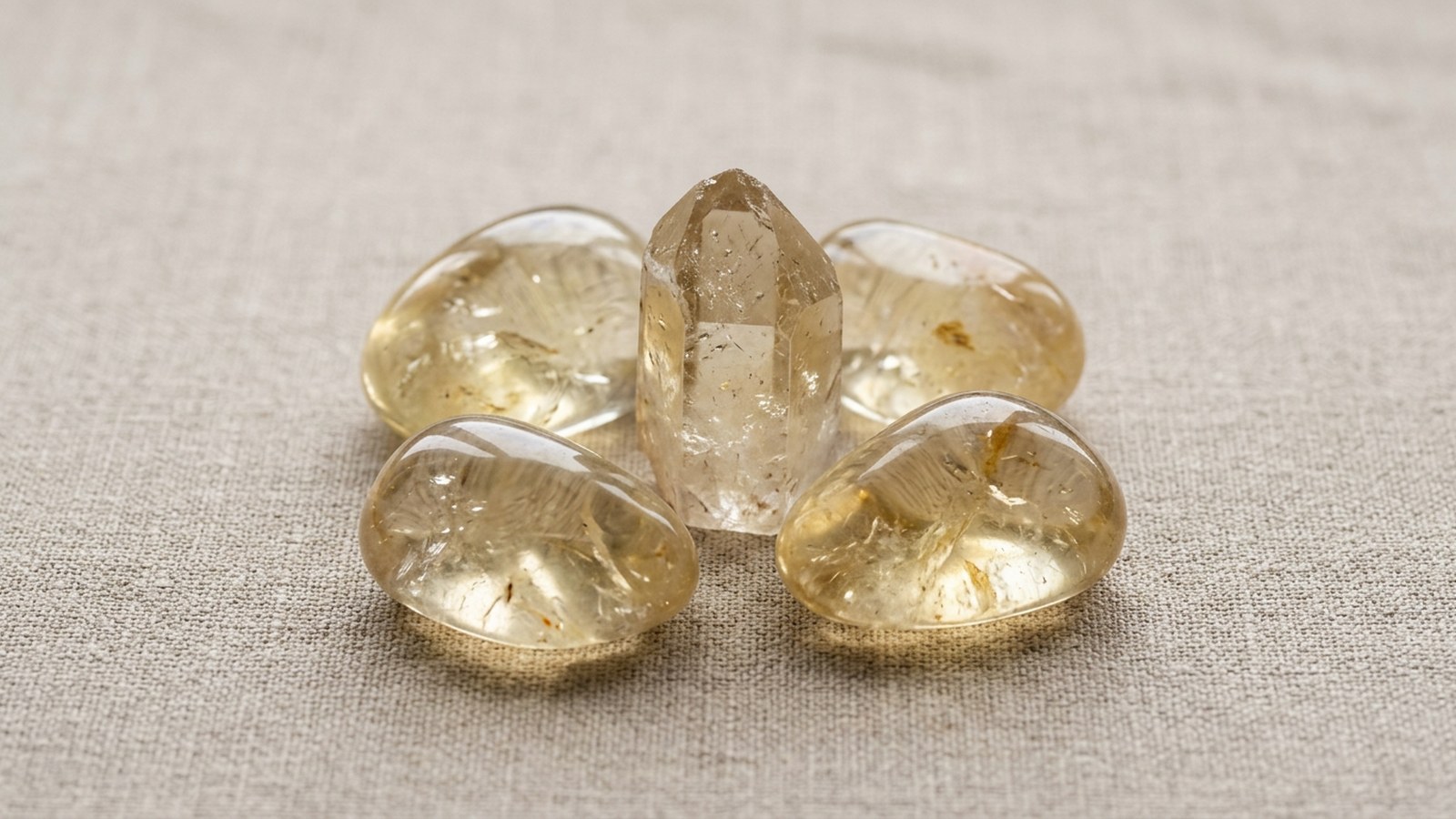
There is a small bowl by my front door that holds my keys, a few coins and two stones: a piece of black tourmaline that has been there for years and a pale, slightly cloudy citrine point I picked up at a mineral fair. Neither of them changes the weather in my flat. What they do is catch my eye twice a day, on the way out and on the way back in, and over time they have become the moment I check how I am actually doing. On the mornings when I feel flat, I take the citrine with me. On the evenings when I come home carrying someone else's bad mood, I put my keys down and leave it there for a while.
That is the honest shape of this guide. People who search for crystals for positive energy usually mean one of four things: a body that feels heavy and slow, a mood that has gone grey, a room that feels stale or tense, or the drained feeling after time with difficult people. Below I sort the stones most often chosen for each of those situations, with their real geology, how I use them, who each suits less well, and a few claims about ions and EMF that I think are worth dropping.
Which crystals are best for positive energy?
The crystals most often chosen for positive energy are citrine and sunstone for mood and warmth, carnelian for physical get-up-and-go, clear quartz to set an intention for a room, rose quartz for warmth around other people, and selenite, smoky quartz and black tourmaline to clear the air first. Choose by where the energy feels low: in your body, your mood, your home or your relationships.
What "positive energy" means here, and what a stone can do
In crystal tradition, every stone is said to carry its own vibration, and the bright, warm-coloured ones (yellow, orange, gold) are associated with the solar plexus and sacral chakras, the centres linked with will, appetite for life and pleasure. That is the lore, and I find it a useful map for choosing.
It is worth knowing what the research says too. In 2001 the psychologist Christopher French and colleagues at Goldsmiths, University of London, asked 80 volunteers to meditate holding either a real quartz crystal or a convincing glass fake. Both groups reported similar tingling, warmth and lifted mood, and the people who already believed in crystal healing reported the most. I read that as evidence about where the effect lives: in attention, expectation and ritual. A stone you choose with care becomes a reliable cue to pause, breathe and notice, and that cue is real and usable whatever you believe about vibration.
Crystals are a companion to rest, daylight, food, movement and good company, never a replacement. If a low mood has lasted more than two weeks, or you feel hopeless, please talk to a doctor or a counsellor; in the US you can call or text 988 at any hour.
Clear the air first: selenite and smoky quartz
Many practitioners say you cannot pour much into a full cup, and in practice I agree: when a space or a day feels heavy, I start by clearing before I reach for anything bright.
Selenite
Selenite is a transparent, fibrous variety of gypsum, a soft calcium sulfate mineral (CaSO4·2H2O) that forms as salty water evaporates. Its silky, moonlike sheen is why tradition treats it as a stone of clarity and cleansing, and many people use a selenite wand or bowl to "reset" other crystals. I keep a slab on a bookshelf and run my hand along it when I come in from a long day, which is mostly a signal to myself that the day is over.
Selenite is only 2 on the Mohs scale and dissolves slowly in water, so never rinse it or use it in a bath. It suits a shelf or a desk better than a pocket.
Smoky quartz
Smoky quartz is quartz coloured brown to near black by natural irradiation in the ground, which activates traces of aluminium in the crystal lattice. It is the grounding stone most often recommended for absorbing tension, and I reach for it after a draining meeting or a difficult phone call, holding it for a few slow breaths before I do anything else. At 7 on the Mohs scale it is tough enough to carry. It suits people who feel scattered and wired more than people who already feel heavy and slow; if that is you, start with the stones in the next section.
When your body feels flat: carnelian and sunstone
Carnelian
Carnelian is a translucent orange to red chalcedony, a microcrystalline quartz coloured by iron oxides. Roman signet rings were often cut from it, partly, it is said, because hot sealing wax does not stick to it, and tradition links it with the sacral chakra, courage and physical vitality. It is the stone I suggest for the afternoons when getting off the sofa feels like a negotiation: hold it, set a ten-minute task, stand up. If what you need is help starting projects rather than general energy, my guide to crystals for motivation goes further. A lot of very bright orange "carnelian" is dyed agate; natural stones show soft, cloudy banding when held to the light.
Sunstone
Sunstone is a feldspar, usually oligoclase, with tiny flat crystals of hematite or copper inside that catch the light and glitter, an effect called aventurescence. Its warm, spangled look is why it is the stone of optimism and personal warmth in modern lore. I like it as a morning stone, worn or kept on the breakfast table, especially through the darker months. At 6 to 6.5 on the Mohs scale it scratches more easily than quartz, so a pendant is safer than a ring. Sunstone suits people who feel low on warmth more than on drive.
When your mood has gone grey: citrine
Citrine is the stone named in nearly every list of positive energy crystals. It is yellow quartz coloured by traces of iron, and tradition calls it the merchant's stone and a stone of joy, linked with the solar plexus. I use it when nothing is wrong exactly but everything feels muted: on the desk where I work, or in a pocket on a day I need to show up for people.
One thing every buyer should know: natural citrine is pale lemon to soft honey, and most of the deep orange "citrine" sold today is amethyst heated to around 450 to 550°C. Heated clusters show a white base under orange tips, which natural citrine does not. Neither is "bad", but you should know which one you own; my guide on how to tell if a crystal is real walks through the checks. If your grey mood is more about worry or loneliness than low energy, my guide to crystals for happiness sorts stones by the kind of low day you are having.
Around other people: rose quartz
Rose quartz is massive pink quartz whose colour comes from microscopic fibrous inclusions. Its tradition is warmth, softness and the heart, and it is the stone I suggest for shared spaces where tempers run short: a kitchen table, a family room, a team desk. It is also a kind thing to give someone going through a hard stretch. Rose quartz suits households more than solitary work, and it can fade with months of direct sun, so keep it out of a bright window.
For the rooms you live in: clear quartz and black tourmaline
Clear quartz
Clear quartz is pure silicon dioxide, the most common crystal on Earth, and tradition calls it the master healer because it is said to amplify whatever intention you give it. I use a single point as the "anchor" of a room, set with a short spoken intention (I describe the method in programming an intention).
Black tourmaline
Black tourmaline, also called schorl, is a striated, glassy black borosilicate and the classic protection stone, traditionally placed at the entrance so that heavy energy stays outside. It is the stone in my bowl by the door. For a deeper look at shielding stones, see crystals for protection.
Where to put them
- Front door or hallway: black tourmaline, to mark the threshold.
- Living room: clear quartz at the centre, rose quartz where people gather.
- Desk: citrine or carnelian, within reach of your hand.
- Bedroom: selenite or smoky quartz rather than the bright, stimulating stones.
- Sunny windowsill: sunstone, carnelian or black tourmaline; keep citrine, rose quartz and amethyst out of strong sun.
My full room-by-room map is in where to place crystals in your home.
Two claims worth dropping: negative ions and EMF
Several sites say crystals "release negative ions" the way a waterfall does. Waterfalls do produce high concentrations of negatively charged air ions as droplets shatter, and a 2013 meta-analysis led by Vanessa Perez found that very high ion densities from generators were associated with lower depression scores in some studies, with no consistent effect on mood in general. A stone on a shelf produces nothing comparable. Tourmaline and quartz are genuinely pyroelectric or piezoelectric, which means they build a tiny charge when heated or squeezed (quartz in your watch is driven by a circuit), but sitting at room temperature they do not ionise a room.
The same goes for the claim that black tourmaline next to your router "blocks EMF". Shielding radio waves requires a continuous conductive enclosure, and your phone would lose signal if a stone could do it. I keep tourmaline by the door for its meaning and as a reminder to leave the day outside, and that is reason enough to have it there.
The stones side by side
| Stone | Best for | Mohs | Water | Strong sun |
|---|---|---|---|---|
| Selenite | Clearing a space | 2 | No, dissolves | Fine |
| Smoky quartz | Releasing tension | 7 | Brief rinse | Fine (fades with heat) |
| Carnelian | Physical drive | 6.5 to 7 | Brief rinse | Fine |
| Sunstone | Warmth, optimism | 6 to 6.5 | Brief rinse | Fine |
| Citrine | Lifting a grey mood | 7 | Brief rinse | Can fade |
| Rose quartz | Warmth with others | 7 | Brief rinse | Can fade |
| Clear quartz | Anchoring a room | 7 | Brief rinse | Fine |
| Black tourmaline | Marking the threshold | 7 to 7.5 | Brief rinse | Fine |
For cleansing methods that suit each stone, see cleansing crystals and crystals and water safety.
A five minute morning practice
The research on habits that I trust most is on implementation intentions, plans written as "when X happens, I will do Y". A 2006 meta-analysis by Peter Gollwitzer and Paschal Sheeran, pooling 94 tests, found they made people noticeably more likely to follow through on goals. A stone you see every morning works well as the "when".
- Pick one stone from the section that matches where your energy is low today.
- Set the cue: "When I pick up my stone after breakfast, I will take three slow breaths."
- Name one good thing from the last day, out loud or on paper, and hold the stone while you do it.
- Choose one small action for the next hour (a walk, a message to a friend, ten minutes on the task you are avoiding).
- Carry or place the stone where you will see it again at midday, and repeat the breaths when you do.
Do it for two weeks before you judge it. In my experience the first thing to change is how often you notice your own state during the day, and that noticing is what lets you act on it.
A last word
If I had to start with one stone, it would be a small natural citrine, kept where your hand falls during the day. Add a clearing stone when your space feels heavy, and let the rest grow from what you notice. You can browse the eight stones from this guide on the positive energy page, and their neighbours on the happiness and protection pages.