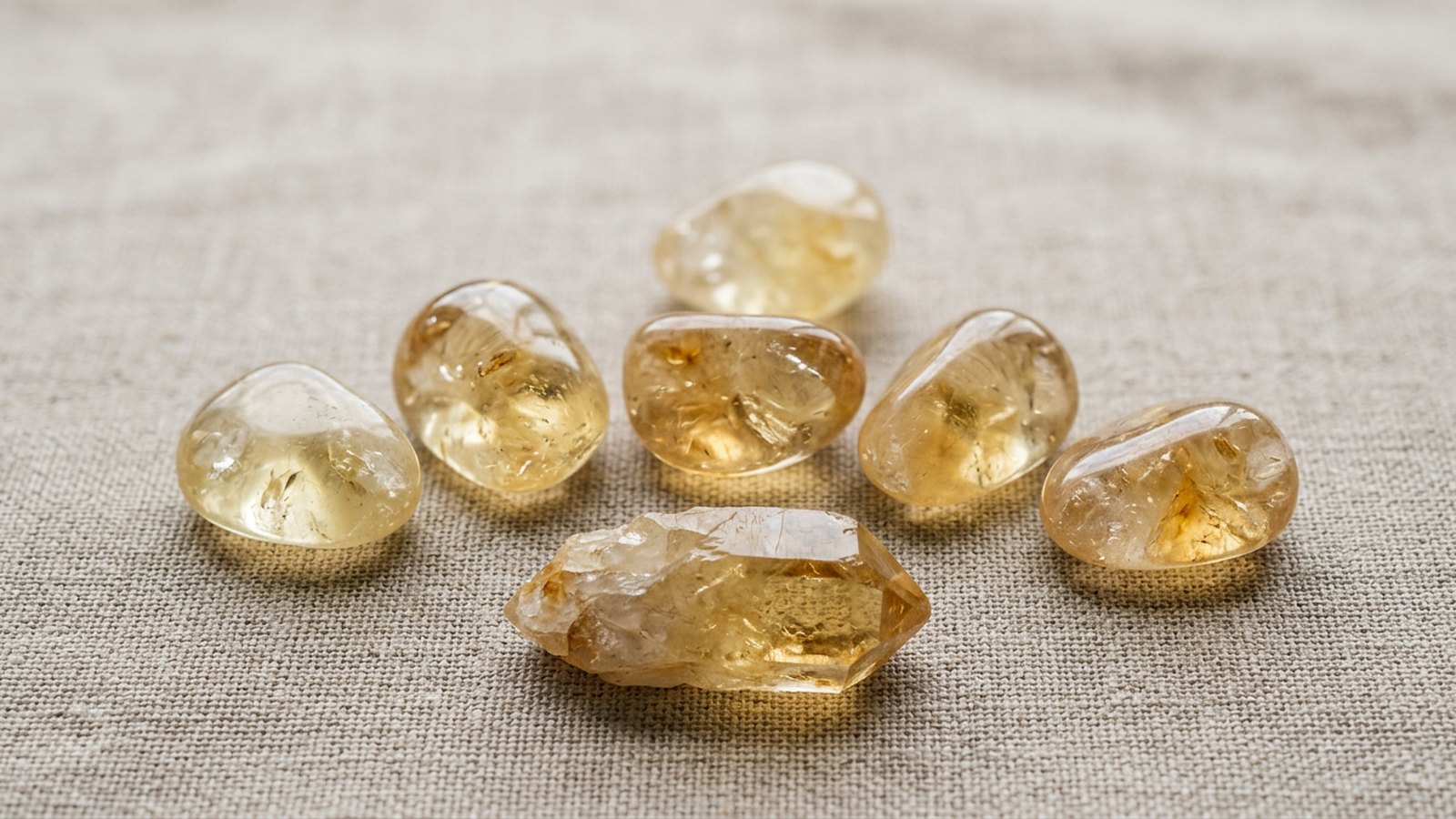
A few winters ago I went through a long stretch where nothing was wrong and nothing was good either. Work was fine, the people I love were well, and every morning still arrived the colour of dishwater. A friend put a rough piece of sunstone in my hand and told me to keep it on my desk until spring. I did, mostly out of politeness, and I started noticing that I reached for it at the same moment every day, around three in the afternoon, when the light in my flat went flat.
That small habit taught me something I have seen confirmed many times since. People who search for crystals for happiness are rarely all in the same place. Some feel grey for no reason they can name. Some have lost the pleasure of doing things they used to enjoy. Some are happy enough underneath and simply too worried to feel it. Some are lonely. The traditional happiness stones answer these situations differently, so this guide is sorted by the kind of low you are in, with the stones that belong to each.
The short answer
The stone most often named for happiness is citrine, a yellow quartz that crystal tradition links to the solar plexus chakra, warmth and optimism. Sunstone is its closest companion for a mood that needs lifting. For lost enthusiasm, reach for carnelian; for joy buried under worry, amethyst; for loneliness, rhodochrosite or rose quartz; and for a quieter, lasting contentment, green aventurine.
What a stone can and cannot do here
I want to be plain about this before the list. Crystals do not change brain chemistry, and nothing in this guide is a treatment. What I have found, and what long tradition describes, is that a stone can work as an anchor: a physical object you have chosen on purpose, that reminds you several times a day of the feeling you are moving towards. That reminder is real and it can matter.
Ordinary low mood and depression are different things. If you have felt empty, hopeless or unable to enjoy anything on most days for more than two weeks, please talk to your doctor or a therapist. If you are in the United States and having thoughts of harming yourself, you can call or text 988 at any hour. A stone can sit beside that help very comfortably, and it should never replace it.
When everything feels grey for no clear reason
This is the flat, dim version of unhappiness, often seasonal, where no single problem explains the weight. The stones that tradition gives to this state are the warm, sunlit ones.
Citrine
Citrine is quartz coloured yellow to honey-orange by traces of iron, and it has carried the nickname "the merchant's stone" and "the happy stone" in crystal circles for decades. Its traditional reading is simple: it brings the feeling of sunlight into a room that has none. I keep a small point on my kitchen table during the dark months, where I see it with my first coffee. It suits people who need a daily nudge towards brightness. It suits people who feel easily overstimulated less well; some of them find its energy a little loud.
Sunstone
Sunstone is a feldspar whose sparkle comes from tiny plates of hematite or copper inside the crystal, a flash called aventurescence. Oregon sunstone, coloured by copper, has been the state gem of Oregon since 1987. In tradition it is the stone of personal warmth and of joy in simple things, and I find it gentler than citrine, more like late afternoon light than midday. Carry it in a pocket on the days you need to leave the house when you would rather not. Feldspar has two directions of cleavage, so keep it away from hard knocks.
When you have lost your spark
Here the difficulty is a loss of pleasure in doing things. The garden you loved feels like a chore, and the guitar sits in its case.
Carnelian
Carnelian is an orange to red chalcedony coloured by iron oxide, and it was set into Egyptian jewellery thousands of years ago, including pieces found in the tomb of Tutankhamun. Its traditional territory is the sacral chakra, the seat of pleasure, appetite and creative play. I use it when I notice that I have stopped doing things for fun. Hold a piece while you start one small enjoyable task, ten minutes of the old hobby, and let the stone mark that moment. If your problem is getting started on work, my guide to crystals for motivation goes further into that.
When worry is crowding out joy
Many people who describe themselves as unhappy are, looking closer, mainly anxious. The good things are present, and a constant low hum of worry keeps them out of reach.
Amethyst
Amethyst is purple quartz, coloured by iron and natural irradiation, and its name comes from the Greek amethystos, "not drunk", from the old belief that it kept the mind clear. Crystal tradition places it at the third eye and crown and treats it as the settling stone. In this context, it makes room: it quietens the chatter so that ordinary contentment can be noticed again. I keep one by the chair where I read in the evening. Pairing it with citrine is a classic combination, which I describe in amethyst and citrine together. If worry is the main thing in your life right now, start with crystals for anxiety instead of this list.
When what is missing is warmth with other people
Loneliness feels a lot like unhappiness, and it responds to different things. The stones here belong to the heart chakra.
Rhodochrosite
Rhodochrosite is manganese carbonate, banded in pinks and raspberry reds, and it is the national stone of Argentina, where the old Inca mines of Catamarca gave it the name "Inca rose". Tradition calls it a stone of emotional warmth and of being able to receive affection as well as give it. It is also soft, only 3.5 to 4 on the Mohs scale, with perfect cleavage, so it belongs on a bedside table or in a pendant, far from rings and pockets full of keys. I reach for it after a period of isolation, when reaching out feels harder than it should.
Rose quartz
Rose quartz is the softer, more familiar companion here, a pink quartz associated with self-compassion. It suits people whose loneliness has turned into harshness towards themselves. My guide to crystals for self-love covers that side in depth.
When you want contentment more than a lift
Some readers are not in a low at all. They want a steadier, everyday sense of being glad for what they have.
Green aventurine
Green aventurine is quartz sparkling with small flakes of fuchsite, a chromium-bearing mica, and folk tradition calls it a stone of optimism and quiet good fortune (it appears in my list of crystals for good luck for that reason). It is the stone I suggest for a gratitude habit: hold it each evening while naming three good things from the day. It is hard, inexpensive and happy in a pocket, which makes it the easiest stone on this list to live with.
The happiness stones side by side
This table adds something the usual lists leave out: how the stones hold up. Several happiness stones are sold with the advice to charge them on a sunny windowsill, and some of them fade there.
| Stone | Best for | Chakra | Mohs hardness | Direct sun |
|---|---|---|---|---|
| Citrine | Grey days | Solar plexus | 7 | Short spells only |
| Sunstone | Low energy, going out | Sacral, solar plexus | 6 to 6.5 | Fine |
| Carnelian | Lost pleasure | Sacral | 6.5 to 7 | Fine |
| Amethyst | Worry | Third eye, crown | 7 | Fades, keep in shade |
| Rhodochrosite | Loneliness | Heart | 3.5 to 4 | Keep in shade |
| Rose quartz | Self-criticism | Heart | 7 | Fades, keep in shade |
| Green aventurine | Everyday contentment | Heart | 6.5 to 7 | Fine |
Amethyst and rose quartz lose colour in strong light over months, and so can natural citrine. For those, moonlight or a bowl of rice works well for cleansing, and I describe gentler options in cleansing crystals. Rhodochrosite should also stay out of long water soaks and salt, as explained in crystals and water safety.
How to use happiness crystals day to day
The stones work best, in my experience, when they are tied to a specific moment instead of left to gather dust.
- Choose one stone for your situation. A single stone you actually notice will do more for you than a drawer of them. Use the sections above to pick.
- Set the intention once. Hold it and say, in plain words, what you want more of: "I want to notice the good parts of my day." My guide to programming an intention explains the simple method I use.
- Tie it to a daily moment. First coffee, the afternoon slump, the evening wind-down. Touch the stone at that moment and pause for three breaths.
- Wear it if you are out a lot. A citrine or sunstone pendant sits close to the solar plexus. See carrying and wearing stones for what survives daily wear.
- Give the home a bright corner. A small cluster of citrine, carnelian and sunstone in the room where you spend your mornings is a simple, pleasant grid.
- Review after a month. Notice whether the moment you tied to the stone has changed. That check is the most reliable guide you have for whether to keep going or try another stone.
Which crystals should not be in the bedroom?
This is one of the most searched questions around happiness stones. There is no scientific evidence that any crystal disturbs sleep. In tradition, though, the bright, energising stones on this list, citrine, sunstone and carnelian, belong to the daytime rooms, and many practitioners keep them away from the bed for that reason. Amethyst, rose quartz and rhodochrosite are the traditional bedroom choices. My guide to crystals for sleep goes into the full list.
Is your citrine really citrine?
Most of the citrine on the market is amethyst that has been heated in a kiln to around 450 to 500 degrees Celsius, which turns the purple to orange and brown. Natural citrine is rarer, usually a pale, even yellow to soft honey with a slightly smoky tone. Heated amethyst tends to show a burnt orange colour concentrated at the tips, often on a white base, as in the bright orange geode clusters sold everywhere. Heated material is still quartz and many people love it; it should simply be sold for what it is and priced accordingly. For more checks, see how to tell if a crystal is real.
A last word
If you take one idea from this guide, let it be that happiness has several shapes, and the most useful stone is the one that fits the shape you are in today. Start with one, give it a month, and be kind with yourself in the meantime. And if the low has lasted a long time, the most important step is the conversation with someone who can help, with a small piece of sunstone in your pocket on the way there.