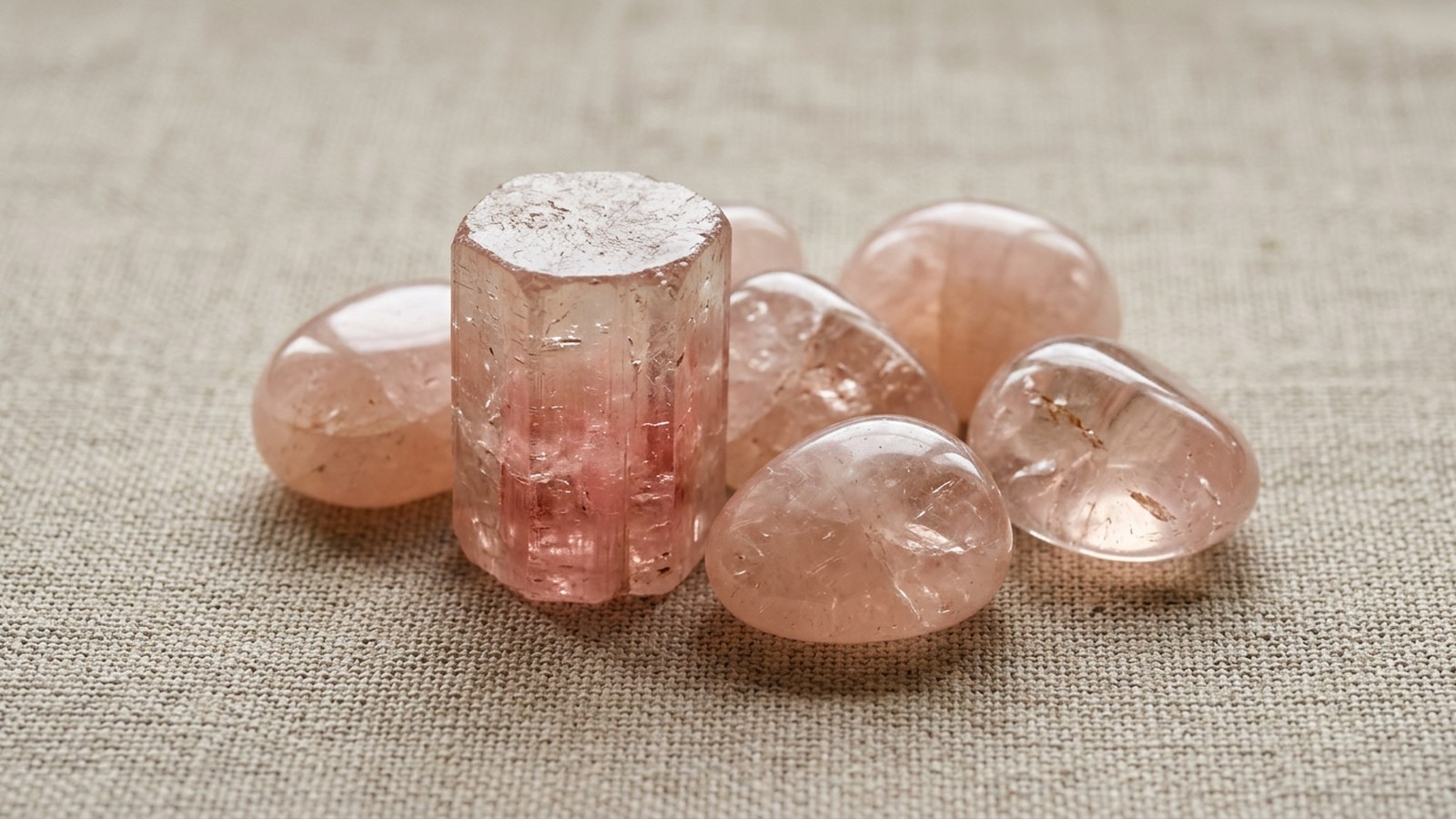
The first morganite I held properly was a rough crystal from Minas Gerais, about the size of a matchbox, with a flat six-sided top and a colour so pale it looked like watered rosé until I turned it on its side. Seen down its length, it warmed to a clear peachy pink. I remember being surprised by how heavy and cool it felt, and by how calm it seemed next to the louder pinks on the same tray.
That quietness is a fair summary of how morganite is used in crystal practice. It is a gentle heart stone, worked with for tenderness, self-kindness and steadier relationships, and it also happens to be a durable gemstone that people now choose for engagement rings. Because it sits in both worlds, the questions people ask about it are a mix of the spiritual and the practical: what morganite means, whether it is valuable, whether you can wear it every day, and which month it belongs to. I will answer all of them here, along with its real geology and history.
Morganite meaning, in short
Morganite is the pink to peach variety of the mineral beryl, the same species as emerald and aquamarine. In crystal tradition it is known as a stone of compassion and "divine love", linked to the heart chakra and used for self-love, emotional healing and softening old defences in relationships. It was named in 1910 after the financier J.P. Morgan. It is hard (7.5 to 8 on the Mohs scale), colour-stable in daylight and well suited to daily jewellery.
Reasons to work with morganite
Morganite is a stone for the stretch after a hard season with someone you love. When a relationship has been through strain and both people are trying again, the instinct is often to keep score. People who keep morganite close describe it as a reminder to speak more softly and to listen before defending, which is the slow work repair actually needs.
Morganite is a companion for self-criticism. If the voice in your head is harsher with you than you would ever be with a friend, this is one of the stones tradition offers for loosening that habit. Its energy is usually described as patient and forgiving, closer in feeling to rose quartz than to the more intense pink of rhodochrosite. It appears in my guide to crystals for self-love for that reason.
Morganite is often chosen during grief and change. Some people carry it after a breakup, a bereavement or a move away from family, when the heart feels bruised and they want something small and steady in a pocket. It sits naturally alongside the stones in crystals for grief, as a gentle presence to hold while time does its work.
Morganite is a stone for caregivers. Nurses, parents of small children and anyone who looks after an ageing relative tend to give warmth outward until there is little left. Morganite is said to help you receive care as well as give it, which is why I often suggest it to people who are very good at looking after everyone except themselves.
Morganite meaning: healing energy
Emotional healing
Emotionally, morganite is associated with tenderness and with letting go of resentment. It is said to ease the guardedness that builds up after a disappointment, so that you can stay open without feeling exposed. Many practitioners place it in the hand during a few slow breaths when an old hurt resurfaces.
Spiritual healing
Spiritually, morganite is called a stone of divine or unconditional love, the idea being that it connects personal affection to a wider sense of compassion. In meditation it is used to rest attention in the centre of the chest, and some people describe its presence as quiet and spacious rather than stirring.
Mental healing
On the mental side, morganite is linked to patience and to clearer thinking during emotional moments. When you are tempted to send a message you will regret, it is the kind of stone people hold for a minute first. Much of what people value in the stone comes from that pause.
Physical healing
Traditional lore connects morganite with the heart and lungs and with stress held in the chest. This is folk tradition and personal experience, not medical advice: a stone cannot treat a heart, lung or circulatory condition, and any such symptoms deserve a doctor.
Morganite at a glance
- Chakra: heart (some writers add the crown)
- Zodiac signs: Libra most often, also Taurus and Pisces
- Element: water
- Numerical vibration: 2 in several numerology tables (lists disagree)
- Affirmation: "I am open to giving and receiving love gently."
Morganite geology: what the stone really is
Morganite is beryl, a beryllium aluminium silicate with the formula Be3Al2Si6O18. It crystallises in the hexagonal system and typically forms short, stubby six-sided prisms with flat ends, quite different from the long, slender crystals of aquamarine. Its hardness is 7.5 to 8, its lustre is vitreous and its refractive index is low, around 1.58 to 1.59, which is why a faceted morganite looks soft and glowing rather than fiery.
The pink colour comes from traces of manganese (Mn2+) in the crystal structure. Many crystals also carry a yellow or orange component, which produces the peach and salmon shades. Morganite is pleochroic, so the colour shifts slightly with viewing direction: paler pink from the side, stronger pink when you look down the length of the crystal, as I saw in that first Brazilian piece.
It grows in granite pegmatites, the coarse, late-crystallising pockets of granite that are rich in rare elements. Morganite in particular tends to occur in pegmatites rich in lithium and caesium, which is why it is found alongside kunzite, lepidolite, pink and green tourmaline, quartz and albite. Many morganites contain caesium, and older texts call them "caesian beryl".
The beryl family shares one formula and many colours. Green beryl coloured by chromium or vanadium is emerald (my peridot vs emerald guide covers it), blue beryl is aquamarine, yellow is heliodor, colourless is goshenite, and the rare red beryl from Utah's Wah Wah Mountains is sometimes sold as "red morganite", though it is a separate variety coloured by trivalent manganese. "Blue morganite" is a marketing name for aquamarine, and "pink emerald" is an old trade name for morganite itself. A deep raspberry stone found in Madagascar in 2002 was first taken for caesium-rich morganite and turned out to be a new mineral, pezzottaite.
Morganite history and lore
Pink beryl was already known from the pegmatites of Pala, California, in the early 1900s, but fine material was scarce. In 1910 a new locality in Madagascar produced large, clean pink crystals, and on 5 December 1910 George Frederick Kunz, Tiffany's chief gemmologist, proposed the name morganite at a meeting of the New York Academy of Sciences. He named it for his friend and client J.P. Morgan, whose gem collections went to the American Museum of Natural History in New York and to the museum in Paris. Kunzite, the lilac spodumene from the same kind of lithium pegmatites, had been named in his honour in 1903.
The most famous single crystal is the Rose of Maine, found on 7 October 1989 at the Bennett Quarry in Buckfield, Maine. It measured about 23 cm long and weighed, with its matrix, just over 23 kg.
Because the name is barely a century old, every spiritual meaning attached to morganite is modern, shaped by twentieth and twenty-first century crystal writers who read its soft pink as a heart colour. Beryl as a species has a much older story. Pliny the Elder described beryls cut as six-sided cylinders, and clear beryl was polished for scrying stones and early reading lenses, which is why the German word for spectacles, Brille, comes from beryllus. Morganite became a jewellery-shop staple only after about 2010, when rose gold and pink engagement rings came into fashion.
Is morganite valuable, and can you wear it every day?
Morganite is rarer than aquamarine, but it is mined steadily enough that it remains far more affordable than emerald or fine pink sapphire. Price depends mostly on colour: stronger, purer pinks and larger clean stones cost much more per carat than pale peach ones. It is a valuable gem in the sense of being genuine and durable, though it is seldom an investment stone.
You can wear morganite every day. At 7.5 to 8 it is harder than the quartz dust in ordinary household grime, so it resists scratching well, and it has only weak cleavage. Two things matter more than hardness in practice. First, morganite readily picks up a film of skin oil and lotion, and because its brilliance is modest, a greasy stone quickly looks dull and cloudy, which is the most common complaint about morganite rings. A quick wash every week or two solves it. Second, a hard knock against a door frame can still chip an edge, so a protective setting such as a bezel or a halo is worth considering for a ring you will wear constantly.
How to tell if morganite is real
Most morganite on the market is heated, usually to a few hundred degrees, to remove the yellow component and leave a cleaner pink. This is standard, permanent and normally undisclosed, and it is accepted in the trade. The stones to watch for are imitations.
- Glass looks similar but often shows round bubbles under a loupe and feels softer and warmer on the skin.
- Pink cubic zirconia is far more fiery, with rainbow flashes morganite rarely shows, and feels noticeably heavier.
- Rose quartz, kunzite and pink topaz can be mislabelled. Kunzite fades in sunlight and has strong cleavage; topaz is heavier.
- Lab-grown pink beryl exists and can only be separated reliably by a gem laboratory.
For anything expensive, ask for a report from an independent lab. My guide on how to tell if a crystal is real covers the general home checks.
Where morganite comes from and how to care for it
The main sources today are Brazil (especially Minas Gerais), Madagascar, Mozambique, Afghanistan, Pakistan and Namibia, with smaller historical production in California and Maine. If provenance matters to you, ask the seller which country and mine a piece came from; a good dealer will know.
Caring for morganite is easy. Clean it in warm water with a drop of mild soap and a soft toothbrush, rinse and dry. Ultrasonic and steam cleaners are usually safe for clean stones but should be avoided if the stone has visible fractures. Keep it away from strong heat, including a jeweller's torch, which can alter the colour. Unlike kunzite, morganite does not fade in daylight, so a sunny windowsill is fine for a raw crystal. It is safe in water (see crystals and water safety), and any of the methods in my guide to cleansing crystals will suit it, from smoke to sound to moonlight. Store it apart from softer stones, which it can scratch, as explained in how to store crystals.
Living with morganite
If you are drawn to morganite, I would start with a small tumbled stone or a modest raw crystal, kept somewhere you will touch it daily. Pair it with rose quartz for a soft heart-centred combination, or with clear quartz if you like a brighter feel. You will find more heart stones in crystals for love and on the love intention page. Whatever you choose, let the stone be a cue to treat yourself and others a little more gently, which is the part of its meaning that holds up best over time.