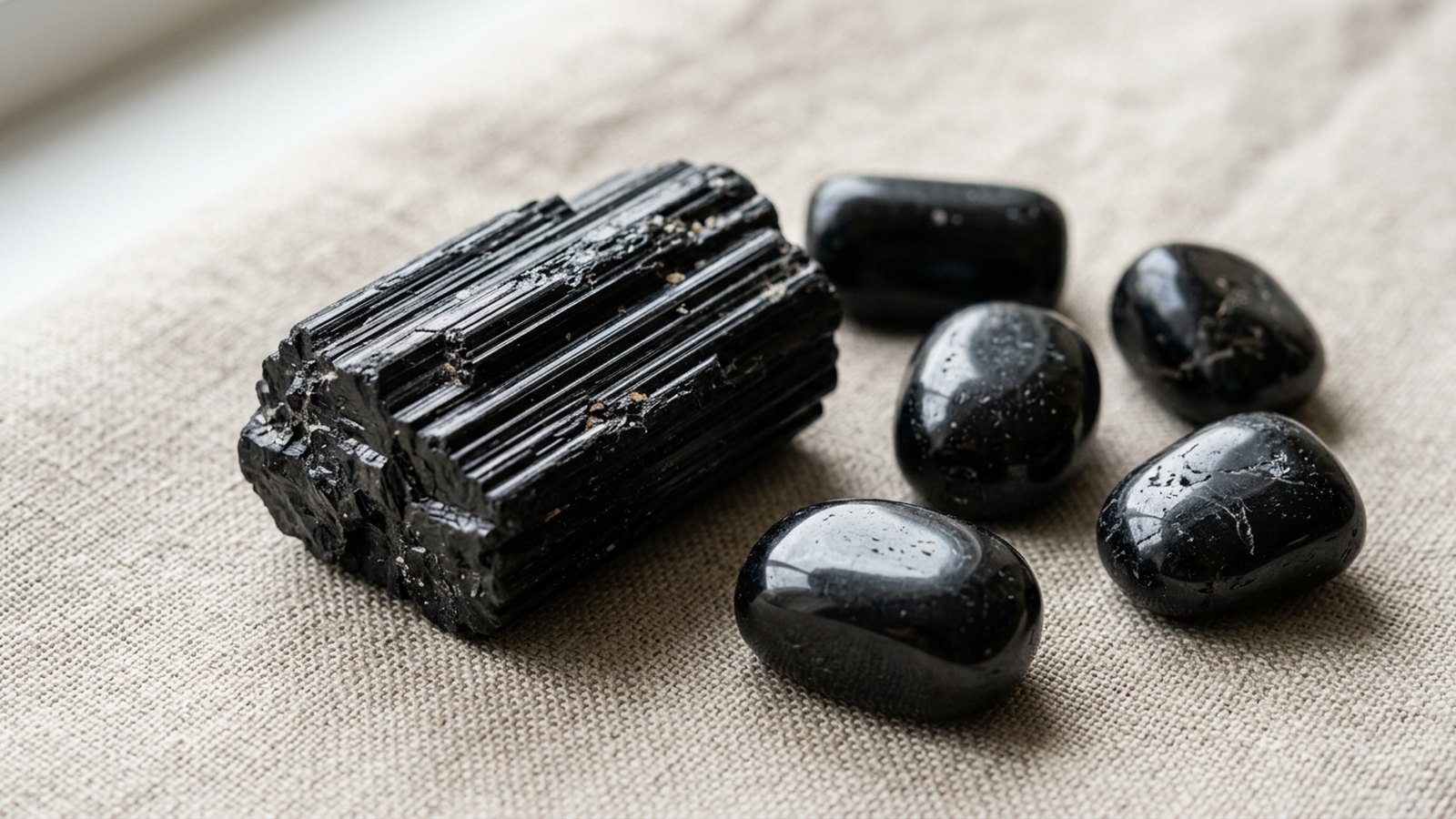
The piece that made me take this pairing seriously is a small matrix specimen on my bookshelf. It is a pale grey-brown quartz point, slightly cloudy at the base, with three black, finely grooved tourmaline prisms growing straight out of the same rock beside it. Nobody glued them there. They formed in the same pocket of cooling granite, and when I hold it I am holding the pair the way the earth assembled it, long before anyone strung the two onto a bracelet.
Black tourmaline and smoky quartz are the most common grounding duo in crystal practice, and they turn up together in protection bracelets, doorway bowls and pocket pouches everywhere. In this guide I explain what each stone actually is, why they so often grow side by side in nature, what tradition asks each of them to do in the pair, the ways I use them, what the combination is not for, how to buy them honestly and how to keep them in good condition.
The short answer
Black tourmaline (the mineral schorl, an iron-rich boron silicate) and smoky quartz (silicon dioxide coloured brown-grey by natural radiation) pair well and safely. Both sit at about 7 on the Mohs scale, so they can share a bracelet or a pouch without scratching each other, and they often crystallise together in the same granite pockets. In crystal tradition both belong to the root chakra: black tourmaline is read as the stone that keeps outside pressure out, and smoky quartz as the one that helps you settle what you are already carrying. Together they make a strong grounding and protection pair, best suited to stretches when you feel both exposed and wound up.
Two stones that grow in the same pocket
This pairing has a geological basis, which goes a long way to explain why the two stones feel coherent together.
Both form late in the life of a granite. As a granite body cools, the last fluids it releases are rich in water, boron and other elements that did not fit into the main rock. They collect in cavities and in the coarse, gem-bearing veins called pegmatites. Boron is the ingredient tourmaline needs, so schorl crystallises there as long black prisms with grooves running down their length. Quartz crystallises in the same pockets, often around or over the tourmaline, which is why you also find black needles trapped inside quartz points.
The smoke in the quartz comes from the same setting. Granite contains small amounts of radioactive potassium, uranium and thorium. Over millions of years, that low natural radiation acts on traces of aluminium sitting in the quartz structure and creates colour centres that absorb light, turning clear quartz brown, grey or, in the dark variety called morion, nearly black. So the rock that supplies the tourmaline's boron is often the same rock that supplies the quartz's colour.
The best-known locality for the pair is the Erongo Mountains in Namibia, where shiny schorl sprays and smoky quartz come out of the same cavities, and Brazil's pegmatites in Minas Gerais produce them together as well. If you search for "smoky quartz with black tourmaline", many of the results are these natural specimens. I find that knowing this changes how I hold a bracelet of the two: it is the bead version of something that already exists.
What each stone does in the pair
I find the two most useful when I keep their traditional roles distinct, so here is how tradition divides the work.
| Black tourmaline | Smoky quartz | |
|---|---|---|
| Mineral | Schorl, NaFe3Al6(BO3)3Si6O18(OH)4 | Quartz, SiO2 |
| Hardness | 7 to 7.5 | 7 |
| Look | Opaque black, grooved along the length | Translucent brown to grey |
| Weight | Dense, specific gravity about 3.1 to 3.2 | Lighter, about 2.65 |
| Traditional role | Boundary, protection, deflection | Settling, release, steady calm |
| Chakra | Root | Root |
| Main care point | Brittle across the prism | Colour bleaches with heat |
Black tourmaline is the boundary stone of crystal tradition. People reach for it when they feel permeable, when a workplace, a crowded commute or a difficult relative leaves them feeling as if other people's moods have soaked in. It also has a real physical oddity: tourmaline is pyroelectric, so a crystal develops a small electrical charge when its temperature changes. Eighteenth-century Dutch traders noticed warmed tourmaline pulling ash towards it and called it the ash puller. The pyroelectric effect is measurable physics, and the protective meaning that grew up around it belongs to tradition, which is how I present it.
Smoky quartz has the gentler reputation. In practice it is the stone for what is already inside: the tension you bring home, the busy head at night, the worry that keeps looping. Its translucence matters to me here, because a smoky quartz point held up to a lamp glows a warm amber, and I find that a softer thing to sit with than a block of pure black.
Put together, one stone covers what comes in and the other covers what has already built up. Both pull towards stability, so the two reinforce each other. That is welcome when stability is what you need, and it can feel heavy on other days.
Ways I use the pair
- A mixed bracelet for difficult days. Because the hardness is matched, alternating beads on one strand do not wear each other down, which is less true of many popular pairs. Some people like to wear grounding stones on the left wrist, the side tradition calls receptive; my guide to which hand to wear a crystal bracelet goes through the reasoning.
- Door and room. The classic placement puts black tourmaline near the front door or the window facing the street, and smoky quartz in the room where you unwind, beside the sofa or on the bedside table. More layouts are in where to place crystals in your home.
- One in each hand for a short sit. When I come home over-stimulated, I sit for five minutes with tourmaline in one palm and smoky quartz in the other, feet flat on the floor, and breathe slowly. The weight difference is noticeable and gives my attention something simple to rest on. Meditating with crystals covers this kind of practice in more detail.
- Desk pair. Tourmaline sits near the screen and smoky quartz within reach of my hand, to pick up when I notice my shoulders creeping up.
- Anchor points in a grid. In a protection grid, black tourmaline works well at the outer points and a smoky quartz point at the centre. The method is in crystal grids for beginners.
What this pairing is not for
One of the most visible search results for this pair is a Reddit thread asking which of the two helps with depression. I want to answer that plainly. Neither stone treats depression, anxiety or any other health condition. If you are struggling with low mood that lasts, please talk to a doctor or a mental health professional. A stone in your pocket can sit alongside that care as a reminder to breathe and slow down, and that is the honest scale of what it offers. My guide to crystals for anxiety treats that question with more care.
The pair also suits some situations better than others. It fits people in high-contact jobs who come home drained, and people who find most crystal aesthetics too sweet. It fits less well if what you are missing is lift, warmth or motivation. Two grounding stones together can feel flat on a day when you already feel low. In that case I swap one of them for something lighter: rose quartz softens black tourmaline well, and smoky quartz and amethyst is a calmer, more airy pair. If you want a third stone that keeps the same direction, hematite sits naturally between them.
People often ask what not to pair with either stone. No crystal tradition I trust forbids specific combinations with black tourmaline or smoky quartz on energetic grounds. The real conflicts are physical. A soft stone such as selenite, calcite or fluorite on the same strand or loose in the same pouch will be scuffed by both, which is the practical point behind black tourmaline and selenite. I go through the wider question in what crystals should not be together.
Buying them honestly
Smoky quartz is often irradiated in a laboratory. Clear quartz is exposed to radiation to produce a dark, very even colour, sometimes followed by gentle heating to adjust the tone. The result is still quartz with the same kind of colour centre that natural radiation creates, so I treat it as a disclosed treatment, and a good seller will mention it. Very uniform, near-black beads at a low price are usually treated. Natural smoky quartz tends to show gentle shifts in colour and sometimes faint banding.
With black tourmaline the usual issue is substitution. Black glass, dyed black agate (sold as onyx) and obsidian can all end up labelled tourmaline in bead bins. On rough pieces, the grooves running along the length of the crystal are the giveaway. On beads, weight helps: tourmaline is noticeably denser than glass or agate, so two beads of the same size feel different in the hand. Tourmaline beads are also rarely perfectly glassy; they often show tiny pits and lines. My guide on how to tell if a crystal is real has more simple checks.
Caring for both
The internet disagrees about whether smoky quartz fades in the sun. My reading of the evidence is that natural smoky quartz is fairly light-stable in ordinary use, and that heat is what really removes the colour: a few hundred degrees will bleach it completely, which is how some "citrine" is made. I still keep it off a hot south-facing sill, because a summer of sun on glass delivers both heat and ultraviolet, and treated material can be less stable than natural.
Black tourmaline is hard but brittle. Raw pieces are often bundles of columns that shed small black flecks and snap across the prism if dropped, so I keep them apart from softer stones and away from the edge of a shelf. Both stones tolerate a quick rinse in lukewarm water and a soft cloth; avoid ultrasonic cleaners, which can open existing cracks in tourmaline. For energetic cleansing, sound, smoke or moonlight suit both. Cleansing crystals, crystals and water safety and how to store crystals cover the details.
A last word
When I want to feel steadier, I come back to this pair more than any other, partly because of what it represents to me: two minerals that grew in the same granite pocket, one keeping its shape and the other taking its colour from the rock around it. If you are building a small set for grounding or protection, I would start here, give each stone its own job, and pay attention to how the combination actually feels over a week or two. You can also explore both on their stone pages, black tourmaline and smoky quartz, or read the wider guide to crystals for protection.
The meanings described here reflect crystal tradition and personal experience. They are not medical or psychological advice and do not replace professional care.