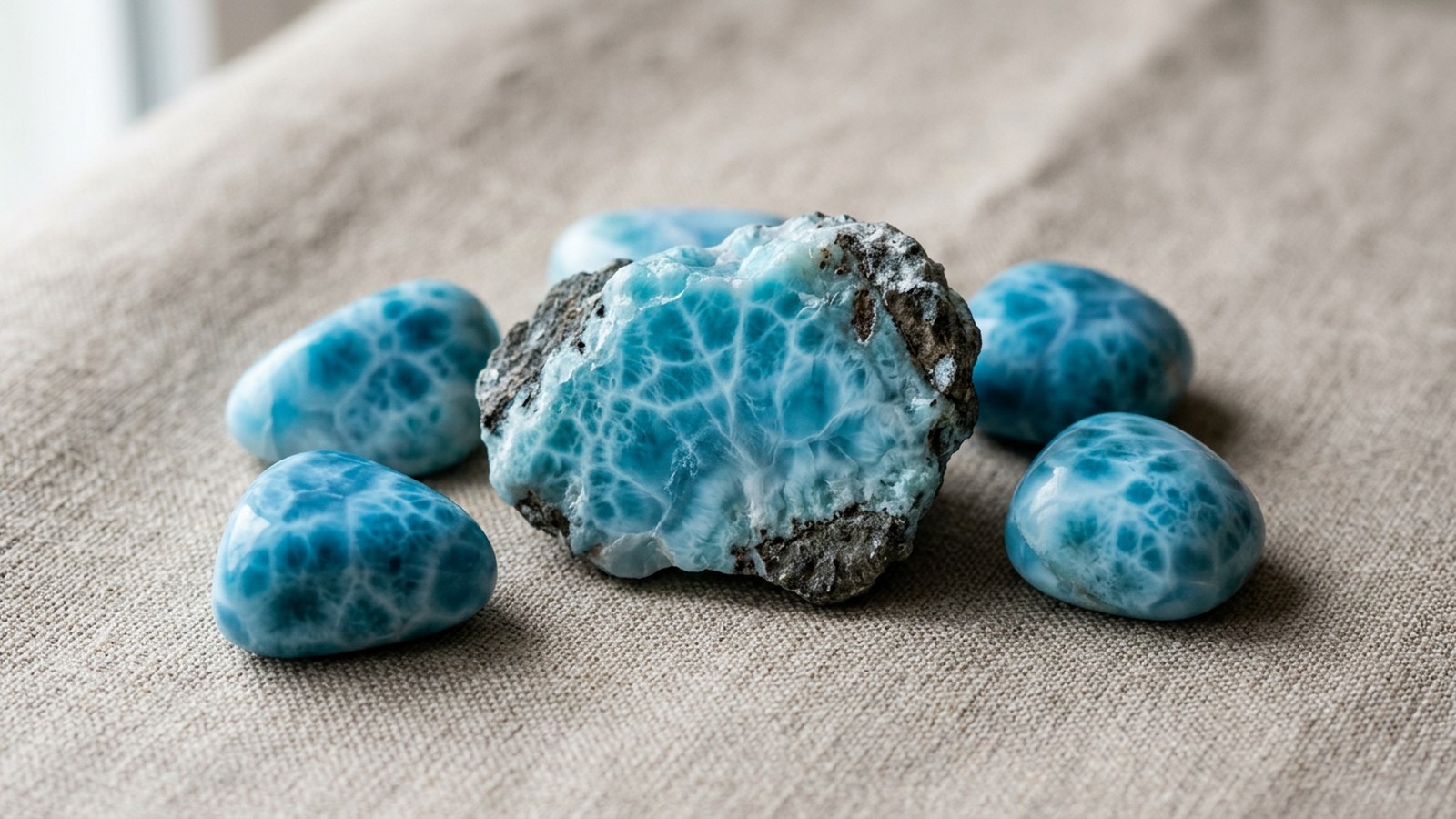
The first piece of larimar I ever held was a small oval cabochon on a market table in Santo Domingo, set in plain silver and priced higher than anything around it. The seller tipped it toward the window so I could see the pattern move: pale sky blue at the edges, a deeper blue toward the centre, and fine white lines running through it like light on the floor of a shallow bay. It felt cool and slightly soapy under my thumb. I did not buy that one, and I thought about it for a week, so the next time I went back I did.
Larimar is a blue variety of the mineral pectolite, and as far as anyone knows it comes from a single mountainside in the southwest of the Dominican Republic. In crystal tradition it is a stone of calm, of clear and gentle speech, and of emotional cooling when feelings run hot. This guide covers what larimar means in that tradition, what it actually is as a mineral, where the name and the Atlantis story come from, why good pieces cost what they do, how to tell real larimar from the imitations, and how to look after a stone that is softer and more light sensitive than most people expect.
What Is Larimar?
Larimar is the trade name for blue pectolite, a sodium calcium silicate that in most of the world grows white or grey. Only in the Barahona province of the Dominican Republic does it form in shades from pale sky blue to deep "volcanic" blue, usually marbled with white. It is opaque, polishes to a soft glassy shine, and sits at about 4.5 to 5 on the Mohs scale, which makes it noticeably softer than quartz.
Because the supply comes from one small mining area, worked largely by hand, larimar is genuinely scarce, and that scarcity shapes everything from its price to the number of imitations on the market.
Reasons to Work With Larimar
Larimar is a stone for the conversation you keep putting off. In modern crystal practice it is tied to the throat chakra, and most people I know who wear it do so before a difficult talk: telling a manager they are overloaded, raising something tender with a partner, or speaking at a funeral. The tradition holds that it helps words come out calmly and kindly. I read it as a physical reminder to breathe before answering, which in my experience makes the first sentence of a hard conversation easier to get right.
Larimar is a stone for people who run hot. Its oldest metaphysical theme is cooling: anger, frustration and the kind of stress that sits in the jaw and shoulders. If you are the person who replies to the email too quickly, a piece on your desk or around your neck is a small, steady cue to wait. For the wider picture, my guide to crystals for anxiety covers the stones I pair it with.
Larimar is a stone for rest after caring for others. Many practitioners describe it as a nurturing, quietly feminine stone, and it is popular with carers, teachers and parents who give attention all day and need a way to set it down in the evening. I keep one on my bedside table in heavy weeks, partly for the tradition and partly because the colour itself is restful to look at.
Larimar Meaning and Healing Energy
Emotional healing. Larimar is traditionally used to soothe irritation and lift the weight of worry, especially worry that comes out as short temper. Its sea imagery suggests tides, and that is how people tend to use it: as something to hold while a strong feeling rises and falls.
Spiritual healing. In New Age writing larimar is linked to the divine feminine, to the energy of water and to a sense of connection with the sea. Some practitioners use it in meditation for the heart chakra as well as the throat, to bring what is felt and what is said into the same place.
Mental healing. It is associated with clear, unhurried thinking, the state where you can see a problem without panicking about it. That makes it a reasonable companion for study or for planning a hard week, used alongside the practical work itself.
Physical healing. Folk tradition links larimar to the throat, to tension in the neck and shoulders, and to cooling of inflammation. This is traditional lore and not medical advice: a stone does not treat any condition, and anything physical deserves a proper consultation.
- Chakras: Throat, with Heart as a secondary
- Zodiac signs: Leo and Pisces are the signs most often given
- Element: Water
- Numerical vibration: books disagree, so I leave it open rather than repeat a number I cannot trace
- Affirmation: "I can speak calmly and let my feelings move through me."
Larimar Geology: What the Stone Really Is
Pectolite has the formula NaCa2Si3O8(OH) and crystallises in the triclinic system, typically as fibrous, needle-like sprays. That fibrous structure is what gives larimar its texture, a faint silky chatoyance in good pieces and the soft, cloudy pattern in most of them.
The Dominican material formed in cavities and veins inside volcanic rock, mostly altered basalt, in the Bahoruco mountains above the coast of Barahona. When the lava cooled, gas bubbles left voids, and hot mineral-rich fluids later moved through the rock and filled them with pectolite. The main mining area is known as Los Chupaderos. Larimar usually comes out as nodules and seams, often with concentric bands of blue and white and a rim of dark host rock. Red or brown dendrites in some pieces are iron oxides, and pieces that keep a strip of the dark host rock are sold as "larimar with matrix".
The blue is usually attributed to copper substituting into the pectolite structure. Gemmological studies have discussed other trace elements, vanadium among them, so I treat copper as the common explanation and keep in mind that the colour chemistry is less settled than vendor pages suggest. What is well documented is that the colour is natural and not a surface treatment, and that it can fade with long exposure to strong light and heat.
The name is recent. In 1974 Miguel Méndez, a local resident, and Norman Rilling, a Peace Corps volunteer, found blue stones on the beach and traced them up the Bahoruco River to their source. Méndez combined the first letters of his daughter Larissa's name with mar, the Spanish word for sea.
Larimar History and Lore
The first written record is older than the name. In November 1916 a Barahona priest, Father Miguel Domingo Fuertes Loren, applied to the Dominican authorities for permission to explore and mine the blue rock he had found. Nothing came of it, and the stone stayed unknown outside the area for almost sixty years. Local people had long picked up the sea-worn pebbles that washed down the river, and some called them "blue stones" thought to come from the sea itself.
Larimar is often called the Atlantis stone, and many websites say the American psychic Edgar Cayce predicted its discovery. I have looked for this, and the claim rests on later interpretation. Cayce's readings speak of Atlantis and the Caribbean, but none of the published readings name larimar or pectolite. I mention it because you will see it everywhere, and I would rather you knew where the story stands. The other nickname, the dolphin stone, comes from the same sea imagery and from the stone's popularity with people who feel a bond with ocean animals.
Since the 1980s Dominican artisans have built a whole jewellery trade around larimar, almost always set in silver, and the stone has become something of a national emblem. It is one of the few crystals whose modern metaphysical meaning grew up at the same time as its commercial life, which is worth knowing when you read claims of "ancient" use.
Why Is Larimar So Expensive?
Price follows three things. The first is supply: one known deposit, steep terrain, and mining done mostly by hand in narrow shafts. The second is yield: cutters estimate that only a small share of the rough, often quoted at around one tenth, is good enough for fine jewellery. The third is colour, which works like this in practice:
- Volcanic blue: deep, saturated blue with crisp white veining, the most sought after
- Sky blue: clear mid-blue, the grade you meet most often
- Green-blue: a turquoise-leaning shade with more pale pectolite showing
- White-dominant: mostly white with soft blue clouds, gentle and much cheaper
A clean, readable pattern with good contrast can matter as much as depth of colour, and pieces without cracks or heavy matrix command more. If a large, deep blue cabochon is priced like a tumbled stone, that is your first warning.
How to Tell Real Larimar From a Fake
Because larimar sells well, imitations are common: dyed howlite or magnesite, blue glass, resin, and reconstituted stone made from larimar dust bound with plastic. These checks help, and my wider guide on how to tell if a crystal is real covers the general method. If your question is whether a blue stone is larimar or turquoise, I compare the two side by side in larimar vs turquoise.
- Look at the pattern under magnification. Real larimar shows a fibrous, slightly feathery texture where blue meets white. Dyed stones show colour pooled in cracks, and glass shows bubbles and a too-even surface.
- Feel the temperature. Natural stone stays cool in the hand for a while. Resin and plastic warm up almost at once and feel light for their size.
- Check the price and the source. Every known source of real larimar is in the Dominican Republic, so a seller who cannot name the origin, or who offers deep blue pieces cheaply in quantity, is worth walking away from.
- Test discreetly with acetone, on an inconspicuous spot. If a cotton bud picks up blue, the stone is dyed. Do this only on a piece you already own.
Cleansing, Activating and Caring for Larimar
Larimar is soft and light sensitive, so the usual "leave it in the sun" advice does it harm. My routine is short:
- Cleansing. Smoke from a herb bundle, a singing bowl, or an hour resting on a selenite or clear quartz piece all work. A quick rinse in lukewarm water with a drop of mild soap is fine for cleaning, dried straight away with a soft cloth. Skip salt, long soaks and anything acidic. My guide to crystals and water safety explains why.
- Recharging and activating. Use moonlight rather than sunlight, or simply hold the stone and set an intention for the conversation or the week ahead. I talk through the options in how to charge crystals. "Activating" in most traditions means exactly that: giving the stone a clear purpose and returning to it.
- Daily care. Keep it out of direct sun, away from radiators, car dashboards and hot baths, and store it apart from harder stones that would scratch it. Pendants and earrings suit it better than everyday rings. No ultrasonic or steam cleaners.
For pairings, smoky quartz adds weight and steadiness to larimar's lightness, and aquamarine shares its sea imagery while being far harder for daily wear. If you love the colour but not the price, blue lace agate carries a similar calm, throat-centred tradition, and chrysocolla offers a copper blue with its own story.
Who Larimar Suits, and Who It Suits Less
Larimar suits people who want a gentle stone for speech and calm, who like wearing their crystals, and who will look after a soft gem. It suits less well anyone after a rugged pocket stone to carry daily alongside keys, or someone who wants to work with sunlight rituals. For the broader set of stones around speaking and listening, see crystals for communication and the throat chakra page.
A Last Word
My larimar pendant still lives in a drawer away from the window, and I put it on for the days when I know I will need to choose my words. Each time I touch it, it reminds me to slow down and to speak from somewhere quieter, and the rest of the work stays with me. If that is what you are looking for, I think you will like it as much as I do.