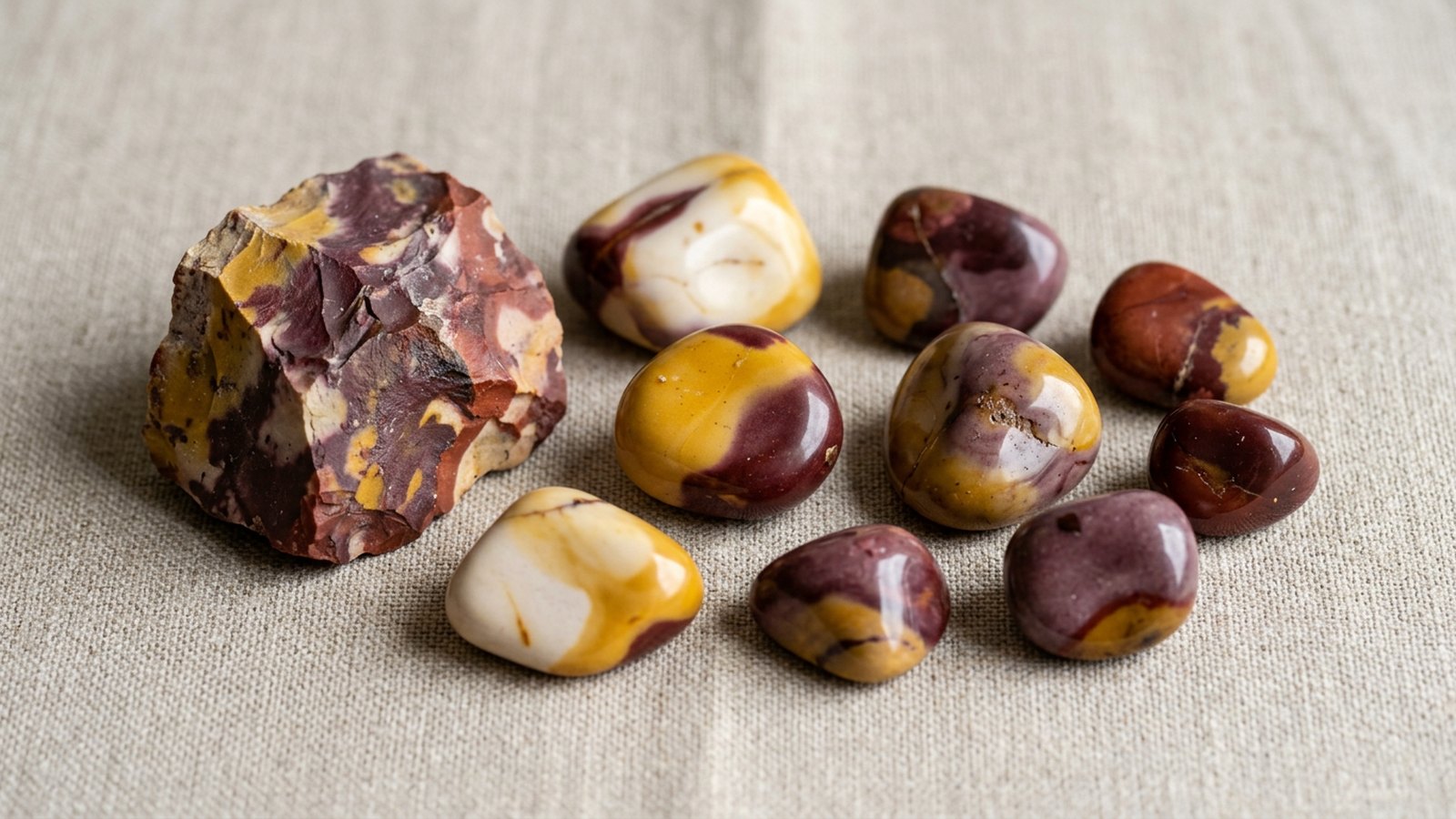
The first piece of mookaite I owned came out of a bowl of tumbled stones at a mineral fair, and I picked it because I could not decide what colour it was. One side was the deep plum of a bruised fig, the other a creamy mustard yellow, and between them ran a blurred band of brick red. It was warm from sitting under the stall lights and heavier than it looked. I carried it home in a coat pocket and it has lived on my desk ever since, through two house moves and one change of career.
Mookaite is an Australian stone from a single small region of Western Australia, sold in the crystal world as mookaite jasper. In crystal tradition it is a grounding stone for people in the middle of change: it is associated with steadiness, practical courage and a willingness to try new things, which is why so many people describe it as a stone for an "ageless spirit". This guide covers that traditional meaning, then the real geology (which is more interesting than most pages admit), the history of the name, what mookaite costs, and how to look after it.
What Is Mookaite?
Mookaite is a fine-grained, opaque silica rock found in the Kennedy Range area of the Gascoyne region of Western Australia, near Mooka Creek and the old Mooka Station, from which it takes its name. Its colours run from cream, white and mustard yellow through red, burgundy and mauve, usually several in one piece. Most sellers call it a jasper, and that is a fair everyday label, though geologists describe the rock more precisely as a silicified radiolarite, a sediment built from the silica skeletons of microscopic sea plankton. I explain what that means in the geology section below.
Reasons to Work With Mookaite
Mookaite is a stone for the middle of a transition. Most of the people I know who reach for it are somewhere in the long, unglamorous part of a change, after the old life has gone and before the new one feels comfortable. A smooth piece in the pocket during that stretch is, in the tradition, a reminder to keep both feet on the ground while things move around you.
Mookaite is a light, warm grounding stone. Some grounding stones, such as smoky quartz or black tourmaline, feel to me like a hand pressing down. Mookaite feels warmer and more lively, closer to the energy of red jasper with a little more colour in it. It is a good one to try if you want to feel settled and still alert, and it appears among the stones on our grounding crystals page.
Mookaite is associated with practical courage. In crystal tradition it is linked to the courage of doing the next sensible thing, such as making the phone call or signing up for the course. I wrote about this kind of everyday bravery in my guide to crystals for courage, and mookaite sits well alongside the stones there.
Mookaite is traditionally linked to vitality and an open, curious spirit. The "ageless spirit" idea that appears in almost every description of it refers to a willingness to keep learning and keep trying new experiences at any age. I like to keep a piece near me when I am starting something where I am a beginner again.
Mookaite is a decision-making companion. Many practitioners hold it while weighing options, on the idea that grounding first makes the choice clearer. I find that simply sitting with a stone in my hand for five quiet minutes slows me down enough to think, and mookaite is pleasant to hold.
Mookaite Meaning and Healing Energy
Emotional healing
Emotionally, mookaite is associated with steadiness during upheaval: moving house, changing jobs, a relationship ending or beginning. It is often recommended for people who feel scattered, or who keep postponing a decision because every option feels risky.
Spiritual healing
Spiritually, mookaite is described as a stone of connection to the Earth and to place. Because it comes from one landscape, many people use it to feel more at home in their own body and surroundings. It is a common choice for nature-based meditation and for anyone who wants their spiritual practice to stay practical.
Mental healing
On the mental side, the tradition links mookaite to clear thinking under pressure and to curiosity. Some people keep it on their desk during study or a demanding project, much as others use red jasper for stamina.
Physical healing
In crystal lore mookaite has been linked to vitality, stamina and recovery, and some sources tie it to the immune system. These are traditional associations, not medical claims, and no stone replaces care from a doctor or a qualified practitioner.
Mookaite at a glance
- Chakras: Root, Sacral and Solar Plexus
- Zodiac signs: most often Virgo and Scorpio
- Element: Earth
- Numerical vibration: 9, in the numerology lists that assign one
- Affirmation: "I stay steady while my life changes, and I am open to what comes next."
Mookaite Geology: A Fossil Sea in Your Hand
Mookaite comes from a rock unit geologists call the Windalia Radiolarite, part of the Carnarvon Basin in Western Australia. It was laid down in the Early Cretaceous, roughly 110 to 120 million years ago, on the floor of a shallow sea that then covered the area.
Radiolarians are single-celled marine organisms that build tiny, intricate skeletons out of silica. When they died, their skeletons sank and piled up as a fine silica-rich ooze mixed with clay. Over millions of years that sediment was buried, compacted and cemented by silica, and it became a hard, fine-grained rock. In technical writing you will see it called radiolarite, porcellanite or chert, depending on how thoroughly it was silicified. Under a microscope some pieces still show the round ghosts of the radiolarians, and some specimens contain other small fossils.
The colours come from iron. Hematite gives the reds and burgundies, goethite and limonite the yellows and browns, and the purples and mauves come from finely dispersed iron oxides in different states. The cream and white areas are where little iron got in. Because the colour was set by groundwater moving through the rock long after it formed, no two pieces are the same.
A few useful facts for the collector:
- Composition: mostly silica (SiO2) as microcrystalline quartz, with clay and iron oxides
- Hardness: about 6.5 to 7 on the Mohs scale for well-silicified material, a little softer in chalky pieces
- Structure: no crystal faces; it is a rock, made of grains too small to see
- Lustre: dull in the rough, a soft waxy shine when polished
Is it a jasper? In the gem trade "jasper" means any opaque, fine-grained silica rock, and mookaite fits that loose definition, which is why the name mookaite jasper has stuck. Strictly speaking, its origin from plankton skeletons makes it a radiolarite, a kind of chert. If you enjoy these naming puzzles, my guide to jasper vs agate explains where the boundaries sit, and both ocean jasper and Dalmatian jasper are further examples of stones sold as jasper that a geologist would name differently.
History and Lore of Mookaite
Mookaite is a young stone in the crystal trade. The rock is ancient, but it was only collected and sold widely from the late twentieth century, when Australian lapidaries began cutting it and it found its way into the crystal healing books of the 1990s and 2000s. You will read online that mookaite was set in gold for medieval lords and ladies. I have found no evidence for that, and given that the stone comes from a remote corner of Western Australia that European miners did not work until modern times, I treat it as a story borrowed from some other gem.
The name comes from Mooka Creek and Mooka Station, a pastoral property near the Kennedy Range, inland from Carnarvon. Many sources say "mooka" is an Aboriginal word meaning "running waters". It is a lovely idea and it fits the springs of the area, but I have not been able to trace it to a published language source, so I pass it on as a widely repeated meaning without vouching for it. The Kennedy Range itself lies on Aboriginal country with a long history of its own, older than any mineral trade.
Within modern crystal practice, mookaite became known as the stone of the "ageless spirit" and of adventure, and it is often given to people starting a long journey. That makes it a natural companion for the stones in my guide to crystals for travel.
How Much Does Mookaite Cost, and Is It Real?
Mookaite is one of the more affordable stones on the market. As a rough guide from what I see in shops and at fairs, small tumbled stones usually sell for a few dollars each, palm stones and worry stones for roughly 10 to 30 dollars, and polished spheres, towers and large free-forms from about 30 dollars up to a few hundred for big, richly coloured pieces. Strong purple and deep red with sharp contrast against yellow tend to command the higher prices.
Because it is inexpensive, outright fakes are uncommon, and the useful questions concern origin and dye:
- Origin. True mookaite comes from Western Australia. You will sometimes see "Brazilian mookaite" or unlabelled red and yellow jaspers sold under the name. They may be perfectly nice stones, but they are a different material. Ask the seller where it was mined.
- Dye. Unnaturally bright pink, blue or green is not natural mookaite. Its natural palette stays within creams, yellows, reds, browns and purples.
- Glass and resin. These feel lighter and warmer in the hand, and may show bubbles. My guide on how to tell if a crystal is real covers the simple checks.
How to Use Mookaite
- Carry it in a pocket or wear it as a bracelet during a period of change. Tumbled stones are smooth and hard enough to handle every day.
- Hold it in meditation, resting it near the base of the spine or on the lower belly, to work with the root and sacral chakras.
- Keep it on your desk when you are learning something new or working through a long project.
- Pair it with carnelian for creative courage, or with smoky quartz when you want a calmer, more settled feel. My guide to crystals for new beginnings has more ideas for fresh starts.
Caring for Mookaite
Mookaite is a forgiving stone. Well-silicified pieces are hard enough to rinse under lukewarm water and wipe with a soft cloth, and the colours do not fade in daylight. Two cautions apply. Softer, chalky pieces can be slightly porous, so I avoid long soaks and keep them away from oils and perfume. And I never leave mookaite in salt water, which can dull a polish over time. My guide to crystals and water safety explains why.
For energetic cleansing, any of the gentle methods in my cleansing crystals guide work well: smoke, sound, moonlight or a short rest on a selenite plate. If you like to make crystal water, use the indirect method with the stone in a separate glass container, as with any rock that may contain clay or iron.
Closing Thoughts
When I hold my old mookaite now, I think about the hundred million years it took a sea floor full of plankton to become a stone small enough for my pocket. That long, slow change is what I like best about it, and it is the quality people have come to associate with the stone. If you are in the middle of a change yourself, it is a good stone to keep close, and if you want a companion, red jasper offers the same earthy steadiness in a single colour.