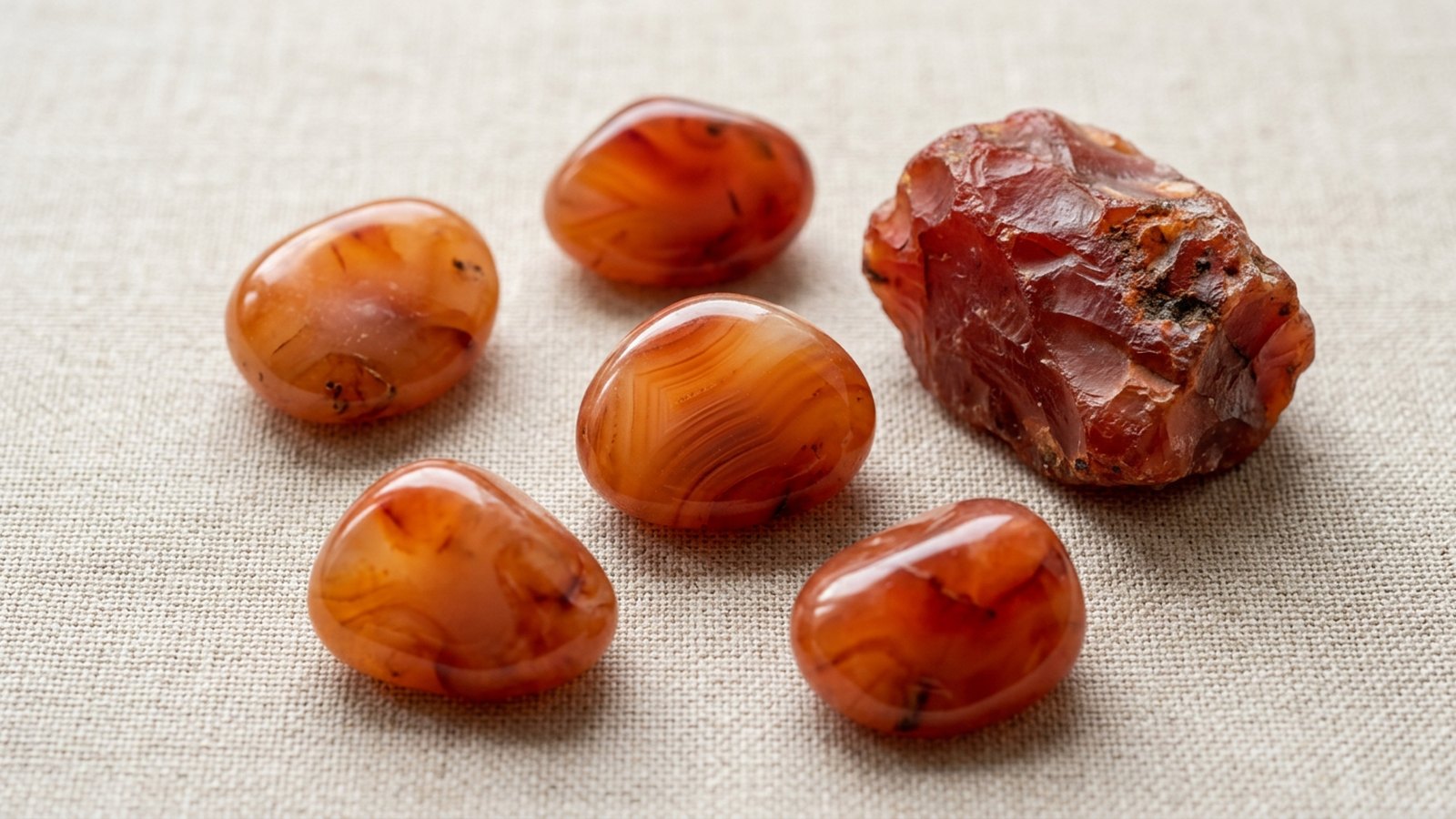
The stone I carried into the hardest conversation of my working life was a small, slightly lopsided piece of carnelian, about the size of a thumbnail. I had to tell a manager I respected that a project we had both championed was failing, and that I thought it should stop. I rehearsed the speech for days. On the morning itself I put the carnelian in my left pocket, and every time my courage drained away in the corridor I pressed my thumb into it and walked a few more steps. I did the talking in that meeting, and the stone stayed in my pocket the whole time as a small, solid reminder of the decision I had made the week before.
That is how I think about crystals for courage. Courage shows up differently depending on what you are afraid of: the fear of starting something, the fear of speaking, the fear of a person, the fear your body feels before a needle or a ladder. So this guide sorts the traditional courage stones by the kind of fear in front of you, with how I use each one, who it suits less well, and a frank word on what a stone can and cannot do.
The short answer
The stones most often named for courage are carnelian, tiger's eye and bloodstone. In crystal tradition carnelian is the stone for taking the first frightening step, tiger's eye for staying steady under pressure, and bloodstone for standing your ground with another person. Red jasper, sunstone and aquamarine complete the list for physical fear, being seen and speaking up. All of them are worked with in the same simple ways: carried in a pocket, worn against the skin, or held for a minute before the moment that scares you, as a cue for a decision you have already made.
Courage, confidence and strength are three different needs
People search for these three words as if they were one, and most shop pages sell the same red and gold stones under all three labels. I find it useful to keep them apart, because the right stone changes with the need.
Confidence is a belief about yourself: I can do this, I deserve to be here. It grows slowly, mostly from evidence. If that is your gap, my guide to crystals for confidence is the better starting point.
Strength, in the sense most people mean, is staying power: keeping going through a long, draining stretch. I wrote about it at length in crystals for strength.
Courage is narrower and more immediate. It is acting while you are still afraid. The psychologist Stanley Rachman, who studied bomb-disposal operators and others in dangerous work for his book Fear and Courage, described courage in exactly those terms: carrying on with an action in the presence of fear. He also observed that courage tends to grow with practice, through repeated small exposures that go well. You can feel no confidence at all and still be courageous for the ten minutes that matter. That is the need this guide answers.
Stones for six kinds of fear
When you have to start: carnelian
Some fears live entirely at the threshold. Sending the application, booking the first lesson, telling a partner you want to move abroad. Once you have begun, the fear usually shrinks; the hard part is the first push.
Carnelian is the stone I reach for here. It is a translucent orange to red chalcedony (microcrystalline quartz) coloured by iron oxides, and it has been carved into seals and amulets since ancient Egypt. In modern crystal practice it is tied to the sacral chakra and to momentum, action and creative nerve. I hold it while I write the first sentence of the email I am afraid to send, then I send it before I put the stone down. If your fear sits in starting, you may also find my crystals for motivation and crystals for new beginnings guides useful.
Who it suits less: people who are already running on adrenaline. If you tend to leap too fast, carnelian's traditional fire may feel like more of what you have.
When you have to speak up: aquamarine
For many people the frightening moment is a voice one: asking for a raise, raising a concern in a meeting, giving a toast, saying "that hurt me" out loud.
Aquamarine, the pale blue beryl long nicknamed the sailor's stone, is linked in tradition to calm seas and the throat chakra. I like it for speaking courage because its energy, as I experience it, is cooling: it suits the shaky, dry-mouthed kind of fear more than a timid one. It is also hard (7.5 to 8 on the Mohs scale), which matters for a pendant worn close to the throat every day. My crystals for communication guide goes further into the stones of the voice.
Who it suits less: if your trouble is getting your energy up at all, aquamarine may feel too quiet.
When you have to stand up to someone: bloodstone
Facing a person is its own kind of fear: a difficult relative, a colleague who talks over you, a landlord, a bully. The fear here is about the relationship and what it might cost you.
Bloodstone is dark green chalcedony scattered with red spots of iron oxide. Pliny the Elder described it under the name heliotrope, and medieval Christian legend said the red spots were drops of Christ's blood fallen on green stone at the crucifixion. Through the centuries it gathered a reputation as a warrior's and a defender's stone, and crystal tradition still treats it as the stone of moral courage, the courage to do the right thing when it is uncomfortable. It is linked to the root chakra and to Aries, the sign ruled by Mars. I keep a bloodstone in my hand during the minutes before a confrontation and write down, in one line, what I need to say. Holding the stone, I read the line twice.
Who it suits less: someone who needs softness more than spine. If the conversation is about grief or reconciliation, a heart stone may serve you better.
When the fear lives in your body: red jasper
Some fears are almost purely physical. The dentist's chair, a blood test, driving again after an accident, climbing a ladder, getting on a plane. The mind knows the situation is safe, and the body still tenses up and wants to leave.
Red jasper is the stone tradition gives to the body: an opaque brick-red quartz rock coloured by hematite, heavy, matte and warm in the hand. It is associated with the root chakra and with steadiness and endurance. When the fear is physical, I want a stone with weight to it, something I can grip during a procedure without worrying about chipping it. A tumbled red jasper is ideal for that. I pair holding it with slow breathing, four counts in and six out, which has real physiological support for calming the stress response. The stone gives my hands something to do while the breathing does its work. If you are unsure which red stone to choose, I compared them in carnelian vs red jasper.
Who it suits less: people who feel heavy already. If your fear makes you freeze rather than panic, try carnelian first.
When you have to hold steady under pressure: tiger's eye
There is a particular fear that arrives in the middle of a test: the job interview, the exam, the driving test, the presentation where someone asks the question you did not prepare for.
Tiger's eye is my companion for that one. It is quartz grown through a fibrous mineral, which gives it the moving band of light gemmologists call chatoyancy, and most of it comes from South Africa. Many writers repeat that Roman soldiers carried it into battle; I have never found a solid historical source for that, so I hold the story lightly. In modern practice tiger's eye belongs to the solar plexus chakra and to clear thinking under stress. I wear it on a bracelet so that I can see it, and I use the shifting light as a cue: when I notice it, I take one breath before I answer. That single breath is often enough to let me answer clearly. Read the full tiger's eye monograph for its geology and lore.
Who it suits less: someone whose fear is slow and diffuse, spread over weeks. In my experience tiger's eye helps most with short, sharp moments.
When you have to be seen: sunstone
The last fear is visibility: posting your work, performing, dating again, walking into a room full of strangers. It is often mixed with shame, the worry of being judged.
Sunstone is a feldspar filled with tiny reflective platelets of hematite or copper that make it glitter from inside. Tradition links it to joy, warmth and personal light, and it is one of the few courage stones whose energy is described as openly playful. I like it for social courage precisely for that reason: it reminds me that being seen can be enjoyable, too. Sunstone is softer than the others (6 to 6.5) and has cleavage, so I keep it as a pocket stone or a pendant rather than a ring that will knock against tables.
Who it suits less: someone in genuine danger from being seen. In that case safety comes first, and no stone changes that.
How I actually use a courage stone
I treat the stone as a cue that anchors a commitment, a habit I build on purpose. Rachman's observation that courage grows with successful practice shapes how I do it.
- Name the fear in one line. "I am afraid to tell my sister I am not coming for the holidays."
- Pick one stone from the list above that matches the kind of fear. One is enough.
- Build a small ladder. Write three or four steps, from the easiest to the real thing: draft the message, read it aloud, send it.
- Hold the stone for each step. A minute is enough. Say a short line, such as "I can be afraid and do this anyway."
- Carry the stone on the day itself, in a pocket or on the body, and touch it right before the hard moment.
- Afterwards, write down what happened. The note builds the evidence that later becomes confidence.
When you finish, rinse or cleanse the stone in whatever way you prefer, and keep it for the next ladder. My guide to carrying and wearing stones covers pockets, pendants and bracelets in more detail.
Which courage stones survive being carried
A courage stone usually lives in a pocket with keys and coins, so durability matters more than most lists admit.
| Stone | Mohs hardness | Everyday carry | Watch out for |
|---|---|---|---|
| Carnelian | 6.5 to 7 | Excellent | Dyed agate sold as carnelian |
| Tiger's eye | 7 | Excellent | Very little |
| Bloodstone | 6.5 to 7 | Excellent | Dyed green stones |
| Red jasper | 6.5 to 7 | Excellent | Very little |
| Aquamarine | 7.5 to 8 | Good as a pendant | Price, glass imitations |
| Sunstone | 6 to 6.5 | Pocket or pendant | Cleavage, chips on impact |
| Hematite | 5.5 to 6.5 | Fragile | Shatters when dropped; magnetic "hematite" beads are synthetic |
Garnet, another traditional stone of perseverance, sits around 6.5 to 7.5 and travels well. Black tourmaline, which some lists include for protection while you face a fear, is hard but can split along its length if raw.
Can two courage stones be carried together?
One of the most asked questions is which crystals cannot be put together. I have never found a pairing that is truly forbidden; the cautions are mostly physical, such as soft stones scratched by hard ones in the same pouch. Energetically, carnelian with tiger's eye is a classic duo, action plus steadiness. If two stones together feel like too much, take one out. I wrote more on this in what crystals should not be together.
What a stone can and cannot do
A crystal cannot remove fear, and I would not trust anything that promised to. What I have seen it do, in my own life and in the people I have shared stones with, is serve as a physical anchor for a decision, a reminder you can touch when your nerve wavers. That is real and it is modest.
If fear is stopping you from leaving the house, working or sleeping, or if it comes with panic attacks, please talk to a doctor or a therapist. Anxiety disorders respond well to treatment, especially to graded exposure, which is the clinical cousin of the ladder above. A stone can sit beside that work. You will find gentler stones for that state in my crystals for anxiety guide, and all the stones in this guide on the crystals for courage page.
Choosing yours
If you only buy one, choose carnelian for starting, tiger's eye for moments of pressure, or bloodstone for people. Then choose the one small, frightening thing you will do while you hold it.