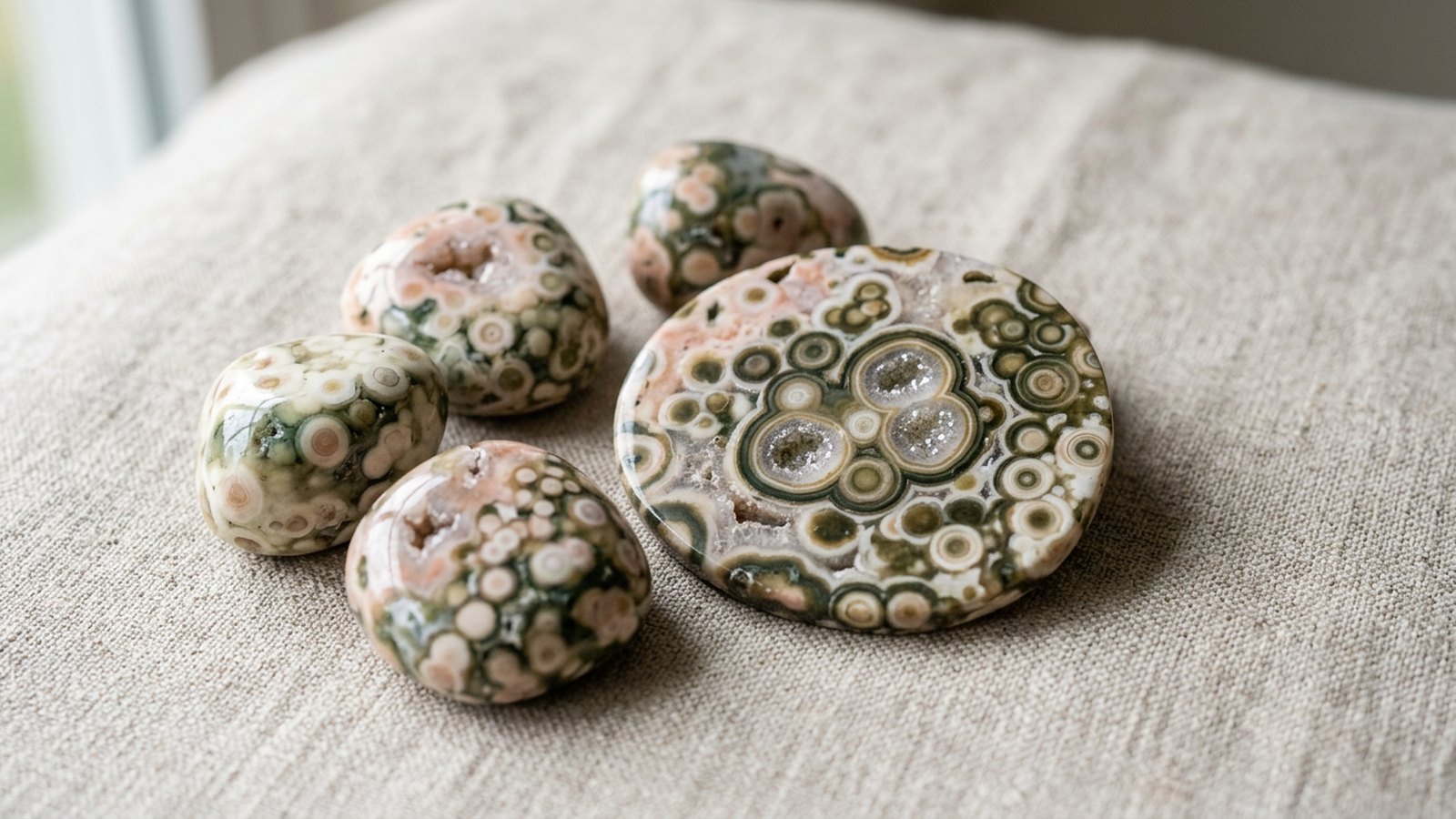
The first ocean jasper I owned was a flat, palm-sized slice with a cream background and a cluster of small green and pink circles near one edge. Each circle had a darker ring around it, and a few of them held a tiny pocket of sparkling crystal at the centre, like a drop of water that had set solid. I kept it on my desk for months and caught myself tracing the rings with a fingertip whenever a phone call went on too long.
That habit is probably the best summary of the stone. In crystal tradition, ocean jasper is a patient, cheerful companion, associated with joy, with going at the pace life actually moves, and with looking after yourself as kindly as you would look after someone else. It suits people who are carrying a lot, who get impatient with their own progress, or who have forgotten how to enjoy an ordinary day.
In this guide I will share what the stone means in tradition, what it really is geologically (the question of whether it is a true jasper comes up constantly), how it was found on a tidal coast in Madagascar, and how to tell real ocean jasper from the dyed look-alikes that fill online shops. If you only need the quick facts, they are on the ocean jasper stone page.
Reasons to Work With Ocean Jasper
Ocean jasper is a stone for long, tiring stretches. When you are caring for a child, a parent or a demanding project, the tradition says it helps you keep a steady rhythm and to rest before you are empty. I reach for it in the weeks that are full of small tasks and short on sleep.
Ocean jasper is a stone for rediscovering small pleasures. Many people call it the joy stone, and the name fits the way its colours feel in the hand: soft greens, pinks and creams that seem to lift a grey room. If your low mood feels flat and colourless, it pairs naturally with the ideas in my guide to crystals for happiness.
Ocean jasper is a stone for patience with yourself. The orbs grew slowly, ring after ring, and the traditional reading borrows that image: change that happens in cycles, the way tides come in and go out. People working through habits, recovery or a slow creative project often keep a piece close for that reason.
Ocean jasper is a stone for kind, honest speech. Because it is linked to both the heart and the throat, it is used when you need to say something difficult without hardening yourself. My guide to crystals for communication goes further on that theme.
Ocean Jasper Meaning and Healing Energy
Emotional Healing
Emotionally, ocean jasper is said to soften pent-up irritation and resentment and to replace them with a calmer, more generous mood. Many practitioners use it for inner child work: when an old hurt surfaces, the stone is held as a reminder to answer it with the patience a good parent would offer. If worry is your main struggle, it sits gently alongside the stones in my guide to crystals for anxiety, and it belongs among the crystals for self-love as a steady, undemanding option.
Spiritual Healing
Spiritually, the circles are read as a symbol of connection: every ring touches the next, and every orb sits inside a larger pattern. Ocean jasper is traditionally linked to service, to being useful to your community, and to the idea that small good actions repeated over time matter as much as big gestures. It is a lovely stone to hold in meditation when you are working with gratitude.
Mental Healing
On the mental level, the tradition credits it with helping you tell apart what you can change and what you cannot, and with easing the loop of overthinking that comes with impatience. I find it useful on a desk during slow, detailed work, where the goal is to keep going at a sustainable pace.
Physical Healing
Crystal healers associate ocean jasper with stamina, digestion and recovery after illness. This is traditional lore and intuition, not medical advice: a stone can be a comforting reminder to rest, and it should never replace care from a doctor.
Chakras: Heart, Solar Plexus and Throat, with some sources adding the sacral chakra Zodiac signs: Leo and Capricorn in many traditions, while other writers favour the water signs Element: Water by association with the sea, though some systems list Earth, as with most jaspers Numerical vibration: 6 Affirmation: "I move at my own pace, and I meet each day with patience and joy."
The disagreement over element and zodiac is worth naming openly. Ocean jasper only entered the crystal world around the year 2000, so its correspondences are recent and still settling. If one reading resonates with you more, trust it. My chakra crystals guide explains how these associations are usually built.
Ocean Jasper Geology
So, is ocean jasper a real jasper? Strictly speaking, it sits just outside the definition. Jasper in the gemmological sense is an opaque, impure form of chalcedony, the microcrystalline variety of quartz (my red jasper guide and my comparison of jasper and agate describe it in detail). Ocean jasper is better described as a silicified volcanic rock, often called an orbicular rhyolite, whose original minerals have been largely replaced and cemented by chalcedony and quartz. Its chemistry is therefore mostly silicon dioxide (SiO2) with iron and other trace elements providing the colour, and the trade name has stuck because it looks and wears like jasper.
The orbs are spherulites. When a silica-rich volcanic glass or gel begins to crystallise, fibres can grow outward from a single seed point in every direction at once, building a sphere. Pauses and changes in the fluid chemistry leave concentric rings in different colours. Later, silica-rich water filled the gaps, and where the centre of an orb stayed hollow, small quartz crystals grew inside it, which is where the sparkling druzy pockets come from.
The stone is opaque to slightly translucent at thin edges, takes a bright polish, and sits at about 6.5 to 7 on the Mohs scale, with no cleavage. The colour range is wide: white, cream, green, yellow, pink, red, brown, grey and, more rarely, blue or purple, often with several colours in one piece. The name "orbicular" comes from the Latin orbiculus, a small disc or little circle.
History of Ocean Jasper
The history is short and well documented. Collectors' accounts trace a first written mention of orbicular stone from the Madagascar coast to the 1920s, after which the exact location was forgotten. In the late 1990s, Paul Obenich of Madagascar Minerals spent weeks searching the northwest coast for it, and he finally found the outcrop near the village of Marovato once he understood the role of the tide: the veins were only exposed at low water and could only be reached by boat.
He introduced the material at the Tucson Gem and Mineral Show in 2000 under the trademarked name Ocean Jasper, and it quickly became one of the most loved ornamental stones of the new century. The original workings were reported as largely depleted by the mid-2000s. Later finds reopened the market, including material sold as "8th Vein" and ocean jasper from a separate deposit sold under the name Kabamby. Each vein has its own palette, which is why collectors often ask where a piece came from.
The alternative names you will meet come from the trade. "Sea jasper" is used for similar orbicular material from the same coastline, sometimes for different veins, and "Atlantis stone" is a purely poetic name with no historical basis.
How I Use Ocean Jasper
My own routine with this stone is simple and easy to repeat, and you can adapt it freely.
- Morning. I hold a palm stone for a minute before opening my messages and set one intention for the day, usually something modest such as finishing one task properly.
- During the day. A tumbled piece sits next to my keyboard. When I notice my shoulders rising or my patience thinning, I pick it up and trace a single orb from the outside ring to the centre while I take three slow breaths.
- Difficult conversations. Before a call I expect to be tense, I rest the stone over the centre of my chest for a moment and think about what I actually want the other person to hear.
- Evening. I put it back on the shelf next to a plant and name one thing from the day that went well. It sounds small, and that small nightly habit is where the joy stone reputation makes the most sense to me.
A little ocean jasper also works well in a shared space. Families sometimes keep a bowl of tumbled pieces where children can pick one up, because the patterns invite touch and each stone looks different.
Real Ocean Jasper or a Fake?
Because ocean jasper is famous and supply comes and goes, look-alikes are common. My general guide on how to tell if a crystal is real applies here, and these points are specific to this stone:
- Look for real orbs. Genuine spherulites have rings that follow the round shape, sometimes with a darker rim, and they cluster, overlap and vary in size. Printed or painted circles tend to be flat and uniform.
- Check the druzy. Tiny sparkling crystal pockets at the centre of some orbs are a good sign of natural material.
- Be wary of neon colours. Very bright blue, turquoise, purple or hot pink beads are usually dyed. So is most "sea sediment jasper", which is dyed and often reconstituted stone sold under a confusingly similar name.
- Know the relatives. Poppy jasper from California is a genuine orbicular jasper with red and yellow orbs, and ocean wave or sci-fi jasper can look similar. Kambaba jasper, with dark green circles, is a stromatolite, a fossilised colony of algae, and forms in a completely different way.
- Ask for the origin. A seller who can name Madagascar, and ideally the vein, is usually handling the real thing.
As for the rarest colour, there is no official scale. Most collectors I know prize deep red orbs, true natural blue, and purple tones, along with pieces where bright orbs sit against a clear or translucent background. Pale cream and green material is the most common, and it can be just as lovely.
Where to Keep Ocean Jasper and How to Care for It
Where you keep it depends on what you want from it. A tumbled stone in a pocket or a bead bracelet keeps it close through a long day (my notes on carrying and wearing stones cover the practical side). A polished palm stone on a desk suits slow, detailed work. Larger slices and spheres look beautiful in a living room or a family space, where the tradition of community and care makes sense, and a small piece on a bedside table works for people who wind down by holding something. The shapes guide will help you choose between a sphere, a slice and a palm stone.
Care is simple. At 6.5 to 7 with no cleavage, it is durable enough for daily wear. A brief rinse under lukewarm water with a soft brush is fine, though druzy pockets trap dust and soap, so rinse them well and dry the stone fully. Avoid long soaks, salt water and harsh cleaners, especially on dyed or stabilised pieces, and see my guide to crystals and water safety for the details. For energetic cleansing, smoke, sound or moonlight all suit it (the full methods are in cleansing crystals), and I store my pieces as described in how to store crystals so harder stones do not scratch the polish.
Living With Ocean Jasper
Ocean jasper is one of those stones that rarely feels dramatic in the hand and slowly becomes part of the day, which may be exactly why people grow so fond of it. If you would like a grounding companion, red jasper adds steadiness, moss agate brings a similar green calm, and amazonite supports the throat side of its energy. Choose the piece whose orbs you keep coming back to, and let it remind you to go at your own pace.