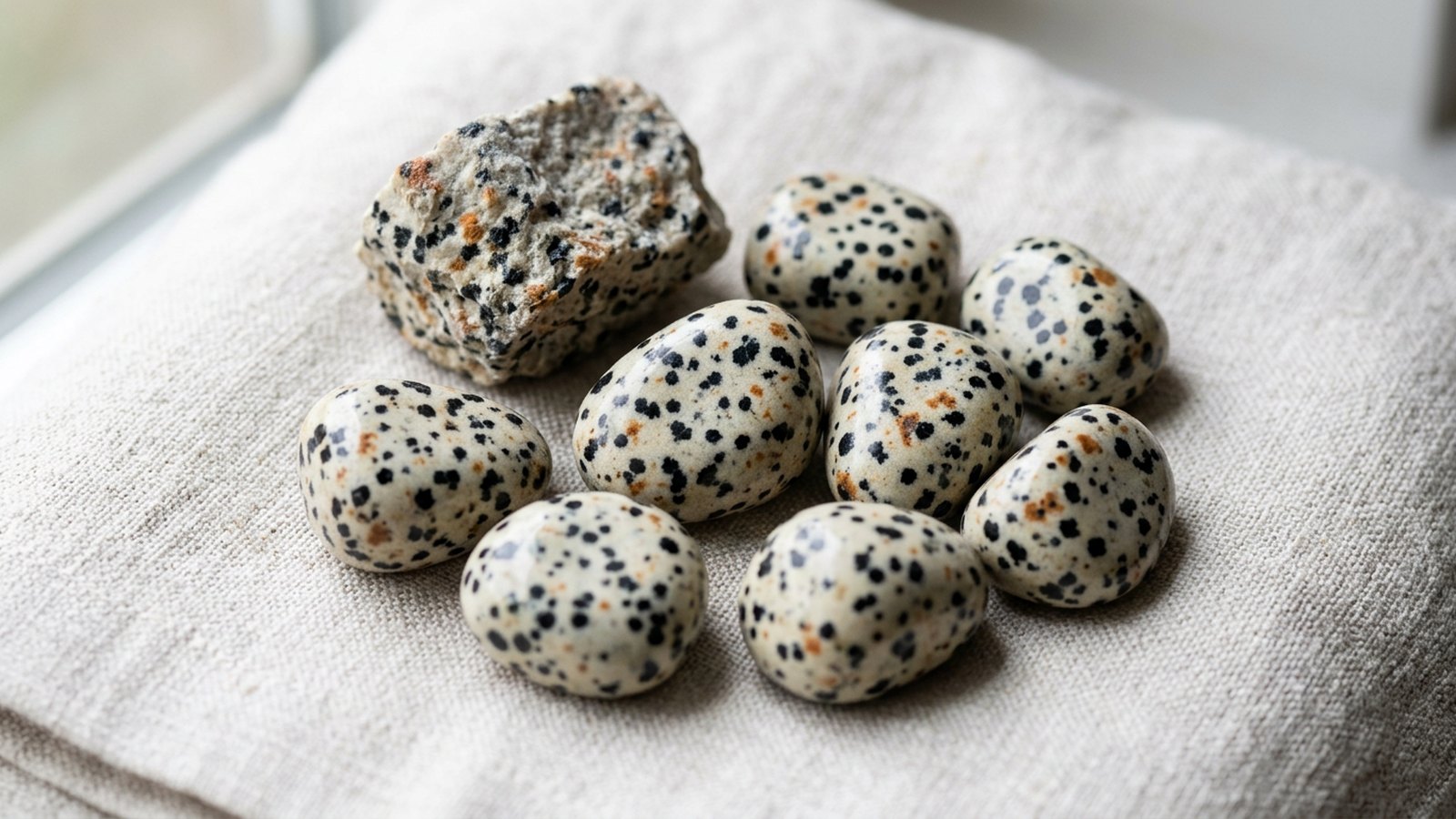
The first dalmatian jasper I owned was a palm stone the size of a hen's egg, creamy white and scattered with black freckles, and one rusty brown spot near the edge that I kept rubbing with my thumb as if it might come off. I bought it on a grey afternoon because it made me smile, which is not a very mineralogical reason, and it has lived on my desk ever since. People who pick it up almost always say the same thing: it looks like the dog.
Dalmatian jasper is one of the gentlest and most affordable stones in any crystal shop. In crystal tradition it is a grounding stone with a light heart, linked to play, loyalty, letting go of old grudges and finding your footing without taking life too seriously. It suits anyone who feels stuck in their head, anyone rebuilding a sense of fun after a hard stretch, and beginners who want an easy, sturdy stone to carry.
In this guide I cover what dalmatian jasper means in crystal work, the real geology behind those spots (the top search results disagree about it), where the name comes from, how rare it is, how to spot dyed pieces, and how to care for it.
What is dalmatian jasper good for?
In short, dalmatian jasper is traditionally used for grounding, lightheartedness and emotional release. It is associated with the root chakra, the Earth element and the sign of Virgo. Geologically it is a light-coloured igneous rock made mostly of feldspar and quartz, with black spots of a dark mineral usually identified as arfvedsonite. It comes almost entirely from Chihuahua, Mexico, and it is common and inexpensive.
Reasons to work with dalmatian jasper
Dalmatian jasper is a stone for people who have forgotten how to play. Long stretches of responsibility, caring for someone, or simply a demanding job can leave you efficient and a little flat. The tradition around this stone speaks of the inner child, and I find the image useful: a stone that invites you to do something for no reason other than enjoying it. I reach for mine on weeks when every hour has a purpose.
Dalmatian jasper is a grounding stone that does not feel heavy. Many root chakra stones, such as hematite or smoky quartz, have a dense, serious presence. Dalmatian jasper steadies you in a lighter way, which is why it is often suggested for children, teenagers and anyone who finds darker grounding stones a bit much.
Dalmatian jasper is linked to letting go of resentment. Several crystal writers describe it as helpful for releasing anger, jealousy or the wish to get even. If you keep replaying an old argument, holding the stone while you name what you are ready to put down is a simple ritual that gives the intention a physical anchor.
Dalmatian jasper is associated with loyalty and animals. Its spots have given it a long-standing link with dogs, and many people keep a piece near a pet's bed or carry one after losing a companion animal. I see it as a warm keepsake. Keep it out of reach of pets that chew, since a small tumbled stone is a choking hazard.
Dalmatian jasper meaning and healing energy
Emotional healing
Emotionally, dalmatian jasper is described as cheerful and forgiving. It is traditionally used when you feel bogged down by guilt, cynicism or a mood that has lasted too long, and it pairs naturally with the stones in my guide to crystals for happiness.
Spiritual healing
Spiritually, the stone is linked to protection and to staying present. Some practitioners treat the black spots as small anchors that keep your energy close to the body during meditation, which makes it a friendly companion for people new to grounding work.
Mental healing
On the mental side, tradition connects dalmatian jasper with steadier focus and less overthinking. It is often suggested for anyone who analyses every decision until it becomes impossible to make one.
Physical healing
Older crystal books link dalmatian jasper with the nervous system and general vitality. This is traditional lore and personal experience, not medical advice: a stone can accompany self-care, and it never replaces a doctor or therapist.
Dalmatian jasper properties at a glance
- Chakras: Root, sometimes sacral
- Zodiac: Virgo, also Gemini in some lists
- Element: Earth
- Numerical vibration: 5
- Affirmation: "I am steady enough to enjoy this moment."
Dalmatian jasper geology: what the spots really are
Dalmatian jasper is not a jasper. True jasper is an opaque, microcrystalline quartz (chalcedony) coloured by iron and other impurities, as I explain in jasper vs agate. Dalmatian stone is a rock, an igneous one, made of visible grains of several minerals. Under a loupe you can see this for yourself: the white body is slightly sugary and granular where a true jasper like red jasper looks smooth and uniform.
The pale matrix is mostly alkali feldspar (albite and microcline are the names that come up in analyses) with quartz. The black spots are the interesting part. Many shop pages say they are black tourmaline. The descriptions I trust most identify them instead as arfvedsonite, a sodium-rich amphibole, with aegirine reported in some pieces. Amphibole crystals are black, slightly glossy and elongated, and they tend to cluster into the round or rice-shaped spots you see. I would not rule out tourmaline in every stone, since the material is sold in large volumes from more than one pocket, but it is not the standard answer.
The rusty orange and brown spots come from weathering. Where the dark mineral breaks down, iron is released and oxidises into goethite and limonite, which stains the feldspar around it. A piece with plenty of brown halos has simply seen more weathering, and it is just as natural as a crisp black and white one.
A few practical numbers:
- Hardness: about 6 to 7 on the Mohs scale, with the feldspar around 6 and the quartz at 7
- Structure: granular, opaque, takes a good polish but can show tiny pits where grains plucked out
- Cleavage: feldspar has two good cleavage directions, so a hard knock on tile can chip an edge
- Main source: Chihuahua state, northern Mexico
Where the name comes from
The name refers to the Dalmatian dog breed and its spotted coat, and it is a trade name that became popular with bead and tumbled stone sellers from the late twentieth century onward. Some pages say the stone was first found in Dalmatia, the coastal region of Croatia. I have found nothing to support that. The breed's name comes from Dalmatia, and the stone's name comes from the breed.
You will also see it sold as dalmatian stone, dalmatian jasperite or spotted jasper. They all refer to the same Mexican material. Because it is so recent on the market, dalmatian jasper has no ancient lore of its own. Its traditions are modern ones, built from its look and from the older reputation of jaspers as protective, earthy stones.
What does jasper mean spiritually?
Across many cultures, jasper has been a stone of protection and endurance. Ancient Egyptians carved red jasper into amulets, including the tyet knot linked to Isis, and jasper is one of the twelve stones listed in the breastplate of the high priest in Exodus and among the foundation stones of the heavenly city in Revelation. Medieval lapidaries recommended it to travellers and to anyone facing a long effort. Modern crystal writers keep that thread and call jasper the supreme nurturer: a stone for steady energy, patience and staying whole under pressure. Dalmatian jasper inherits that reputation and adds its own note of play.
Is dalmatian jasper rare?
No. It is one of the most abundant stones in the trade, and tumbles, beads and palm stones usually cost only a few dollars. What varies is quality. The pieces I like best have a bright, even white base, well spaced black spots with sharp edges, and a smooth polish without too many pits. Large carvings and spheres with that look cost more, and even then they stay affordable.
How to spot dyed dalmatian jasper
Because the grainy feldspar soaks up colour easily, dalmatian jasper is often dyed blue, pink, purple, green or turquoise. Natural stone is white to cream, sometimes pale yellow, with black and rust-brown spots. Any bright colour is dyed. Look for colour pooling in cracks, pits and drill holes, a tint that is stronger at the surface than inside a chip, and dye that comes off on a damp cotton pad. Dyed pieces are fine to own as long as they are sold honestly, and my guide on how to tell if a crystal is real covers the wider checks.
Look-alikes
Snowflake obsidian is the inverse pattern: white spots on a black, glassy base, with a conchoidal fracture and a vitreous shine. Dyed howlite can look similar in bead strands, but its dark marks are thin grey veins in a web, never round spots. Some spotted jaspers and dotted feldspar rocks from other countries are sold under the same name; they behave the same way and are harmless, but it is worth asking the seller where the material comes from.
Who should wear jasper, and how to use dalmatian jasper
In crystal tradition, jasper suits people who want steadiness over excitement: anyone going through a long, tiring period, people who feel scattered, and anyone who wants a protective stone they can wear every day. Dalmatian jasper adds humour to that. It is a good first stone for children and teenagers, a thoughtful gift for a dog lover, and a calm companion for Virgos, who are said to over-plan.
Here is how I use it:
- As a bracelet or pocket stone. A bracelet keeps it in contact through the day; my notes on carrying and wearing stones apply here.
- In a short grounding practice. Hold a palm stone with both hands, feel its weight for a few breaths, and name one thing you want to do just for pleasure this week.
- On a desk or in a family room, where its cheerful look does half the work.
- With other stones. It sits well with black tourmaline for protection and with ocean jasper for joy. For a steadier mood, see crystals for balance.
If you are dealing with persistent anxiety, the stones in crystals for anxiety can be a gentle support alongside professional help.
Caring for dalmatian jasper
Dalmatian jasper is sturdy enough for daily wear, with a couple of cautions. Rinse undyed stones briefly under lukewarm water with a drop of mild soap and dry them straight away. Avoid long soaks and salt baths, because water and salt work into the grain boundaries and feldspar cleavage. Keep dyed pieces out of water and out of strong sun, since dye can bleed or fade. Store it apart from softer stones and away from diamonds or corundum, which will scratch it.
For energetic cleansing, smoke, sound or a night on a selenite plate are all safe choices. My guides to cleansing crystals and crystals and water safety go into each method.
A last word
I still pick up that first palm stone when my days get too earnest. Each time, it reminds me to look up from the work and enjoy something small. If that is what you need, dalmatian jasper is a kind and affordable place to start, and a piece of black tourmaline or red jasper beside it makes a steady little pair.