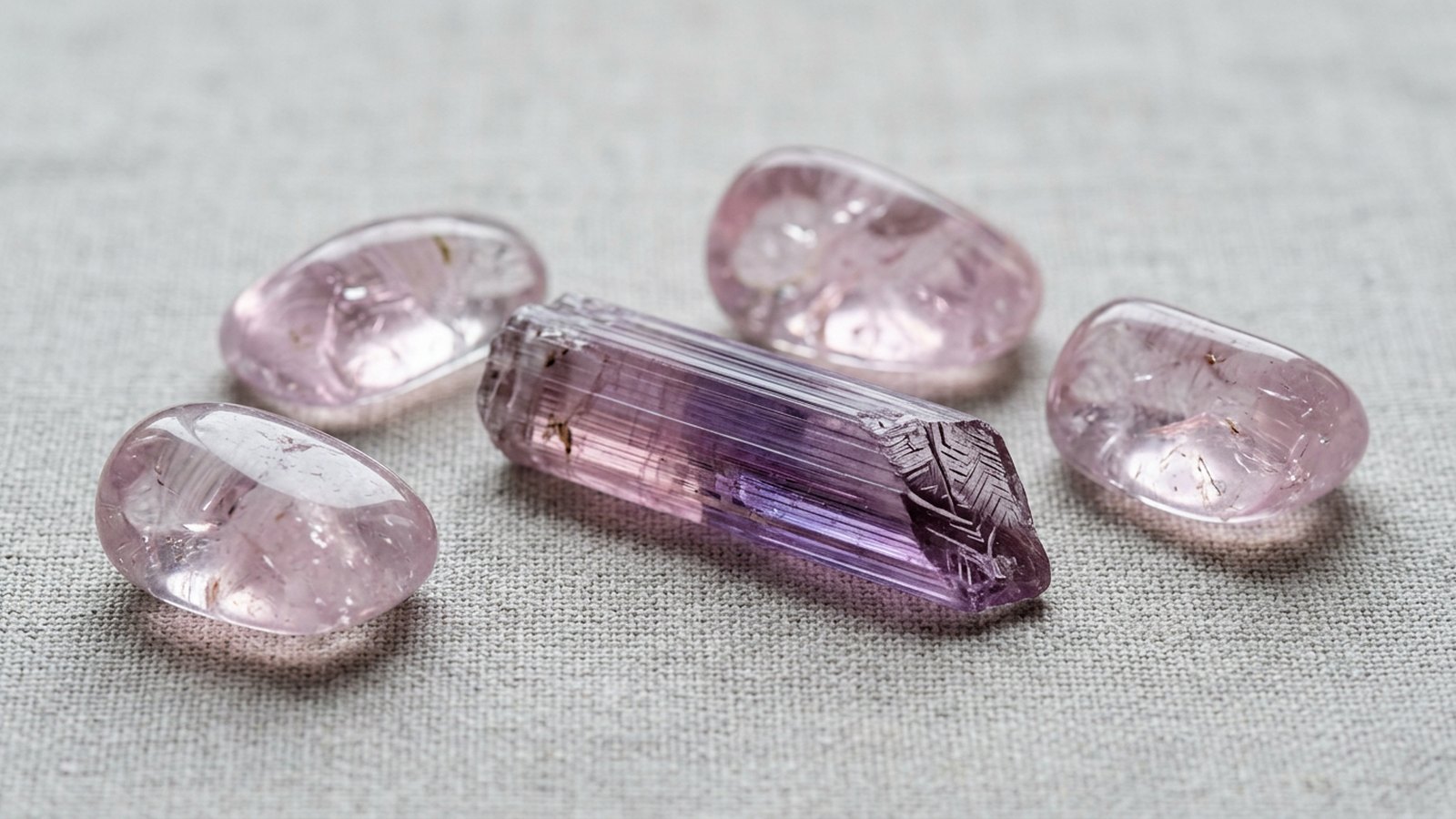
My first piece of kunzite was a small, flat crystal, pale pink at one end and almost lilac at the other, with fine parallel lines running down its length like the grain in a piece of wood. When I tilted it toward the window the colour deepened, and when I turned it sideways it went nearly clear. I kept turning it for a good ten minutes before I realised I had not put it down once.
Kunzite is a soft-coloured gem with a quiet reputation. In crystal tradition it is a heart stone, linked to tenderness, self-acceptance and the slow easing of emotional tension, and many people reach for it during periods of grief, new parenthood or burnout. It suits sensitive people, anyone learning to be kinder to themselves, and collectors who love a stone with real optical character.
In this guide I cover what kunzite means in crystal work, the benefits people describe when they wear it, the stones it pairs well with, its geology and the gemmologist it was named after, how much it costs, how to tell it from look-alikes, and the two habits that keep it from fading or splitting.
What is kunzite good for?
In short, kunzite is traditionally used for emotional healing, self-love and calm, and it is associated with the heart chakra and the crown chakra, the signs of Taurus, Leo and Scorpio, and the number 7. Geologically it is the pink to violet variety of spodumene, a lithium aluminium silicate (LiAlSi2O6), coloured by traces of manganese. It is a genuine gemstone, hardness 6.5 to 7, with a perfect cleavage and a colour that can fade in strong light.
Reasons to work with kunzite
Kunzite is a gentle companion for a heavy heart. When someone is grieving, or carrying an old hurt that never quite closed, a soft stone can be easier to hold than a bright one. Kunzite's reputation in crystal circles is that it softens without pushing, and I find its pale colour fits that kind of season well. It sits comfortably alongside the stones I describe in my guide to crystals for grief.
Kunzite is a reminder to treat yourself the way you treat the people you love. Many readers who struggle with self-criticism keep a piece of kunzite where they see it each morning. The stone works here as an anchor for attention: you notice it, you remember the intention you gave it, and you speak to yourself a little more kindly. If this is where you are, my guide to crystals for self-love goes further.
Kunzite is traditionally offered to new mothers and carers. Some crystal writers call it a woman's stone, and it has a long association with pregnancy, the weeks after birth and the exhausting tenderness of caring for someone. I see it as a stone for anyone who gives a lot and needs somewhere to set their own feelings down.
Kunzite is a calm presence when the mind will not settle. It is often placed on a bedside table or held during a short breathing practice at the end of a stressful day. It is a modest tool, and it sits well with the approaches in my guide to crystals for anxiety, alongside proper support when anxiety is persistent.
Kunzite meaning and healing energy
Emotional healing. This is the heart of kunzite's tradition. It is described as a stone of "divine love" or unconditional love, said to help people release emotional heaviness, forgive themselves and open again after disappointment. Its energy is usually described as soft and receptive.
Spiritual healing. Through its crown chakra link, kunzite is associated with meditation, devotion and a sense of being held by something larger than yourself. Many people use it to begin a quiet practice, holding it in the left hand during a few minutes of slow breathing.
Mental healing. Kunzite is traditionally linked with easing rumination, the loops of worry that replay the same conversation at night. It is said to help the mind shift from analysis to feeling, which some people find restful.
Physical healing. In crystal lore, kunzite is associated with the heart, circulation and the nervous system, and it is sometimes kept near the bed to support rest. This is traditional lore and not medical advice. A stone does not replace a doctor, a therapist or prescribed treatment.
- Chakras: Heart, Crown
- Zodiac signs: Taurus, Leo, Scorpio
- Element: Water
- Numerical vibration: 7
- Affirmation: "I am gentle with myself, and I let love move freely through me."
Kunzite geology: a pink spodumene
Kunzite belongs to spodumene, a member of the pyroxene group with the formula LiAlSi2O6. Spodumene comes in several colours with their own trade names: the pink to violet variety is kunzite, the green variety is hiddenite, and pale yellow material is sometimes called triphane. Colourless and greyish spodumene is far more common and is one of the world's main ores of lithium.
It forms in granite pegmatites, the coarse-grained final stage of a cooling granite where rare elements such as lithium, boron and caesium concentrate in the last fluids. That is why kunzite often shares a pocket with lepidolite, pink tourmaline and quartz. Pegmatite pockets allow crystals to grow very large, and kunzite crystals the length of a forearm are known. They are typically flattened and lath-shaped, with striations along their length and etched, wedge-shaped ends.
The pink colour comes from traces of manganese. Natural radiation inside the rock creates the colour centres that give it depth, and the same colour centres can be bleached by light and heat. This is why kunzite has the old nickname "evening stone": jewellers advised wearing it at night rather than in strong sun.
Three properties matter in the hand. Kunzite is monoclinic and has two perfect cleavages at roughly 87 degrees, so a sharp knock along those planes can split a crystal cleanly, even though its hardness of 6.5 to 7 resists scratching. It is strongly pleochroic: looking down the length of the crystal shows the deepest violet pink, while looking from the side shows paler pink or near colourless, so cutters orient the stone carefully to show the best colour. Under ultraviolet light many kunzites fluoresce orange-pink, and some glow faintly for a moment after the lamp goes off.
The most important sources today are Afghanistan (Nuristan and Laghman), Pakistan, Brazil (Minas Gerais), Madagascar and Nigeria, with the historic deposits of the Pala district in San Diego County, California, still famous among collectors.
History and lore: the gemmologist behind the name
Pink spodumene was found in the Pala pegmatites of Southern California around 1902. A specimen reached George Frederick Kunz, the gemmologist and mineralogist who worked for Tiffany and Co. for more than half a century and did more than almost anyone to popularise American gemstones. In 1903 the chemist Charles Baskerville described the material and named it kunzite in his honour.
The green variety, hiddenite, had already been named two decades earlier after William Earl Hidden, who worked the North Carolina deposit where it was found. So both coloured spodumenes carry the names of the people who brought them to attention, which tells you how new they were to the gem world.
Kunzite has never had the ancient lore of jade or lapis lazuli. Its meaning was built in the twentieth century, largely by crystal writers who connected its colour with the heart and its lithium content with calm. Its best-known moment in jewellery history is a large kunzite and diamond ring associated with Jacqueline Kennedy, widely reported as a gift from John F. Kennedy and sold with her estate in 1996.
Is kunzite expensive?
Kunzite is one of the more affordable pink gems. Tumbled pieces and rough crystals cost a few dollars to a few tens of dollars, depending on size and colour. Facet-grade kunzite with clean clarity is priced per carat, and the value rises with depth of colour: pale stones are inexpensive, while saturated violet pink stones of good size cost noticeably more. Because kunzite grows in large crystals, big cut stones are available at prices that would be out of reach in pink sapphire or fine morganite.
When buying, look for even colour, few visible fractures and clean edges. Some kunzite is irradiated or heated to adjust its colour; this is accepted in the trade but should be disclosed, and treated colour can be less stable in light.
How to tell real kunzite from look-alikes
Kunzite is most often confused with rose quartz, morganite, pink tourmaline and glass. A few checks help:
- Rose quartz is usually cloudy and milky, while kunzite of the same colour is typically transparent with fine striations.
- Morganite, the pink to peach beryl and a cousin of aquamarine, shows little colour change with angle. Kunzite changes clearly from pink to near colourless as you turn it.
- Pink tourmaline tends to be a stronger, warmer pink and lacks the lilac tint and easy cleavage.
- Glass may show round bubbles and swirl lines and feels warmer on the skin.
For a broader method, my guide on how to tell if a crystal is real walks through simple home tests.
One clarification I give often: kunzite contains lithium in its structure, but holding or wearing it does not deliver lithium to the body. Please do not make elixirs with it or treat it as a substitute for prescribed medication.
What stones pair well with kunzite?
These pairings come from crystal tradition and from my own practice, each with the reason it works.
- Kunzite and lepidolite. Both are lithium-bearing minerals from the same pegmatites, and both are associated with calm. Together they suit evenings and anxious seasons.
- Kunzite and rose quartz. A doubled heart intention for self-love and reconciliation. Rose quartz adds warmth, kunzite adds a lighter, more spiritual note. My guide to crystals for love and the crystals for love collection explore this further.
- Kunzite and amethyst. For heart-to-crown work and meditation. The two share a lilac register, and amethyst brings a quieter, more contemplative tone. My amethyst and rose quartz guide covers a similar heart and crown pairing.
- Kunzite and rhodonite. For forgiveness. Rhodonite is the more grounded of the two and helps when kindness needs to be backed by clear boundaries.
- Kunzite and moonstone. A traditional choice for pregnancy and new motherhood, both associated with cycles and tenderness.
How to use and care for kunzite
The benefits people describe from wearing kunzite come from keeping it close: a pendant over the heart, a ring you notice when you write or cook, or a crystal on the bedside table. I suggest pendants and earrings over rings for daily wear, because a ring takes knocks that can find the cleavage. My guide to carrying and wearing stones has more ideas.
Care comes down to light and impact. Keep kunzite out of direct sunlight, store it in a drawer or fabric pouch, and do not leave it on a sunny windowsill or charge it in the sun. Clean it with lukewarm water, mild soap and a soft cloth, then dry it at once; avoid ultrasonic cleaners, steam and sudden temperature changes. For energetic cleansing, smoke, sound or moonlight are gentle choices, as covered in my crystal cleansing guide. For storage, my guide on how to store crystals and my notes on crystals and water safety apply directly.
A last word
I keep my kunzite in a small box beside the bed, and I take it out on evenings when I have been hard on myself. It has become a quiet signal to soften. If you are drawn to it, start with a modest piece, wear it in the evening light it prefers, and see how it feels after a few weeks. If you want to explore the heart further, the chakra crystals guide is a good next step.