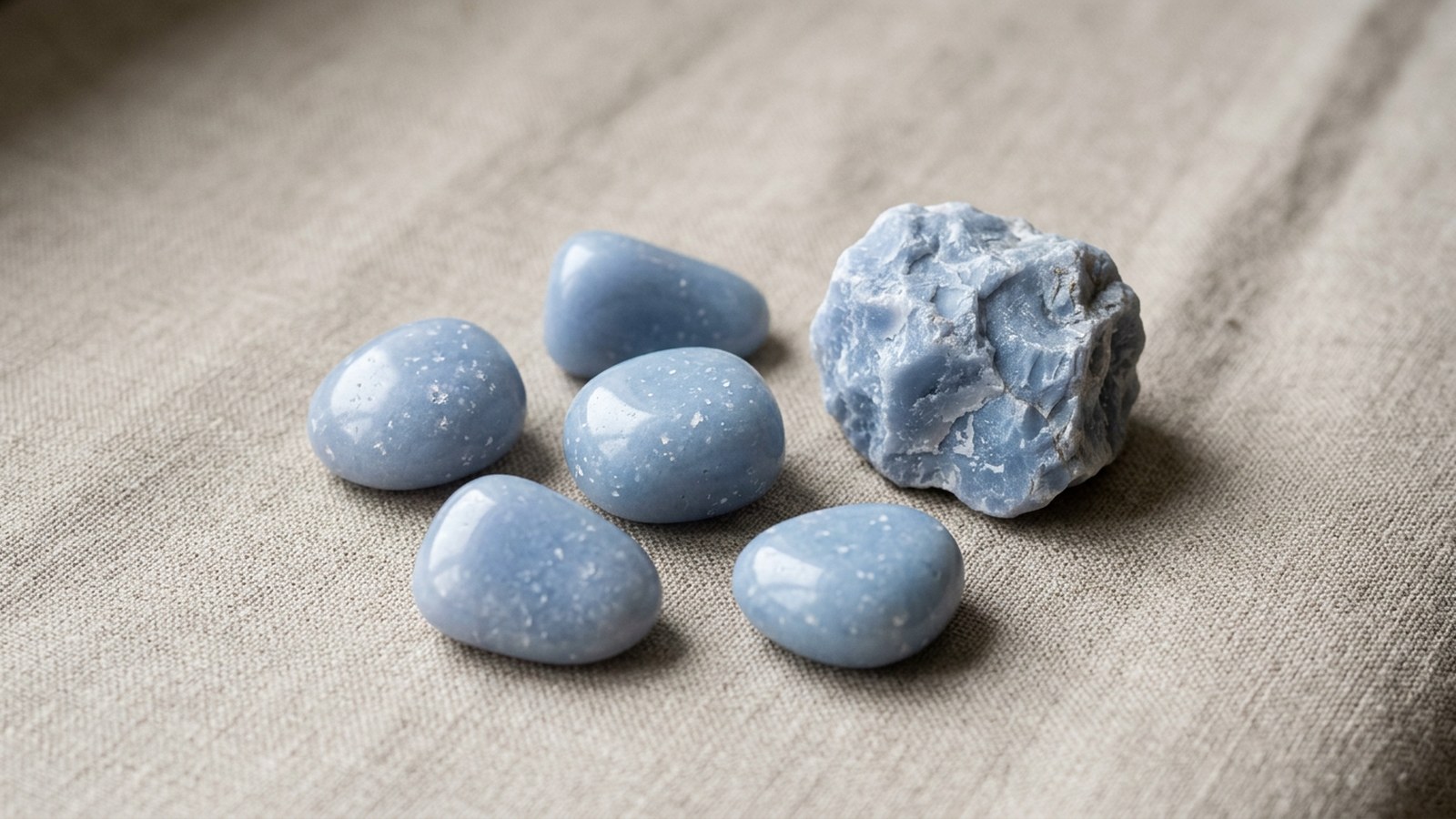
The first angelite I owned was a palm stone the colour of a winter sky just after sunrise, a pale, powdery blue with a faint lilac haze and a few white flecks near one edge. It had a soft, almost velvety feel, and a warmth in the hand that quartz never quite has. I kept it on my desk for a year before I understood why the white flecks were there, and that small mystery is a good way into this stone, because angelite is gentle in more ways than one.
In crystal tradition angelite is a stone of calm, of honest and kind speech, and of feeling accompanied when you are tired or grieving. It is linked to the throat, third eye and crown chakras and to the sign of Aquarius. This guide covers what angelite means in that tradition and who tends to reach for it, then what the stone actually is as a mineral, where its name comes from (the real story is more recent than many shops suggest), how it compares with celestite and blue calcite, and how to care for a stone that slowly changes when it meets water.
What Is Angelite?
Angelite is the trade name for blue anhydrite, a calcium sulfate mineral (CaSO4) that sits at about 3 to 3.5 on the Mohs scale. Most of the material sold under the name comes from Peru, where it forms as pale blue to blue lilac nodules. Anhydrite contains no water in its crystal structure, and over time it can take up moisture and turn into gypsum, which is why angelite should be kept dry.
You say it AN-juh-lite, with the stress on the first syllable, like the word angel.
Reasons to Work With Angelite
Angelite is a stone for the days when you have been talking all day and still feel unheard. People whose work is spoken, teachers, nurses, carers, people who answer phones, tend to describe it as a quiet stone to hold at the end of a shift, when the voice is tired and the mind keeps replaying conversations. Its soft blue is easy on the eye in a way that bright stones are not.
Angelite is traditionally used before a difficult conversation. The throat chakra association makes it a common choice when you need to say something true without saying it harshly, such as asking for help, setting a limit with a relative, or apologising well. I like to hold it for a minute beforehand and work out the one sentence I most need to say.
Angelite is a gentle companion in grief. Its name has given it a strong link with angels and with the sense that someone who has died is still near. You do not need to share that belief to find comfort in a stone that is soft, cool and calm to hold when you are missing someone. For a fuller list of stones used in loss, my guide to crystals for grief goes further.
Angelite is a natural fit for the bedside. Many people keep it near the bed to wind down, and its pale colour suits a dim room. If sleep is your main concern, see crystals for sleep as well, since tradition offers several options.
Angelite Meaning: Healing Energy
Emotional Healing
Emotionally, angelite is associated with calm, patience and a softening of the urge to react. It is often given to people who carry worry quietly for others. In my own practice it is the stone I pick up when I notice my jaw is tight and my shoulders have crept toward my ears, and it pairs well with the stones in my guide to calming crystals.
Spiritual Healing
Spiritually, angelite is the stone most closely tied to angelic contact, spirit guides and prayer in modern crystal writing. Practitioners use it in meditation to feel accompanied and to sit quietly with a question. If you want to try it, my guide to meditating with crystals explains a simple sitting practice.
Mental Healing
Mentally, angelite is linked to clear, compassionate communication and to telepathy in older New Age texts. In everyday terms, I find it useful as a cue to slow down before writing a reply I might regret. It is a common pick in lists of crystals for communication.
Physical Healing
Some practitioners associate angelite with the throat, ears and thyroid, and with lowering tension in the body. This is traditional lore, not medical advice. A stone does not replace a doctor, and anything persistent deserves a proper check.
Angelite Properties at a Glance
- Chakras: Throat, Third Eye, Crown
- Zodiac sign: Aquarius
- Element: Air
- Numerical vibration: 6
- Birthstone: none in the traditional lists
- Affirmation: "I speak with kindness and I am never truly alone."
Who Should Wear Angelite?
Angelite suits people who spend their days speaking and listening, people in a period of grief, sensitive sleepers, and anyone working on the throat chakra. Aquarians are said to be its natural match, since tradition credits the stone with supporting the honest, humane communication associated with the sign. Because it is soft, I suggest pendants, earrings and loose stones rather than rings or bracelets, which knock against desks and door handles. If you already wear more robust stones daily, angelite can live in a pocket or on a nightstand instead.
How to Use Angelite
These are the ways I and the people I have taught use angelite most often. All of them are simple, and none of them needs special tools.
- Hold it before you speak. Take the stone in your hand for a minute before a call, a meeting or a hard talk at home. Breathe out slowly a few times and decide on the one thing you want the other person to hear.
- Wear it at the throat. A short pendant sits close to the throat chakra, which is the traditional placement for communication work. Choose a protective bezel setting, since an exposed edge chips easily.
- Keep it by the bed. Place a tumbled stone or a small palm stone on the nightstand, or under the pillow if it is smooth and you sleep still. Pair it with a short evening routine so the stone becomes a cue to wind down.
- Meditate with it. Lie down and rest the stone at the base of the throat or on the forehead for ten minutes, or hold it in your left hand while sitting. Some people ask a question at the start and simply notice what comes.
- Give it a quiet corner. A larger piece on a shelf in a bedroom, a reading nook or a therapy room adds a soft note of colour. Avoid bathrooms and kitchens, where steam will slowly dull it.
Angelite Geology
Angelite is anhydrite, a calcium sulfate in the orthorhombic crystal system with the formula CaSO4. Its name comes from the Greek anhydros, meaning without water, because it is the water free cousin of gypsum (CaSO4·2H2O). It reaches about 3 to 3.5 on the Mohs scale, has a specific gravity close to 3.0, and breaks along three cleavage directions at right angles, so a chipped edge often looks stepped and almost cubic. The lustre is pearly to dull, and polished pieces have a soft satin sheen.
Anhydrite usually forms in evaporite beds, where seawater or salty lakes dried out, or when buried gypsum loses its water under heat and pressure. The Peruvian angelite on the market comes from the Casapalca mining district east of Lima, where it grew as nodules in altered limestone. Its pale blue is usually attributed to traces of iron.
Many crystal sites repeat that angelite is celestite compressed over millions of years. That is not correct. Celestite is strontium sulfate and angelite is calcium sulfate, two separate minerals with different chemistry. They look alike and they sometimes occur in the same kinds of rock, which is probably where the confusion started.
Anhydrite also comes in white, grey, pink, red and lilac. Stones sold as "purple angelite" or "red angelite" are anhydrite in those colours, often from Mexico. The material is real and lovely, and strictly speaking only the blue Peruvian type carries the angelite name.
Angelite History and Lore
Angelite has no ancient lore under that name, because the name is less than forty years old. Blue anhydrite reached the crystal market from Peru in the late 1980s, and the story most often told by dealers links it to the Harmonic Convergence of August 1987, when people gathered at Machu Picchu and other sites for a global peace meditation. Stones sold to visitors there may have been named at that time, though nobody has documented who chose the word.
The first solid record comes from the Spring 1989 issue of Gems & Gemology, whose Gem News column reported angelite on sale at the Tucson show and confirmed, by testing, that it was anhydrite. You will read online that the gemmologists John Koivula and Robert Kammerling named or discovered angelite. Their report identified the mineral, and the name was already in use when they examined it.
The mineral itself has a much longer human story. Blue anhydrite has been found among objects in ancient Egyptian tombs, though it is unclear whether it was mined locally or traded in. Its modern meaning, angels, guides and peace, grew directly from its name and from the gathering where it first appeared, which I find a sweet and honest origin for a stone people hold when they want to feel less alone.
Angelite vs Celestite and Blue Calcite
Angelite, celestite and blue calcite are the three soft blue stones most often confused, and dyed howlite is sometimes sold as any of them. Here is how I tell them apart.
| Stone | Mineral | Look | Weight in hand | Water |
|---|---|---|---|---|
| Angelite | Calcium sulfate (anhydrite) | Opaque, pale blue to lilac, satin sheen, white flecks | Medium, SG about 3.0 | Keep dry |
| Celestite | Strontium sulfate | Transparent to translucent crystals, often in geodes | Heavy, SG about 3.9 | Keep dry, also fades in sun |
| Blue calcite | Calcium carbonate | Waxy, translucent, icy blue | Light, SG about 2.7 | Brief rinse only |
| Dyed howlite | Calcium borosilicate | Chalky, bright or uneven blue, dark veins | Light | Dye can bleed |
The quickest field test is weight: two stones of the same size, and celestite feels noticeably heavier. Celestite is also sold mostly as crystal clusters and geodes, while angelite almost always comes as tumbled, polished or carved massive stone. In crystal tradition they share calm and angelic associations, with celestite read as a little lighter and more dreamy, and angelite as more grounded and steady.
Is My Angelite Real?
Real angelite is pale. A vivid, saturated or neon blue usually means dyed howlite or magnesite, and dye often gathers in cracks and veins. Look for small white specks or patches on the surface, which are spots where the anhydrite has already started to turn to gypsum, and for that soft satin lustre. A real piece scratches with a steel knife. Please test on the base only, or skip the test entirely, since you can damage a good stone. My guide on how to tell if a crystal is real covers the general checks.
Caring for Angelite
Angelite and water are a poor match, and the reason is chemical. Anhydrite slowly takes up water and becomes gypsum, a softer mineral that is also slightly bigger, so long soaking, steam, salt water or a humid bathroom can cloud the polish, raise white patches and in time crack the stone. A splash from washing up is no disaster: dry it straight away and it will be fine. Just never use water cleansing, salt or moon water on it, and take angelite jewellery off before showering or swimming. My page on crystals and water safety lists the other stones to treat the same way.
For energetic cleansing, I use smoke, sound, a short rest on selenite or moonlight. There is a small irony in the selenite method, since selenite is gypsum, the very mineral angelite would become if it got wet, and the two are perfectly happy together when kept dry. Store angelite in a soft pouch away from harder stones, because quartz will scratch it easily. More options are in my crystal cleansing guide.
Pairing Angelite With Other Stones
Angelite pairs naturally with amethyst for a calm mind before sleep, with blue lace agate for gentle speech, and with lepidolite on anxious evenings. If you find soft blue stones leave you floaty, add black tourmaline for grounding. For more on the intentions it serves, see the calm, sleep and intuition pages.
A Last Word
My palm stone still has its white flecks, a few more than when I bought it, and I have come to like them as a record of the years it has spent with me. If you choose angelite, choose a pale, honest piece, keep it dry, and give it a spot where you will actually pick it up: by the bed, by the phone, or in the pocket you reach into before a hard conversation.